Why People Resist Change

Change is hard, people will fight to keep things the same, but why? Why is change so difficult? I was reading an article by Lynn Hardaway (with The Bridge Network of Churches) that brings a few key insights.

What can be done when your church’s core values have drifted away from what makes a church healthy? How can a pastor lead people back to Great Commission values? The first step is to understand why people in an established congregation resist change.

1. They do not feel a need to change.
Unless the church is in crisis, most members believe “all is well” and will not be responsive to the pastor’s pleas to adopt different values. An old adage from the farm says, “You can lead a horse to water, but you can’t make it drink; you can, however, mix a little salt with its oats!” Show them the benefits of change and the danger of refusing to change.

2. People prefer the status quo.
It is safe, comfortable and familiar; moving out of that safe zone to a new place risks giving up control and feeling vulnerable. You should lead them to stop looking at what “is” and to start looking at “what can be” and “what should be.”

3. They have vested interests.
Because some people have been resident members of the congregation for an extended period of time, they have accrued positions of power and influence. You and your ideas for change are new on the scene and, in many churches, you are merely the current pastor who will probably leave within a few years; why should they change their values for a temporary leader? This leads to the next reason people resist change:

4. They do not trust you, yet.
You will need some time and successes to build your credibility in their eyes before they will let you make organizational and behavioral changes. People want to know if you can be trusted, if you know where you are going, and if you are capable of leading them there.

5. Old values and traditions have become sacred to them.
Whether those traditions are grounded in the Scripture or not is irrelevant; they are closely tied to how your people understand and relate to God. We all know pastors who found themselves ostracized because they dared to challenge the “sacred cows” in a congregation. Preach the Word of God compassionately, carefully lead the people to understand the difference between biblical values and cultural forms of worship, and you may be able to lead them away from this unhealthy mindset.

6. People prefer the simple over the complex.
When you introduce healthy systems, such as assimilation and evangelism, it can create confusion and frustration in the minds of your members, and they will naturally resist what they do not understand. They do not have the time or expertise to grasp novel concepts, so you must go the extra mile in clarifying and simplifying the process for them.

7. All human beings are basically self-centered.
While Christian people aspire to selflessness, most of us will react to a new value or idea with the question, “How will this affect my life?” You must remind your people regularly that life is not about them; life is about God’s great passion to see lost people become fully devoted followers of Jesus Christ.

Once you understand these seven reasons people resist change, you can begin the process of moving them from unhealthy values to healthy values.
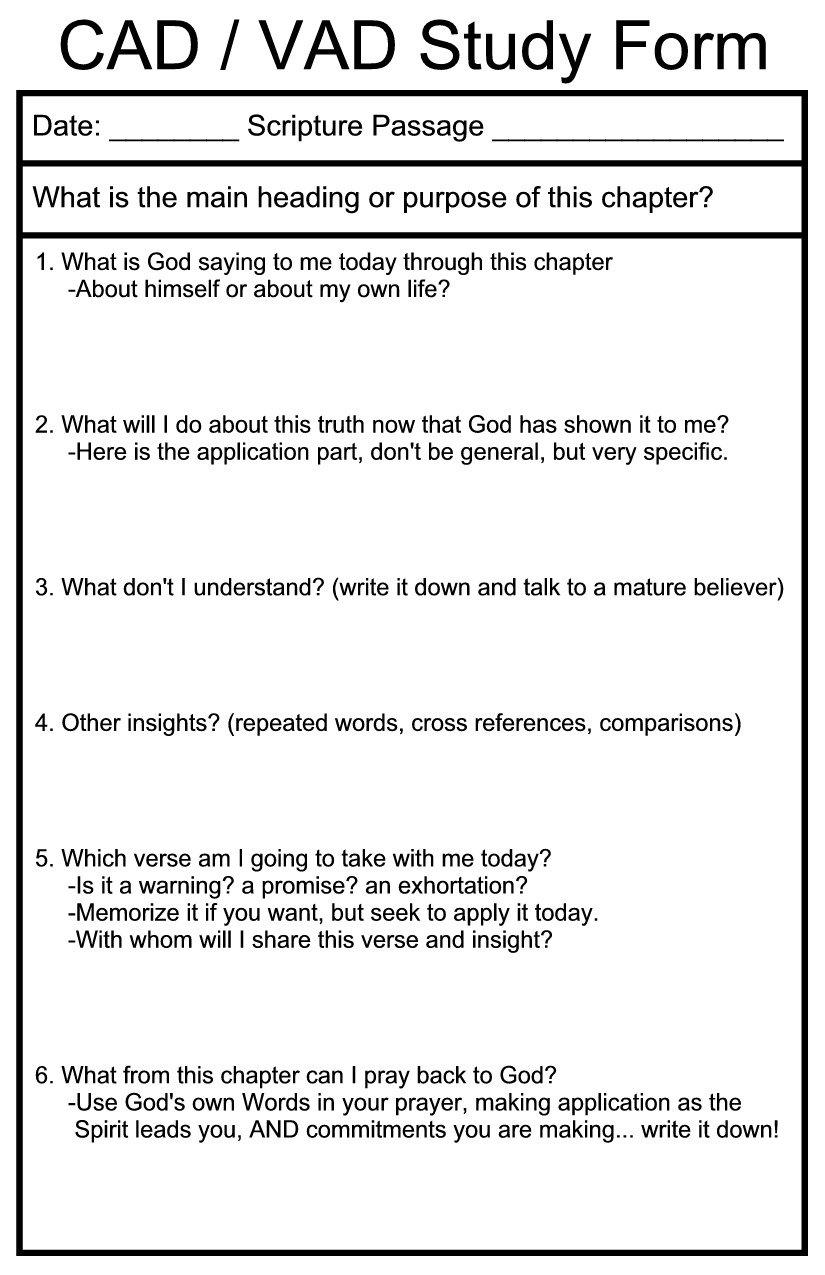
Daily Bible Study Form

In order to get the most out of personal Bible study, try using a form like this one, a Chapter A Day / Verse A Day. Read a whole chapter but focus on one verse in this chapter that really speaks to you today:

Chapter Study Form

God wants the Word of Christ to richly dwell in us (Colossians 3:16) and his Word change our lives. Many times we don’t know where to begin… start in Genesis? Matthew? John? Revelation? Some say to read for content, doctrine, or instruction and rules, while others say to read the Bible devotionally. With this method you can study the Bible for APPLICATION. The emphasis is on what the Bible says, and also on what God is saying to YOU.

Where to start? How about in the gospels in order to meet Jesus fresh each day at the very beginning? John, Mark, Luke, then Matthew. You can mix up your chapters by reading from the Old Testament some weeks and then back to the New Testament.

This is not about checking off these chapters in your “read the Bible through in a year” plan, it is about seeking the God of the Bible. The idea is to meet with God daily (Luke 9:23).

This is an adaptation of CAD/VAD, 1989, College Park Ministries, Carmel IN

Casting Vision

I was just today reading some information about VISION from Bruce Wilkinson, regarding Proverbs 29:18, which says, “Where there is no vision, the people are unrestrained (or perish), But happy is he who keeps the law.”

Wilkinson mentions that meanings of the Hebrew meaning adds a lot to the understanding of the verse. The word for VISION never means a plan or a goal, but rather a “divine revelation” (the essence of our Bible, a record of God’s self-revelation of himself). The word used for PERISH never means to lose motivation, slip into apathy, or death, but rather, “to run without restraint into immorality.” So the better translation is “Where there is no Bible (taught correctly) the people will run without restraint into immorality.” It is little wonder why teaching the Bible is so important!

When it comes to making plans for the future, how do you cast a vision that will motivate people toward the great possibility of what you see? Here are four elements that we need to keep in mind, according to pastor Ronnie Floyd.

When you are casting vision, I think you need to filter it by ensuring the vision is:

Clear: Clarity around a vision is imperative. As the communicator, you have to be clear about your understanding of it. This is why writing the vision is also imperative. This written documentation is what you will return to again and again. Through a meticulous process, you learn how to communicate the vision clearly. When the vision is clear to you, you are more able to clearly communicate it to others.

Concrete: I think having a concrete vision means that you have a vision that is real and tangible. It is not about using language that no one understands or trying to impress others with great and extensive content. It is a vision that people can touch, feel, and become engaged in personally.

Concise: In today’s world it is really true: less is more. This is especially true when we cast a vision. It needs to be concise. It needs to be brief, free of too many details. You will go deeper into details so you know that you understand the vision; however, when you cast it before others, they just need to know the work is already done. You need to be on top of it, but remember you are breaking it down, not only so others can grasp it, but also for them to be able to communicate it to others. I will state it again: It is not about how much you share, but share enough for the people to have complete clarity.

Compelling: A compelling vision moves the people to action. As a servant-leader, you are God’s instrument to rally the people to a better future. You are there to lead them into a future where they would not go on their own.

To sum up, the vision has to be…

  1. Clear enough for them to understand
  2. Concrete enough for them to believe it is real
  3. Concise enough for them to communicate
  4. Compelling enough for them to own personally and enthusiastically

As the communicator of the vision, do your very best to be strong, believable, and capable of moving people into owning the vision enthusiastically. If the vision is going to capture their imagination and heart, moving them into the vision personally and enthusiastically, then the vision must be compelling.

Worship is More Than You Think

There is a lot of talk about worship in some circles and I sense that it is so much more than attending a meeting at church at 11:00 on Sunday morning. Worship is a lifestyle.

According to the Holman Bible Dictionary, the term worship is used to refer to the act or action associated with attributing honor, reverence, or worth to that which is considered to be divine by religious adherents. Christian worship is often defined as the ascription of worth or honor to the triune God. Worship is more fully understood as an interrelation between divine action and human response: worship is the human response to the self-revelation of the triune God, which includes:

  1. Divine initiation in which God reveals Himself, His purposes, and His will;
  2. A spiritual and personal relationship with God through Jesus Christ on the part of the worshiper; and
  3. A response by the worshiper of adoration, humility, submission, and obedience to God.

Worship may be understood in either a broad or narrow context. In a broad sense, worship is seen as a way of life (Romans 12:1). In this context all of life is viewed as an act of worship or service before God (1 Corinthians 10:31; Colossians 3:17).

Worship is also pictured as an act of the assembled people of God, as seen in the worship prescribed by God in the tabernacle (Exodus 25-40; Leviticus 1-7) and temple (1 Chronicles 22-29; 2 Chronicles 3-7; 29-31), as well as in the worship of the New Testament church (Acts 13:2; 1 Corinthians 11-14).

In addition to the various congregational descriptions, worship sometimes involves individual encounters with God (Genesis 29:35; 35:11-15; Exodus 3:1-22; Joshua 5:13-15; Isaiah 6), family worship (Genesis 4:2-5; 8:16-9:17; 35:2-7), and includes a few descriptions of worship in heaven (Isaiah 6; Revelation 4; 5; 7; 15; 19).

But I like lists and acrostics, so how does this help us get a grip on what worship is all about?

  • Wait upon the Lord – trust in his timing and care for us, without becoming anxious.
  • Offer praises to Him – in the good and the difficult times of life.
  • Rest in His presence – simply be still and know he is God and he will be exalted among the nations (Psalm 46:10).
  • Sing unto Him – Christians have a song in our hearts and we are commanded six times in the psalms to sing a NEW SONG (Psalm 33:3, 40:3, 96:1, 98:1, 144:9, 149:1)… why not include all the “new song” verses (Isaiah 42:10, Revelation 5:9, 14:3).
  • Humble ourselves before Him – God opposes the proud (1 Peter 5:5) and he will lift up those who humble themselves (James 4:10).
  • Intimacy with God – He desires that we have a close relationship with him, not just performing some sacrificial duty or ritual.
  • Pleasing God – would this not be the goal of all those who have a lover, looking at the other as more important than yourself (Philippians 2:2-4).

Remember Failure is not Final

Take a moment and think about some of the familiar stories we heard as children (like “Cinderella” or “The Ugly Duckling”). What do they have in common? They are stories of transformation.

There’s a story of true transformation you will find in Genesis 28, where Jacob turned out to be one of the brightest stars in the Hebrew heaven, but he didn’t start out that way. He began as a failure with so much going against him.

Jacob had a lot of family problems. His father, Isaac, loved God, but he was a very sensual man. His mother, Rebekah, was a scheming woman who helped Jacob deceive his father (Genesis 27:5-17). Jacob’s twin brother, Esau, was a self-sufficient, self-centered brute who didn’t care at all about the things of God.

Jacob also had internal problems. His name originally meant “trickster” or “liar,” and that’s what he was by nature. It was hard for him to do right. He was just moving through life from one failure to another, but I want you to see God’s grace in Jacob’s life.

With all Jacob had against him, he did have a couple of redeeming factors.

The first thing he had going for him was that God loved him. The Bible tells us clearly in Romans 9:13 that God said, “I loved Jacob.” He didn’t love him because of his faults, but in spite of his faults. God didn’t change him in order to love him. God loved him so he could change him.

The second thing Jacob had going for him was that he had a spiritual hunger; he wanted to know God. Early in his life, he had cheated his brother out of the birthright which was the spiritual blessing (Genesis 25:19-34). Although Esau didn’t really care about the spiritual blessing, Jacob wanted it, but went about getting it in the wrong way.

Because of these two factors, Jacob experienced a transformation in his life (Genesis 28:10-22). Jacob had left his home because Esau was trying to kill him. He had been gone for many years and on his return trip he spent the night in the desert and had a dream about a ladder that came down from heaven with angels ascending and descending on it.

Up to this point, Jacob had been a religious man, but I don’t think he was a saved man. He was like a lot of people: he knew ABOUT God, but he didn’t KNOW God personally. He was separated from God, separated by his deceitfulness and sentenced to death.

New Consciousness: God began to reveal Himself to Jacob, and suddenly he had a new consciousness of God. Genesis 28:16 says Jacob awakened out of his sleep and said, “Surely the Lord is in this place, and I wasn’t even aware of it!” God revealed himself to Jacob but he almost missed him!

New Communion: Along with a new consciousness, Jacob also had a new communion with God. Genesis 28:17 says he was afraid. He said, “What an awesome place this is! It is none other than the house of God, the very gateway to heaven!”

Then Jacob rose up early in the morning, took the stone that he had used for his pillow and set it up for a pillar. He poured oil on the top of it and worshiped God. Jacob then changed the name of the place as it’s told in Genesis 28:19, “He called the name of that place Bethel: but the name of that city was called Luz at the first.”

  • Luz means “separation,” which is what it used to be.
  • But now he calls it Bethel, which means “the house of God.”

Bethel is the place where he met the Lord. Meeting God at Bethel transformed Jacob’s life.

Do you have a Bethel? Do you have a place where you moved from separation to fellowship with God? From failure to success? God loved Jacob, and he loves you. Even though you may see yourself as having so much against you, you have the same thing going for you that Jacob did, and that is that God loves you.

Do you have a hunger for God? God would not just let things go. He saw in Jacob a hunger for himself. It was likely there all along, but God had to awaken this knowledge in Jacob. Do you have a hunger for God?

Do you have the ladder? There’s a ladder that goes from Earth to heaven and his name is Jesus. He said, “I am the Way, the Truth, and the Life.” (John 14:6) and he wants to transform you from a failure into a success.

Defining Success

Have you ever asked this question in a group of church people? “How do you know if the church is being successful?”

Generally there is silence and a perceived need for clarification, so let’s rephrase the question: “How do you measure the success of your ministry?” Generally more silence. Either people are afraid to say what they think, or they have no definitive answer.

We’re wired with a desire to succeed, whether it’s a relationship, the classroom, the marketplace, the athletic field, or ministry. Since success is so important to us, we should have a way to measure it.

Consider these four questions, which are intended for every believer, not just pastors and church staff, because God wants us all to pursue success as He defines it.

Question 1: Are You Being Faithful?
I read a book long ago called Liberating Your Ministry from Success Syndrome. In that book the author challenged the reader to step away from the numbers game. Pastors love to play this game at the Convention… “We grew by 55% this past year,” or “We baptized 30 new believers.” But the pastor of a small church who faithfully preaches the gospel, witnesses in the community and shepherds his local congregation year after year with little results, what about him? The numbers indicate that he is not successful like these other churches.

I suppose that we would declare the apostle Paul as unsuccessful… after all, he was a jail bird who was run out of town on several occasions, causing riots and turning the world upside down. But I suspect that none of us would classify Paul as a failure.

We all want to hear God say, “Well done, good and faithful servant.” Hearing those words would shout success. In the parable of the talents (Matthew 25:14-30), it’s profound to note that the master commended faithfulness: What did you do with what I gave you? The second servant received the exact same commendations as the first servant, even though he produced less of a return. Jesus is making the point that being a faithful steward of what you’ve been given is what matters most. Are you being faithful?

Question 2: Are You Bearing Fruit?
In John 15:1-11, Jesus taught that it’s God’s will that we bear much fruit. As we do so, God is glorified, and we prove to be Christ’s disciples. The New Testament speaks of two kinds of fruit:

  1. The fruit of Christ-like character (Galatians 5:22-23). The fruit of the Holy Spirit includes nine characteristics that should fittingly describe those who call themselves Christians.
  2. The fruit of Christ-like influence (Acts 10:38). We’re called to make a difference in the world in the name of Jesus.

So, are you bearing fruit?

Question 3: Are You Fulfilled?
My dictionary defines fulfill as, among other things, “to make full.” Is your life or ministry making you full of joy. Looking again at the parable of the talents, the master told his faithful servants, “Enter into the joy of your master” (Matthew 25:21, 23). Joy is one of the primary blessings of faithful and fruitful service.

This is exactly what Jesus indicated as He concluded His remarks in John 15 about fruit-bearing: “These things I have spoken to you, that My joy may be in you, and that your joy may be made full” (John 15:11). Jesus taught them to bear fruit so they would know His joy, and experience it in the fullest way. Are you fulfilled?

Question 4: Are You Making God Famous?
God wants us to be faithful, to bear fruit, and to experience fulfillment (his joy) in a way that makes him famous. Peter teaches that the faithful exercise of our gifts is “so that in all things God may be glorified” (1 Peter 4:10-11). Jesus tells us, “My Father is glorified by this, that you bear much fruit, and in such a way that they may see your good works, and glorify your Father who is in heaven.” (Matthew 5:16). Are you making God famous?

Imagine for a moment what your church or ministry would be like if every believer was successful in biblical teams: faithful, fruitful, fulfilled, and engaged in making God famous. While such an objective may not be as quantifiable as other measures, it’s worth pursuing because it’s God’s measurement of success.

Minding Your Mind and Emotions

The counseling process has been around a long time, and there are a lot of different methods, theories and procedures that are as different as night and day. Many begin with how the therapist views the nature of mankind, others focus on:

  1. The psychoanalysis of Sigmund Freud, understanding the Id, Ego and Super-ego and the role of the subconscious in our mental functioning, and using dream analysis to discover both manifest and latent content (hidden symbolic disguised messages);
  2. The transactional-analysis of Eric Berne tells us that life and relationships are full of scripts that run through our minds and these transactions are sent and received by the scripts of the parent, adult, or the child inside of us;
  3. Or the use of behavior modification techniques to increase or decrease the likelihood of a certain behavior;

There are so many directions one can take:

  1. The Rational-Emotive Therapy of Albert Ellis which focuses on how beliefs influence our behavior;
  2. The Client Centered Therapy of Carl Rogers which focuses on the belief that all people possess a strong drive toward personal growth, health, and adjustment (which he calls self-actualization);
  3. The Reality Therapy of William Glasser which focuses on the three Rs of facing reality, doing right, and being responsible;
  4. The Logotherapy of Viktor Frankl which focuses on mankind’s search for meaning in life.

Dr. Page Huff would be able to tell story after story of people suffering through life and the need for help in coping with stresses, hurts, pain, self-image, neuroses, psychoses, relationships, decisions…

The passage in Romans 12:2 challenges us to have a renewed mind. We are human and live in a fallen world so when Paul tells us that anyone in Christ is a new creation, the old is passed away and all things become new, we wonder why we continue with the same struggles, experience the same pains, and give in to the same vices as we did before we were saved. We are desperately seeking for a renewed mind, but how can we do it?

That which was available in the first century is still available to us today. With all of the science, technology, and counseling theories to help explain our thoughts and behaviors, sometimes getting back to the basics of Scripture can help a huge percentage of what ails us. Psychology has a definite place in our society, and is a great tool for helping people gain insight and awareness into the reasons for their behavior and thinking, but if we can get back to the time of the Bible to see how the spiritual side of mankind can help us cope with developing a renewed mind.

Why is it so important to renew your mind? Because of Proverbs 23:7 – “As a man thinks within himself, so is he.” NASB

Skip has mentioned this before, but today I want to expand on the idea that emotions respond to a signal sent to them by the mind.

Here is a wife and mother:  “Why do I feel so much resentment toward Harold every time he comes into the house?”  Her life and marriage were being destroyed because of the powerful emotion of resentment.  Her emotions were being produced by the thoughts within her mind.

Or how about you driving down highway when suddenly a glance into the rear-view mirror reveals that a highway patrol car is closing on you with its blue lights flashing.  Your heart leaps into your throat.  You feel nervous, uncertain, and the palms of your hands begin to sweat (perspire).  You begin to pull over, all the time wondering what you did, and contemplating receiving a ticket.  As you begin to pull over, the patrol car pulls on around you and keeps going.  Then you realize that he is not after you and your emotions return to normal.  What has just happened?

  • You thought you were going to be stopped and issued a ticket.
  • Your emotions responded to that thought.

You placed a wrong interpretation on one fact, the patrol car coming up behind you with its blue lights on. You did NOT think of other reasons why it was happening.  (Maybe the car ahead of you was his target . . . maybe he had received a call and was being dispatched to an accident scene . . . Maybe the Krispy Kreme doughnut sign was flashing hot and ready . . .)

  • Your distorted view and interpretation of that one fact produced your emotion.
  • Your emotions responded to the signal that your mind sent them.

Listen Carefully:  It is not the actual event but your perception of the event that results in changes in your moods . . . your emotions.

  • You determine your emotions by the choice of thoughts you hold and believe. Something happens and then you THINK before your FEEL.
  • Emotions are not external entities which enter our bodies arbitrarily like a germ. They are a part of our makeup form the very beginning and rise up within us because of what we THINK.
  • So, your emotions, regardless of their nature, are the product of your thoughts.
    • You re in the driver’s seat . . . You select your emotions when you select your thoughts.
    • You feel the way you do right now because of the thoughts you are presently thinking.
    • The bottom line: change your thinking and your will change your emotions.

The Five Senses:  (Sight, sound, touch, taste, and smell) These are the doors to the mind . . . especially the eyes and the ears.

This is why we must be very careful as to what we allow to enter our minds through our eyes and ears. There is an old computer phrase that is very applicable to human beings… “GIGO” which stands for Garbage In Garbage Out.

The band Casting Crowns took that little children’s song and challenged the dads in our generation to stay pure by guarding ourselves from the negative things that enter our lives through the senses, “be careful little eyes what you see…” Garbage in, garbage out.

Let’s look at some biblical support for this concept:

  • Proverbs 4:23 – “Keep your heart with all diligence, for out of it spring the issues of life.”
  • Galatians 6:7 – “Don’t be deceived: God is not mocked. For whatever a man sows he will also reap.”

We must be diligent to lean toward purity, righteousness, and thinking, because sowing negative thoughts produce negative emotions, and negative behaviors and consequences.

Think Right to Feel Right:

Look at Proverbs 23:7 again – “As a man thinks within himself, so is he.” NASB

“How do you feel?”  The answer to this question depends on what you are thinking at the moment.

  • If you are thinking positive thoughts your response may be, “I feel great!” or “I have a positive outlook.”
  • On the other hand, if your frame of mind is negative you may say:
    • “I don’t feel so hot.” “I feel lousy.” Or “I’ve felt better.”
    • Like the old song, “Everybody hates me, nobody likes me, I think I’ll go eat worms…”

If you think negative thoughts, you WILL reap a crop of negative emotions.  If you think positive thoughts you will reap a crop of positive emotions. So, WHY do we dwell on the negative when there is an alternative?

Feelings Aren’t Facts!

In the police illustration at the beginning, the blue lights were NOT intended for you.  You felt at the moment that they were, but the true fact was that they were NOT for you.  Feeling they WERE for you did not make them be FOR you. Feeling are not facts.

Bill Bright, with Campus Crusade for Christ, developed a graphic called FACT, FAITH, FEELINGS Train. The fact is the engine, your faith is the coal car and the caboose is your feelings. Many times we reverse the order; we put our faith in our feelings. We say things like, “I just don’t feel saved” and we live in ambiguity and fear rather than conviction and assurance. The challenge is to change your thinking. Put your faith in the facts that we find in the Bible, and the fact that you have committed yourself to Christ. So when you don’t FEEL saved, it’s because of your improper thinking. Dwell on the FACTS so that you KNOW you are saved whether you feel like it or not.

Emotions respond to feelings whether the feeling is factual or not. Our minds will respond to the FACTS whether they feel like it or not.

Twisted Thinking:

Twisted thinking produces emotions that are also twisted. I worked with a fellow, a professional counselor, years ago and he told me about his philosophy of counseling. He mentioned that people with emotional problems will often listen to negative self-talk, which is rarely based on facts. They will play this tape over and over about how bad they are, how worthless they are, how trapped they are, how pointless life is for them. His goal was to help them to understand the truth (the facts) no matter how they feel. He needed them to get rid of their twisted thinking.

Twisted thinking is your mind processing thoughts, not actual facts or events, and producing emotional responses such as fatigue, nervousness, anxiety, depression, loss of appetite, and a host of others ailments.

Twisted thinking can create problems for people. We move out on what we FEEL is true rather than letting the facts guide us.

Ever heard the phrase, “Just follow your heart?” I sense that following your heart is the single worst piece of advice that someone can give to another person. Now that I have you thinking differently, and you have the emotional response to support it, let me explain. Check out Jeremiah 17:9, “The human heart is the most deceitful of all things, and desperately wicked. Who really knows how bad it is?” So, when you follow your heart, you will end up with heartache.

Failure and negative thoughts, which produce twisted thinking, need to be ejected from our mind. Let me give you a biblical example. Saul, before his conversion, is a great example of twisted thinking.

In his defense before King Agrippa, he acknowledged the results of his twisted thinking.  Acts 26:9-10 – “So then, I thought to myself that I had to do many things hostile to the name of Jesus of Nazareth.  And this is just what I did in Jerusalem; not only did I lock up many of the saints in prisons, having received authority from the chief priests, but also when they were being put to death I cast my vote against them.”

The prime motivation behind Paul’s actions against the church, Christ and his followers, AND his emotions, according to his OWN confession, was his thinking.  “I thought to myself that I had to do. . .”

He was the product of what he permitted to enter his mind, the negative and false teachings about Christ and Christianity.

  • He thought both were wrong and needed to be eliminated.
  • Later, through proper instruction which he accepted, he was able to straighten his twisted thinking.

Apply this principle to people in a denomination and you will better understand that their feelings and emotions are based on what they THINK is right, even if it isn’t according to biblical instruction.  Churches may adopt unbiblical stances on hot topics and politically correct issues, but deep down that position cannot be condoned or supported through proper exegetical Bible investigation.

When people’s thinking is changed, their feelings and emotions will also be changed.

People’s thinking is NOT changed by dealing with feelings, but dealing honestly with their thinking.  You are not going to change their feelings until you change their thinking . . . perceived facts. This is why it is so important to have a renewed mind (Romans 12:2).

My friend’s counseling goal was helping them to hear positive, rather than negative self-talk. Stop playing the tapes of the lies we tell ourselves about us, the world and other people, and the world around us. So, the discipline of counseling helps correct their stinkin’ thinkin’.

Sometimes we need help to understand why we have this negative self-talk, or what triggers the negative thinking, but you know, all of us can search for the truth to know exactly what the Bible says about us, our behavior and the world around us.  This is why the matter of biblical authority is so profoundly important.

  • John 8:32 – “You will know the truth, and the truth will set you free.”
  • John 17:17 – “Sanctify them by the truth; Your word is truth.”

What About the Truth?

  • Romans 1:28 – The truth can be suppressed.
  • Romans 1:25 – The truth can be exchanged for a lie.
  • Romans 2:8 – Truth that is not obeyed leads to unrighteousness.
  • Romans 9:1 – Truth can be told and taught to others with the authority of the Holy Spirit.
  • 1 Corinthians 13:6 – Truth can be rejoiced in.
  • Galatians 2:5 – The truth continues, remains or preserves.
  • Galatians 3:1 – Truth will not be obeyed by foolish people.
  • Colossians 1:5 – The truth is the gospel of Christ.
  • 2 Thessalonians 2:12 – Condemnation comes where the truth is not believed.
  • 2 Thessalonians 2:13 – The truth is involved in salvation.
  • James 3:14 – People lie against or cover up the truth.
  • 1 John 2:21 – The truth can be discerned from lies.
  • 3 John 3 – The truth can be confirmed to others and people can live by the truth.
  • 3 John 4 – The truth can be walked in . . . and lived.

It has been proven over and over again that the emotions do not know the difference between an established fact and an erroneous fact.

Illustration: Man received a phone call and thought the caller said his father was dying with a heart attack.  He got into his car and drove as fast as he could to his father’s house, only to be greeted by his father at the door.  The son almost had a heart attack himself.  His emotions were responding to thoughts the mind were holding as true, but were not actually true.  In his mind he believed his father was dying, thus his body acted accordingly.  Later he learned the caller had said “John,” instead of “Don.”  John was a friend of the family.

The Keys to Winning Over Stinkin’ Thinkin’ or the meat of the message, to Find God in Psychology.

We need to recognize that our thought patterns and habits can be changed for the better and we can experience release from twisted thinking, reactions and responses that eventually will defeat us.

1. Recognize that YOU are in control of your thoughts.  God created you with this wonderful ability to take every thought captive and make it obedient to Christ (2 Corinthians 10:5).

2. Don’t try to suppress your thoughts. Burying thoughts only reinforces the negative response demonstrated by your emotions. We must be alert to these thoughts as they come into our minds and say “NO” to them, and saying “YES” to a positive replacement.

3. When you are challenged by a twisted thought, ask yourself, “Why am I thinking this way?  What has triggered this negative thought?”  Determining the stimulus or root of the thought is a key to victory.

4. At the very suggestion of a defeating thought, eject it from your mind with a positive Bible verse. I don’t suggest this lightly, or because I’m a pastor. The New Living Translation of Philippians 4:8 reads:  “And now, dear brothers and sisters, one final thing. Fix your thoughts on what is true, and honorable, and right, and pure, and lovely, and admirable. Think about things that are excellent and worthy of praise.”

Isn’t that a wonderful piece of advice  . . . It came from God through the Holy Spirit as penned by the apostle Paul. As a matter of fact, I plan to preach this passage on Sunday October 13, How to Fortify Your Mind.

5. Changing your thinking is an act of the will.

  • Colossians 3:2 – “Set your mind on things above.” Now are you beginning to see why the Bible teaches this? This imperative statement involves an act of the will . . . Who sets your mind . . .  YOU set your mind.
  • Colossians 3:5 – “Therefore, put to death whatever in you is worldly: sexual immorality, impurity, lust, evil desire, and greed, which is idolatry.”
  • Colossians 3:8 – “But now is the time to get rid of anger, rage, malicious behavior, slander, and dirty language…“
  • Colossians 3:12 – “Put on or clothe yourselves with tenderhearted mercy, kindness, humility, gentleness, and patience.”

6. You cannot control what others say about you or think about you, but you can control how you react to it. If I’m having a bad day it is because I choose to allow the circumstance of that day to bring me down.

  • Proverbs 25:28 – “A man who does not control his temper is like a city whose wall is broken down.” Question:  What can happen to a city whose wall is broken down? It will be overrun by the enemy.

Our desire is not to rid ourselves of our emotions, but rather, learn how to control them with God’s help.

7. Pray to God for wisdom and strength.

We need to face life in the spirit of a man who lost his eyesight.  He rushed to the doctor.  The treatment by the physician made it possible for him to see again, but the return of his sight caused him to lose his memory.  He returned to the doctor.  This time he was treated for a loss of memory.  The man regained his memory but lost his eyesight again.  “Well,” said the physician, “we can’t cure both of them together, so you’ll have to choose between sight and memory.  Which will it be?”  The man answered, “Eyesight!  I’d rather see where I’m going than to know where I’ve been.”

It doesn’t matter that you have been plagued in the past with twisted thinking or warped emotions; the next step you take to handle it is what counts.

The Curse of Self-righteousness

I love reading A. W. Tozier, and here is something he writes concerning self-righteousness in the church:

Self-righteousness is terrible among God’s people. If we feel that we are what we ought to be, then we will remain what we are. We will not look for any change or improvement in our lives. This will quite naturally lead us to judge everyone by what we are. This is the judgment of which we must be careful. To judge others by ourselves is to create havoc in the local assembly.

Self-righteousness also leads to complacency and complacency is a great sin. Some have the attitude, “Lord, I’m satisfied with my spiritual condition. I hope one of these days You will come, I will be taken up to meet You in the air and I will rule over five cities” (like in Revelation 20:6). These people cannot rule over their own houses and families, but they expect to rule over five cities. They pray spottily and sparsely, rarely attending prayer meeting, but they read their Bibles and expect to go zooming off into the blue yonder and join the Lord in the triumph of the victorious saints.

“Lord, keep me from the curse of self-righteousness. Show me my sin and need for continued growth. If revival is to come, it needs to start with me, and it won’t start unless I’m constantly reminded of my need. Amen.”

(Philippians 3:13-14)

Why We Don’t Witness

For years, I have heard church leaders bemoan the reality that the majority of Christians never or rarely share their faith with unbelievers. Though declaring the good new of Jesus to others is the responsibility of every Christ-follower, few people in our churches embrace the holy assignment. Why?

In his book, Contagious, author and professor, Jonathan Berger, writes about how thinking and social influence spread, or “why things catch on.” In one chapter, he shares insights from a study that sought to discover why some online articles are shared more than other articles.

Several insights were gleaned, but the strongest discovery was that articles that drove a sense of awe into readers were 30 times more likely to make the list of “most shared articles.” Readers are much more likely to share articles that evoke a sense of awe.

Quite simply, we can’t help but spread news that we find amazing.

Though the book is on every marketing professional’s shelf, the chapter was convicting for me as a believer in Jesus Christ.

According to the research, if I am not sharing the gospel, it is because I have lost my sense of awe and appreciation for it.

The reason the majority of the people in our churches don’t share the gospel is not because they haven’t been through a course. Nor is it because they failed to participate in a training seminar.

Not sharing the gospel reveals a loss of awe about the depths to which He plunged to rescue us. Not sharing the faith with others reveals a loss of amazement that He gave us His righteousness for our sin.

If we are still in awe that the holy and eternal God of the universe would pursue us in our sinfulness, humble Himself and suffer in our place, become the curse for our sin, and absorb our punishment to give us His peace, then we can’t help but share this news. If we are convinced that the news about Jesus is truly good news, we can’t help but spread it.

When the religious leaders asked Peter and John, two of Jesus’ disciples, to stop speaking about Jesus, they replied, “We are unable to stop speaking about what we have seen and heard” (Acts 4:20). Their hearts were filled with awe for Jesus and His work for them; thus, there was no way they could be silent.

When Jeremiah considered not speaking for the Lord, he realized he could not hold the message inside without exploding: “If I say, ‘I won’t mention Him or speak any longer in His name,” His message becomes a fire burning in my heart, shut up in my bones. I become tired of holding it in, and I cannot prevail” (Jeremiah 20:9).

Whatever we find amazing, we share. We spread what we are in awe of.

By Eric Geiger

How is the Bible God’s Word?

How does one convince a nonbeliever that the Bible is the Word of God?

Before I try to answer that question directly, let me make a distinction that is important at the outset. There’s a difference between objective proof and the persuasion or conviction that follows. John Calvin argued that the Bible carries both persuasion and conviction in terms of its internal testimony—the marks of truth that could be found just by an examination of the book itself—as well as external evidences that would corroborate that substantial evidence to give solid proof for its being the Word of God.

Yet the last thing people would want is a book telling them they are in desperate need of repentance and of a changed life and of bowing in humility before Christ. We don’t want that book to be the truth. Calvin claimed that there is a tremendous bias and prejudice built into the human heart that only the influence of God the Holy Spirit can overcome. Calvin distinguished between what he called the undicia—those objective evidences for the trustworthiness of Scripture—and what he called the internal testimony of the Holy Spirit, which is necessary to cause us to surrender to the evidence and acknowledge that it is the Word of God.

But I think this is a critical issue upon which so much of the Christian faith depends. The Bible makes the claim that it is the unvarnished Word of God, that it is the truth of God, that it comes from him. God is its ultimate author and source, though indeed he used human authors to communicate that message.

In speaking with people about this, we have to go through the laborious process of showing first of all that the Bible as a collection of historical documents is basically reliable. The same tests that we would apply to Herodotus or Suetonius or any other ancient historian would have to be applied to the biblical records. The Christian should not be afraid to apply those kinds of historical standards of credibility to the Scriptures, because they have withstood a tremendous amount of criticism from that standpoint, and their credibility remains intact.

On the basis of that, we come to an idea. If the book is basically reliable, it doesn’t have to be inerrent or infallible; it gives us a basically reliable portrait of Jesus of Nazareth and what he taught.

We move from there in linear fashion. If we can on the basis of general reliability come to the conclusion that Jesus Christ did the things that history claims he did, it would indicate that Jesus is more than an ordinary human being and that his testimony would be compelling.

I would move first to a study of the person of Jesus and then ask the question, what did Jesus teach about Scripture? For me, in the final analysis, our doctrine of Scripture is drawn from the teaching of Jesus and from our understanding of who he is.

From That’s a Good Question! Copyright © 1996 by R. C. Sproul.