Expectations and Anger

It is easy to live under the illusion that we can determine what people should do or how situations should be decided. “My destiny should be this; therefore, people should do that.” We pray and expect God to do everything we ask.

The primary problem with these expectations can center around one simple word, pride. Ask the Lord, “Do I act as though I am at the center of my world?”

Here is a tough word from the Lord: “What causes fights and quarrels among you? Don’t they come from your desires that battle within you? You want something but don’t get it. You kill and covet, but you cannot have what you want. You quarrel and fight. You do not have, because you do not ask God. When you ask, you do not receive, because you ask with wrong motives, that you may spend what you get on your pleasures.… ‘God opposes the proud, but gives grace to the humble.’ ” (James 4:1–3, 6)

UNREALISTIC EXPECTATIONS

Anger over Circumstances: “I expected good things would always come my way … but life is clearly not what I’d expected.”

Anger toward Others: “I expected that you would always be here for me, to always support and love me … but now I’m left alone.”

Anger toward Yourself: “I expected to always excel … but now I am struggling and feel like a failure.”

  • The more we expect people to do what we want, the angrier we become when they fail us.
  • The more we try to control others, the more control we give them over us.
  • The more demands we put on others, the more power we give them to anger us.

Instead, we need to humble ourselves and submit to God’s sovereignty over our lives and over the lives of others. We need to leave our destiny in His hands—where it rightly resides.

The Bible says that we are to lay our expectations before the Lord and allow Him to determine what we should receive. “Find rest, O my soul, in God alone; my hope comes from him.” (Psalm 62:5)

“How can I handle my anger over the losses in my life?” When you experience significant loss in your life, you will go through a time of grieving.

Admit your feelings—your hurt or sense of injustice, your fear or frustration. Release to God all the pain you feel, along with the situations that are beyond your control.

Express your faith—trust God to give you the grace and insight to deal constructively with each loss. Release your expectation that life must go your way.

Pray to your Father—“Lord, thank You that You are sovereign over my life. Whatever it takes, I want to respond to You with a heart of gratitude and to accept these unchangeable circumstances in my life. I choose to stop making myself and those around me miserable for something none of us can change. Instead, I thank You for how You are going to use everything in my life for my good and for Christ’s glory. In His holy name I pray. Amen.”

“Give thanks in all circumstances, for this is God’s will for you in Christ Jesus.” (1 Thessalonians 5:18)

This information comes from Hunt, J. (2008). Biblical Counseling Keys on Anger: Facing the Fire Within, Dallas, TX: Hope For The Heart.
Sources of Anger

Anger is typically started and fueled by one of four sources: hurt, injustice, fear, or frustration. With these roots, anger is a secondary response to one or more of these four sources. Probing into buried feelings from your past can be painful, so it can seem easier to stay angry than to uncover the cause, turn loose of your “rights,” and grow in maturity. We must have perseverance because, “Perseverance must finish its work so that you may be mature and complete, not lacking anything.” (James 1:4)

Hurt: Your heart is wounded. Everyone has a God-given inner need for unconditional love. When you experience rejection or emotional pain of any kind, anger can become a protective wall that keeps people and pain away.

BIBLICAL EXAMPLE: 12 Sons of Jacob… Joseph was the undisputed favorite of the twelve sons of Jacob. Feeling hurt and rejected by their father, the older sons became angry and vindictive toward their younger brother! “Israel [Jacob] loved Joseph more than any of his other sons, because he had been born to him in his old age; and he made a richly ornamented robe for him. When his brothers saw that their father loved him more than any of them, they hated him and could not speak a kind word to him.” (Genesis 37:3–4)

Injustice: Your right is violated. Everyone has an inner moral code that produces a sense of right and wrong, fair and unfair, just and unjust. When you perceive that an injustice has occurred against you or others (especially those whom you love), you may feel angry. If you hold on to the offense, the unresolved anger can begin to make a home in your heart.

BIBLICAL EXAMPLE: King Saul… Saul’s unjust treatment of David evoked Jonathan’s anger. When Jonathan, son of Saul, heard his own father pronounce a death sentence on his dear friend David, he asked, “ ‘Why should he be put to death? What has he done?’ Jonathan asked his father. But Saul hurled his spear at him to kill him [Jonathan]. Then Jonathan knew that his father intended to kill David. Jonathan got up from the table in fierce anger; on that second day of the month he did not eat, because he was grieved at his father’s shameful treatment of David” (1 Samuel 20:32–34).

Fear: Your future is threatened. Everyone is created with a God-given inner need for security. When you begin to worry, feel threatened, or get angry because of a change in circumstances, you may be responding to fear. A fearful heart reveals a lack of trust in God’s perfect plan for your life.

BIBLICAL EXAMPLE: King Saul… Saul became angry because of David’s many successes on the battlefield. He was threatened by David’s popularity and feared he would lose his kingdom. (Read 1 Samuel 18:5–15, 28–29.) “Saul was very angry.… ‘They have credited David with tens of thousands,’ he thought, ‘but me with only thousands.’ … Saul was afraid of David, because the Lord was with David but had left Saul.” (1 Samuel 18:8, 12)

Frustration: Your performance is not accepted. Everyone has a God-given inner need for significance. When your efforts are thwarted or do not meet your own personal expectations, your sense of significance can be threatened. Frustration over unmet expectations of yourself or of others is a major source of anger.

BIBLICAL EXAMPLE: Cain… Both Cain and Abel brought offerings to God, but Cain’s offering was clearly unacceptable. Cain had chosen to offer what he himself wanted to give rather than what God said was right and acceptable. When Cain’s self-effort was rejected, his frustration led to anger, and his anger led to the murder of his own brother. “In the course of time Cain brought some of the fruits of the soil as an offering to the LORD. But Abel brought fat portions from some of the firstborn of his flock. The LORD looked with favor on Abel and his offering, but on Cain and his offering he did not look with favor. So Cain was very angry, and his face was downcast.… Now Cain said to his brother Abel, ‘Let’s go out to the field.’ And while they were in the field, Cain attacked his brother Abel and killed him.” (Genesis 4:3–5, 8)

Ask yourself this important question: “What does God want me to do about my inappropriate anger?” God wants you to examine the true source of your anger. Is it hurt, injustice, fear, frustration, or a combination? Then evaluate whether you are using anger to try to get your inner needs for love, for significance, and for security met.

Hurt: Have you been hurt by rejection or someone’s unkind words? If so, evaluate. Are you using anger to intimidate or coerce someone into remaining in a relationship with you?

Injustice: Have you been the victim of a real or perceived injustice? If so, evaluate. Are you using angry, accusatory words to cause someone to feel guilty and obligated to you?

Fear: Has something occurred that causes you to have fear? If so, evaluate. Are you using anger to overpower and control someone in order to get your way?

Frustration: Do you feel a sense of frustration because of unmet expectations? If so, evaluate. Are you using angry threats and shaming words to manipulate someone into meeting your demands?

In searching your heart, decide that you will not use anger to try to get your needs met. Instead, repent and enter into a deeper dependence on the Lord to meet these God-given needs. “The LORD will guide you always; he will satisfy your needs in a sun-scorched land and will strengthen your frame. You will be like a well-watered garden, like a spring whose waters never fail.” (Isaiah 58:11)

This information comes from Hunt, J. (2008). Biblical Counseling Keys on Anger: Facing the Fire Within, Dallas, TX: Hope For The Heart.

Hidden Anger

Many people live life unaware that they have hidden anger, or suppressed anger that only occasionally surfaces. While hidden anger is usually rooted in past childhood hurts, the underlying effects are always ready to surface at any time. For example, when someone says or does something wrong, the one with suppressed anger often overreacts. When someone makes an innocent mistake, the magnitude of anger is out of proportion to the mistake.

If you have hidden anger, you can find yourself at one extreme or another; from feeling hopeless to feeling hostile, and can be totally unaware of why you are experiencing these feelings. The Bible makes it clear that some of our motives and emotions are hidden from our own view. “Who can discern his errors? Forgive my hidden faults.” (Psalm 19:12)

CLUES TO FIND HIDDEN ANGER

  • Do you have irritability over trifles?
  • Do you smile on the outside, while you hurt on the inside?
  • Do you find your identity and worth in excessive work?
  • Do you deny ever being impatient?
  • Do you have to have the last word?
  • Do those close to you say that you blame others?
  • Do you feel emotionally flat?
  • Do you find yourself quickly fatigued?
  • Do you have a loss of interest in life?
  • Do you become easily frustrated?

If you find that you have hidden anger, resolve to follow the Lord’s directive to these Christians in Colossae, “You must rid yourselves of all such things as these: anger, rage, malice, slander, and filthy language from your lips.” (Colossians 3:8)

This information comes from Hunt, J. (2008). Biblical Counseling Keys on Anger: Facing the Fire Within, Dallas, TX: Hope For The Heart.

Unresolved Anger

The emotion of anger is not a problem in itself, but anger becomes a problem when left unresolved. Prolonged anger brings bitterness and unforgiveness. One way you can choose to harbor anger is by refusing to face your feelings in a healthy way. This unresolved anger not only creates a rift between you and God, but also damages your body, destroys your emotions, and demoralizes your relationships.

Whether you recognize it or not, extended anger can cause significant physical, emotional, and spiritual problems. Jesus said, “I tell you that anyone who is angry with his brother will be subject to judgment.” (Matthew 5:22)

Unresolved anger is known to produce in many people some of the following physical, emotional, and spiritual symptoms:

Physical Symptoms: High blood pressure, Heart disease, Stomach disorders, Intestinal disorders, Headaches, Blurred vision, Insomnia, Compulsive eating

Emotional Symptoms: Anxiety, Bitterness, Compulsions, Depression, Fear, Insecurity, Phobias, Worry

Spiritual Symptoms:

  • Loss of Perspective
  • Allowing your emotions to distort your thinking
  • Loss of Vision
  • Losing a sense of purpose for your life
  • Loss of Sensitivity
  • Failing to hear the Spirit of God speaking to your heart
  • Loss of Energy
  • Lacking strength for your service to God and others
  • Loss of Freedom
  • Becoming a prisoner of your circumstances
  • Loss of Confidence
  • Feeling insecure about your response to difficulties
  • Loss of Faith
  • Failing to trust that God is working in your life
  • Loss of Identity
  • Becoming like the person toward whom you are bitter

Unresolved anger produces bitterness. And the Bible links bitterness with being in bondage to sin. “I see that you are full of bitterness and captive to sin.” (Acts 8:23)

This information comes from Hunt, J. (2008). Biblical Counseling Keys on Anger: Facing the Fire Within, Dallas, TX: Hope For The Heart.

Action or Reaction in Anger

It’s time for some self-evaluation… ask yourself these questions:

  1. When you are angry, does reason rule the day or do tense emotions take over?
  2. Do you allow the mind of Christ within you to determine how best you should act, a choice that leads to appropriate action … or do you have a knee-jerk reaction that leads to inappropriate reaction?

If you have never evaluated what happens when you feel angry or if you lack insight as to how others perceive you when you are angry, seek God’s wisdom and understanding. “If you call out for insight and cry aloud for understanding, and if you look for it as for silver and search for it as for hidden treasure, then you will understand the fear of the LORD and find the knowledge of God. For the LORD gives wisdom, and from his mouth come knowledge and understanding.” (Proverbs 2:3–6)

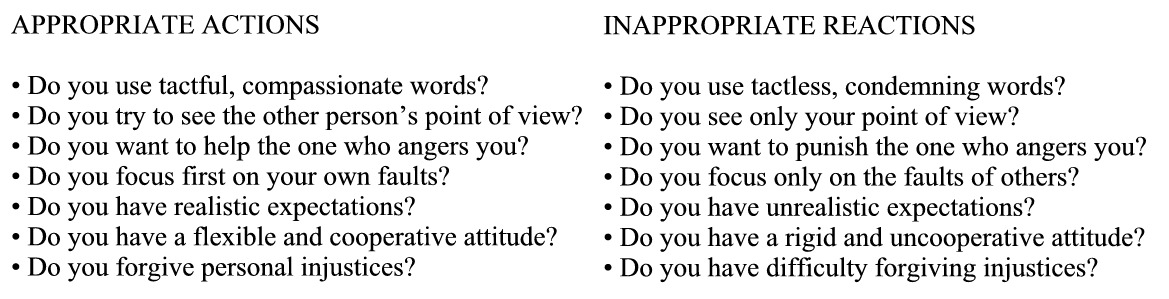
An appropriate action is expressing your thoughts and feelings with restraint, understanding, and concern for the other person’s welfare. “A man of knowledge uses words with restraint, and a man of understanding is even-tempered.” (Proverbs 17:27)

An inappropriate reaction is expressing your thoughts and feelings in such a way that stirs up anger in others so that it produces strife. Proverbs, the book on wisdom, paints this graphic picture, “As churning the milk produces butter, and as twisting the nose produces blood, so stirring up anger produces strife.” (Proverbs 30:33)

To help assess whether you act or react, take time to answer the following questions:

Anger Actions

Even though a situation may evoke anger, those who allow the Lord to be their strength will respond appropriately. “As God’s chosen people, holy and dearly loved, clothe yourselves with compassion, kindness, humility, gentleness and patience.” (Colossians 3:12)

This information comes from Hunt, J. (2008). Biblical Counseling Keys on Anger: Facing the Fire Within, Dallas, TX: Hope For The Heart.

The Magnitude of Anger

Anger, like heat, has many degrees ranging from from mild, controlled irritation to a hot, uncontrolled explosion. Anger covers many levels of the emotion. “Simeon and Levi are brothers—their swords are weapons of violence. Let me not enter their council, let me not join their assembly, for they have killed men in their anger and hamstrung oxen as they pleased. Cursed be their anger, so fierce, and their fury, so cruel! I will scatter them in Jacob and disperse them in Israel.” (Genesis 49:5–7)

Indignation is simmering anger provoked by something appearing unjust or unworthy and often perceived as justified. Jesus became “indignant” when the disciples were preventing parents from bringing their children to Jesus so that He might touch and bless them. “When Jesus saw this, he was indignant. He said to them, ‘Let the little children come to me, and do not hinder them, for the kingdom of God belongs to such as these.’ ” (Mark 10:14)

Wrath is burning anger accompanied by a desire to avenge. Wrath often moves from the emotion of anger to the outward expression of anger. In Romans 1:18, God expresses His wrath as divine judgment on those who commit willful sin. “The wrath of God is being revealed from heaven against all the godlessness and wickedness of men who suppress the truth by their wickedness.” (Romans 1:18)

Fury is fiery anger so fierce that it destroys common sense. The word fury suggests a powerful force compelled to harm or destroy. Some members of the Sanhedrin were so angry with Peter and the other apostles for proclaiming that Jesus was God that “they were furious and wanted to put them to death” (Acts 5:33). That is why the Bible says, “Anger is cruel and fury overwhelming.” (Proverbs 27:4)

Rage is blazing anger resulting in loss of self-control, often to the extreme of violence and temporary insanity. After an outburst of rage, how many times have we heard this cry of remorse, “I can’t believe I did that!” Yet those who continue to vent their rage toward others, including toward God, find themselves defeated by their own destructive decisions and ruined relationships. “A man’s own folly ruins his life, yet his heart rages against the LORD.” (Proverbs 19:3)

This information comes from Hunt, J. (2008). Biblical Counseling Keys on Anger: Facing the Fire Within, Dallas, TX: Hope For The Heart.

The Meaning of Anger

In a fire, things can get out of control pretty quickly, so take action at the first signs of becoming angry before it consumes your life and destroys your relationships. “A quick-tempered man does foolish things.” (Proverbs 14:17)

  1. Anger is a strong emotion of irritation or agitation that occurs when a need or expectation is not met. “An angry man stirs up dissension, and a hot-tempered one commits many sins.” (Proverbs 29:22)
  2. Anger is the fuel for what the Bible describes as a hot-tempered or quick-tempered person. “A hot-tempered man stirs up dissension, but a patient man calms a quarrel.” (Proverbs 15:18)
  3. Anger in the Old Testament is most frequently the Hebrew literally meaning “nose or nostrils” and, figuratively, picturing nostrils flaring with anger. Later, the word came to represent the entire face as seen in two ancient Hebrew sayings:
    1. “Long of face” (or nose) meaning … slow to anger. “The LORD is gracious and compassionate, slow to anger and rich in love.” (Psalm 145:8)
    2. “Short of face” (or nose) meaning … quick to anger. “Do not make friends with a hot-tempered man, do not associate with one easily angered.” (Proverbs 22:24)
  4. Anger in the New Testament is a Greek word which originally meant any “natural impulse or desire,” but later came to signify “anger as the strongest of all passions.” It is often translated as “wrath” because of its powerful, lasting nature. “For those who are self-seeking and who reject the truth and follow evil, there will be wrath and anger.” (Romans 2:8)

This information comes from Hunt, J. (2008). Biblical Counseling Keys on Anger: Facing the Fire Within, Dallas, TX: Hope For The Heart.

What’s New?

What’s New, According to the Bible?

We like new stuff… new cars, new homes, new gadgets like computers, cell phones and iPads, new shoes, new large screen HD TVs, make new friends, need new ideas, have a new attitude, new wave, newfangled, new day, new dawn, the New Deal, turning over a new leaf, the new kid on the block, new baby in the family, ring out the old and bring in the new, Happy New Year, brand spanking new, something old something new something borrowed something blue, a brave new world, new and improved, looking for that new workout, that new diet, a new recipe, a new direction, and we even have the emperor’s new clothes.

It was Solomon, the wisest man who ever lived, who said that there is nothing new under the sun (Ecclesiastes 1:9)

2 “Everything is meaningless,” says the Teacher, “completely meaningless!”

3 What do people get for all their hard work under the sun? 4 Generations come and generations go, but the earth never changes. 5 The sun rises and the sun sets, then hurries around to rise again. 6 The wind blows south, and then turns north. Around and around it goes, blowing in circles. 7 Rivers run into the sea, but the sea is never full. Then the water returns again to the rivers and flows out again to the sea. 8 Everything is wearisome beyond description. No matter how much we see, we are never satisfied. No matter how much we hear, we are not content.

9 History merely repeats itself. It has all been done before. Nothing under the sun is truly new. 10 Sometimes people say, “Here is something new!” But actually it is old; nothing is ever truly new. 11 We don’t remember what happened in the past, and in future generations, no one will remember what we are doing now.

He refers to his observation of the effects of repetitious, persistent activity in God’s creation over many generations compared to the brief, comparatively profitless activity of one person which fails to produce lasting satisfaction, so he concludes that all of life is wearisome. He sees life as offering nothing new, and over time nothing will be remembered… so life is futile, it is like chasing after the wind.

But when you read through the Bible, you find A LOT of information on the topic of newness…

New Jerusalem – Revelation 21:2

New Heaven and Earth –

  • Isaiah 65:17 (Look! I am creating new heavens and a new earth, and no one will even think about the old ones anymore)
  • Isaiah 66:22 (As surely as my new heavens and earth will remain, so will you always be my people, with a name that will never disappear)
  • 2 Peter 3:13 (But we are looking forward to the new heavens and new earth he has promised, a world filled with God’s righteousness.)
  • Revelation 21:1 (Then I saw a new heaven and a new earth, for the old heaven and the old earth had disappeared.)

New Creation –

  • 2 Corinthians 5:17 (if any person is in Christ, they are a new creation…)
  • Galatians 6:15 (It is not about religious ritual. What counts is whether we have been transformed into a new creation)

New Song – Ps 33:3, 40:3, 96:1, 98:1, 144:9, 149:1, Isaiah 42:10, Revelation 5:9, 14:3

New Branch – Isaiah 11:1 (Out of the stump of David’s family will grow a shoot— yes, a new Branch bearing fruit from the old root.)

New Strength – Isaiah 40:31 (But those who trust in the Lord will find new strength. They will soar high on wings like eagles. They will run and not grow weary. They will walk and not faint.)

New Path – Isaiah 64:16 (I will lead blind Israel down a new path, guiding them along an unfamiliar way. I will brighten the darkness before them and smooth out the road ahead of them. Yes, I will indeed do these things; I will not forsake them.)

New Name –

  • Isaiah 62:2 (The nations will see your righteousness. World leaders will be blinded by your glory. And you will be given a new name by the Lord’s own mouth.)
  • Isaiah 62:4 (Never again will you be called “The Forsaken City” or “The Desolate Land.” Your new name will be “The City of God’s Delight” and “The Bride of God,” for the Lord delights in you and will claim you as his bride.)
  • Revelation 2:17 (To everyone who is victorious I will give some of the manna that has been hidden away in heaven. And I will give to each one a white stone, and on the stone will be engraved a new name that no one understands except the one who receives it.)

New Heart and New Spirit –

  • Ezekiel 18:31 (Put all your rebellion behind you, and find yourselves a new heart and a new spirit.)
  • Ezekiel 36:26 (And I will give you a new heart, and I will put a new spirit in you. I will take out your stony, stubborn heart and give you a tender, responsive heart.)

New Patch and New Wine – Matthew 9:16-17 (no one puts new wine into old wineskins)

New World – Matthew 19:28 (Jesus replied, “I assure you that when the world is made new and the Son of Mansits upon his glorious throne, you who have been my followers will also sit on twelve thrones, judging the twelve tribes of Israel.)

New Tomb – Matthew 27:60 (Jesus was placed in a new tomb)

New Covenant – Luke 22:20, 1 Corinthians 11:25, 2 Corinthians 3:6, Hebrews 8:13, 12:24 (there’s way to much theology to even comment right now, but the rest of the message will unpack this new covenant)

New Commandment – John 13:34 (love one another)

New Life – Romans 5:18, 1 Corinthians 15:22, 2 Corinthians 5:15, Galatians 3:21, Colossians 3:1, 11, Titus 3:5, 1 Peter 1:23, 3:7 (this is the essence of the entire New Testament)

New Person – Romans 12:2, 2 Corinthians 5:17, Galatians 6:15-16

New Bodies – 1 Corinthians 15:38, 2 Corinthians 5:4

New Way – 2 Corinthians 3:7-12 (the glory of the new covenant)

New Nature – Colossians 3:10 (Put on your new nature, and be renewed as you learn to know your Creator and become like him.)

New Birth – Titus 3:5 (he saved us, not because of the righteous things we had done, but because of his mercy. He washed away our sins, giving us a new birth and new life through the Holy Spirit.)

New Everything – Revelation 21:5 (And the one sitting on the throne said, “Look, I am making everything new!” And then he said to me, “Write this down, for what I tell you is trustworthy and true.”)

Wow, so much newness. So on this last Sunday of 2013, and as we launch into a new year, let’s take another look at the passage from Jeremiah 31:31-34…

31 “The day is coming,” says the Lord, “when I will make a new covenant with the people of Israel and Judah. 32 This covenant will not be like the one I made with their ancestors when I took them by the hand and brought them out of the land of Egypt. They broke that covenant, though I loved them as a husband loves his wife,” says the Lord.

33 “But this is the new covenant I will make with the people of Israel on that day,” says the Lord. “I will put my instructions deep within them, and I will write them on their hearts. I will be their God, and they will be my people. 34 And they will not need to teach their neighbors, nor will they need to teach their relatives, saying, ‘You should know the Lord.’ For everyone, from the least to the greatest, will know me already,” says the Lord. “And I will forgive their wickedness, and I will never again remember their sins.”

This passage is actually the longest Old Testament passage quoted in the New Testament, and it is applied to the church (2 Corinthians 3:5-18, Hebrews 8:8-12, 10:16-17).

The word “new” is described as “different from one of the same which existed before; made fresh.” There is a larger concept of newness where Scripture expresses God’s concern for people and the creation in four broad categories.

1. God’s New Act: Scripture often calls for us to remember his past activities, such as creation and the exodus, which reveal God’s care for God’s world and God’s people. Although faith is rooted in God’s acts in history, biblical faith does not leave God in the distant past. Time and again writers of Scripture called for God’s people to anticipate God’s new intervention in their lives.

In Isaiah 43:14-21 God promised Babylonian exiles that he was now “doing a new thing” which paralleled God’s acts of saving Israel from Egyptian slavery. It would be THAT big.

By the time we get to the New Testament, God again acted in a new way in Jesus Christ, who offered a new teaching with amazing authority (Mark 1:27). His ministry would be compared to new wine bursting old expectations of God’s involvement in human salvation (Mark 2:22).

There would not only be God acting in a new way, there would be the building of new relationships.

2. New Relationships: The Bible records how God acted in the past to establish relationships, primarily with the descendants of Abraham and the people of Israel at Sinai. Jeremiah anticipated God’s establishing a new covenant with God’s habitually faithless people. This new covenant would make knowledge of the law a matter of the heart, something internal rather than external (Jeremiah 31:31-34; Hebrews 8:8-13).

Take a look at Luke 22:20, After supper he took another cup of wine and said, “This cup is the new covenant between God and his people—an agreement confirmed with my blood, which is poured out as a sacrifice for you.

Luke points to the sacrificial death of Christ on the cross as the basis for this new covenant. In Jesus Christ the believer experiences newness of life (Romans 6:4; 2 Corinthians 5:17) and this renewed life is characterized by new relationships with God and with other people (Ephesians 2:15-16; Colossians 3:10-11). So, we have God’s new acts, bringing new relationships, which leads to new birth.

3. New Birth: Out of the concept of new relationships comes the term, new birth, which refers to God’s gift of spiritual life to undeserving sinners. It is synonymous with regeneration and finds its origin in John 3:1-10, where Jesus told Nicodemus, “Unless someone is born again, he cannot see the kingdom of God” (John 3:3). Jesus indicated that the idea of the new birth is rooted in the OT when he scolded Nicodemus for not remembering his seminary Old Testament classes: “Are you a teacher of Israel and don’t know these things?” (John 3:10; cp. Ezekiel 36:26-27).

The new birth is caused by the gracious and sovereign act of God apart from human cooperation or effort (John 1:13; Ephesians 2:4-5). We cannot earn our salvation. God brings this new birth through the preaching of the word of God (1 Peter 1:23; James 1:18).

So, today, you must ask yourself these questions, “Have I experienced this new birth? Am I in a new relationship with God through Jesus Christ?” If you are not sure, or know that you have never taken that step of faith, today is the day that you can nail down your destiny.

The result of the new birth is a changed life; a new life (2 Corinthians 5:17) which includes saving faith, repentance (Ephesians 2:8; Acts 11:18; 16:14) and obedience to God’s law (1 John 3:9). With God’s new acts, and new relationships, and new birth, this all leads us to this new covenant.

4. New Covenant: This New Covenant is all about the unity of five divine covenants we find in the Old Testament: Despite their differences, these covenants reveal a structural and thematic unity of grace that is found throughout all the Scripture. It is NOT simply a matter of Law versus Grace, so let’s take a quick look at these previous covenants.

The Noahic covenant preserves the human race from destruction so that the Messiah might be born. It demonstrates the grace of God in that he promises to patiently put up with the human race until the coming of Christ (cp. Acts 17:30).

The Abrahamic covenant follows the covenant of grace as well, creating a historical lineage or family through which the promised Messiah would come.

The Mosaic covenant, too, is part of the covenant of grace and is an extension of the Abrahamic covenant. The Scriptures specifically says that the Mosaic covenant is established because God “remembered His covenant with Abraham, Isaac, and Jacob” (Exodus 2:24). By delivering Israel from Egypt and forming them into a nation by giving them the Law, God established an arrangement in which all of mankind might see that they cannot live up to the covenant of works, and then they will realize their need for a Savior.

Within the context of the nation of Israel, God founded the Davidic covenant that provided the divine monarchy through which God would govern his redeemed people for all eternity. God also kept this covenant unconditionally, preserving the rebellious Hebrew nation and bringing them back from exile “for My own sake and for My servant David’s sake” (2 Kings 20:4-6 NASB).

This New Covenant brings the covenant of grace to fulfillment with the life, death, resurrection, and ascension of Jesus Christ who is the promised Messiah of the covenant of grace. So, in the progressive revelation of these covenants, we can see one unified, unfolding story of God’s plan.

Let’s get back to the New Covenant in Jeremiah 31, which lists four provisions, or “I Will” statements, which indicate what God is going to do:

  1. I will make a new covenant; here God is taking the initiative in making this covenant, this is renewal (v.31)
  2. I will put my instructions deep within them, writing it on their hearts; this is regeneration. (v.33)
  3. I will be their God and they will be my people; this is restoration of relationship. (v.33)
  4. I will forgive their sins and remember them no more; this is removal, complete justification, wiping the board totally clean. (v.34)

This is a profound Word of Hope is for a hopeless people who are alienated from God by their own sin. They have a broken relationship and they are a disobedient people, yet God has not abandoned them. Like the parent of a prodigal child, God longs to gather his people back into his arms again. We know that Jeremiah’s mention of this New Covenant is fulfilled completely in Jesus Christ.

The New Covenant is established by the blood that Jesus shed on the cross. That blood, which guarantees to Israel the New Covenant, also provides for the forgiveness of sins for the believers who are the church. Jesus’ payment for sins is more than adequate to pay for the sins of the whole world.

So, as we make New Year’s resolutions, all these promises that we intend to keep yet faithfully forsake by the end of January, remember this: any plan for the betterment of humanity or society that ignores the sin problem is destined for failure.

It is not enough to change your environment; we need to change our heart problem. God wants to change the hearts of his people so they will WANT to love him and follow him. God initiates a new covenant to replace the old one. Ever since the time of Moses, this old covenant would direct their conduct but did precious little to change their character.

Have you ever wondered why you fail in the Christian life so often? You have been working on your conduct, to adhere to some external list of rules and regulations, do’s and don’ts. What you need is a new heart whereby God will begin to change your character.

Hear the words of the prophet Ezekiel, I will give you a new heart, and I will put a new spirit in you. I will take out your stony, stubborn heart and give you a tender, responsive heart. (Ezekiel 36:26)

Where are you in this new covenant? Have you recognized your alienation from God? Do you understand that Jesus Christ is the only solution to the sin problem and gaining access to the Father? (John 14:6).

God’s new covenant is offered to all those who receive Jesus Christ as their Lord and Savior. As the writer of Ecclesiastes tells us, that there is nothing new under the sun, today we see that there is plenty of newness in the Bible and in a relationship with God.

What is holding you back from being ALL IN? You have tried to change your behavior, failing year after year. Now it is time for a new heart, a heart transplant. God’s Word can be written to your heart where he can effectively change your character that will eventually change your conduct.

Perhaps without knowing it, maybe this is what you have been seeking all these years, to see God acting in human history, to experience a new relationship with God and with other people, to understand and accept this new birth (receiving forgiveness and power to live a life pleasing to God), and to embrace the new covenant of which Jesus speaks during the last supper, this new covenant in his blood.

Happiness is Not Our Goal

This is a hard subject, but we in the West often believe that the primary goal of our life is to be happy. The Declaration of Independence for the United States of America promotes the concept that mankind is endowed by our Creator with certain inalienable rights of life, liberty and the pursuit of happiness. But is happiness the goal in life?

You therefore must endure hardship as a good soldier of Jesus Christ. No one engaged in warfare entangles himself with the affairs of this life, that he may please him who enlisted him as a soldier. (2 Timothy 2:3-4)

The fact that we are born to be happy is rarely questioned by anyone. No one bothers to prove that fallen human beings have ANY moral right to happiness, or that they are any better off happy. The goal is often to get the most happiness out of life.

I was read A. W. Tozer and he writes that “the whole hectic scramble after happiness is an evil as certainly as is the scramble after money or fame or success….”

This can be easily discovered by simply reading the New Testament. The emphasis of God is not upon our happiness but upon our holiness. God is more concerned with the state of people’s hearts than with the state of their feelings.

The soldier does not seek to be happy in the field; he seeks rather to get the fighting over with, to win the war and get back home to his loved ones. When he gets home, it is there that he or she may enjoy life to the fullest. While the battle is raging, his most pressing job is to be a good soldier regardless of how he feels. (from “Of God and Men” pp. 48-49)

Ask yourself a few direct questions…

  1. Do you seek your holiness more than your happiness?
  2. Will you reorganize your priorities to reflect your commitment to Christ and his kingdom?
  3. Will you allow God to speak to you through your reading his Word, so you better know the leadership of the Holy Spirit in your life? [ Read the Bible in 2014 ]
  4. Who in your life will hold you accountable for the commitments you know that you need to make?

The Monster in the Manger

It’s the most wonderful time of the year… you can’t read those words without adding the tune, at least in your mind. Christmas is a wonderful time because it is the time of celebration of the coming of the long-awaited Messiah. He was to be born in Bethlehem of Judea (Micah 5:2). Christians recognize the Messiah to be the baby born of a virgin (Isaiah 7:14). The sign to the shepherds was finding the baby lying in a manger (Luke 2:12). So, much of Old Testament prophecy pointed to this great event in the life of the community.

In America, we have removed the Messiah in the manger and replaced him with the monster in the manger. To a few people, it appears to be offensive to make any reference to Jesus during Christmas, preferring to emphasize Santa, reindeer and good old fashioned consumerism (dare I say, materialism). In a lot of places we have to remove the word “Christmas” and insert “holidays.” Hey, if this is the only persecution the church receives, it is pretty mild compared to what believers are enduring around the world, just for professing faith in Jesus Christ.

Today I want to remind you of an over-used story in the Bible (although never to my knowledge is it in the context of Christmas). It is used often in the context of choices, women’s roles, discipleship, service, or the need to spend more time with Jesus (Luke 10:38-42).

38 As Jesus and the disciples continued on their way to Jerusalem, they came to a certain village where a woman named Martha welcomed him into her home. 39 Her sister, Mary, sat at the Lord’s feet, listening to what he taught. 40 But Martha was distracted by the big dinner she was preparing. She came to Jesus and said, “Lord, doesn’t it seem unfair to you that my sister just sits here while I do all the work? Tell her to come and help me.”

41 But the Lord said to her, “My dear Martha, you are worried and upset over all these details! 42 There is only one thing worth being concerned about. Mary has discovered it, and it will not be taken away from her.”

This was a family whom Jesus loved very much. It was sort of like family coming home for the holidays. The first thing I notice is that Martha spent so much time serving Jesus that she had no time to enjoy his company. As a pastor, I fear this happening in my life and must constantly be on my guard against it. After all, Jesus called his disciples to first BE WITH him (Mark 3:14) before he sent them out to serve him.

Frustration apparently arose over Mary not doing her part to help out. Everything had to be perfect for the guest who were coming over. That which started out as gladness and celebration ended up in resentment and envy.

Christmas is a special time when we want everything to be perfect… the right thoughtful gift that expresses our feelings for someone; the party plans require cleaning, and shopping, and invitations, and cooking, and decorations, and all of this leads to exhaustion. If it is not perfect, then we are just a failure. How many times have you been so spent physically and emotionally that you are unable to enjoy the Christmas season?

We must keep the baby in the manger as our primary focus during Christmas, because we can be all about being so busy during Christmas that we forget what the nativity is all about. If the Messiah is being diminished, we are replacing him with a monster!

Even if what you are doing is for the glory of God, God will not ask you to do something that will hinder your relationship with him! Spend time with him rather than just serve him. Sometimes we actively serve him and at other times we quietly sit at his feet.