A Fully Devoted Disciple of Jesus

Today we talked about what a fully devoted disciple of Jesus looks like, and a good bit about evangelism. When I was a youth pastor, I had an idea of what I wanted my students to look like, and that would indicate proper spiritual growth, something that I could measure. Read more on what I shared in the class (How to Spot a Disciple of Jesus). But as you can see in that article, I helped my students look more like Jesus’ chief opponents rather than those first disciples.

So, upon reconsideration over the past decade, I have come to realize that there must be a better criteria in which to measure the spiritual growth of followers of Jesus Christ. On May 18 we talked about what a disciple should really look like. It may be harder to measure, but I sense it is more accurate that turning people in Pharisees. Below is from Rick Leineweber’s list, but also check out my list of what a disciple of Jesus looks like.
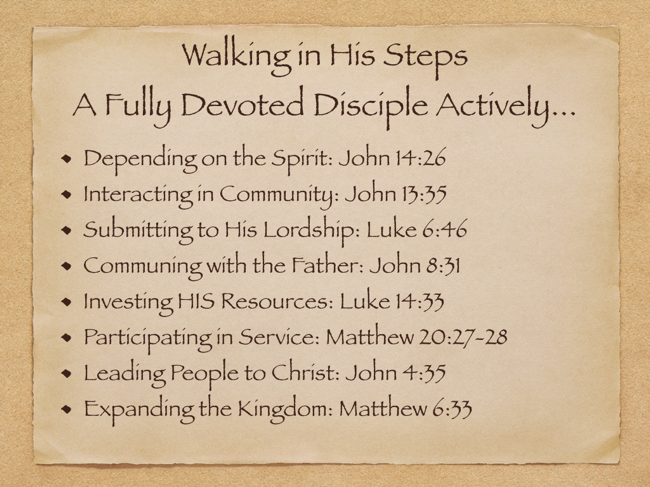
A Fully Devoted Disciple of Jesus is Actively:

Depending on the Spirit: A person who is actively depending on the Holy Spirit to transform and empower him/her to walk as Jesus walked (John 14:26). The person must recognize from where the power to live a Christian life comes, it is not by one’s own will and determination. The Holy Spirit takes up residence and transforms the follower into the image of Christ, walking as Jesus walked.

Interacting in Community: A person who is actively interacting with other believers in a small group for mutual care and spiritual formation (John 13:35). The only way to express love is in community, love is demonstrative. Love defines the believer.

I mentioned the concept of mutual care, and it just doesn’t happen in corporate worship, it is the small group that cares for its members, like a family. I would hope that if the pastor shows up at the hospital, you might be worse off than the doctors were letting on. Also, in real life… many people might have 25 visits from people that week, but if the pastor didn’t come see them, they’re disappointed. It is so sad that the visits of 25 people didn’t count in this person’s eyes. It is time to decentralize pastoral care, and get it back where it belongs, in the small group.

Spiritual formation is another area that we cannot measure in a large group corporate context. It is in the context of a small group that we see progress and victories. It is also here where we share struggles and failures. If you want to grow, you must become vulnerable with a select few other people, those who have your back and are looking out for you. It is called accountability.

Submitting to His Lordship: A person who is actively submitting to Christ’s Lordship in every area of his/her life (Luke 6:46). While this is never an all-or-nothing proposition, we must intentionally decide to turn over known areas to his lordship. That means making needed changes in our lives to reflect new ownership. When the boss tells you what to do this week and at the end of the week he comes back to see your progress only to discover you decided to do something totally different. You might not be employed there much longer. But how do we treat the Creator of the universe? Often with self-styled obedience, doing what we choose and hoping he will bless it.

Communing with the Father: A person who is actively developing intimacy with God through the spiritual disciplines (John 8:31). We must continue in God’s Word in order to know who he is and what he wants from us. Communion is so important, it is more than just following a set of rules. We pray in order to open ourselves for God to reveal himself and his will through his word. A disciple will be communing on a regular basis, not just a Sunday at 11:00 binge.

Investing His Resources: A person who actively sees himself/herself as a steward of his/her resources (time, treasure & talents) rather than an owner, and invests them to advance God’s work (Matthew 6:20-21). It comes down to stewardship, recognizing that God is the owner of everything and we are charged to care for it, being responsible with all he has entrusted to us.

Participating in Service: A person who is actively participating in acts of service toward those inside and outside the church for the glory of God (Matthew 20:27-28). We are moved by the Great Commandment, to love God and to love others. We talked about service and how we often are motivated to serve Jesus, when in fact this verse tells us that Jesus did not come to be served. So why do we feel the need to serve Jesus? Let’s change our focus to serving others. Matthew 25:40 mentions that when we do things for the least of these our brothers, we actually do them for Jesus. So, let’s serve others as we would serve Jesus himself.

Leading People to Christ: A person who is actively seeking opportunities to share his/her faith with lost people through his/her personal style of evangelism (John 4:35). Many people feel that evangelism is all about drawing the net of decision, or covering the gospel presentation outline, but we often forget that Jesus has called us to be witnesses. A witness simply tells what he knows or has seen. Telling your own story of salvation is one way, telling what insight from Scripture you discovered this week is another. We ALL can tell our story and prove to be a witness of Christ.

However, there comes a time when someone may ask about how they too might enter into a relationship with Christ, and become a disciple of Jesus. It takes more than your testimony here, so it is important to actually know a plan of salvation (Four Spirituals Laws, Evangelism Explosion, CWT, the Romans Road, the single verse John 3:16). Think about ways that God is moving in your life, and look for opportunities to put in a good word for Jesus.

Expanding the Kingdom: A person who is actively committed to a ministry of multiplication both here at home and abroad (Matthew 6:33). It is so important to have a kingdom mindset; where we see life in light of God’s plan for the nations. When we do that, we see how he is moving through his servants and cannot help but ask how we can be involved in what God is doing. Henry Blackaby said to see where God is at work and join him there (refer to the Experiencing God posts from 2013). Jesus truly is our model!

[Based on my classes with Richard D. Leineweber, Jr. c. 2000]

How to Build Trust

People will not follow you if you cannot be trusted, it is the foundation for doing ministry. Trust is the critical component for healthy and effective relationships and teams. David Horsager writes, “As trust within an organization increases, so do output, morale, productivity and loyalty” (in his book The Trust Edge).

Horsager suggest eight pillars for building (or rebuilding) trust with the people you lead. Think about how these principles transfer to the church world.

How do you rate in these trust-building qualities:

Clarity: This is straight from Simple Church, the message and process must be clear or people will not get on board. People trust leaders who provide clear communication, whether it’s vision for a new ministry or program goals.

Compassion: This is a lesson straight from Jesus himself, who had compassion people in need. It’s why everyone liked Mother Teresa, but you don’t have to be a saint to show people you care.

Character: This has been defined by Bill Hybels as, “the person you are when no one is looking.” We must do what’s right, not what’s easy. This may be a deal breaker if you don’t show your team biblical integrity. There is a reason I like this quality coming before competency; we so often emphasize competency and training for the task that we sacrifice the quality of character. Jesus invested into his disciples, not only for competency in the task, but also character. We must develop people.

Competency: Training is so important in the ministry; we want people to be successful in what they do, and sometimes just a little training will get them on the right path toward a fruitful ministry. You don’t have to be an expert is everything, but make sure you stay on top of your primary ministry focus. On the negative side, why do people so often resist training?

Contribution: People want to trust that you’ll get the job done, and get it done right. Don’t settle for less than your best. The body of Christ all working together makes “the body” of Christ, never minimize your contribution to the whole; everyone is important.

Commitment: The quickest way to build trust is to make and keep your commitments. Think about all the people you trusted to do what they said they were going to do, now think of those who fell through, failing to keep their commitments.

Connection: As John Maxwell teaches, “everyone communicates, few connect.” It’s all about relationships. Connect with those you lead, as friends, not just as workers accomplishing a task. Volunteers will walk away from a task sooner than they’ll abandon a relationship.

Consistency: It’s why we trust a restaurant franchise; we get the same food in Bangkok as in Birmingham. Leadership consistency lets people know you’re dependable.

DARING PROPOSITION: Ask your team members which of these trust-builders you demonstrate most, and which ones need improvement. Your commitment to trust-building will model this value and create a strong ministry team.

The Great Commandment

Today we reviewed the lessons so far, wrapping up the section on our purpose: the Great Commission.

This gospel message is for all peoples, nations, tribes and tongues. Acts 1:8 gives us a little direction, that our mission involved being his witnesses locally and globally. Last time I covered the SCOPE and RECIPIENTS.

The FUEL for the Great Commission is worship, meaning God is seeking worshipers who will worship him in spirit and in truth (John 4:23-24). John Piper makes a great statement in his book, Let the Nations Be Glad, “Missions exists because worship doesn’t.” The Great Commission is given in order that people stop giving glory (that belongs to God alone) not be given to any created thing. We have an innate sense of worship, the question always comes up, what will be the object of our worship? God is seeking true worshipers. Once all people are worshiping the Creator of heaven and earth, there will be no need for missions. That will not happen until we make it to heaven, where it is full of people who have chosen to worship God because he deserves it and it is the right thing to do. The goal of our mission is to see all peoples worshiping God around his throne (Revelation 7:9)

The DURATION is until the end of the age. These commands do not have a shelf life, they never become outdated. We must keep the main thing the main thing until the end of time. The local church exists to make disciples who in turn are able to make other disciples. The purpose of the church as an institution is to equip the saints for the work of service in order to fulfill the Great Commission. God works through everyday, ordinary people.

Then we moved toward our passion, what drives us to minister in the name of Christ? The Great Commandment in Matthew 22:34-40 helps us to focus on two essential directions: God and Others.

At KGBC, we break this down into four ministry areas. Consider what it means to Love God and Love Others, and what activities of the local church help this become a reality?

  1. The Great Commission (Mark 12:28-31)
    1. Loving God is demonstrated through individual and corporate worship
    2. Loving Others is demonstrated through ministry
  2. The Great Commission (Matthew 28:19-20)
    1. Go, and Make Disciples is a ministry of evangelism
    2. Teaching them to observe and obey is called discipleship

Stephen Covey tells us in his book, The 7 Habit of Highly Effective People, that “we must begin with the end in mind.” There are likely many definitions of what a disciple is, but for the most part, a fully devoted disciple is quite ambiguous; we don’t understand what a disciple LOOKS LIKE. At the very least, let’s look at the basics of what a disciple looks like. Next week we will look at specific on how that is done practically.

  1. Romans 8:29 – tells us specifically that we are to conform to the image of his Son. We are to look like Jesus. If Jesus does it, that should be our goal as well. When people see us, they should also recognize Jesus who lives through us.
  2. Galatians 4:19 – Paul tells us that his goal in all his labor is that Christ is formed in us.
  3. Ephesians 4:11-13 – Wow, this passage is full of information…
    1. We are to be equipped for the work of service, active in living out our faith.
    2. We are to be built up, representing the body of Christ.
    3. We are to have unity in our faith, no factions or divisions.
    4. We are to grow into the full measure of the stature which belongs to the fullness of Christ.

The bottom line: we are to become imitators of Christ; his attitudes and action, how he lived, how he spoke, how he loved, how he related to the Father, how he carried out his mission…

Our Product: Fully Devoted Disciples
We begin with the end in mind…

  • Romans 8:29
  • Galatians 4:19
  • Ephesians 4:11-13

[Based on my classes with Richard D. Leineweber, Jr. c. 2000]

 

Post Resurrection Appearances

The imperative command of “making disciples” was not just for the first disciples and foundational leaders of the church. Remember that, “his last command is my first concern.” The Great Commission was given to over 500 people who had joined the 11 disciples on that final hilltop (Matthew 28:16-20, 1 Corinthians 15:6 – this is noticed in Thomas and Gundry, Harmony, section 256 NASB).

You might notice that the term GREAT is never associated with the commission, which tells me that this is an ordinary, everyday commission to people who are willing to be used by our risen Lord and Savior.

10 Post Resurrection Appearances

  1. Mary Magdalene: Mark 16:9-11, John 20:11-18
  2. Other Women: Matthew 28:9-11
  3. 2 Men on the Emmaus Road: Luke 24:13-32
  4. Peter: Luke 24:33-35, 1 Corinthians 15:5a
  5. 10 Disciples, Thomas Absent: John 20:19-25
  6. 11 Disciples, Thomas Present: John 20:26-31
  7. 7 Disciples Fishing: John 21:1-35
  8. 11 Disciples in Galilee: Matthew 28:16-20
  9. James, Jesus’ Brother: 1 Corinthians 15:7
  10. Disciples in Jerusalem: Luke 24:44-49, and Acts 1:3-8

[Based on my classes with Richard D. Leineweber, Jr. c. 2000]

Why Obey Jesus’ Commands?

Today we reviewed a little about the Great Commission, the importance of understanding the end from the beginning. The point of starting with obeying the Commands of Jesus is due to the fact that we to TEACH all that he has commanded us… (Matthew 28:19-20).

Teaching is an important moment in the life of discipleship, something must transpire from one person to another. We are also supposed to teach ALL that he has commanded, meaning, let’s not pick and choose our favorite verses of pet topics. The whole of Scripture is important for instruction, reproof, correction, and training in righteousness (2 Timothy 3:16). Then we are to teach all that he has commanded YOU. The point is that we cannot teach that which God has not taught us. While we are not perfect, we are to teach the things that God has shown us, and taught us along this life.

The question of the day is, “Why are we to obey the commands of Christ?” So, what is the point or what is the benefit of our obedience? Here are ten benefits of obeying the commands of Christ.

  1. John 15:14 – to be Jesus’ friend
  2. John 15:10 – to enjoy God’s love
  3. 1 John 3:22 – to see your prayers answered
  4. John 14:15 – to prove your love for God
  5. 1 John 2:3 – to experience security of salvation
  6. John 14:21 – to know Jesus more deeply
  7. John 14:23 – to have close fellowship with God
  8. 1 John 5:2 – to genuinely love others
  9. 1 John 5:3 – to avoid many of the burdens of life
  10. John 13:34-35 – to be known as a disciple of Jesus Christ

Remember that we are to take this good news into all the world, but being a witness for Jesus does not mean we have to be a missionary in Africa to do it. From Acts 1:8, we understand that there are four levels of witness for the disciple of Jesus. This is our scope.

  1. Jerusalem: that place we might call home, reaching those in our immediate area, those around us at home, the store, work, school, neighborhood, social club, recreation center. These are the places of our natural circles of influence.
  2. Judea: that place in our region takes us away from our comfort zones. It is nearby, perhaps serving people similar to us, but outside of our circles of influence.
  3. Samaria: this place is full of people who are not like us, socially, racially, economically, culturally. Jews had no dealings with Samaritans, to we might conclude that we might go to those whom we have nothing in common, or people we don’t even like.
  4. The ends of the earth: this place can literally take us to the other side of the world, whether it is for a week, a summer project, a year stint, or a lifetime.

Our Purpose: The Great Commission

  • The Scope: all the nations, Matthew 28:19
  • The Recipients: more than 500 disciples at one time – Matthew 28:16
  • The Fuel: They Worshiped Him – Matthew 28:16
  • The Duration: The End of the Age – Matthew 28:20

The recipients of the Great Commission are much more than just a few has been fishermen, or even the CHURCH as an institution, the Great Commission is given to each of us, individually. WE are the church, and the church is alive and active as we interact in community. We do not carry out the Great Commission alone… we even receive power from the Holy Spirit to do the work he has called us to do.

We continue with the Post Resurrection Appearances of Jesus…

[Based on my classes with Richard D. Leineweber, Jr. c. 2000]


Commands Class Introduction

These are the notes from my new class called, Walking In His Steps. Perhaps these will be a reminder of what we talked about in class. The notes are located just to the right, labeled the Commands of Christ.

If you are seeking a class to attend, maybe join us in the sanctuary at King’s Grant Baptist Church on Sundays at 9:45 am.

The main point about our purpose is that Jesus gave us the Great Commission, and as it says in Evangelism Explosion, “His last command is my first concern.”

  • The Purpose: The Great Commission, Matthew 28:16-20
  • The Task: Make Disciples, 28:19, Imperative
  • The Process: a Three-fold Process, with Participles

In dissecting the main parts of Matthew 28:19-20, the main verb is our command to “make disciples.” The other verbs in this sentence are participles, so the command is not to GO, BAPTIZE, and TEACH, but to make disciples. A participle supports the main verb, for instance “as you are going” make disciples; baptize those whom you are making into disciples; as you are making disciples, teach them. So, how and what are we to teach them?

  1. ALL – let’s not pick and choose our favorite passages, or pet doctrines, ignoring the harder sayings, warnings, and difficult teachings.
  2. I – remember who is doing the teaching, it’s not about me or some famous Bible teacher, it is all about Jesus.
  3. COMMANDED – we are going to take a look at the imperative statements of Jesus throughout the gospels.
  4. YOU – we are not supposed to teach that which we have not learned ourselves, so it is of vital importance to embrace the commands of Christ, wrestle with them, submit to them, apply them… I cannot impact others if God’s Word has not already impacted me.

Next week we are going to take a look at WHY we should obey the commands of Christ. What are the benefits? What does my obedience to the commands of Christ accomplish?

[Based on my classes with Richard D. Leineweber, Jr. c. 2000]

The Secret Things of God

Today I’m going to talk about Deuteronomy 29:29 – the “secret things” of God.

ILLUSTRATION: Are you a fan of the old Twilight Zone show? It’s a lot different from the Twilight series we have today! Do you remember this episode?

THE DOWNSIDE OF DIVINATION
When Don and Pat Carter’s automobile breaks down in Ridgeview, Ohio, they decide to have lunch at the Busy Bee Cafe while they wait. The booth they sit in has a fortune telling machine on the table that answers yes or no questions for a penny each. Don asks the “mystic seer” if he is going to get a promotion at work. The card says that it has been decided in his favor. When Don calls the office, he discovers that the seer was right. Because of this initial success, Don asks the seer more and more questions.

Pat begins to recognize that Don is taking the seer too seriously. Based on the seer’s predictions, Don believes it is unsafe to leave the diner until after 3 p.m. Pat convinces him to leave a few minutes before 3, but the couple is almost struck by a car while crossing the street. A nearby clock shows it is 3 p.m. After they calm down, Don wants to go back to the cafe for more answers.

The breaking point comes when Don wants the seer to tell him where they’re going to live and asks the seer every conceivable yes/no question to arrive at that information. Pat tries to break the spell the seer has over Don. After a persuasive speech from Pat, Don apologizes and then announces directly to the mystic seer that they’re leaving to go do what they please.

INTRODUCTION: This is a great example of our desire to know “secret things,” those things that have not been revealed to us.

God seems to be so mysterious. There are a lot of things that we just don’t know about or understand about God; we have questions of which we don’t have answers that satisfy the human mind or heart.

  1. Why is there suffering in the world?
  2. What is God’s will for my life?
  3. When is Jesus coming back again?

THE MISUSE OF MYSTERY
Some things are just a mystery. We finished a January Bible Study a couple of weeks ago in the book of Colossians, and the concept of “mystery” was a big part of it.

I was made a minister according to the stewardship from God bestowed on me for your benefit, so that I might fully carry out the preaching of the word of God, 26 that is, the mystery which has been hidden from the past ages and generations, but has now been manifested to His saints, 27 to whom God willed to make known what is the riches of the glory of this mystery among the Gentiles, which is Christ in you, the hope of glory. –Colossians 1:25-27

At the time, there was a philosophy called Gnosticism, which claimed that only certain people had some special knowledge of God, and it was a secret to most people. It was a heresy that was condemned by Paul as well as early church councils. In Colossians, Paul’s reference to the “mystery” was not some secret knowledge, but the mystery of how God is able to bring Jews and Gentiles together into one family, breaking down the dividing wall of separation.

THE CONTEXT IS COVENANT
Moses writes about some secret things of God, but we must seek to understand this verse in context. Let me read it again, in the NASB…

The secret things belong to the Lord our God, but the things revealed belong to us and to our sons forever, that we may observe all the words of this law. –Deuteronomy 29:29

The first thing to understand about this passage is that it is in the context of the “covenant.” This chapter is describing the conditions of the covenant and the results of disobedience. The phrases in this verse pair together: “the secret things” with “the things revealed.” Since the Jews were the chosen people of God who possess these unconditional promises of God, there is a question that poses a problem, “How could Israel, the recipient of everlasting promises, be destroyed and deported?”

THE EXPECTATION OF EXILE
God’s word says it best in Deuteronomy 29:24-28…

24 And all the surrounding nations will ask, ‘Why has the Lord done this to this land? Why was he so angry?’ 25 “And the answer will be, ‘This happened because the people of the land abandoned the covenant that the Lord, the God of their ancestors, made with them when he brought them out of the land of Egypt. 26 Instead, they turned away to serve and worship gods they had not known before, gods that were not from the Lord. 27 That is why the Lord’s anger has burned against this land, bringing down on it every curse recorded in this book. 28 In great anger and fury the Lord uprooted his people from their land and banished them to another land, where they still live today!’

This is the problem, the continuation of Israel and its apparent termination seem to be mutually exclusive. They saw no hope of recovery. But God’s people should know better, because God had revealed the end from the beginning.

THE REGATHERING OF THE REMNANT
In the very next chapter, we read – then the LORD your God will restore you from captivity, and have compassion on you, and will gather you again from all the peoples where the LORD your God has scattered you. -Deuteronomy 30:3

This is generally referred to as the remnant returning from exile. Not everyone came back, since after 70 years many families established new roots, building businesses and growing their families. But there were three returning stages under Zerubbabal (525 BC), Ezra (458 BC), and Nehemiah (444 BC), which is the fulfillment of what we read in Deuteronomy 30:5 – The LORD your God will bring you into the land which your fathers possessed, and you shall possess it; and He will prosper you and multiply you more than your fathers.

Actually, the first ten verses of Deuteronomy 30 is a prediction of this regathering of Israel from all nations to which she was scattered. It did not look very likely, but perhaps you remember that Ezekiel had a vision where he saw the “dry bones” of Israel in exile coming back together, infused with divine breath that would resuscitate the nation to its proper role as 1) servant of the Lord and 2) mediator of God’s divine grace (Ezekiel 37:1-28).

THE CLOSENESS OF THE COMMANDMENT
In order to make clear the possibility of knowing and doing the will of God, Moses spoke of the accessibility of the Lord’s commands and requirements in Deuteronomy 30:11-14. As I read this, the word “commandment,” which occurs regularly in Deuteronomy, refers to the ENTIRE Law of God, not a single command they are to keep.

11 For this commandment which I command you today is not too difficult for you, nor is it out of reach. 12 “It is not in heaven, that you should say, ‘Who will go up to heaven for us to get it for us and make us hear it, that we may observe it?’ 13 “Nor is it beyond the sea, that you should say, ‘Who will cross the sea for us to get it for us and make us hear it, that we may observe it?’ 14 “But the word is very near you, in your mouth and in your heart, that you may observe it. –Deuteronomy 30:11-14

The point here is NOT the ease or even the possibility of keeping God’s Law, but the fact that we can even KNOW God’s Law at all. Contrary to the pagan nations around them, the Lord’s promises and purposes for Israel are crystal clear; they are NOT too difficult, or too wonderful, or beyond comprehension. Human beings CAN understand God and his Law despite their human limitations.

Notice what you DON’T need to do to find, hear, or listen to God’s Word: you don’t seek it in the highest heaven, or cross the deepest sea, because then we can blame it on someone else who has not gone to these places to retrieve the Commands of God. “Ignorance is bliss,” we say. Moses assures us that his Word is “very near you” in your mouth and in your heart. This tells me that Bible study is not all that difficult since we have the Holy Spirit guiding us, illuminating us, and inspiring us. This passage is very reminiscent of the Shema (Deuteronomy 6:6-7),

6 These words, which I am commanding you today, shall be on your HEART. 7 “You shall teach them diligently to your sons and shall TALK of them when you sit in your house and when you walk by the way and when you lie down and when you rise up.

Everything God wants his people to know is revealed in his Word, which is unveiled to the human heart and mind, and is to be communicated by one’s mouth.

Perhaps you recognize that Paul picks up this theme in Romans 10:6-8…

6 But the righteousness based on faith speaks as follows: “DO NOT SAY IN YOUR HEART, ‘WHO WILL ASCEND INTO HEAVEN?’ (that is, to bring Christ down), 7 or ‘WHO WILL DESCEND INTO THE ABYSS?’ (that is, to bring Christ up from the dead).” 8 But what does it say? “THE WORD IS NEAR YOU, IN YOUR MOUTH AND IN YOUR HEART”—that is, the word of faith which we are preaching, 9 that if you confess with your mouth Jesus as Lord, and believe in your heart that God raised Him from the dead, you will be saved; 10 for with the heart a person believes, resulting in righteousness, and with the mouth he confesses, resulting in salvation.

There is no need to go to heaven to get the message, or cross the sea to get it; the incarnation and the resurrection have already occurred and don’t need to be repeated. Instead, there is a life-changing message of the gospel, the word of faith that is to 1) be believed in the HEART and 2) confessed with the MOUTH. Just as the gospel message represents the very presence and purpose of Jesus Christ, Moses tells us in Deuteronomy 30, that the word of this covenant is close and authoritative, just as the Lord is close and authoritative.

So, back to Deuteronomy 29:29, it was this knowledge and hope that should have inspired obedience to “all the words of this law.” (Deuteronomy 29:29) Let’s read it again:

The Lord our God has secrets known to no one. We are not accountable for them, but we and our children are accountable forever for all that he has revealed to us, so that we may obey all the terms of these instructions. -NLT

THE PASSAGES ABOUT OUR PURPOSE – WHAT IS GOD’S WILL?
Now it is time to get practical:

Is God keeping secrets from us? Well, since we don’t (and can’t) know everything, he obviously has kept some things from us. Even Jesus said that only the Father knows the timing of his second coming (Mark 13:32). Remember, anything that we know about God, is known ONLY because he has revealed it to us.

What is the one thing that most people seek to know from God? What does the future hold for me? Or what is God’s will for my life? Or why do bad things happen to good people or innocent people? Or why do the innocent suffer?

So, let’s talk about the future. What IS God’s will for my life? Well, we’ve talked about this before; but we usually ask the wrong question. We should be asking, “What is God’s will?” We should not search for that one, elusive, divine plan, and, at the risk of choosing poorly, forever being out of God’s will. We must discover God’s will, God’s purposes, and then align our lives to that revealed purpose. When we discover that which God is doing, we seek to deny self, take up our cross daily, and follow him to join him in that work (Luke 9:23).

Here are some passages that tell us about God’s will:

  • Mark 3:35 – For whoever does the will of God, he is My brother and sister and mother. (Believing and serving the Lord is God’s will)
  • Romans 8:27 – and He who searches the hearts knows what the mind of the Spirit is, because He intercedes for the saints according to the will of God. (Intercession or prayer is God’s Will)
  • Romans 12:2 – And do not be conformed to this world, but be transformed by the renewing of your mind, so that you may prove what the will of God is, that which is good and acceptable and perfect. (The renewal of our mind is his will).
  • 1 Corinthians 1:1, 2 Corinthians 1:1, Ephesians 1:1, Colossians 1:1, 2 Timothy 1:1 – Paul, called as an apostle of Jesus Christ by the will of God, (Paul was called to be sent out, which was God’s will)
  • 2 Corinthians 7:9 – I now rejoice, not that you were made sorrowful, but that you were made sorrowful to the point of repentance; for you were made sorrowful according to the will of God, so that you might not suffer loss in anything through us. (Godly sorrow for and repentance of sin is God’s will)
  • 2 Corinthians 8:5 – and this, not as we had expected, but they first gave themselves to the Lord and to us by the will of God. (giving yourself to the Lord and to others is God’s will)
  • Colossians 4:12 – Epaphras, who is one of your number, a bondslave of Jesus Christ, sends you his greetings, always laboring earnestly for you in his prayers, that you may stand perfect and fully assured in all the will of God. (A holy life and assurance of salvation is God’s will)
  • 1 Thessalonians 4:3 – For this is the will of God, your sanctification; that is, that you abstain from sexual immorality; (your sanctification [becoming like Jesus] and personal purity, is God’s will)
  • 1 Thessalonians 5:18 – in everything give thanks; for this is God’s will for you in Christ Jesus. (Being a thankful person is God’s will)
  • 1 Peter 2:15 – For such is the will of God that by doing right you may silence the ignorance of foolish men. (Living rightly as a testimony of the gospel is God’s will)
  • 1 Peter 4:2 – so as to live the rest of the time in the flesh no longer for the lusts of men, but for the will of God. (Avoiding the lusts of men is God’s will)
  • 1 Peter 4:6 – For the gospel has for this purpose been preached even to those who are dead, that though they are judged in the flesh as men, they may live in the spirit according to the will of God. (Living in the spirit is God’s will)
  • 1 Peter 4:19 – Therefore, those also who suffer according to the will of God shall entrust their souls to a faithful Creator in doing what is right. (Suffering for the cause of Christ is God’s will)
  • 1 Peter 5:2 – shepherd the flock of God among you, exercising oversight not under compulsion, but voluntarily, according to the will of God; and not for sordid gain, but with eagerness; (Eagerness in serving and shepherding others is God’s will)

But for human beings, even believers, we want to know the future, rather than seek God’s will. Have you noticed, in the One Year Bible reading, that divination is condemned; the Bible tells us to avoid soothsayers, seers, fortunetellers, astrologers, psychics, mediums. Why? Because God knows there is a problem in wanting to know the future.

THE CHOICES TO CONSIDER
I believe that THIS is the reason why. If we know the future, we no longer LIVE and WALK by faith. How often have we read about the admonition to walk by faith and not by sight? (2 Corinthians 5:7, Colossians 2:6). Eventually we will begin to place our trust in some other person or discipline rather than trusting in the living God. We are in essence telling God that all of the information you have revealed to us is NOT sufficient. Peter tells us…

He has granted to us EVERYTHING pertaining to life and godliness, through the true knowledge of him who calls us by his own glory and excellence (2 Peter 1:3).

When we look to the stars by reading our horoscope, or call Miss Cleo’s 800 number during late night TV, we slap God in the face and tell him that he is NOT sufficient. He is NOT all that we need. The sacrifice of Christ was NOT enough, I need more answers.

Warren Wiersbe writes, “Our responsibility as God’s people is NOT to pry open the doors to the future, but to obey God’s will here and now. It is not necessary that we know God’s secrets, but it is essential to obey that which he has revealed to us.”

Ask yourself these penetrating questions at the bottom of your outline.

As we finish here, what has God said to you this morning?

  1. Maybe you recognize that your have not been trusting God with your future. Today is the day to repent and make things right with God. Tell him today that he IS sufficient and repent of your seeking answers in some place other than in Christ. This morning is a time to pray, trust, repent, and start fresh in your relationship with Christ. Recommit yourself to God right now.
  2. Maybe you have been attending here for a long time, and it’s time to officially join this congregation. You’ve held out for months if not years. You’ve been waiting for some special revelation from God when his will has been very clear for so long. You continue to worship here for a reason, it’s time to be obedient and join the family. A Christian without a church family is an orphan. Every team has a roster, every class has a roll, it’s time to join the family.
  3. If you don’t know Christ as your Savior and Lord, don’t let this opportunity to get away from you. Today is the day of salvation. You’ve been seeking answers all this time and God has made it painfully clear that he is very near. You sense his presence. You long to understand and experience forgiveness and purpose he has for your life. Remember, you don’t need to know all the secret things of God; only believe the things he has already revealed.

How Loss Relates to Grief

Everyone has been created with three God-given inner needs—the needs for love, for significance, and for security. When one or more of these needs is no longer being met, we naturally feel a sense of loss, which in turn causes grief.

Unmet need → Sense of loss → Feeling of grief

Throughout our lives we will incur numerous losses. Although we need to feel the pain of our losses, we do not need to be controlled by our losses. Instead we must rely on God’s promise that He will meet our deepest inner needs. The Bible says, “My God will meet all your needs according to his glorious riches in Christ Jesus” (Philippians 4:19).

LOSS OF LOVE

  • loss of significant family member (spouse, parent, unborn baby, child)
  • loss of an endeared pet
  • loss of a romantic relationship
  • loss of ability to have children (childlessness, infertility)
  • loss of a close friend
  • loss of an admired mentor or role model

Great Trial: “I’m still in agony over the death of my husband, and I feel like I’m only half a person.”

God’s Truth: Take comfort in this. Although your loss is severe and even though you have no earthly husband, the Lord says He will be your husband—He will be your Provider and Protector. “For your Maker is your husband—the LORD Almighty is his name” (Isaiah 54:5).

LOSS OF SIGNIFICANCE

  • loss of employment
  • loss of hopes and dreams
  • loss of freedom
  • loss of achievement
  • loss of respect/reputation
  • loss of purpose

Great Trial: “I’ve lost everything that gives my life purpose, and I feel such a sense of loss.”

God’s Truth: Take comfort in this. As long as you are alive, your life has purpose. “The LORD will fulfill his purpose for me; your love, O LORD, endures forever” (Psalm 138:8).

LOSS OF SECURITY

  • loss of companionship
  • loss of health (physical abilities)
  • loss of finances
  • loss of home
  • loss of justice
  • loss of family environment

Great Trial: “I’ve just experienced the greatest rejection of my life, and I feel overwhelmed with grief.”

God’s Truth: Take comfort in this. While people reject people, the Lord will not reject you. He says, “I have chosen you and have not rejected you. So do not fear, for I am with you; do not be dismayed, for I am your God. I will strengthen you and help you; I will uphold you with my righteous right hand” (Isaiah 41:9–10).

__________________________________________________________________
Hunt, J. (2008). Biblical Counseling Keys on Grief Recovery: Living at Peace with Loss. Dallas, TX: Hope For The Heart.

How to Know You Are Grieving

When we initially experience a significant loss, we can plunge into depths of grief and have difficulty coming up for air. Then eventually, after we surface, we are simply treading water, not swimming toward a real destination. The reason is called grief. When you feel engulfed with grief, realize that you have a Deliverer who will keep you from drowning in the depths of despair. “He reached down from on high and took hold of me; he drew me out of deep waters” (Psalm 18:16).

What Does Grief Look Like?

  • Do you feel alone and isolated?
  • Do you feel that you are mechanically going through the motions of life?
  • Do you feel resentful toward God for allowing your loss?
  • Do you ask, “Why?” over and over again?
  • Do you feel overwhelmed, not knowing what to do or where to turn?
  • Do you feel emotionally distraught because of your loss?
  • Do you have frequent daydreams about your loss?
  • Do you feel angry or bitter over your loss?
  • Do you have difficulty forgiving those who caused your loss?
  • Do you frequently dream at night about your loss?
  • Do you see life as an empty struggle without much reward?
  • Do you feel helpless knowing how much others must also be suffering?
  • Do you wonder what kind of God would allow your loss?
  • Do you view God as uninvolved and lacking compassion?

Regardless of your view of God right now, the Bible says, “The LORD is good, a refuge in times of trouble. He cares for those who trust in him” (Nahum 1:7).

What Are Characteristics of Chronic Grief?

Allowing yourself to be open and honest about your intense sorrow takes great courage. For some, the reality of personal pain has been buried so deeply that the ability to experience real grief is blocked. People do many things to camouflage or ignore their grief so that they don’t have to acknowledge and work through it. As a result, they have unhealthy, chronic grief, which is a barrier to emotional maturity. This unresolved sorrow blocks the comfort that Christ wants to give us. In the Beatitudes Jesus said, “Blessed are those who mourn, for they will be comforted” (Matthew 5:4)

  • Inhibited grief, denial of grief: “This is not really happening to me.”
  • Isolated grief, selective remembering: “I refuse to think about that car accident again.”
  • Insulated grief, reduced emotional involvement: “I’m not going to open myself up to be hurt this way again.”
  • Intellectualized grief, rationally explaining events: “It could have been worse.”
  • Inverted grief, returning to immature ways of responding: “I can’t believe it! I just had a temper tantrum like one I had when I was five years old.”
  • Immortalized grief, inability to let go of the loss: “He will always be a part of everything in my life.”

__________________________________________________________________
Hunt, J. (2008). Biblical Counseling Keys on Grief Recovery: Living at Peace with Loss. Dallas, TX: Hope For The Heart.