The Definition of Communication

Have you ever heard, “We just don’t communicate!” Message sent, and message received, DONE. But we often forget the messages are filtered through individual experience and interpretation, so the message they receive may NOT be the message you sent. It’s not just what you say, but the way you say it, the way you listen to others, and the way you look at others; all of these are means of communication. It’s not a matter of whether you will communicate, but a matter of WHAT you will communicate. Ultimately, the thing that determines whether you encourage or discourage others, whether you help or hurt others, is your heart. Your communication originates not in your mind but in your heart. “Out of the overflow of the heart the mouth speaks” (Matthew 12:34).

What Is Communication?

Unfortunately, many conversations can be compared to a tennis match: two players stand on opposite ends of the court preparing to send the ball across the net in such a way that the other has little or no chance of a successful return. The goal is not to keep the ball going back and forth between them, but to deliver the ball so as to prevent a response.

Good relational conversations can be better characterized as a game of “catch.” Both people attempt to deliver the ball to the other in such a way that it can be received and then successfully returned. The goal is not to win but to keep the ball going back and forth between them.

Satisfying relational communication is a process of verbal and nonverbal interaction with others in which thoughts and feelings are shared and understood; the receiver of the communication hears what is said and understands what is MEANT by the sender.

  • Verbal communication conveys thoughts and feelings with the spoken word (both choice of words and tone of voice).
  • Nonverbal communication expresses thoughts and feelings without words (facial expressions, body posture, hand gestures, direct or indirect eye contact, patient or impatient listening, gentle or rough touch, style of dress and clothing, apathetic or silent responses, platonic or romantic kisses, style of discipline, use of money or gifts).

Biblical Languages:

The Hebrew word dabar, which means “word,” is used in the Old Testament to express the concept of communication. It implies speaking about something. The Bible speaks to us about God and is one of the ways God speaks to us on matters pertaining to life. Old Testament language also speaks about the life-giving power of God’s Word. “He sent forth his word and healed them; he rescued them from the grave” (Psalm 107:20).

In New Testament Greek, logos (word) is not just “the expression of a thought, concept or idea,” but refers also to the name of an object. In the first chapter of John, “the Word” (logos) signifies the Divine Expression, Christ. “The Word became flesh and made his dwelling among us. We have seen his glory, the glory of the One and Only, who came from the Father, full of grace and truth.” (John 1:14)

An Initial Question:

“How can I communicate with others in a way that is most pleasing to God?” The method of communication most pleasing to God is one that reflects Jesus Christ in all you say and do. That means allowing Jesus Christ to be Lord of your life, allowing Him to express His words and actions through you.

“Let the word of Christ dwell in you richly as you teach and admonish one another with all wisdom, and as you sing psalms, hymns and spiritual songs with gratitude in your hearts to God. And whatever you do, whether in word or deed, do it all in the name of the Lord Jesus, giving thanks to God the Father through him.” (Colossians 3:16–17)

This series is largely based on my reading of Hunt, J. (2008). Biblical Counseling Keys on Communication: The Heart of the Matter. Dallas, TX: Hope For The Heart

Making Disciples Jesus’ Way

Yesterday we looked at the example of Jesus, that he and the Bible challenge us to walk in this life the way Jesus walked, to follow in his steps, and to be imitators of Jesus Christ. Even Luke emphasized the fact that his purpose was to write about all that Jesus DID and SAID, the things he began to DO and to TEACH.

Our Process: Following Jesus’ Example

  1. 1 John 2:6 – To walk as HE walked…
  2. 1 Peter 2:21 – To follow in His steps…
  3. 1 Corinthians 11:1 – Be imitators of me/Christ
  4. Acts 1:1 – What Jesus began to do and teach
  5. Acts 14:21 – and had MADE many disciples…

We discussed the topic of what exactly is the gospel, which came out of the Acts 14:21 passage, Paul preached the gospel and made disciples. The focal passage for the gospel is actually found in 1 Corinthians 15:3-5, (below is a chart that explains it fairly well). The point is that the gospel cannot be divorced from the death and resurrection of Jesus Christ. We can do things in the name of Christ, but we have not shared the gospel unless we talk about the death and resurrection of Jesus. THAT is the essence of the gospel, and Paul is saying that these facts are of first importance. Jesus died according to the Scriptures, and was raised according to the Scriptures. This was an early creed in the first century church. The main points are: proof of his death was the burial, proof of the resurrection were the appearances.

Gospel SlideSt. Francis said something like this: “preach the gospel always, and if necessary, use words.” It all sound good at first, but really makes no sense when we truly understand the gospel. It is not just about living a life that honors God, but putting in a good word for Jesus when the opportunity presents itself. Sharing the gospel without using words is like saying, “feed hungry people, and if necessary, use food.”

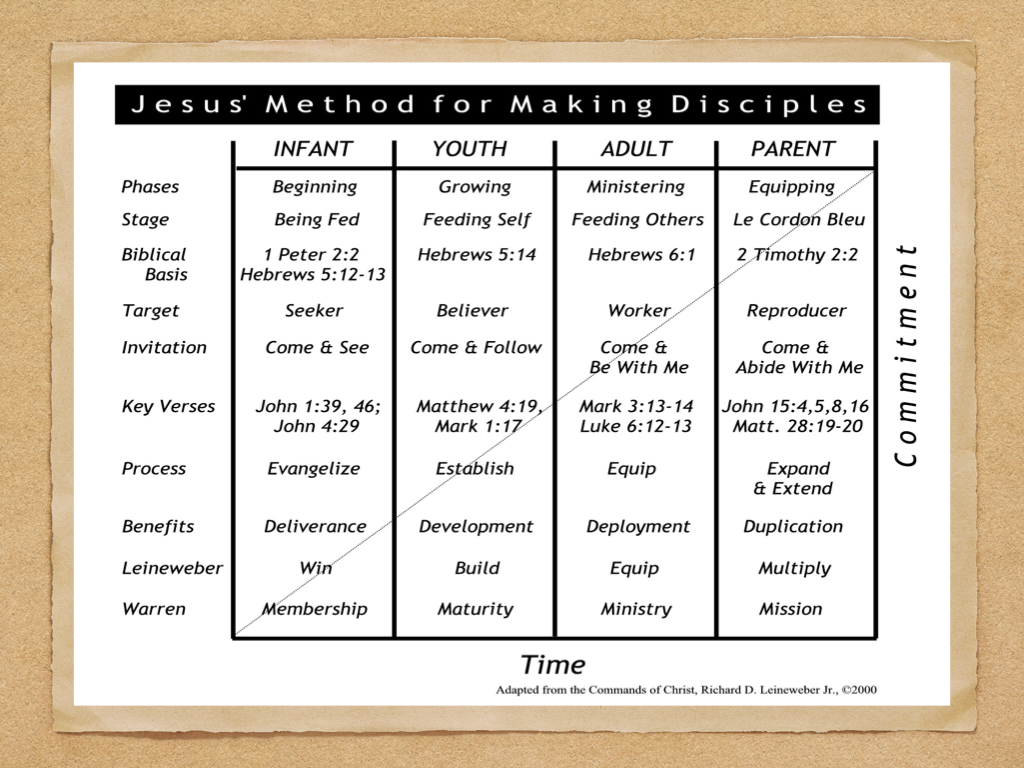
OK, now we are getting past the introductory material and into the Commands of Christ! The following Chart is a great visual on how Jesus turned his rag-tag group of men into the disciples that would turn the world upside down. In the next steps in our study, we will look specifically at each command of Jesus at each stage of disciple making. To understand the graphic, notice that the horizontal grid is relative to TIME and the vertical grid refers to COMMITMENT. As people start out with Jesus, they are in the bottom left part of this chart. As they grow in commitment over time, you can progress from seeker, believer, worker, and reproducer.

Jesus Method Chart Slide

[Based on my classes with Richard D. Leineweber, Jr. c. 2000]

Signposts Regarding Stress

Road signs give you notice of impending change or danger. Do you get anxious when you have to stop for others? Do you resent having to yield the right-of-way? Do you get impatient when road repairs make you change your speed or detour from the familiar? God’s warning signs often relay the same messages as those obstacles you encounter on the highways. What may seem an unpleasant hindrance to your movement through life may be God’s notice that you are going dangerously fast or that you are driving down the wrong road.

SLOW:

1. Slow down and make the necessary changes for good physical health.

  • Do I eat a balanced and healthy diet?
  • Do I exercise at least three times a week?
  • Do I take at least one day of rest each week?
  • Do I get adequate restful sleep most nights?

“In vain you rise early and stay up late, toiling for food to eat—for he grants sleep to those he loves” (Psalm 127:2).

2. Slow down and evaluate your priorities.

  • Make a list of everything you do.
  • Consider other priorities that should be on the list.
  • Number in order of importance.
  • Choose your commitments carefully.
  • Eliminate unnecessary stressful obligations.
  • Don’t accept impossible deadlines.
  • Don’t give in to the pressure of urgency.
  • Tackle only one problem at a time.

“Better one handful with tranquility than two handfuls with toil and chasing after the wind” (Ecclesiastes 4:6).

3. Slow down and nourish your spiritual life.

  • Remind yourself daily to, “Be still, and know that I am God” (Psalm 46:10).
  • Open lines of honest communication with God about your concerns, needs and fears.
    Set aside time daily for personal prayer and Scripture meditation.
  • Memorize Scripture that builds assurance of God’s love (Jeremiah 31:3; Psalm 36:7; John 14:21; Romans 8:39).

“It was good for me to be afflicted so that I might learn your decrees.” (Psalm 119:71)

STOP:

1. Stop and look at the real reason you are experiencing stress.

  • Do I try to meet my own needs instead of waiting on the Lord?
  • Do I think God cannot get along without me?
  • Do I seek self-worth through proving my adequacy and effectiveness?
  • Am I Spirit-led or people-pressured?

“Am I now trying to win the approval of men, or of God? Or am I trying to please men? If I were still trying to please men, I would not be a servant of Christ” (Galatians 1:10).

2. Stop, confess and turn away from any known sin in your life.

  • Do I manipulate or control others?
  • Do I feel envious or jealous of others?
  • Do I express my feelings inappropriately?
  • Do I overreact to criticism?
  • Do I have impure motives?

“He who conceals his sins does not prosper, but whoever confesses and renounces them finds mercy” (Proverbs 28:13).

YIELD:

1. Yield to God’s sovereign control over your circumstances.

  • What is God doing in my circumstances?
  • In what way does God want me to change?
  • How does God want me to respond?
  • Do I have impure motives?

“The king’s heart is in the hand of the LORD; he directs it like a watercourse wherever he pleases” (Proverbs 21:1).

2. Yield to God your rights and expectations.

  • I yield my right to control my circumstances.
  • I yield my right to be accepted by others.
  • I yield my right to be successful.
  • I yield my right to be heard and understood.
  • I yield my right to be right.

“Trust in the LORD with all your heart and lean not on your own understanding” (Proverbs 3:5).

RESUME SPEED: Resume speed, living in the presence of God.

Dear Lord,

  • I choose to let Christ live His life through me.
  • I choose to live in the present, not worrying about tomorrow.
  • I will refocus my thoughts away from my pressures to Your purposes for allowing this pressure.
  • I choose to have a thankful heart regardless of the pressure I feel.
  • I will call on You, Lord, for wisdom and peace.
  • I will commit to talking less and listening more.

“Blessed are those who have learned to acclaim you, who walk in the light of your presence, O LORD” (Psalm 89:15).

“My soul finds rest in God alone; my salvation comes from him” (Psalm 62:1).

[June Hunt, Hope for the Heart, 2008]

The Causes of Stress

When there is a problem, looking under the hood of your car isn’t enough. You need to inspect the parts that have received excessive wear and tear. Are you worn and torn by stress? Have you analyzed your own condition? By taking a closer look at Paul’s many experiences, you can check out what circumstances are most likely to cause stress. If the pressures in your life are not being used to press you closer to the Lord, you may be on the way to a blowout!

“Are they Hebrews? So am I. Are they Israelites? So am I. Are they Abraham’s descendants? So am I. Are they servants of Christ? (I am out of my mind to talk like this.) I am more. I have worked much harder, been in prison more frequently, been flogged more severely, and been exposed to death again and again. Five times I received from the Jews the forty lashes minus one. Three times I was beaten with rods, once I was stoned, three times I was shipwrecked, I spent a night and a day in the open sea, I have been constantly on the move. I have been in danger from rivers, in danger from bandits, in danger from my own countrymen, in danger from Gentiles; in danger in the city, in danger in the country, in danger at sea; and in danger from false brothers. I have labored and toiled and have often gone without sleep; I have known hunger and thirst and have often gone without food; I have been cold and naked. Besides everything else, I face daily the pressure of my concern for all the churches. Who is weak, and I do not feel weak? Who is led into sin, and I do not inwardly burn? If I must boast, I will boast of the things that show my weakness. The God and Father of the Lord Jesus, who is to be praised forever, knows that I am not lying.” (2 Corinthians 11:22–31)

CONFLICT: Paul was met with extreme opposition from others. 2 Corinthians 11:23–24

  • Opposing values of family and friends
  • Unresolved anger in relationships
  • Unrealistic expectations of another person
  • Lack of open communication in relationships

CRISIS: Paul was shipwrecked and often in extreme danger. 2 Corinthians 11:25–26

  • Death of a friend or family member
  • Separation or divorce
  • Severe illness or handicaps
  • Unexpected trauma of any kind

CHANGE: Paul was constantly on the move, often going without sleep. 2 Corinthians 11:26–27

  • Change of environment
  • Change in financial state
  • Change in employment
  • Change in sleeping and health habits

CONDEMNATION: Paul was rejected and betrayed by the Gentiles and by his own people. 2 Corinthians 11:26

  • Rejection by significant people in your life
  • Lack of support from your coworkers
  • Unfaithfulness of a friend
  • False accusations about your character

CONCERNS: Paul carried the daily pressure of concern for the churches. 2 Corinthians 11:28

  • Concern for loved ones
  • Anxiety about the future
  • Fear of failure
  • Perfectionism and excessive concern with detail

COMPETITION: Paul chose to boast only in his weaknesses. 2 Corinthians 11:30

  • Base your acceptance on who you are in Christ.
  • See your weaknesses as God’s opportunities.
  • Give up the need to be in control.
  • Rejoice in the success of others.

CONSCIENCE: Paul was secure in his integrity before the Lord. 2 Corinthians 11:31

  • Put God first in all your activities.
  • Allow God to meet your needs.
  • Respond to the needs of others.
  • Repent of sin in your life.

Paul was able to have peace in the midst of terrible stress and suffering, so we must look to see if there is a root cause of our stress.

What do you need to know and believe that will enable you to have success over stress?

  • WRONG BELIEF: “My life is out of control. I feel helpless to cope with all this stress in my life.”
  • RIGHT BELIEF: God has allowed this stress in my life to bless my life and reveal my weaknesses. I am grateful for the pressures that have pressed me closer to Him and caused me to allow Christ to be my strength. “ ‘My grace is sufficient for you, for my power is made perfect in weakness.’ Therefore I will boast all the more gladly about my weaknesses, so that Christ’s power may rest on me. That is why, for Christ’s sake, I delight in weaknesses, in insults, in hardships, in persecutions, in difficulties. For when I am weak, then I am strong” (2 Corinthians 12:9–10).

[June Hunt, Hope for the Heart, 2008]

Four Stages of Stress

It might be helpful to look at the four stages of stress:

Stage 1 – NO LIGHT

  1. Insufficient Stress.
  2. No motivation to move responsibly.
  3. When there is insufficient stress to move responsibly, you will find that the person:
    1. avoids responsibility
    2. has poor relationships
    3. is not productive
    4. has no energy
    5. experiences depression
    6. has no purpose
    7. lacks perspective on life

Stage 2 – GREEN LIGHT

  1. Positive Stress.
  2. Motivation to move responsibly.
  3. When there is positive stress, you will see that the person:
    1. faces responsibility
    2. has responsible relationships
    3. is productive
    4. is energetic
    5. is enthusiastic
    6. has fulfillment of purpose
    7. has a positive perspective

Stage 3 – YELLOW LIGHT

  1. Negative Stress.
  2. Motivational warning signs to slow down movement.
  3. The warning signs of stress are like the amber lights on a traffic signal: They caution you to be on the alert, to slow down and to be prepared for upcoming change. The physical warning signs of stress can be:
    1. tension headaches
    2. muscle aches
    3. heavy sighing
    4. high blood pressure
    5. ulcers
    6. hyper-alertness
    7. loss of sleep/excessive sleep
    8. lack of concentration
    9. indecisiveness
    10. irritability

Stage 4 – RED LIGHT

  1. Burnout.
  2. Movement is stopped and repair is necessary.
  3. Burnout is certainly not God’s will for us. It may actually mean that we have not processed the stresses of life in a godly way. Instead of living at Stage 2, we become:
    1. overwhelmed by responsibility
    2. withdrawn from relationships
    3. minimally productive
    4. depressed (lack of enthusiasm)
    5. purposeless
    6. without perspective
    7. easily fatigued
    8. lacking the ability to concentrate
    9. indecisive
    10. irritable

If your car begins to clunk and smoke pours from the hood, you would search for the nearest station and a competent mechanic. The first phrase you hear is, “Let’s take a look under the hood.” Unfortunately, many of us may be more concerned about the distressing condition of our car than the condition of our physical bodies. Are you sensitive to the warnings of your emotional engine? Your physical symptoms could register that you’re on the brink of burnout. “A man may be chastened on a bed of pain with constant distress in his bones” (Job 33:19).

Checklist for Burnout:

  • I have difficulty relaxing.
  • I have lower back pain.
  • I feel tired and lifeless most of the time.
  • I have frequent severe headaches.
  • I get indigestion often.
  • I often have diarrhea or constipation.
  • I could be getting an ulcer.
  • I have trouble sleeping at night.
  • I grind my teeth at night.
  • I am susceptible to every cold and virus.
  • I have allergies or asthma.
  • I eat and snack excessively.
  • I have lost a lot of weight.
  • I often have cold hands and sweating palms.
  • I have shortness of breath.
  • I have a rapid pulse.
  • I generally feel nervous and unsettled.

No one will experience all these symptoms, but if you checked four or more, you may need to evaluate how you are responding to the pressures in your life. Are you releasing your heavy load to the Lord and allowing His peace to permeate your heart? “A heart at peace gives life to the body” (Proverbs 14:30).

[June Hunt, Hope for the Heart, 2008]

Spiritual Implications of Stress

Stress is ultimately a spiritual issue that affects your whole life. Pressure is not the perpetrator. Your reaction to pressure is what reveals your understanding of God’s ways. You can allow pressure to come between you and the Lord, or you can allow pressure to press you closer to the Lord. Evaluate your mental, emotional and physical response to the pressures that produce stress in your life.

Mental stress is a result of how you think about or interpret events. If you dwell on losing your job, you will feel stress. If you dwell on God’s faithfulness to provide, he will replace your stress with his peace. Ask yourself whether you have a positive or negative outlook. If you dwell on negative thoughts, you can turn almost anything, even good circumstances, into stress. This is why God wants you to meditate on what is pure and good. “If anything is excellent or praiseworthy—think about such things.… And the God of peace will be with you” (Philippians 4:8–9).

Emotional stress is the result of how you process your thoughts. If you think bitter thoughts, you will feel bitter emotions. If you think forgiving thoughts, you will feel forgiveness in your heart. Although feelings need to be recognized and acknowledged, they are basically a product of your thinking, and therefore they can be controlled. Emotional immaturity makes you a prisoner to your feelings and keeps you chained to undue stress. “Do not conform any longer to the pattern of this world, but be transformed by the renewing of your mind” (Romans 12:2).

Physical stress causes your body to automatically respond external pressure. If you dwell on your difficulties, you can develop fatigue. If you trust God for His timing, he provides you peace. Even medical science has its own special definition of stress, which threads mental and emotional reactions to the central nervous system. As other physiological systems begin to activate in order to meet the external demands in life, if the pressure is not dealt with in a healthy way, you become susceptible to a variety of physical problems. God reveals in Proverbs that by keeping his words in your heart, you can avoid many of the consequences of stress. “Keep them [God’s words of wisdom] within your heart; for they are life to those who find them and health to a man’s whole body” (Proverbs 4:21–22).

[June Hunt, Hope for the Heart, 2008]

Scripture to Deal with Stress

People react to pressure much the same way as does any metal that needs to be made useful. Stress can increase your ability to endure, but excessive pressure can break you. Your response to stress is critical. As you submit to God, he will reproduce the life of Christ in you, creating a person who is useful to his kingdom.

Here are some encouraging words from the Bible: “We are hard pressed on every side, but not crushed; perplexed, but not in despair; persecuted, but not abandoned; struck down, but not destroyed. We always carry around in our body the death of Jesus, so that the life of Jesus may also be revealed in our body” (2 Corinthians 4:8–10).

Distress is a word used more than 100 times in the Bible to describe negative stress. It most often pictures the negative result that pressure and pain can have on the heart. The Old Testament Hebrew word tsarah is taken from the root word meaning “tightness” which means distress, anguish or affliction in a spiritual or psychological sense.

Due to a famine in Israel, Joseph’s brothers traveled to Egypt in an attempt to buy grain, but as they found themselves in a stressful situation, they reflected on what they had done to Joseph many years before. “We saw how distressed he was when he pleaded with us for his life, but we would not listen; that’s why this distress has come upon us” (Genesis 42:21).

[June Hunt, Hope for the Heart, 2008]

Baptism of the Dead?

Sometimes verses in the Bible jump off the page for me, like is one, 1 Corinthians 15:29, regarding  baptism of the dead.

This is the argument, like what we understand about our Mormon friends: Baptism for the dead is a non-biblical practice where a living person is baptized in lieu of a person that passed away, as a means of making a public profession of faith for a person that is already deceased. We can, essentially, think of it as the practice of baptizing a dead person.

Those who have this belief base these baptisms on Paul’s words in 1 Corinthians 15:29, “Now if there is no resurrection, what will those do who are baptized for the dead? If the dead are not raised at all, why are people baptized for them?”

This is a difficult passage to interpret, but we know by comparing it with the rest of Scripture that it does not mean that a dead person can be saved by someone else being baptized on his or her behalf, because baptism is not a requirement for salvation in the first place (Ephesians 2:8; Romans 3:28; 4:3; 6:3-4). The entire passage (1 Corinthians 15:12-29) is about the certainty of the resurrection, not about baptism for the dead.

Let’s look carefully at the Bible itself:

The mention of people being baptized to save the souls of the dead is found nowhere else in Scripture. In fact, this interpretation (vicarious baptism) was condemned as heresy by many of the early church fathers! False teachers had infiltrated the church saying, “There is no resurrection of the dead” (1 Corinthians 15:12), so the entire chapter of 1 Corinthians 15 addresses the historical fact of the resurrection of the dead.

What was being baptized for the dead? It is a mysterious passage, and there have been many different interpretations.

  1. The plain meaning of the Greek in 1 Corinthians 15:29 is that some people are being baptized on behalf of those who have died (proxy baptism)—and if there is no resurrection, why are they doing this at all?
  2. Either Paul is referring to a pagan custom (notice he uses “they,” not “we”), or to a superstitious and unscriptural practice in the Corinthian church of vicarious baptism for believers who died before being baptized.
  3. Either way, Paul certainly does not approve of the practice; he merely says that if there is no resurrection, why would the custom take place? The Mormon practice of baptism for the dead is neither scriptural nor sensible. Baptism for the dead is a practice that was common in the pagan religions of Greece and is still practiced today by some cults; but it doesn’t change a person’s eternal destiny, for that is determined while he lives (Luke 16:26).

First Corinthians 15 gives reasons why this practice is based on false teaching from false teachers:

  1. There were over 500 eyewitnesses to Christ’s resurrection from the dead, most of whom were still alive at the time of this writing (1 Corinthians 15:5–7).
  2. Ultimately, a major inconsistency is evident: If they did not believe in life after death, then why are they being baptized for the dead. Paul is simply saying, “If you reject the resurrection of the dead, you shouldn’t baptize for the dead. It is illogical!”
  3. Those practicing baptism of the dead were the false teachers, not Paul or the other Christians. This is evident because Paul referred to the ones being baptized as “those” and “people” (not “I,” “you,” or “we”).
  4. Even for those who believe in the resurrection, the practice of baptism for the dead in order to earn another person’s salvation cannot be reconciled with Scripture. The Bible says that salvation comes as a gift of God’s grace, but only through each individual’s faith in Christ—that is faith alone, not any work of baptism. Ephesians 2:8–9 says, “It is by grace you have been saved, through faith—and this not from yourselves, it is the gift of God—not by works, so that no one can boast.”
  5. The Bible clearly teaches that there are no opportunities for salvation after a person has died. “Man is destined to die once, and after that to face judgment.” (Hebrews 9:27)

Perhaps it could it refer to the fact that people are being saved through faith and are being baptized because of the testimony and witness of the martyrs. Could it be the witness of those saints who are now dead, impacted lost people so that these new believers are being baptized (because of the testimony) of the dead?

The phrase could read something like, “being baptized to take the place of those believers who have died.” Wiersbe argues that if there is no resurrection of the dead, why bother to witness and win others to faith in Christ? That would mean life is a dead-end street.

Weep over those who have died, but also weep over those who still have the opportunity to be saved before it is too late.

The Numbers Game

I have always been aware of numbers. Go to any gathering of ministers and the conversation always turns toward how many we have in our programs. Kent Hughes has a great resource I have valued for years, “Liberating Your Ministry from Success Syndrome.” While I understand the need for measurement, the question is, “what is the best way to do that?”

“Numbers. They’re the currency of ministry. The crowd has become the definition of ministry success.” — Thom Schultz

As an example on a local level, how many people attended your last Bible study or event? And how did you feel about that number? Probably one of two ways:

  1. Yea! More people showed up; we must be doing it right!
  2. Sigh…Not as many people as we wanted or expected came. What are we doing wrong?

Sound familiar? You invested a lot of time, energy, and emotion to create the opportunity for people to connect and grow in their faith. You prayed. You asked God for wisdom, guidance, and strength. You were excited for the vision he gave you and your ministry team.

Then, only 5 people showed up, or only 50, or only 200 instead of the 250 you had last time. The numbers fell short. You felt disappointed, discouraged, and perhaps even defeated.

That’s how numbers become the currency of ministry: high equals good, low equals bad. Most leaders don’t realize how often they measure success by crowd size instead of life transformation (changed lives).

How would Jesus measure success? “When you produce much fruit, you are my true disciples. This brings great glory to my Father” (John 15:8). People are easy to count. Spiritual fruit is not. So after your next event, will you count quantity, or will you invest the time to measure quality? If the number was small, how where the people in the small group impacted?

In order to measure quality, count change, the true currency of ministry. If only one person showed up for your Bible study, would you be willing to laugh, cry, and share as God transforms that person’s life? One solitary life? Isn’t it time we got excited over a few who get it, a couple whose lives are changed, instead of the number of chairs we filled?

Practically: Ask the people impacted by your ministry leadership to share their stories. Make a file or ministry database filled with short testimonies to document how people’s lives were transformed through your ministry. Maybe start a Facebook page or blog to create opportunities for people to share.

Remember, the number in the crowd does not equal the success of your ministry. Even though Jesus had large crowds follow him, the people weren’t amazed because of the numbers. They were amazed at HIM. Measure the fruit of change in your ministry, and you’ll be amazed at Jesus, too!

[Thanks Linda Crawford and Group’s Women’s Ministry Leader]

How Do You Respond to Jesus?

The message comes from all of John chapter seven, but on Sunday we read only John 7:40-52.

The Feast of Tabernacles looked back to Israel’s journey through the wilderness, and looked forward to the promised kingdom of the Messiah. The Jews lived in these booths (or tabernacles, or shelters) made of branches to remind them of God’s providential care of the nation for nearly 40 years of wandering in the wilderness (Leviticus 23 33-44).

Following the Feast of Trumpets and the solemn Day of Atonement, Tabernacles was a festive time for the people. The temple area was illuminated by large candlesticks that reminded the people of the guiding pillar of fire, and each day the priest would carry water from the pool of Siloam and pour it out from the golden pitcher, reminding the Jews of God’s miraculous provision of water from the rock.

The feast may have been an exciting time for the people, but it was a difficult time for Jesus because it marked the beginning of open and militant opposition toward him and his ministry. Ever since he had healed that paralytic on the Sabbath day (John 5:1-15), Jesus had been targeted by the Jewish leaders who wanted to kill him, so he remained in Galilee, where he would be safer, but he could not stay in Galilee and observe the feast.

1. Before the feast there was DISBELIEF (John 7:1-10)

The first 10 verses in chapter 7 reveal a little bit about the family life of Jesus. Mary, the mother of Jesus, had other children with Joseph, so Jesus would have been their half-brother. It seems incredible that his brothers could have lived with him all those years and not realized the uniqueness of Jesus. Certainly they knew about his miracles because everybody else did. They had the closest contact with him and had the best opportunity to watch him and test him, yet they remained unbelievers.

These men were going up to a religious feast, at the same time rejecting their own promised Messiah. But before we judge them too quickly, think about how easy is it to follow religious tradition and miss an eternal truth? In John 7, the common people were rejoicing at the message of Jesus, but his own half-brothers were making fun of him (see John 7:3-5).

These men certainly have the world’s point of view, if you want to get a following; you take opportunities to do something spectacular. Jerusalem would be crowded with religious pilgrims, and this would give Jesus the ideal platform to present himself to the public and win disciples. No doubt the brothers knew about all those disciples who had deserted Jesus back in John 6:66, so going to Jerusalem was his opportunity to recoup his losses.

Jesus was exercising caution because he knew that the Jewish leaders wanted to kill him (John 7:1). Although they were religious leaders, they were a part of the establishment that hated Jesus because he exposed their evil deeds. By his character and by his ministry, he revealed just how shallow and empty the existing religious system was. But Jesus did not go up with his brothers, his time had not yet come (John 7:6, 8) so he stays in Galilee (John 7:9).

Interestingly enough, Jesus immediately goes up to the feast anyway, but in secret, he did not go publicly as the brothers recommended (John 7:10).

2. In the midst of the feast there is DEBATE (John 7:11-29)

While in Jerusalem, at the Feast of Tabernacles, Jesus gets involved in various debates with three different groups of people.

1) First, there were the “Jewish leaders” who lived in Jerusalem and were involved in the temple ministry. This would include the Pharisees and the chief priests as well as the scribes. While these men differed theologically, they agreed on one thing, they opposed Jesus and were determined to get rid of him. The only known exceptions were Nicodemus and Joseph of Arimathea.

2) The second group of people would be the “festival crowd” who traveled to Jerusalem to worship. Many of these would NOT be influenced by the attitude of the religious leaders in Jerusalem. In John 7:20, the people were amazed that anybody would want to kill Jesus. They were not up-to-date on all the gossip in the city and had to learn on the streets that Jesus was considered a law breaker by the religious officials.

3) The third group of people was composed of Jews who actually lived in Jerusalem. They would have likely sided with the religious leaders.

The debate begins even before Jesus arrives in the city, and it is centered on his character (John 7:11-13). The religious leaders kept seeking Jesus, but the crowd kept arguing 1) whether he was a GOOD MAN or 2) a DECEIVER who was leading the multitudes astray (John 7:12). In their minds he would have to be one or the other, because a truly good man would not deceive anybody. Jesus is either who he claims to be, or he is a liar.

When Jesus began to teach openly in the temple, the debate shifted to his doctrine (John 7:14-19). It is interesting how character and doctrine go together. It would be foolish to trust the teachings of a liar. The Jews were amazed at what Jesus taught, because he didn’t have any credentials from their approved rabbinical schools (John 7:15). Since he lacked this proper accreditation, his enemies must have said that his teachings were nothing but private opinions and not worth much of anything (but Jesus responds in John 7:18, Those who speak for themselves want glory only for themselves, but a person who seeks to honor the one who sent him speaks truth, not lies).

It is interesting to note that it was often said that “Jesus taught with authority,” while all the scribes and Pharisees “taught from authorities,” quoting all the famous Rabbis.

The first debate was with the Jews, but then the visitors to the city entered into the discussion (John 7:20). Jesus boldly announced that the leaders wanted to kill him because he had violated the Sabbath (back in John 5:1-9) and then he claimed to be God (John 5:10-18). But look what Jesus says in John 7:23, the Jews would break the Sabbath laws when they had their sons circumcised on the Sabbath Day, so why could Jesus not heal a man on the Sabbath? So, “Why do YOU lawbreakers want to kill ME?” (John 7:19)

But the visitors to the city did not know that the religious leaders were out to kill Jesus, so they challenged Jesus in his statement. Their response contained a serious third accusation, 3) that Jesus had a DEMON. This goes way beyond debating whether he was a good man or a deceiver. But it was not a new accusation, because the leaders had said it before (Matthew 9:34, 11:18, John 8:48-49). I’m not sure if they actually believed Jesus had a demon, or if the people were simply saying, “You must be crazy to think that anybody wants to kill you.”

The residents of Jerusalem entered into the conversation in John 7:25, Some of the people who lived in Jerusalem started to ask each other, “Isn’t this the man they are trying to kill?

They knew that the rulers wanted to kill Jesus, and they were amazed that he was teaching openly and getting away with it. Maybe they thought, “Perhaps the religious leaders are now convinced that Jesus was the Messiah, sent from God, but then WHY were they not worshiping Him and leading others to worship Him?”

3. The end of the feast brought DIVISION (John 7:40-52)

So, here, at the point of debate, is the main point, exactly WHO is Jesus and how will YOU respond to him? Jesus mentions that he is the living water that springs up from our innermost being (John 7:38). He give them an opportunity to respond to his claims, but what was the result of his declaration and invitation? The people were divided. Some defended him and some wanted to arrest him. Let’s review a few possibilities, and then add a few more.

  1. Is he a good man? (John 7:11-12a, 43-46)
  2. Is he a deceiver? (John 7:12b-13, 47-48, 52)
  3. Is he demon-possessed? (John 7:20)
  4. Is he an ordinary man? (John 7:25-27, 41b-42)
  5. Is he a promised prophet? (John 7:40, Matthew 16:13-14)
  6. Is he the Christ, the Messiah? (John 7:31, 41a)

If only they had honestly examined the evidence, they would have discovered that indeed, he was the Christ, the Son of the living God.

The leaders refused to face these facts honestly, but passed judgment on the basis of their personal prejudices and their superficial examination of the facts.

Is that not human nature? It is much easier to label people than listen to the facts they present. It’s like the Pharisees were saying, “Have you been led astray? Some other people have believed in Jesus, but these common people know nothing about the law anyway! Have any important people like US believed in him?” (John 7:47-49)

Then Nicodemus spoke up. This man is found three times in John’s gospel, and each time he is identified as “the one who came to Jesus by night.” No doubt Nicodemus had been doing a great deal of thinking and studying since that first interview with Jesus in John 3, and he was not afraid to take a stand for truth.

Nicodemus was sure that the council was not giving Jesus an honest hearing. The rulers had already passed judgment and they were trying to condemn him before they even gave him a fair and lawful trial.

WHAT did Nicodemus want them to consider about Jesus? Examine his words and his works. It was Jesus 1) the teacher and 2) Jesus the miracle worker who has attracted people in the first place. In fact, Jesus previously pointed to his WORKS as proof of his DEITY. He also repeatedly urged people to pay attention to his WORDS. John 5:36 says, But I have a greater witness than John—my teachings and my miracles. The Father gave me these works to accomplish, and they prove that he sent me.
The two go together, because the miracles point to the messages, and the messages interpret the spiritual meaning of the miracles. The miracles were signs; they were events that pointed to something greater than the miracle itself.

In John 7:52, you can almost hear the sarcasm in the reply of the Pharisees, “Are you a lonely and despised Galilean, too?” They refused to admit that Nicodemus was right in asking for a fair trial, but the only way they could answer him was by means of ridicule. This is an ancient debating trick that is present today (especially during an election year), when you cannot answer the argument because of the facts, you attack the speaker.

You cannot help but feel sorry for the people described in this chapter, people who responded to Jesus in the wrong ways. His half-brothers responded with disbelief, various people in Jerusalem responded with debate, and the result was division.

Had they willingly received the truth and had they acted with sincere obedience, they would have ended up at the feet of Jesus, confessing him as Messiah and the Son of God.

As you can see, people today commit the same mistake and permit their personal prejudices and superficial evaluations to blind them to the truth. Don’t let this happen to you.

So, what about YOU? Who is Jesus to YOU? Will you examine the evidence and come to the same conclusion as believers throughout the centuries; just like Peter in Matthew 16:13-16…

When Jesus came to the region of Caesarea Philippi, he asked his disciples, “Who do people say that the Son of Man is?” “Well,” they replied, “some say John the Baptist, some say Elijah, and others say Jeremiah or one of the other prophets.” Then he asked them, “But who do you say I am?” Simon Peter answered, “You are the Messiah, the Son of the living God.”

Is Jesus Christ a Legend, Lunatic, Liar, or Lord?

You see, there really is only one choice when we think about this logically. It may be a surprise to many people but you actually DON’T put your brain in neutral when you come to faith in Jesus Christ. Christianity knows NOTHING about BLIND FAITH, and let me tell you why…

Jesus claims to be God, this is an unmistakable fact in the gospels, the local people and religious leaders understood his words and wanted to kill him for blasphemy, making himself equal with God. There was no confusion about Jesus claiming to be God.

So, there are only two options, his claim was either TRUE or it was FALSE. Let’s assume for a moment that the claim was false. There are also only two options, he either KNEW the claim was false or he did NOT KNOW the claim was false.

If Jesus KNEW his claim to be God was false, that would make him a LIAR. Remember the character issue that a good man would not deceive anyone, so this does not match the Jesus of the gospels.

If he knew the claim was false, that would also make him a HYPOCRITE since he taught people to be honest, and even worse, this would make him a DEMON because he was telling people to trust their eternal destinies to him. So practically, it makes him a FOOL for dying for a claim that he knew was not true.

Let’s assume he claims to be God and he DOESN’T KNOW that his claim is false. This would make Jesus a LUNATIC, on the level of a crazy man on the street saying that HE is Jesus.

If Jesus’ claim of divinity was false, there is absolutely NO REASON for us to pay any attention to him, he would NOT be a 1) good man, or 2) a great moral teacher, or 3) the founder of a new religious movement. He should be dismissed.

Since the claim of divinity being false is absurd, let’s agree that his claim to be God is TRUE. Then there are really only two choices, we either ACCEPT that fact, which makes Jesus our LORD, or we REJECT that fact, which makes us LOST.

For you visual learners, it looks like this:

Liar Lunatic Lord

In his famous book Mere Christianity, C.S. Lewis makes this statement, “A man who was merely a man and said the sort of things Jesus said would not be a great moral teacher. He would either be a lunatic–on the level with a man who says he is a poached egg–or he would be the devil of hell. You must make your choice. Either this was, and is, the Son of God, or else a madman or something worse. You can shut him up for a fool or you can fall at his feet and call him Lord and God. But let us not come with any patronizing nonsense about his being a great human teacher.”

As we are reading through the Bible, this is the chapter that God has placed in front of us for this weekend; it is unavoidable that we will be confronted with the claims of Christ, whether we do it in THIS life or in the NEXT life. If we wait until the next life, it is too late; there is no second chance because Hebrews 9:27 tells us that, each person is destined to die once and after that comes judgment,

  • Are you ready to meet God? Don’t put it off, any decision to wait or put it off is a decision to reject his invitation.
  • Where do you stand with Christ?
  • Who do you say that he is?
  • Maybe you have received him as your Savior, but you are asking yourself why you live as though he doesn’t exist.

Today is the day to make things right, to set things in order, to lay a foundation upon which you can build your life, build your family. You are here for a reason today. What commitments are you going to make now that we have opened up John 7 this morning?

The end of your outline has several questions to consider, and I hope that you get with a couple of friends to talk about these. They are designed to help you chew on what we learned in the Bible today. Those questions are to help you grow in your faith and have spiritual conversations this week.

As we sing this last song, what decisions are you going to make? Maybe you have never officially come to faith in Christ, today is the day to get this nailed down. Let me talk with you after the service, come find me!

Perhaps you have been attending for a while, so there is a reason you keep attending King’s Grant, why not officially join the church? You can do that today. Let’s talk about it.

Maybe you are going to take this information you learned today and have decided to live boldly for the cause of Christ. We can help with your relationship with God, knowledge the Bible, and how to make an impact on those around you. Jesus uses the terms of being SALT and LIGHT in the community, the idea is to make a difference in the lives of those around us.

Father, you know our hearts, you know our thoughts, you know whether we are serious about our faith and our relationship with you, or if we are playing church games. Give us wisdom to take an honest assessment of where we are in Christ and the courage to make necessary changes, in Jesus name, Amen.

[Thanks to Warren Wiersbe for his insight]