Repent and Believe

Today we get to the second command in the Win – Infant – Membership level; Repent and Believe the Gospel (Mark 1:14-15). Here is the overview of the six commands at this level:

  1. Come and See – Invitation – John 1:35-51
  2. Repent and Believe – Salvation – Mark 1:14-15, Luke 4:14-15
  3. Fear, a Barrier to Faith – Luke 12:4-12
  4. Greed, a Barrier to Faith – Luke 12:13-21
  5. Baptism – Matthew 28:19-20
  6. Evangelism – John 4:3-42

Why did Jesus withdraw to Galilee? (Mark 1:14)

  1. Political pressure of the Pharisees (John 4:1).
  2. John the Baptist into prison by Herod (Matthew 4:12, Mark 1:14, Luke 3:19-20).
  3. The influence of the Holy Spirit (Luke 4:14).

On the way, Jesus ministers to non-religious people (John 4:5-42, John 4:46-54).

This section and command is about the essence of the Good News, if we receive the gospel in faith and repent of our sin. It also involves humility since I am admitting that I need forgiveness, am a sinner, and I cannot trust in in myself for my salvation. Notice that Jesus’ teaching is identical to the message of John the Baptist (Matthew 3:2, 8, 11, Mark 1:4, 1:15, Luke 3:3, 8, Acts 13:24, 19:4).

Repentance is a central theme in the gospel:

  1. Jesus preached the necessity of repentance, (Matthew 4:17, 9:13, 11:20-21, 12:41, Mark 1:15, 2:17, Luke 5:31-32, 11:32, 13:3-5, 15:7, 10, 16:30, 24:47).
  2. Disciples preached the message of repentance (Mark 6:12).
  3. Repentance is illustrated in the book of Acts:
    1. Peter, Acts 2:38, 3:19, 8:22, 11:18.
    2. Paul, Acts 17:30, 20:21, 26:20.
  4. Repentance is amplified in the epistles:
    1. By Paul writes about repentance in Romans 2:4, 2 Corinthians 7:9-10, 2 Timothy 2:25.
    2. By the writer of Hebrews 6:1, 6, 12:17.
    3. By Peter, 2 Peter 3:9.
    4. By John, Revelation 9:20-21, 16:9, 11.

What was the message of Jesus? (Matthew 4:17, Mark 1:14-15, Galatians 1:6-9, 1 Corinthians 15:1-4).

  1. Repent and believe IN the gospel
  2. The kingdom of heaven (or kingdom of God) is at hand.
  3. Hope and mercy, not accusation and condemnation (John 3:16-17).

What is the gospel?

  1. Romans chapters 1-6 is a clear presentation and reality of the gospel.
  2. Galatians 1:6-9, 3:8, is a clarification of the gospel, which people had distorted.
  3. A concise synopsis of the gospel is found in 1 Corinthians 15:1-5, an early creed, according to the Scriptures…
    1. The death of Jesus
    2. The resurrection of Jesus

What is the kingdom of God?
The coming of the kingdom of God is the initial, central, and final declaration of Christ.

  1. It began with repent and believe, Mark 1:14-15.
  2. It is expanded in the Sermon on the Mount, Matthew 5-7.
  3. It would set a dawning course of this age, Matthew 24:14.

Seven aspects unfolded in God’s revelation:

  1. God as Creator is proprietor and ruler of all (Psalm 10:16, 24:1-2, 9-10).
  2. God is Israel’s king, even if they wanted an earthly king (Judges 8:22-23, 1 Samuel 8:4-9).
  3. While allowing a line of human kings, God establishes a theocracy through his prophets (1 Samuel 13:14, 2 Samuel 7:15-16, Isaiah 11:1-9, Daniel 7:13-14)
  4. Jesus comes from the Davidic line (Matthew 1:1, Luke 1:23-33) and offers the kingdom promised through the prophets, which the people of God rejected (Luke 19:11).
  5. Jewish rejection of the Good News opened the door of salvation to the Gentiles, the new aspect took the form of the mystery of the church, in which, Christ reigns (John 3:3-5, Colossians 1:13).
  6. The kingdom is temporarily hidden in the hearts of men, but Jesus will one day appear, ushering in a new kingdom (Revelation 20:4-6).
  7. God’s reign is forever, but the earthly kingdom will one day end and give way to the Messiah’s eternal kingdom (1 Corinthians 15:24-26, 28, 2 Timothy 4:18, Revelation 22:3, 5).

What does “is at hand” mean?

  1. Supernatural powers: these powers came upon those who heard the proclamation and witnessed the signs (Matthew 12:28, Luke 11:20).
  2. Personal presence of the king: he was actually in their midst (Luke 17:21). Luke 17:21 KJV says “within” but in no sense would the kingdom be within the Pharisees, in context, they had just charged Jesus with blasphemy! (Matthew 12:24-28).
  3. An actual kingdom: an actual establishment of a government on earth, the tense is “has drawn near.” Jesus established and built his church (Matthew 16:18), which he governs the citizens of his kingdom. A long-awaited kingdom of OT prophecy was now seen in the face of Jesus, and others witnessed the kingdom in the miracles Jesus performed.

What is saving faith?

  1. An intellectual assent, or belief? (James 2:19). If this were true, even the demons would be saved.
  2. Is it trusting God in the here and now for temporal relief? (John 2:23-25)
  3. Transferring trust OFF of ourselves and ONTO Jesus alone for eternal relief from the wrath to come (Matthew 3:7-10, Romans 5:8-9)
  4. GRACE = God’s Riches At Christ’s Expense, Jesus paid the debt I could not pay.
    1. Grace alone will save us (Titus 2:11, 1 Corinthians 15:1-4)
    2. Our works contribute nothing to our salvation (Romans 3:23-24, 4:2-5, Ephesians 2:8-9, Titus 3:5, 2 Timothy 2:9)

What does repentance mean?

  1. Metanioa means change of mind.
    1. About sin (Revelation 9:20-21)
    2. About God (Acts 2:38, 20:21)
    3. About Dead works (Hebrews 6:1)
  2. More than a change of mind, but a change of behavior.
  3. Repentance is changing FROM something TO something; about-face, a 180 degree turn.

Is repentance necessary for salvation?

  1. Repentance that leads to life (Acts 11:18)
  2. For all to come to repentance (2 Peter 3:9). To change one’s mind regarding Jesus Christ (Acts 2:38).
  3. Repentance does not save (since salvation is by grace through faith, Ephesians 2:8-9) but how can you be saved without repentance of mind and behavior?

What is the result of true repentance?

  1. Bearing fruit (Matthew 3:8, Luke 3:8-14), the question, “what shall we do?” are examples.
  2. Turn to God, and perform deeds appropriate to repentance (Acts 26:19-20).
  3. Jesus commissioned his followers to preach repentance for the forgiveness of sins (Luke 24:47).

What four things lead to repentance?

  1. God’s Word (Luke 16:29-31)
  2. God’s goodness or kindness (Romans 2:4)
  3. Godly sorrow (2 Corinthians 7:9-11)
  4. God’s intervention (2 Timothy 2:25)

What is godly sorrow vs. worldly sorrow?

  1. The example in the Corinthians church (2 Corinthians 7:9-11). A person had been involved with open and grievous sin, church discipline had worked, and the offender had repented.
  2. Judas had worldly sorrow (Matthew 27:3-5, Acts 1:18-20), remorse that led to suicide.
  3. Peter had godly sorrow (Matthew 26:75).

What are the characteristics of godly sorrow? (2 Corinthians 7:11)

  1. “What earnestness” – diligence to try to change things in contrast to previous indifference.
  2. “What vindication of yourselves” – eagerness to clear oneself.
  3. “What indignation” – anger that they have troubled others with their sin.
  4. “What fear” – fear over God’s displeasure.
  5. “What longing” – yearning to see the matter rectified and relationships restored.
  6. “What zeal” – enthusiasm to do what is right.
  7. “What avenging of wrong” – a readiness to turn against oneself.

[Based on my classes with Richard D. Leineweber, Jr. c. 2000]

What the Disciples Witnessed

Since the first disciples of Jesus watched Jesus so closely, believing him to be a person worth investigating, what did they actually observe?

What Did the Disciples Witness?

  1. Jesus focused evangelistic efforts on friends, John 1:40-41, 43-45.
  2. Jesus cast a vision of what people could be, John 1:42.
  3. Jesus refused to allow people to be exploited in church, John 2:14-17.
  4. Jesus allowed people to investigate his claims in the shadows, John 3:2.
  5. Jesus used a tailor-made approach to witnessing, John 3:1-21, 4:7-26.
  6. Jesus gave them an introductory exposure to the nature of his ministry, John 3:35-36.
  7. Baptism of new converts, John 4:1-2.
  8. Jesus demonstrated that prejudice does not stand in the way of ministry, John 4:4, 9, 27.
  9. Jesus challenged them to value the spiritual (eternal) over the physical (temporal), John 4:8, 31-34.
  10. Jesus challenged them to see the harvest, John 4:35.
  11. Jesus challenged them to consider the urgency of evangelism, John 4:35.
  12. Jesus introduced team evangelism, John 4:36-38.
  13. Jesus gave them time to embrace the vision, a great harvest of souls, John 4:43.

The Six Actual Commands at This Level

  1. COME and SEE (present imperative) John 1:39
  2. REPENT and BELIEVE, Mark 1:15
  3. DO NOT FEAR, Luke 12:5, 7
  4. BEWARE, BE ON YOUR GUARD, Luke 12:15
  5. BAPTIZING (present participle), Matthew 28:19
  6. LIFT UP and LOOK ON (aorist imperative), John 4:35

[Based on my classes with Richard D. Leineweber, Jr. c. 2000]

A Person Worth Investigating

After a long series of introductory material, we finally made it to the first section on the earliest commands that Jesus gave his disciples. At this point they were disciples of John the Baptist, but he pointed them toward the Lamb of God who would take away the sin of the world.

Discipleship is a strategy, a process whereby people grow in their faith through various stages. Here is the model I presented yesterday.

Masters Plan - Discipleship Chart

In the chart above, the PGA refers to my Personal Growth and Accountability (PGA) series.

  • BASIC Training (Brothers And Sisters In Christ) is for new believers or seekers, emphasizing the basics, but encouraging those to become a part of the family of God.
  • The PGA series is based on Bill Bright, Campus Crusade, and Navigators short courses on the basics of the Christian faith.
  • OCS Training (Organized Christian Servants) refers to advanced material in how to find and train others to make disciples of others.

As we investigate this man Jesus, my desire is that we all come to a fresh passion to walk as Jesus walked, and to allow the footsteps of Jesus and his first disciples to be OUR footsteps. Those timeless commands are to be OUR commands. Below is simply a short list of the commands and the passages that we will eventually study in depth.

There are SIX Commands at This Level

  1. Come and See Invitation – John 1:35-51
  2. Repent & Believe – Mark 1:14-15, Luke 4:14-15
  3. Fear, a Barrier to Faith – Luke 12:4-12
  4. Greed, a Barrier to Faith – Luke 12:13-21
  5. Baptism – Matthew 28:19-20
  6. Evangelism – John 4:3-42

In this overview, you will notice that three of these six commands fall outside of the early months in the disciples’ faith stages: FEAR / GREED (Luke 12) and BAPTISM (Matthew 28). These three commands fall into the proper place thematically but not chronologically.

The first step for a seeker or a new convert is to understand that Jesus is a person worth investigating, which is just what the early disciples did. At Jesus’ invitation, he told them to “Come and see.” I mentioned a lot of confusion by authors in search of the “historical Jesus.” They have many theories about how Jesus did not believe he was the Messiah or even that he was God (and since they are university professors, why would we doubt them?). We are talking about the Gospel of Thomas, or The Gospel of Jesus’ Wife (recently debunked as a fake).

I mentioned the Gospel of Thomas, which is dated between AD 140-180, which obviously is using Thomas’ name to present his own version of Jesus (you can read more here). As I mentioned, all you have to do is read the book to see why it was rejected by early church leaders. It is strongly anti-female, just read this quote:

Simon Peter said to Him, “Let Mary leave us, for women are not worthy of Life.” Jesus said, “I myself shall lead her in order to make her male, so that she too may become a living spirit resembling you males. For every woman who will make herself male will enter the Kingdom of Heaven.” (114)

That is so against the authentic gospels that affirm women (Gospel of Mark as an example).

Next week we will look more intently into John chapter 1, but also Jesus’ warning about FALSE CHRISTS that would come, and Jesus’ emphasis that seekers need Christian friends.

[Based on my classes with Richard D. Leineweber, Jr. c. 2000]

Languages of Love From Luke

Once we understand that relationships, not accomplishments, have the deepest meaning in life, our primary goal in communication becomes, “How can I meet the love needs of the other person?” Do you know what specific language fills the emotional needs of those God has placed in your life to love?

Are you aware of the meaningful expressions of affection that fill up your own cup? Selfless behavior and self-disclosure are like sugar and cream, the flavor enhancements to deeper and more intimate communication. Everyone needs one or more of these expressions of sincere love in order for life to “taste good!”

Time: a healthy dose of opportunities for intimate interaction (both quantity and quality of time)

  • Undivided, focused attention: Put the newspaper down
  • Eye contact: “I love you” seen from across the room,
  • Listening without giving advice: No formulas for fixing it, please.
  • Togetherness activities: “Let’s go for a walk.”
  • Physical presence: “I like having you around.”

Biblical Example: Mary sitting at the feet of Jesus (Read Luke 10:38–42).

Talk: compliments and words that affirm or build up

  • Words of affirmation: “Our relationship is important to me.”
  • Verbal compliments: “You did a great job on this meal.”
  • Encouragement: “I’ve noticed that you write thoughtful notes and letters.”
  • Words of appreciation: “I really appreciate your cleaning up the garage.”
  • Words spoken kindly: “I love you. Will you please forgive me?”

Biblical Example: Parable of tree and its fruit (Read Luke 6:43–45).

Tasks: doing things that are meaningful to one another

  • Acts of serving one another: Pitching in when help is needed
  • Doing chores together: Cooking, cleaning, yard work or running errands
  • Recognizing when there is a need: “You’re feeling bad. Let me clean up.”
  • Discerning the “right” things to do: What is most meaningful to the other, not to you?
  • Serving your loved one’s extended family: “I’ll sit with your grandmother in the hospital.”

Biblical Example: The Good Samaritan (Read Luke 10:30–37).

Tokens: giving gifts as visual symbols of love

  • Communicate love and affection through giving gifts.
  • Discern what kind of gifts are most desired, not what you would desire.
  • Gifts should never be used as a bribe or have strings attached.
  • Cost is not the issue unless it is way out of line with the available resources.
  • Tokens of love can also be written notes of admiration and encouragement.

Biblical Example: The widow’s mite (Read Luke 21:1–4).

Touch: tender and loving physical contact

  • Kissing, touching and embracing often
  • Appropriate, playful touching
  • Holding hands
  • Back and foot rubs
  • Hand on the shoulder

Biblical Example: Jesus anointed by a sinful woman (Read Luke 7:36–38).

To discover your love language: ask yourself these questions:

“What complaints do I hear the most in regard to what I am not doing?”
“What am I often requested to do?”
“How does my loved one show love to others?”
“Have I lovingly asked what is most meaningful?”
“Can I respond in another’s language of love, even when I don’t feel like it?”

“A word aptly spoken is like apples of gold in settings of silver” (Proverbs 25:11).

This series is largely based on my reading of Hunt, J. (2008). Biblical Counseling Keys on Communication: The Heart of the Matter. Dallas, TX: Hope For The Heart

[For more info on the Love Languages, go to www.5lovelanguages.com]

Making Disciples Jesus’ Way

Yesterday we looked at the example of Jesus, that he and the Bible challenge us to walk in this life the way Jesus walked, to follow in his steps, and to be imitators of Jesus Christ. Even Luke emphasized the fact that his purpose was to write about all that Jesus DID and SAID, the things he began to DO and to TEACH.

Our Process: Following Jesus’ Example

  1. 1 John 2:6 – To walk as HE walked…
  2. 1 Peter 2:21 – To follow in His steps…
  3. 1 Corinthians 11:1 – Be imitators of me/Christ
  4. Acts 1:1 – What Jesus began to do and teach
  5. Acts 14:21 – and had MADE many disciples…

We discussed the topic of what exactly is the gospel, which came out of the Acts 14:21 passage, Paul preached the gospel and made disciples. The focal passage for the gospel is actually found in 1 Corinthians 15:3-5, (below is a chart that explains it fairly well). The point is that the gospel cannot be divorced from the death and resurrection of Jesus Christ. We can do things in the name of Christ, but we have not shared the gospel unless we talk about the death and resurrection of Jesus. THAT is the essence of the gospel, and Paul is saying that these facts are of first importance. Jesus died according to the Scriptures, and was raised according to the Scriptures. This was an early creed in the first century church. The main points are: proof of his death was the burial, proof of the resurrection were the appearances.

Gospel SlideSt. Francis said something like this: “preach the gospel always, and if necessary, use words.” It all sound good at first, but really makes no sense when we truly understand the gospel. It is not just about living a life that honors God, but putting in a good word for Jesus when the opportunity presents itself. Sharing the gospel without using words is like saying, “feed hungry people, and if necessary, use food.”

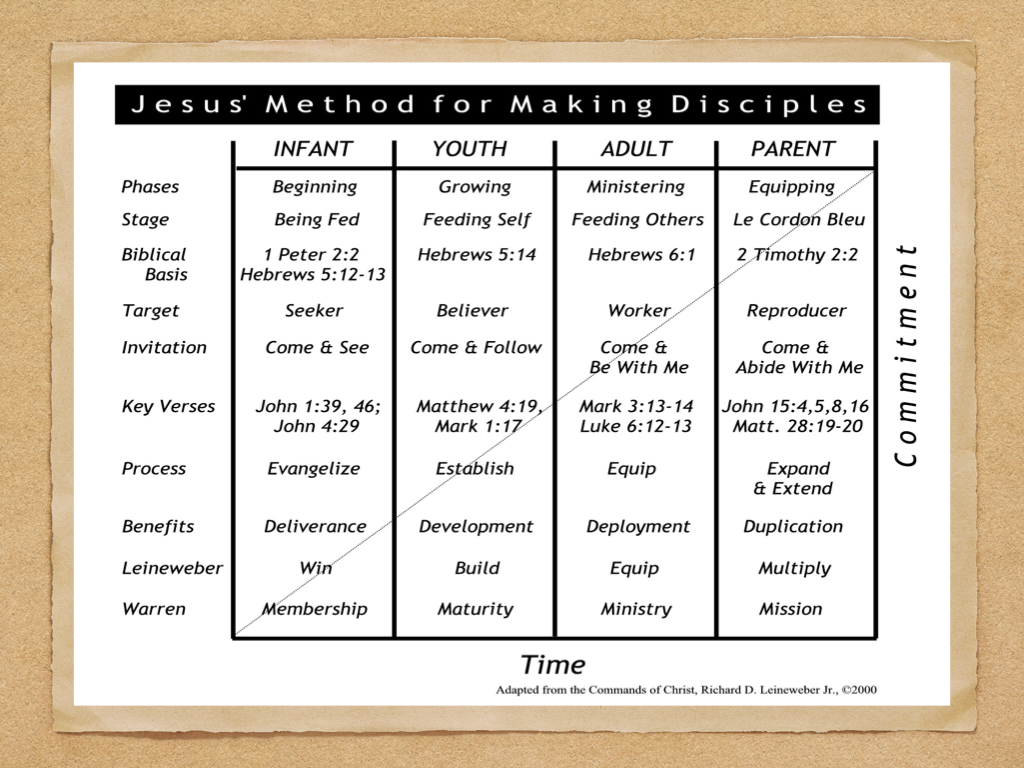
OK, now we are getting past the introductory material and into the Commands of Christ! The following Chart is a great visual on how Jesus turned his rag-tag group of men into the disciples that would turn the world upside down. In the next steps in our study, we will look specifically at each command of Jesus at each stage of disciple making. To understand the graphic, notice that the horizontal grid is relative to TIME and the vertical grid refers to COMMITMENT. As people start out with Jesus, they are in the bottom left part of this chart. As they grow in commitment over time, you can progress from seeker, believer, worker, and reproducer.

Jesus Method Chart Slide

[Based on my classes with Richard D. Leineweber, Jr. c. 2000]
Way of the Master Evangelism

The “Way of the Master” evangelism method is a technique developed by TV-show hosts Ray Comfort and Kirk Cameron, which seeks to witness to the lost by application of the Mosaic Law to show men their sin and ultimately bring them to conviction and subsequent repentance.

Way of the Master witness encounters are typically initiated with the question “Do you consider yourself to be a good person?” When the individual answers positively, the evangelist will walk him or her systematically through the Law:

  1. How many lies do you think you have told in your life?
  2. Have you ever stolen something, irrespective of its value?
  3. Have you ever taken the Lord’s name in vain?
  4. Have you ever looked at a woman with lust?

Then there is a brief summation of the individual’s admissions and the question is asked concerning the individual’s eternal well-being: “In light of your own admission, if God were to judge you by the standard of the ten commandments, do you think you would be found innocent or guilty and would you be going to heaven or hell?”

This is followed by a summary of the key elements of the gospel, with particular emphasis on doctrines such as propitiation and the need for faith and repentance.

Biblical support for this method includes such passages as…

  • Romans 3:19-20 – “Now we know that whatever the law says, it says to those who are under the law, so that every mouth may be silenced and the whole world held accountable to God. Therefore no one will be declared righteous in his sight by observing the law; rather, through the law we become conscious of sin”
  • Galatians 3:24-25 says – “…the law was put in charge to lead us to Christ that we might be justified by faith. Now that faith has come, we are no longer under the supervision of the law.”
  • Psalm 19:7 also proclaims that “the law of the Lord is perfect, converting the soul.”

As the Apostle Paul puts it in Romans 3:21-26 – “But now a righteousness from God, apart from law, has been made known, to which the Law and the Prophets testify. This righteousness from God comes through faith in Jesus Christ to all who believe. There is no difference, for all have sinned and fall short of the glory of God, and are justified freely by his grace through the redemption that came by Christ Jesus. God presented him as a sacrifice of atonement, through faith in his blood. He did this to demonstrate his justice, because in his forbearance he had left the sins committed beforehand unpunished – he did it to demonstrate his justice at the present time, so as to be just and the one who justifies those who have faith in Jesus.”

[print_link] [email_link] [ from GotQuestions.org ]

How to Love Your Wife

The Bible commands men to love their wives as Christ loves the church. This is a very difficult command to obey because Christ gave His own life for the church. In fact He died for it.

  • The church is spoken of as the Bride of Christ and Jesus is the Bridegroom and the two are engaged to one another.
  • The marriage feast of the Lamb of God will take place after the consummation of the marriage at His return.

The kind of love that Christ has for the church is the divine kind of love; a self sacrificing and unconditional love that humans can only hope to experience. So, how are husbands to love their wives the way that Jesus loves the church? There is no better marriage advice for husbands given anywhere, by anyone, at anytime, than in the Bible.

Two Become One: The very first marriage ceremony was done so by God himself in Genesis 2:23. When a man marries a woman, the two become one. The fact that Adam said, “This is now bone of my bones and flesh of my flesh” is important. That means when she feels pain, then he should feel it. When the wife rejoices, then the husband should rejoice. They are sharing everything in life; the ups and the downs.

The one flesh teaching also has a literal sense in that this new family unit produces children. Also, one flesh teaches that each should person in the couple may share in the benefits of this new marital consummation. Sexual activity produces an intimacy that is not to be fulfilled in any other relationship or activity.

Another important thing in this verse is the addition of a man leaving his father and mother to be united to his wife. These two separate humans now form a new family unit where the previous family will not have influence or authority. Think of the problems a young couple has when this principle is violated.

Love Your Wife Through Action: Few people understand a little known command for husbands is given in Colossians 3:19 “Husbands, love your wives and do not be harsh with them.” After a long day of work, a husband has the potential to come home and be harsh to the one he loves. His actions will speak louder than his words.

Love is a verb – it’s an action, its something we do. Saying “I love you” is important, but showing it by demonstrating kindness, consideration, and a soft spoken tone is more important. Husbands, don’t wait for her to show kindness first. Romans 5:8 tells us that while WE were yet sinners, Christ died for US. Love your wife by demonstrating that love through actions.

Wives and Husbands – Co-Heirs and Co-Equals: This tends to be hotly debated, male-headship or egalitarian? Bottom line here is that a wife needs for her husband to be considerate. Tell her thank you for making dinner, cleaning the litter box, washing your clothes, or making the bed. Modify your expectations and roles. Why not take some of this heavy load off of her shoulders? Listen to what the Apostle Peter tells husbands in 1 Peter 3:7, “Husbands, in the same way be considerate as you live with your wives, and treat them with respect as the weaker partner and as heirs with you of the gracious gift of life, so that nothing will hinder your prayers.” This is a pretty strong verse; the way you treat your wife affects your spiritual life!

Loving Her As You Love Yourself: Ephesians five is regarded as the biblical marriage instruction manual. No amount of human reasoning can match the wisdom of the Holy Spirit and since the Bible is the inspired Word of God, we should listen to God’s advice for marriage. Ephesians 5:28 says, “In this same way, husbands ought to love their wives as their own bodies. He who loves his wife loves himself.” In what same way is Paul talking about?

Reading the previous verses tells us in Ephesians 5:25-28, “Husbands, love your wives, just as Christ loved the church and gave himself up for her to make her holy, cleansing her by the washing with water through the word, and to present her to himself as a radiant church, without stain or wrinkle or any other blemish, but holy and blameless. In this same way, husbands ought to love their wives as their own bodies. He who loves his wife loves himself.”

This “same way” is how Christ treats His church. Paul equates loving the wife as we love ourselves. If the husband runs all the hot water out of the hot water tank by taking a long shower, he is not loving his wife the way he loves himself. A husband is to look out for her best interests. If we are cold, we turn up the heat; if we are hungry, we eat; if we are tired, we rest. So, with this same regard that husbands have for themselves in taking care of themselves, husbands should treat their wives.

Redeeming Your Time Together: The wisest man who ever lived shared some wisdom about marriage. In Ecclesiastes 9:9 Solomon writes,“Enjoy life with your wife, whom you love, all the days of this meaningless life that God has given you under the sun—all your meaningless days. For this is your lot in life and in your toilsome labor under the sun.”

A man’s wife ought to be his best friend. Before marriage, they are usually friends first, and God intends that we enjoy each other after the ceremony. Have fun together and spend time together. What about sex? Well, sex was God’s idea, and was created not just for procreation, but for marital recreation. God doesn’t make mistakes.

The Faithful Husband: Husbands made a vow before God and family to love their wives until death. God does not take that lightly because adultery is a very serious sin. Husbands will pay severely for marital infidelity. There is no room for compromise in moral purity. The lesson for husbands is to remain forever faithful to their wives. Adultery, or even flirting with another woman which can lead to adultery in the heart, can shatter families, wreck a home, cause bankruptcy, destroy children’s faith in marriage, and can bring down any man.

  • Ephesians 5:3 has Paul’s warning to husbands, as well as wives: “But immorality or any impurity or greed must not even be named among you, as is proper among saints;”
  • Exodus 20:14 is the seventh commandment where God warns couples to not commit adultery.
  • Ephesians 5:5 says: “For this you know with certainty, that no immoral or impure person or covetous man, who is an idolater, has an inheritance in the kingdom of Christ and God.”
  • Colossians 3:6, we are told that fornication, uncleanness, and inordinate affection will cause “the wrath of God to come upon the children of disobedience.”
  • Adultery can come from the heart as Jesus declares in Matthew 5:28, “Whosoever looks on a woman to lust after her, has committed adultery with her already in his heart.”

Loving Your Wife Like Christ: Ephesians 5:25-28 shows what type of love husbands ought to show their wives; “Husbands, love your wives, just as Christ loved the church and gave himself up for her to make her holy, cleansing her by the washing with water through the word, and to present her to himself as a radiant church, without stain or wrinkle or any other blemish, but holy and blameless.” This is something that husbands can not do in their own strength. It takes a supernatural empowerment by the Holy Spirit. It is not within human strength, power or capacity to love someone like Christ loves the church.

Christ was also forgiving, even while they were crucifying him. He told the Father to forgive them because they didn’t know what they were doing. Husbands can not hold onto past grievances only to bring them up at a later date. To bring up old issues is not loving their wives as Christ loved the church. He gave himself up for us and so husbands must give up themselves – including their own interests – for their wives.

[print_link] [email_link] Adapted from Jack Wellman