College Students and Church

Virginia Tech is having freshman orientation this week and I have a friend’s son headed off to Tech this fall. It got me thinking about my own college days and the things that became important. While social networking is much different today, students will still seek out various organizations like fraternities or clubs on campus.

As a Christian student I became involved in Baptist Student Union, an organization that meets many needs of students away at college (fellowship, belonging, spiritual growth, community service, missionary efforts). A lot of students chose to make the BSU their church, choosing instead to sleep in on Sundays, but they missed out on many of the blessings they could have received by participating in a local church.

Besides the church being the only institution on earth that Jesus promised to build and to bless, here are a few great benefits of students getting out of the college bubble and participating in a local church:

  1. Steady spiritual growth
  2. Hear messages from God’s Word
  3. Exposure to older, wiser believers
  4. Exposure to career role models
  5. Exposure to marriage role models
  6. Exposure to parenting role models
  7. Opportunities for service using your spiritual gifts
  8. A chance to impact younger kids
  9. Participation in church ordinances
  10. Intergenerational worship and fellowship
  11. Doctrinal and moral accountability
  12. A safety net when times get tough
  13. A home/family away from your home/family
  14. Possible free meals from people who recognize you as a member of the family!

“The age-old question about joining a local church always comes up, “Why join the church if I know I’ll be gone during the summer and graduating in four years?” Membership has its privileges! When you are a part of the body of believers, it shows your commitment to the local church, and it allows the local church to be committed to you. If not membership, consider what is called “Watch Care.” It usually has all the benefits of membership without being allowed to vote in meetings! It still says that you are committing yourself, your gifts and your abilities into this particular congregation.

“The church is not a department store where you come and get the spiritual commodity you want, then go your way. To speak of loving Christ, while neglecting his body, the church, is hypocritical” – Donald Whitney

Remember that in your new freedom from your parents’ control, do the right thing and CHOOSE CHURCH!
[print_link] [email_link]

Teachers vs Shepherds

I recently discovered a way to tell the difference between a teacher and a shepherd in Sunday School: ask the question, “What are you teaching right now in your church?”

The one who says they are teaching a five-week class on First John is the teacher; the one who says they are teaching middle school boys is the shepherd! I got this question from David Francis’ work on spiritual gifts. I found this to be a very provocative observation.

So often we believe that we are teaching lessons from the Bible when in reality we are teaching people the Bible! Here are other observations regarding shepherding:

  1. Shepherds know their sheep – The best teachers are those who take into account those whom they are teaching, we must know about life stages, gender differences, how to communicate, how this group learns, etc.
  2. Shepherds know their flock – They keep up with details about individuals in the class, maybe using a notebook to keep up with birthdays, anniversaries, hobbies, etc.
  3. Shepherds don’t wait for Sunday – Plenty of ministry opportunities await the shepherd when they are involved in the lives of their sheep during the week.
  4. Shepherds use a staff – They organize the class into smaller groups to help distribute the task of keeping up with the flock.

The key for me is that we teach people, we don’t teach lessons!

Everybody Has Six Basic Spiritual Needs

I recently read about George Gallup, who years ago delivered a speech at Princeton Theological Seminary where he shared six basic spiritual needs of all people. This is from the famous survey and research guy…

1. The need to believe that life is meaningful and has purpose – The success of Rick Warren’s book, The Purpose-Driven Life may be evidence that people really are searching for meaning and purpose in life.

2. The need for a sense of a deeper community and deeper relationship – The church is not a building but a community of like-minded people, uniting in the common bond in Christ. Look at the development of sports clubs and civic leagues that often will compete with the church for members’ time and loyalties.

3. The need to be appreciated and respected – Jesus broke the mold with His stance on women and the outcasts of society. God is no respecter of persons and each person is created in the image of God and deserving of dignity and respect. There is no joy in life if we do not feel appreciated at home, work, school or in the church.

4. The need to be listened to and heard – In this communication age where blogging is so prevalent, this may be more true than ever. “Can you hear me now?” No one wants to be voiceless!

5. The need to feel that one is growing in faith – All living things grow. The lack of growth means the living thing is either not a living thing or it has died! If we are alive in Christ, made into a new creation, how can we not continue to grow in our faith? I’m not saying it’s easy, but the Christian life takes effort to develop our relationship with God. How many so-called Christians have settled for the status quo of a mediocre life?

6. The need for practical help in developing a mature faith – That is why the community of faith is so important in the Christian life. Without community, we are left to die cold and alone! It’s like a bonfire where a log has rolled away from the flames. The only way for that smoldering log to be re-ignited is to throw it back on the pile. The body of believers (called the church) is this fire of community that offers practical help from the Bible for developing one’s faith.

Enemies of Relationship Building

We may agree that building relationships is essential to the mission of Christ and the evangelization of the world, but what are the barriers to our building relationships? Jay Dennis suggests these six “enemies” and I challenge authentic followers of Christ to find ways to overcome them:

1. Past hurts – Everyone has been hurt in a relationship before. How will we overcome that hurt and risk getting involved with others in a meaningful way?

2. Pride – How often do you tell yourself that you will not make the first move in relationship toward someone?

3. Prejudice – There is a hidden enemy that creeps in to all of us that says, “I’m not going to build a relationship with that person” for whatever reason.

4. Guilt – Perhaps you have said something or done something wrong against a person and that holds you back.

5. Busyness – We all have 24 hours in a day and need just a little bit more time to build relationships. We make time for what is important to us.

6. Selfishness – If I am going to take the time to build relationships, I’ll have to give up something else. Choices can be tough. We must decide what is important and what is urgent.

So, which enemy is holding you back?

[print_link] [email_link]

Being Missional Vs. Missions Involvement

Gary Chapman of the Southwest Virginia Christian Leadership Network reminded me of the recent movement termed “missional.” To me, this makes sense:

You’ve likely heard the term, “the missional church”, in conferences and conversation.  Simply put, it is a call to churches to be biblically faithful to be Christ’s presence in their local community.  In Breaking the Missional Code by Ed Stetzer and David Putman, the authors make the following statement:

It may sound uncharitable, but we don’t mean it to be so. But . . . many will say that these shifts, and a book like this, do not matter.  They are convinced if you just “preach the gospel” and perhaps “love people” that your church will reach people. They are wrong, and their ideas hurt the mission of the church. Communities across North America are filled with churches led by loving gospel preachers—most of whom, if statistics are true, are not reaching people.

You cannot grow a biblically faithful church without loving people and preaching the gospel. But loving people means understanding and communicating with them. Preaching the gospel means to proclaim a gospel about the Word becoming flesh—and proclaiming that the body of Christ needs to become incarnate in every cultural expression.

So, practically speaking, what would it mean for the church to become “missional?”  This list is from Dan Kimball’s book, They Like Jesus But Not the Church and explains what Stetzer and Putman are suggesting:

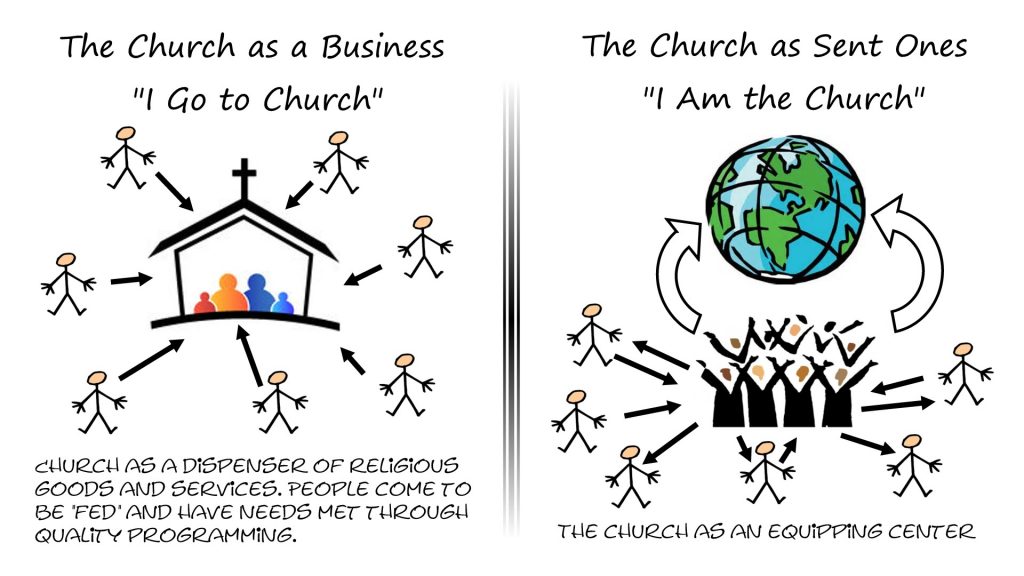
  • Being missional means that the church sees itself as being missionaries, rather than having a missions department, and that we see ourselves as missionaries right where we live.
  • Being missional means that we see ourselves as representatives of Jesus “sent” into our communities, and that the church aligns everything it does with the missio dei (mission of God).
  • Being missional means we see the church not as a place we go only on Sunday, but as something we are throughout the week.
  • Being missional means we understand we don’t “bring Jesus” to people but that we realize Jesus is active in our culture and we join him in what he is doing.
  • Being missional means we are very much in the world and engaged in culture but are not conforming to the world.
  • Being missional means we serve our communities, and that we build relationships with the people in them, rather than seeing them as evangelistic targets.
  • Being missional means being all the more dependent on Jesus and the Spirit through prayer, the Scriptures, and each other in community. 

Authentic followers of Christ would seem to be missional in their mindset as described here. It’s more than being involved in missions activities; it’s a way of life! Check out this image…

On a wider level. people just might consider the claims of Christ or at least view Christianity with some mention of respect if they could just see more people actually living out what they profess to believe. A lot of people may be into spirituality but they are certainly not into the church. How can we grow into authentic followers of Christ? How can we embrace what it means to be missional?

“An authentic life is the most personal form of worship. Everyday life has become my prayer.” –Sarah Ban Breathnach

What is a Christian?

I read a Homelife Magazine article this week by and about Tullian Tchivijian (Billy Graham’s prodigal grandson who admits defeat) called a magnificent defeat at the hand of God. He discusses that as a teenager he rebelled against all he knew to be right and was sucked into sex, drugs and rock ‘n roll… now jump to the present, he is currently founding pastor of New City Church in Fort Lauderdale, Florida. 


As I read, my first question was… “What?” Did this guy know who his grandfather was? Did this not influence him at all? Billy Graham was/is God’s ambassador to sitting presidents, heads of state as well as the common people all over the world, who preached the message of the resurrection to more people than the apostle Paul could ever had hoped for. Yes, he knew; and that’s why his life went awry.  


A great quote from the article: 


“The problem between knowing about God and knowing God is as massive as the Grand Canyon. That distance, that separateness, is something that must be resolved.” 


That’s why his life was bankrupt. Now back to my original question, “What is a Christian?” We have all heard various definitions: 

o    One who believes in the resurrection of Christ

o    One who trusts in Christ for his salvation

o    One who believes a certain set of propositional truth

o    One who participates in an organized church

o    One who follows the teachings of Jesus or the Bible

o    One who tries to live by the Ten Commandments

o    The list goes on…


Another amazing quote from the article: 


When my kids ask me, “Dad, what’s a Christian?” I always answer, “A Christian is one who can say, ‘As the deer pants for streams of water, so my soul pants for you, 0 God. My soul thirsts for God”‘ (Ps. 42:1-2). A Christian is someone who hungers for God more than anything else; more than health, wealth, status, good looks, or a spouse. Make no mistake: What we love is a surer test of who we are than what we say. Actions are much easier to fabricate than affections. 


That’s the point of HeartQuest 101, to love God more than anything else; to find that pearl of great price and risk everything to get it; to risk getting out of our comfort zones; to step out of our boats of mediocrity and experience water-walking with Jesus (a story from Matthew 14).  


This lifelong journey is a quest of the heart, to actively search for God in order to bring a sense of meaning and purpose to this life, then to bring honor and glory to our Creator and Sustainer of this world. So, how does your life reveal the love of your life? If we claim Christ has that number one spot, how does life lived out back up our affections?

Cross-Generational Chords of Discontent

I’m fascinated by a book by Gary L. McIntosh called, One Church Four Generations. I am a part of a congregation full of Builders, often called The Greatest Generation that built this country into what it is today. But as I think about the future of the church, how will we reach the younger generation of Boomers, Busters and Bridgers? 


McIntosh writes about the conflict over worship styles: 


While not every member of each generation sees things the same way, essentially the areas of difficulty are as follows: 

o    Pace of the service. Builders like worship services to move along slowly and predictably. Boomers like worship to move at a fast clip, while Busters and Bridgers want it to move even quicker. Both Busters and Bridgers look for variety and spontaneity.

o    Brightness of the lighting. Builders prefer softer lighting as it gives more of a worshipful feeling. Boomers look for a brighter lighting so they can see people well. Most Busters and Bridgers also like brighter lighting, but some prefer a darker setting, perhaps with candles or other subdued lighting.

o    Loudness of sound. Builders appreciate being able to hear well but dislike sound that blasts. Boomers and Busters want the music loud enough that they can feel it. Some Bridgers also appreciate louder sound and in some situations are comfortable with lots of interactive noise from videos, music, and talking.

o    Length of service. Builders have a longer attention span and thus are willing to sit through longer services. The attention span of Boomers, Busters, and Bridgers has been increasingly shorter.

o    Formality of service. Builders expect a certain level of formality and decorum, whereas Boomers prefer somewhat of a dressy casual. Busters and Bridgers like things to be flexible and casual. Builders equate reverence with formality of dress. They experience great frustration with Bridgers who may wear baseball caps in the church, perhaps even while in the worship service.

o    Feel of the service. Builders look for a worship service that is quiet and reverent. Boomers and Busters desire an upbeat celebration time. Bridgers, however, appear to appreciate worship that is real and honest regardless of the style.

o    Participation in the service. Builders tend to watch and enjoy while Boomers and older Busters who grew up in church like to participate with clapping and similar forms of involvement. Bridgers like a highly interactive worship service that allows for multiple forms of involvement. Unchurched Boomers, Busters, and Bridgers want to be entertained to some extent.

o    Type of music. Builders love the hymnal and the familiar songs of the faith. They like their music to be slowly paced and reverent. Boomers appreciate the praise music of the ’70s and ’80s, while Busters and Bridgers like to “sing a new song” to the Lord using a variety of music styles.

o    Quality. Builders associate quality with the effort that is extended. Thus a person may sing off-key, but Builders appreciate the quality of his or her effort. Boomers see quality as being mistake free. They expect the music, sound, announcements, and message to be well done. Busters and Bridgers tend to view quality as equal to authenticity. To them a Boomer worship service comes across as too slick and contrived. A few mistakes in the worship service are fine with them, as it is more authentic and real.


So how do you work through these issues? What about a blended service trying to be all things to all men? What about starting a contemporary service to reach the younger generation? Would it meet on Sunday morning or maybe Saturday evening? What about meeting in a different venue than the church property? Is it OK to have two separate congregations in one church, each service meeting the needs of their “target” audience?

[print_link]

Reaching the Buster Generation

This is a continuation of my previous post on Ministering to the Buster Generation.


The stats are interesting. In 2001, 33% of those ages 18-29 attended church, (compared to 40% of those ages 30-64 and 52% of those ages 65-74). So how does today’s church design a strategy for reaching unchurched Busters? Gary McIntosh (One Church Four Generations) suggests five concepts the church must keep in mind, (the author elaborates but you can brainstorm the possibilities under each point). 

1.   Physically, nothing captivates Busters more than sports and fitness.

2.   Relationally, nothing captivates Busters than friends and family.

3.   Mentally, nothing captivates Busters more than entertainment and music.

4.   Socially, nothing captivates Busters more than improving the environment.

5.   Spiritually, nothing captivates Busters more than a search for serenity.


While one-size-fits-all does not fit the Buster generation, there are some keys to reaching them. Each church must determine if they are Buster-centered, Buster-friendly or Buster-hostile. Consider these ideas in becoming more Buster-centered (like saying, “welcome, we’ve prepared this experience just for you”).

·     Play down titles and use first names.

·     Eliminate churchy words like foyer, vestibule and sanctuary and replace them with platform, lobby and auditorium.

·     Provide excellent child-care facilities.

·     Explain everything you do, so they have some idea of what’s going on.

·     Use a style of music that they would listen to on the radio.

·     Dress casually.

·     Remodel the church to reflect contemporary colors, rather than outdated.

·     Install equipment that Busters expect: computer and multimedia projector.

·     Don’t call attention to guests, but welcome visitors as a group and invite them to sit back and enjoy the service, directing them to a welcome center in the lobby.


Not only can the church value Busters, but other things can be done to reach this generation:

·     Start a new worship experience designed for them.

·     Make a good first impression.

·     Keep things relaxed.

·     Be positive: help Busters to see the joy in serving Christ.

·     Use a response card rather than asking them to come forward after a service.

·     Start a drama ministry or a video production team.

·     Preach “how-to” messages.

·     Establish new ministries.

·     Teach life skills.

·     Provide parafamily structures: small groups, sports teams, task oriented committees.

·     Be involved in the community.

·     Stress marriage and family.

·     Communicate your vision with practical results of your ministries.

·     Offer time and space since their pilgrimage may last longer than others: they are the first post-Christian generation who lack a Christian foundation; they carry hurts that need healing before they can move to another place in their lives; they learn by experimenting and they are predisposed to thinking that church is irrelevant.

The main thing for Busters is relationships, purpose in life and personal healing… wow, healing hurts and building bridges. What a great task for the church! 

Ministering to the Buster Generation

Broadly defined, Busters were born between 1965 and 1983 and represent about 66 million Americans (roughly ages 25 to 42). They have seen many changes and advances in their lifetime: Roe v. Wade, high technology, video games, television quality and choices, the Challenger disaster, the Berlin Wall came down, peer groups became essential, music had become more cynical, AIDS, the Persian Gulf war, the youthful Clinton administration (his relatively young age and who can forget Monica)…


Their characteristics may be described as desiring freedom, non-work-a-holic, into 60’s nostalgia, survival (from AIDS to pollution to over population), feeling neglected (divorced parents, single-parent homes, virtual communities), rejecting the values of the Boomers and even postponing marriage.


So, where do they fit in the church? Busters value a true family atmosphere (often coming out of a generation of broken families); get involved in local causes in order to see the results of their efforts, have shorter attention spans (the sound bite generation); want a church to meet their own needs (a pragmatic faith that works for them) and a faith that works for others (becoming involved in social, political and environmental issues)…


Let me get to my subject. Gary McIntosh (One Church Four Generations) suggests many ways the church can seek to understand this generation.

  • Define Vision – we must have a clearly defined vision and a commitment to accomplish the task. He says that “to know Christ and make Him known” is too theoretical to be relevant to Busters. Pragmatic busters want to know how the mission will be carried out; how are we going to get to know Christ and to whom is the church trying to make Christ known?
  • Keep Worship Authentic – honest, straightforward, tell-it-like-it-is services are attractive to Busters. They can be short or long, but they cannot be considered a waste of time. They are not so much bored with worship but with services that move slowly. Music is important, so we need to use up-to-date music in a variety of styles, even having busters help plan the services.
  • Focus on local issues – rather than far away places. They will feed the homeless in their own area but seldom will they minister across the country. They want to know that their money is making a difference and do not give because they are asked to give to the regular Boomer channels of missions support. So, experiencing missions is important, even if that experience takes them internationally.
  • Challenge to Short-term Service – the general rule is to recruit for short-term and to renew for long-term. Long-term commitments are not the norm, so experiencing a ministry first helps develop a commitment to it in the long term.
  • Small Groups – Busters love feedback and discussion with people they trust. Step-by-step instructions and accountability are usually needed to move from concepts into action.
  • Answer Questions – since Busters need to sort out various hurts in their lives, the church needs to provide practical messages, classes and groups. They need help with problems they face every day: AIDS, divorce, pornography, immorality, child abuse, drugs and alcohol abuse, STDs. They need honest answers and biblical solutions.
  • Develop Need-Based Ministry – we might call some of these support groups: divorce care, overcoming addictions, surviving abuse.

We have to understand the driving forces behind the group we are trying to reach. This group is the future of the church. What will the church look like after the Builders and Boomers begin to die off? So, what do you think? 

Christianity Has An Image Problem

There is a fascinating book called, unChristian (Kinnaman and Lyons) that declares Christianity has an image problem. I’ve known it for years but did not really have any research to support it. I often heard stories like:

  1. The church is only after my money
  2. Look at the lifestyles of TV evangelists
  3. Church is boring or irrelevant
  4. Remember Ted Haggard and Jim Bakker?
  5. The church is full of hypocrites
  6. I don’t need to go to church to worship God
  7. Too many priest sex scandals and cover-ups
  8. Christians are too narrow-minded

Once teenagers get their driver’s licenses, it seems participation in church activity is usually the first item scratched off the list. Remember that Christianity is a relationship more than it is a religion. Jesus said that a tree is known by its fruit, so believers not living out what they say they believe is one of the greatest barriers to outsiders giving Jesus a try. Believers in Christ are the church; it’s not the building or an activity we do on Sundays. It seems I read that Gandhi would have become a Christian, but he could not find any of His followers.

So how has the Christian faith portrayed itself to a skeptical generation? What does Christian mean to you? For many, it means very conservative, indoctrinated, anti-gay, anti-choice, angry, violent, judgmental, illogical, hypocritical, too political, building their own empires, trying to convert everyone to their way of thinking, who cannot live at peace with anyone who believes differently than themselves. So, what did I leave out? A lot of this originates from the hurtful past of former believers.

How are Christians to overcome this negative stereotype? Today’s Christians are known more for what they are against than what they really stand for. Its one thing to know about Jesus, it is another to really know Him. Assent to a set of propositions is not what Jesus desires, but that we become His disciples, followers who live out what we believe. We are not alone, there are other authentic pilgrims on this journey.

I heard Greg Stier of Dare2Share Ministries tell a story of when he was a pastor, about being in a coffee shop, studying at a table with all his Jesus books in front of him. As he was leaving to pay, there was a Goth looking kid wearing a Marilyn Manson T-shirt behind him who noticed all his books. “Are you religious?” he asked, “Because I don’t like religious people.” Greg looked at the guy and said, “Me neither, I can’t stand religious people! You know who else didn’t like religious people? Jesus! Eventually those religious people had him killed.”

So, there he was with this kid with the Manson gear, both agreeing that religious people made them sick. But Jesus showed them by rising from the dead! Greg then went on to tell him about Jesus being into relationship rather than religion. In some ways people may be into spirituality or even into Jesus, but they don’t like the church. Sad reality, since believers ARE the church.