The Root Cause of Anger

When we feel that our real or perceived “rights” have been violated, we can easily respond with anger.

But what are our legitimate rights? One person might answer, “Happiness” while another might say, “Freedom to live life my way.” But this was not the mind-set of Jesus. He yielded His rights to His heavenly Father. Based on the Bible, we have the right to live in the light of God’s will as revealed in His Word.

Other than that, we are to yield our rights to the Lord and let Him have His way in our hearts. “Trust in the LORD with all your heart and lean not on your own understanding; in all your ways acknowledge him, and he will make your paths straight.” (Proverbs 3:5–6)

WRONG BELIEF: “Based on what I believe is fair, I have the right to be angry about the disappointments in my life and to stay angry for as long as I feel like it. I have the right to express my anger in whatever way is natural for me.”

RIGHT BELIEF: “Since the Lord is sovereign over me and I trust Him with my life, I have yielded my rights to Him. My human disappointments are now God’s appointments to increase my faith and develop His character in me. I choose to not be controlled by anger, but to use anger to motivate me to do whatever God wants me to do.”

In this you greatly rejoice, though now for a little while you may have had to suffer grief in all kinds of trials. These have come so that your faith—of greater worth than gold, which perishes even though refined by fire—may be proved genuine and may result in praise, glory and honor when Jesus Christ is revealed.” (1 Peter 1:6–7)

[print_link] [email_link]

This information comes from Hunt, J. (2008). Biblical Counseling Keys on Anger: Facing the Fire Within, Dallas, TX: Hope For The Heart.
Expectations and Anger

It is easy to live under the illusion that we can determine what people should do or how situations should be decided. “My destiny should be this; therefore, people should do that.” We pray and expect God to do everything we ask.

The primary problem with these expectations can center around one simple word, pride. Ask the Lord, “Do I act as though I am at the center of my world?”

Here is a tough word from the Lord: “What causes fights and quarrels among you? Don’t they come from your desires that battle within you? You want something but don’t get it. You kill and covet, but you cannot have what you want. You quarrel and fight. You do not have, because you do not ask God. When you ask, you do not receive, because you ask with wrong motives, that you may spend what you get on your pleasures.… ‘God opposes the proud, but gives grace to the humble.’ ” (James 4:1–3, 6)

UNREALISTIC EXPECTATIONS

Anger over Circumstances: “I expected good things would always come my way … but life is clearly not what I’d expected.”

Anger toward Others: “I expected that you would always be here for me, to always support and love me … but now I’m left alone.”

Anger toward Yourself: “I expected to always excel … but now I am struggling and feel like a failure.”

  • The more we expect people to do what we want, the angrier we become when they fail us.
  • The more we try to control others, the more control we give them over us.
  • The more demands we put on others, the more power we give them to anger us.

Instead, we need to humble ourselves and submit to God’s sovereignty over our lives and over the lives of others. We need to leave our destiny in His hands—where it rightly resides.

The Bible says that we are to lay our expectations before the Lord and allow Him to determine what we should receive. “Find rest, O my soul, in God alone; my hope comes from him.” (Psalm 62:5)

“How can I handle my anger over the losses in my life?” When you experience significant loss in your life, you will go through a time of grieving.

Admit your feelings—your hurt or sense of injustice, your fear or frustration. Release to God all the pain you feel, along with the situations that are beyond your control.

Express your faith—trust God to give you the grace and insight to deal constructively with each loss. Release your expectation that life must go your way.

Pray to your Father—“Lord, thank You that You are sovereign over my life. Whatever it takes, I want to respond to You with a heart of gratitude and to accept these unchangeable circumstances in my life. I choose to stop making myself and those around me miserable for something none of us can change. Instead, I thank You for how You are going to use everything in my life for my good and for Christ’s glory. In His holy name I pray. Amen.”

Give thanks in all circumstances, for this is God’s will for you in Christ Jesus.” (1 Thessalonians 5:18)

[print_link] [email_link]

This information comes from Hunt, J. (2008). Biblical Counseling Keys on Anger: Facing the Fire Within, Dallas, TX: Hope For The Heart.

Sources of Anger

Anger is typically started and fueled by one of four sources: hurt, injustice, fear, or frustration. With these roots, anger is a secondary response to one or more of these four sources. Probing into buried feelings from your past can be painful, so it can seem easier to stay angry than to uncover the cause, turn loose of your “rights,” and grow in maturity. We must have perseverance because, “Perseverance must finish its work so that you may be mature and complete, not lacking anything.” (James 1:4)

Hurt: Your heart is wounded. Everyone has a God-given inner need for unconditional love. When you experience rejection or emotional pain of any kind, anger can become a protective wall that keeps people and pain away.

BIBLICAL EXAMPLE: 12 Sons of Jacob… Joseph was the undisputed favorite of the twelve sons of Jacob. Feeling hurt and rejected by their father, the older sons became angry and vindictive toward their younger brother! “Israel [Jacob] loved Joseph more than any of his other sons, because he had been born to him in his old age; and he made a richly ornamented robe for him. When his brothers saw that their father loved him more than any of them, they hated him and could not speak a kind word to him.” (Genesis 37:3–4)

Injustice: Your right is violated. Everyone has an inner moral code that produces a sense of right and wrong, fair and unfair, just and unjust. When you perceive that an injustice has occurred against you or others (especially those whom you love), you may feel angry. If you hold on to the offense, the unresolved anger can begin to make a home in your heart.

BIBLICAL EXAMPLE: King Saul… Saul’s unjust treatment of David evoked Jonathan’s anger. When Jonathan, son of Saul, heard his own father pronounce a death sentence on his dear friend David, he asked, “ ‘Why should he be put to death? What has he done?’ Jonathan asked his father. But Saul hurled his spear at him to kill him [Jonathan]. Then Jonathan knew that his father intended to kill David. Jonathan got up from the table in fierce anger; on that second day of the month he did not eat, because he was grieved at his father’s shameful treatment of David” (1 Samuel 20:32–34).

Fear: Your future is threatened. Everyone is created with a God-given inner need for security. When you begin to worry, feel threatened, or get angry because of a change in circumstances, you may be responding to fear. A fearful heart reveals a lack of trust in God’s perfect plan for your life.

BIBLICAL EXAMPLE: King Saul… Saul became angry because of David’s many successes on the battlefield. He was threatened by David’s popularity and feared he would lose his kingdom. (Read 1 Samuel 18:5–15, 28–29.) “Saul was very angry.… ‘They have credited David with tens of thousands,’ he thought, ‘but me with only thousands.’ … Saul was afraid of David, because the Lord was with David but had left Saul.” (1 Samuel 18:8, 12)

Frustration: Your performance is not accepted. Everyone has a God-given inner need for significance. When your efforts are thwarted or do not meet your own personal expectations, your sense of significance can be threatened. Frustration over unmet expectations of yourself or of others is a major source of anger.

BIBLICAL EXAMPLE: Cain… Both Cain and Abel brought offerings to God, but Cain’s offering was clearly unacceptable. Cain had chosen to offer what he himself wanted to give rather than what God said was right and acceptable. When Cain’s self-effort was rejected, his frustration led to anger, and his anger led to the murder of his own brother. “In the course of time Cain brought some of the fruits of the soil as an offering to the LORD. But Abel brought fat portions from some of the firstborn of his flock. The LORD looked with favor on Abel and his offering, but on Cain and his offering he did not look with favor. So Cain was very angry, and his face was downcast.… Now Cain said to his brother Abel, ‘Let’s go out to the field.’ And while they were in the field, Cain attacked his brother Abel and killed him.” (Genesis 4:3–5, 8)

Ask yourself this important question: “What does God want me to do about my inappropriate anger?” God wants you to examine the true source of your anger. Is it hurt, injustice, fear, frustration, or a combination? Then evaluate whether you are using anger to try to get your inner needs for love, for significance, and for security met.

Hurt: Have you been hurt by rejection or someone’s unkind words? If so, evaluate. Are you using anger to intimidate or coerce someone into remaining in a relationship with you?

Injustice: Have you been the victim of a real or perceived injustice? If so, evaluate. Are you using angry, accusatory words to cause someone to feel guilty and obligated to you?

Fear: Has something occurred that causes you to have fear? If so, evaluate. Are you using anger to overpower and control someone in order to get your way?

Frustration: Do you feel a sense of frustration because of unmet expectations? If so, evaluate. Are you using angry threats and shaming words to manipulate someone into meeting your demands?

In searching your heart, decide that you will not use anger to try to get your needs met. Instead, repent and enter into a deeper dependence on the Lord to meet these God-given needs. “The LORD will guide you always; he will satisfy your needs in a sun-scorched land and will strengthen your frame. You will be like a well-watered garden, like a spring whose waters never fail.” (Isaiah 58:11)

[print_link] [email_link]

This information comes from Hunt, J. (2008). Biblical Counseling Keys on Anger: Facing the Fire Within, Dallas, TX: Hope For The Heart.

Hidden Anger

Many people live life unaware that they have hidden anger, or suppressed anger that only occasionally surfaces. While hidden anger is usually rooted in past childhood hurts, the underlying effects are always ready to surface at any time. For example, when someone says or does something wrong, the one with suppressed anger often overreacts. When someone makes an innocent mistake, the magnitude of anger is out of proportion to the mistake.

If you have hidden anger, you can find yourself at one extreme or another; from feeling hopeless to feeling hostile, and can be totally unaware of why you are experiencing these feelings. The Bible makes it clear that some of our motives and emotions are hidden from our own view. “Who can discern his errors? Forgive my hidden faults.” (Psalm 19:12)

CLUES TO FIND HIDDEN ANGER

  • Do you have irritability over trifles?
  • Do you smile on the outside, while you hurt on the inside?
  • Do you find your identity and worth in excessive work?
  • Do you deny ever being impatient?
  • Do you have to have the last word?
  • Do those close to you say that you blame others?
  • Do you feel emotionally flat?
  • Do you find yourself quickly fatigued?
  • Do you have a loss of interest in life?
  • Do you become easily frustrated?

If you find that you have hidden anger, resolve to follow the Lord’s directive to these Christians in Colossae, “You must rid yourselves of all such things as these: anger, rage, malice, slander, and filthy language from your lips.” (Colossians 3:8)

[print_link] [email_link]

This information comes from Hunt, J. (2008). Biblical Counseling Keys on Anger: Facing the Fire Within, Dallas, TX: Hope For The Heart.

Unresolved Anger

The emotion of anger is not a problem in itself, but anger becomes a problem when left unresolved. Prolonged anger brings bitterness and unforgiveness. One way you can choose to harbor anger is by refusing to face your feelings in a healthy way. This unresolved anger not only creates a rift between you and God, but also damages your body, destroys your emotions, and demoralizes your relationships.

Whether you recognize it or not, extended anger can cause significant physical, emotional, and spiritual problems. Jesus said, “I tell you that anyone who is angry with his brother will be subject to judgment.” (Matthew 5:22)

Unresolved anger is known to produce in many people some of the following physical, emotional, and spiritual symptoms:

Physical Symptoms: High blood pressure, Heart disease, Stomach disorders, Intestinal disorders, Headaches, Blurred vision, Insomnia, Compulsive eating

Emotional Symptoms: Anxiety, Bitterness, Compulsions, Depression, Fear, Insecurity, Phobias, Worry

Spiritual Symptoms:

  • Loss of Perspective
  • Allowing your emotions to distort your thinking
  • Loss of Vision
  • Losing a sense of purpose for your life
  • Loss of Sensitivity
  • Failing to hear the Spirit of God speaking to your heart
  • Loss of Energy
  • Lacking strength for your service to God and others
  • Loss of Freedom
  • Becoming a prisoner of your circumstances
  • Loss of Confidence
  • Feeling insecure about your response to difficulties
  • Loss of Faith
  • Failing to trust that God is working in your life
  • Loss of Identity
  • Becoming like the person toward whom you are bitter

Unresolved anger produces bitterness. And the Bible links bitterness with being in bondage to sin. “I see that you are full of bitterness and captive to sin.” (Acts 8:23)

[print_link] [email_link]

This information comes from Hunt, J. (2008). Biblical Counseling Keys on Anger: Facing the Fire Within, Dallas, TX: Hope For The Heart.

Action or Reaction in Anger

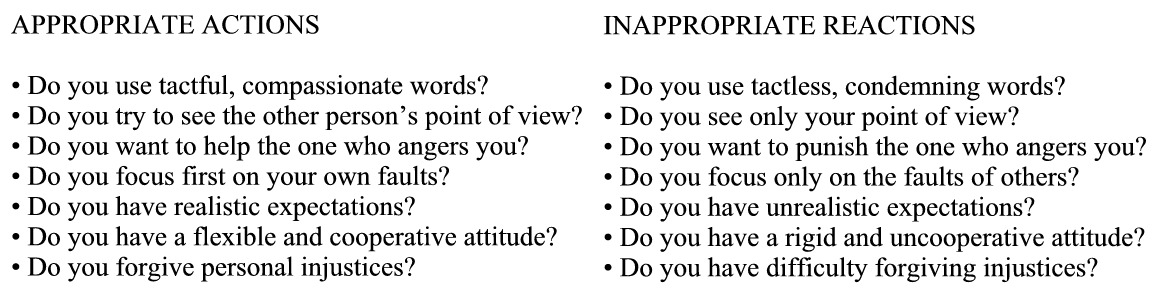
It’s time for some self-evaluation… ask yourself these questions:

  1. When you are angry, does reason rule the day or do tense emotions take over?
  2. Do you allow the mind of Christ within you to determine how best you should act, a choice that leads to appropriate action … or do you have a knee-jerk reaction that leads to inappropriate reaction?

If you have never evaluated what happens when you feel angry or if you lack insight as to how others perceive you when you are angry, seek God’s wisdom and understanding. “If you call out for insight and cry aloud for understanding, and if you look for it as for silver and search for it as for hidden treasure, then you will understand the fear of the LORD and find the knowledge of God. For the LORD gives wisdom, and from his mouth come knowledge and understanding.” (Proverbs 2:3–6)

An appropriate action is expressing your thoughts and feelings with restraint, understanding, and concern for the other person’s welfare. “A man of knowledge uses words with restraint, and a man of understanding is even-tempered.” (Proverbs 17:27)

An inappropriate reaction is expressing your thoughts and feelings in such a way that stirs up anger in others so that it produces strife. Proverbs, the book on wisdom, paints this graphic picture, “As churning the milk produces butter, and as twisting the nose produces blood, so stirring up anger produces strife.” (Proverbs 30:33)

To help assess whether you act or react, take time to answer the following questions:

Anger ActionsEven though a situation may evoke anger, those who allow the Lord to be their strength will respond appropriately. “As God’s chosen people, holy and dearly loved, clothe yourselves with compassion, kindness, humility, gentleness and patience.” (Colossians 3:12)

[print_link] [email_link]

This information comes from Hunt, J. (2008). Biblical Counseling Keys on Anger: Facing the Fire Within, Dallas, TX: Hope For The Heart.

The Magnitude of Anger

Anger, like heat, has many degrees ranging from from mild, controlled irritation to a hot, uncontrolled explosion. Anger covers many levels of the emotion. “Simeon and Levi are brothers—their swords are weapons of violence. Let me not enter their council, let me not join their assembly, for they have killed men in their anger and hamstrung oxen as they pleased. Cursed be their anger, so fierce, and their fury, so cruel! I will scatter them in Jacob and disperse them in Israel.” (Genesis 49:5–7)

Indignation is simmering anger provoked by something appearing unjust or unworthy and often perceived as justified. Jesus became “indignant” when the disciples were preventing parents from bringing their children to Jesus so that He might touch and bless them. “When Jesus saw this, he was indignant. He said to them, ‘Let the little children come to me, and do not hinder them, for the kingdom of God belongs to such as these.’ ” (Mark 10:14)

Wrath is burning anger accompanied by a desire to avenge. Wrath often moves from the emotion of anger to the outward expression of anger. In Romans 1:18, God expresses His wrath as divine judgment on those who commit willful sin. “The wrath of God is being revealed from heaven against all the godlessness and wickedness of men who suppress the truth by their wickedness.” (Romans 1:18)

Fury is fiery anger so fierce that it destroys common sense. The word fury suggests a powerful force compelled to harm or destroy. Some members of the Sanhedrin were so angry with Peter and the other apostles for proclaiming that Jesus was God that “they were furious and wanted to put them to death” (Acts 5:33). That is why the Bible says, “Anger is cruel and fury overwhelming.” (Proverbs 27:4)

Rage is blazing anger resulting in loss of self-control, often to the extreme of violence and temporary insanity. After an outburst of rage, how many times have we heard this cry of remorse, “I can’t believe I did that!” Yet those who continue to vent their rage toward others, including toward God, find themselves defeated by their own destructive decisions and ruined relationships. “A man’s own folly ruins his life, yet his heart rages against the LORD.” (Proverbs 19:3)

[print_link] [email_link]

This information comes from Hunt, J. (2008). Biblical Counseling Keys on Anger: Facing the Fire Within, Dallas, TX: Hope For The Heart.

The Meaning of Anger

In a fire, things can get out of control pretty quickly, so take action at the first signs of becoming angry before it consumes your life and destroys your relationships. “A quick-tempered man does foolish things.” (Proverbs 14:17)

  1. Anger is a strong emotion of irritation or agitation that occurs when a need or expectation is not met. “An angry man stirs up dissension, and a hot-tempered one commits many sins.” (Proverbs 29:22)
  2. Anger is the fuel for what the Bible describes as a hot-tempered or quick-tempered person. “A hot-tempered man stirs up dissension, but a patient man calms a quarrel.” (Proverbs 15:18)
  3. Anger in the Old Testament is most frequently the Hebrew literally meaning “nose or nostrils” and, figuratively, picturing nostrils flaring with anger. Later, the word came to represent the entire face as seen in two ancient Hebrew sayings:
    1. “Long of face” (or nose) meaning … slow to anger. “The LORD is gracious and compassionate, slow to anger and rich in love.” (Psalm 145:8)
    2. “Short of face” (or nose) meaning … quick to anger. “Do not make friends with a hot-tempered man, do not associate with one easily angered.” (Proverbs 22:24)
  4. Anger in the New Testament is a Greek word which originally meant any “natural impulse or desire,” but later came to signify “anger as the strongest of all passions.” It is often translated as “wrath” because of its powerful, lasting nature. “For those who are self-seeking and who reject the truth and follow evil, there will be wrath and anger.” (Romans 2:8)

[print_link] [email_link]

This information comes from Hunt, J. (2008). Biblical Counseling Keys on Anger: Facing the Fire Within, Dallas, TX: Hope For The Heart.

Happiness is Not Our Goal

This is a hard subject, but we in the West often believe that the primary goal of our life is to be happy. The Declaration of Independence for the United States of America promotes the concept that mankind is endowed by our Creator with certain inalienable rights of life, liberty and the pursuit of happiness. But is happiness the goal in life?

You therefore must endure hardship as a good soldier of Jesus Christ. No one engaged in warfare entangles himself with the affairs of this life, that he may please him who enlisted him as a soldier. (2 Timothy 2:3-4)

The fact that we are born to be happy is rarely questioned by anyone. No one bothers to prove that fallen human beings have ANY moral right to happiness, or that they are any better off happy. The goal is often to get the most happiness out of life.

I was read A. W. Tozer and he writes that “the whole hectic scramble after happiness is an evil as certainly as is the scramble after money or fame or success….”

This can be easily discovered by simply reading the New Testament. The emphasis of God is not upon our happiness but upon our holiness. God is more concerned with the state of people’s hearts than with the state of their feelings.

The soldier does not seek to be happy in the field; he seeks rather to get the fighting over with, to win the war and get back home to his loved ones. When he gets home, it is there that he or she may enjoy life to the fullest. While the battle is raging, his most pressing job is to be a good soldier regardless of how he feels. (from “Of God and Men” pp. 48-49)

Ask yourself a few direct questions…

  1. Do you seek your holiness more than your happiness?
  2. Will you reorganize your priorities to reflect your commitment to Christ and his kingdom?
  3. Will you allow God to speak to you through your reading his Word, so you better know the leadership of the Holy Spirit in your life? [ Read the Bible in 2014 ]
  4. Who in your life will hold you accountable for the commitments you know that you need to make?

[print_link] [email_link]

Why People Resist Change

Change is hard, people will fight to keep things the same, but why? Why is change so difficult? I was reading an article by Lynn Hardaway (with The Bridge Network of Churches) that brings a few key insights.

What can be done when your church’s core values have drifted away from what makes a church healthy? How can a pastor lead people back to Great Commission values? The first step is to understand why people in an established congregation resist change.

1. They do not feel a need to change.
Unless the church is in crisis, most members believe “all is well” and will not be responsive to the pastor’s pleas to adopt different values. An old adage from the farm says, “You can lead a horse to water, but you can’t make it drink; you can, however, mix a little salt with its oats!” Show them the benefits of change and the danger of refusing to change.

2. People prefer the status quo.
It is safe, comfortable and familiar; moving out of that safe zone to a new place risks giving up control and feeling vulnerable. You should lead them to stop looking at what “is” and to start looking at “what can be” and “what should be.”

3. They have vested interests.
Because some people have been resident members of the congregation for an extended period of time, they have accrued positions of power and influence. You and your ideas for change are new on the scene and, in many churches, you are merely the current pastor who will probably leave within a few years; why should they change their values for a temporary leader? This leads to the next reason people resist change:

4. They do not trust you, yet.
You will need some time and successes to build your credibility in their eyes before they will let you make organizational and behavioral changes. People want to know if you can be trusted, if you know where you are going, and if you are capable of leading them there.

5. Old values and traditions have become sacred to them.
Whether those traditions are grounded in the Scripture or not is irrelevant; they are closely tied to how your people understand and relate to God. We all know pastors who found themselves ostracized because they dared to challenge the “sacred cows” in a congregation. Preach the Word of God compassionately, carefully lead the people to understand the difference between biblical values and cultural forms of worship, and you may be able to lead them away from this unhealthy mindset.

6. People prefer the simple over the complex.
When you introduce healthy systems, such as assimilation and evangelism, it can create confusion and frustration in the minds of your members, and they will naturally resist what they do not understand. They do not have the time or expertise to grasp novel concepts, so you must go the extra mile in clarifying and simplifying the process for them.

7. All human beings are basically self-centered.
While Christian people aspire to selflessness, most of us will react to a new value or idea with the question, “How will this affect my life?” You must remind your people regularly that life is not about them; life is about God’s great passion to see lost people become fully devoted followers of Jesus Christ.

Once you understand these seven reasons people resist change, you can begin the process of moving them from unhealthy values to healthy values.

[print_link] [email_link]