Renew Your Mind

Jesus has been called the greatest teacher who has ever lived (John 3:2), but have you ever asked him to be your personal teacher who guides your thoughts in all of life? It takes a renewed mind.

OVERVIEW:

  1. The difference between the natural mind and the renewed mind.
  2. What it means to have the mind of Christ.
  3. Discover the process of renewal for the mind.
  4. Discover three ways to be more spiritually minded.

The Natural Mind: refers to the thinking process that is limited to human reason and resources (1 Corinthians 2:14). What does Paul write about people who live according to their natural minds? (Ephesians 4:17-18)

The natural mind inevitably becomes enslaved to other masters (Romans 1:18-32).

  1. 2 Corinthians 3:14, 4:4
  2. Romans 1:28
  3. 1 Timothy 6:5
  4. Colossians 2:18

A renewed mind is able to know with certainty how trustworthy and how correct the will of God is (Romans 12:2).

  1. The natural and renewed mind has basic similarities: thinking, judging, reasoning, evaluating, but the difference is control.
  2. The renewed mind is obedient to Christ, thinking from the viewpoint of Jesus, freeing the personality by enlarging it to encompass the world of the spirit as well as the senses.

The Carnal Mind: is ruled by fleshly thoughts and desires (Romans 8:1-14).

  1. Jesus wants to be to your mind what a compass is to a ship (2 Corinthians 10:5).
    • Demolish worldly imaginations or arguments that obstruct the knowledge of God.
    • Take every thought captive and make them obedient to Christ’s control.
  2. Paul’s reasoning about thoughts is to ask Jesus to take control of them.

The Mind of Christ: is the disciple’s goal (Philippians 2:5). This is all about filling your mind with the thought of Christ.

  1. To remove all obstacles to your knowledge of God.
  2. To make every thought captive obedient to Christ.
  3. To possess the mind of Christ.
  4. To renew your mind.

How to Renew Your Mind:

  1. Romans 8:5-6
  2. John 16:13
  3. Colossians 3:2
  4. Philippians 4:8
  5. Psalm 1:2-3
  6. John 8:31-32
    • What term does Jesus use for someone who continues in his word?
    • What does living in God’s truth do for the enslaved mind?

Evaluate the Degree to Which Your Mind is Being Renewed:

  1. Are you really a disciple of Jesus? If so, how? (John 8:31, 1 Corinthians 2:12)
  2. If you are a disciple, what source of power is renewing your mind daily?
  3. Are you willing to make a commitment to get God’s Word into your daily life? How? What is your goal?
  4. What actions are you going to take to renew your mind?
Do the Will of God

OUR CALLING:

  1. To distinguish between God’s will and our own will.
  2. To discover God’s purpose for my life.
  3. To understand the process and provision by which we accomplish his will.
  4. To apply the teachings about God’s will to my life.

HUMAN WILL: Deuteronomy 30:19-20, Romans 7:18, 1 Timothy 2:3-4

GOD’S WILL: Every person is included in the scope of God’s will (2 Peter 3:9)

  1. Matthew 12:50
  2. John 4:34
  3. Romans 12:2
  4. Colossians 1:9

THE DIFFERENCE: is in capacity and in purpose.

  1. Our purposes are varied and can be corrupted.
  2. God’s capacity to carry out his will is unlimited and his purpose is consistent and holy.

GOD’S PRIMARY PURPOSE: (Ephesians 1:5-6, 12, 14)

  1. To bring glory to God.
  2. To win the lost.
  3. To be a good example.

BRINGING GLORY TO GOD: John 5:30, John 6:38, John 17:4, Luke 22:42

COMMITTING YOUR WHOLE PERSONALITY TO GOD:

  1. Hindrances to doing God’s will (1 John 2:15-17)
  2. Temptation is a real struggle (Hebrews 4:15, Matthew 26:38-44)
  3. Every part of your personality must be committed to God
    • Will (Philippians 2:13)
    • Mind (Romans 12:2)
    • Body (Romans 12:1, Matthew 26:41)
    • Emotions (Galatians 5:18-25)
    • Life (Galatians 2:20)

GOD’S PROMISES: Philippians 4:19, Romans 8:28

GOD’S PROCESSES: Philippians 1:6, 2:13, 1 Thessalonians 5:24

GOD’S EXAMPLES:

  1. Moses (Hebrews 11:24-27)
  2. Jesus (John 6:38, Hebrews 10:5-7, 12:2)
  3. Paul (Philippians 3:7-14, 4:13)
  4. Me (Hebrews 13:21)

Take Up Your Cross

The Essence of Luke 9:23

  1. Self-denial
  2. Cross-bearing
  3. Following Jesus

The First Commitment:

  1. While family relationships are important, they cannot be in the primary spot (Luke 14:26-27). Family commitment are subject to his lordship.
  2. Those insistent on self-love and self-interest will lose the very essence of life.
  3. We are put to death with Christ, and we allow him to live through us every day (Galatians 2:20).

The Second Commitment:

  1. Jesus explained the purpose of his death (John 12:24). Death to the old way of life brings forth new life.
  2. We must move from self-commitment to being committed to Christ.
  3. What happens to a person who refuses to be a cross-bearer? (Luke 14:26)
  4. This involves sacrificial, loving service to others.
  5. Paul explained why Jesus was willing to take up his cross (Philippians 2:8)
    • A voluntary commitment.
    • An act of obedience.

The Third Commitment:

  1. The Father revealed his will to Jesus (John 5:19-43)
  2. As Jesus followed the Father, we are to follow Jesus.
    • Matthew 11:28
    • Mark 1:17
    • Luke 9:1-2
    • John 12:26
  3. The results of following Jesus.
    • Knowledge of the truth.
    • Understanding of God’s will.
    • Rest for the soul.
    • Power to do his work.
    • The authority to represent Jesus.
    • Equipping others to be disciples.
  4. The word translated “life” is Greek, psuche (Luke 9:24, John 12:25) and “soul” in Matthew 11:29. What happens to the soul of a disciple of Jesus?
    • The soul will be purified.
    • The soul will be separated from the body.
    • The soul will be saved.
  5. The meaning of the word “salvation” in the New Testament.
    • To become whole, or to make whole.
    • When the soul of a disciple is lost or given up (Luke 9:23), the disciple is saved or made whole.
    • Placing Jesus in first place in life produces harmony or wholeness in life. We are made complete.
  6. Maturity is the degree to which we experience harmony or wholeness in relationship to God and to others.

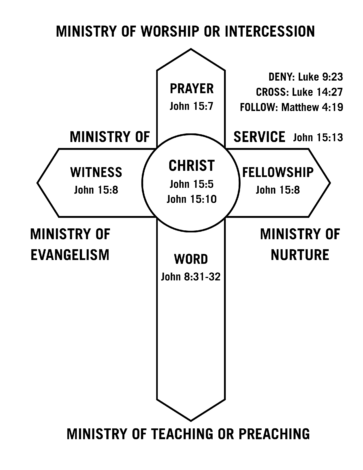
The Disciples Cross

  1. One Lord: Christ at the Center
    • Your LIFE is the Circle
    • Christ is at the Center Living in and Through You
  2. Two Relationships: with God and Others (Matthew 22:36-40)
  3. Three Commitments: Luke 9:23
    • Deny Self
    • Take up Your Cross
    • Follow
  4. Four Disciplines:
    • The Word of God
    • Praying in Faith
    • Fellowshipping with Believers
    • Witness to the World
  5. Five Ministries:
    • Teaching or Preaching
    • Worship or Intercession
    • Nurture
    • Evangelism
    • Service

Your Quiet Time

We are to engage is practices of Bible reading, meditation, and prayer. There is no substitution for communing with God and practicing private worship. We should the reasons for having a devotional time, know the requirements for an effective devotional time, and express a commitment to have a daily quiet time with God.

  1. People communicate with those whom they love, so we should have a desire to spend time with our heavenly Father.
    • Why do you love God? (1 John 4:19)
    • How do you know that God loves you? (1 John 4:9-10)
  2. The first reason for having a quiet time is to get to know God: Fellowship with others is based on fellowship with who? (1 John 1:3)
  3. The second reason for having a quiet time is to receive direction and guidance in daily decisions.
    • What did the psalmist ask God to do for him? (Psalm 143:8)
    • What happens when we pray in accordance to God’s will? (1 John 5:14)
  4. The third reason for having a quiet time is to bring needs before God; he wants to supply our needs.
    • Philippians 4:6-7
    • Psalm 34:17
    • Hebrews 4:16
    • Isaiah 40:31
  5. The fourth reason for having a quiet time is to enable ourselves to bear fruit (John 15:4-5).
  6. Jesus enjoyed a unique relationship with the Father.
    • Mark 1:35
    • Luke 6:12
    • Matthew 14:23
    • Mark 6:46
  7. If it was important for Jesus, we also should schedule our times with God.
    • Psalm 5:3
    • Psalm 57:7-8
    • Genesis 19:27
  8. How about you? (time, place, and procedure)
    • What time of day is best for you?
    • What place is best to communicate with God?
    • What must you give up to add these times of devotion into your day?
    • What distractions prevent you for encountering God in your quiet time?
    • What pattern have you developed for having a meaning quiet time?
    • How do you stay focused during your quiet time?
  9. What should I include in my quiet time with God?
    • Psalm 66:18
    • Mark 11:25
    • John 14:13
    • 1 John 3:22
    • John 8:31
    • 1 Peter 2:5
  10. How might God’s Word give me direction in my life?
    • Psalm 119:11
    • Psalm 119:130
    • Psalm 40:8
    • Colossians 3:16

Follow Me

Disciple in the New Testament:

  1. A general term used for a committed follower of a teacher or group (Mark 2:18).
  2. A term used for the twelve apostles (Mark 3:14).
  3. A term for those who met the requirements of Jesus (Luke 14:26-33)
  4. Additional insights: Luke 9:57-62, 14:25-26, John 6:64-66
  5. Jesus taught that his disciples must love him more than any other…
    • Person (Luke 14:33)
    • Purpose (Luke 14:27)
    • Possession (Luke 14:26)
  6. List occurrences that illustrate that Jesus’ disciples love Christ more than anything (Acts 4:18-37).
  7. A disciple must count the cost of following Jesus, so what is presently taking priority in your life?
  8. The secret of discipleship is lordship. Without Jesus in our lives, what can we do to bear fruit without him? (John 15:5)
  9. Three things will characterize our lives when we are abiding in Christ.
    • Luke 6:16
    • John 15:8
    • John 13:34-35
  10. What are the benefits of obeying the commands of Christ?
    • John 15:10
    • John 14:21
    • John 13:17
    • John 13:34-35
  11. To obey the command of Christ, two things are required: To know them and to do them. Read these verses and discover where Jesus puts the emphasis:
    • Matthew 5:19-20
    • Matthew 7:21, 24-27
    • Matthew 28:19-20
    • John 1:22
  12. Jesus called his disciples to leave what they were doing and follow him.
    • Matthew 4:18-22
    • Matthew 9:9
    • Matthew 17:27 – what is Jesus asking you to do?
    • Mark 11:3 – what does the Lord need from you?
    • John 6:5-11 – what might Jesus ask you to do?
  13. Jesus committed himself to providing resources for his disciples by…
    • John 17:6-19, 20-26
    • John 14:15-21, 26, 15: 26-27, 16:7-11
    • John 14:25-26, 1 John 5:13

Abiding in Christ

Read John 15:1-17

  1. What is your first impression of this passage?
    • What do you find confusing?
    • What do you find challenging?
    • What do you find comforting?
    • What do you find scary?
  2. Imagine Jesus is speaking directly to you, what is he saying?
    • John 15:5
    • John 15:9
    • John 15:9
    • John 15:15
    • John 15:16
  3. How do you feel as you read this passage?
  4. How does it feel to read that if we are to abide in his love, we must keep his commandments?
    • Bribery into obedience?
    • Sharing the secret to knowing the Father’s love?
    • Asking too much?
    • He doesn’t love me?
    • That’s how I show my love for him?
  5. How do you feel about Jesus ordaining that I bear fruit that will last?
  6. For me to abide in Christ, I need to do what?
  7. In response to Jesus speaking to me through this passage, how will I behave differently than I have been?

Additional Question for Further Study:

Open It
1. What are the marks of a true friendship?
2. What do you do to maintain your friendships?

Explore It
1. How are Jesus and the Father related? (15:1)
2. What is Jesus and who is the Father? (15:1)
3. How does the gardener tend to the branches that bear fruit and the branches that do not? (15:2)
4. What did Jesus say the branches must do in order to bear fruit? (15:4)
5. Who are the branches? (15:5)
6. What did Jesus say would happen to the branches that did not remain in Him? (15:6)
7. What privilege was given to the branches that remained in the vine? (15:7)
8. What would be demonstrated by the disciples’ bearing much fruit? (15:8)
9. What did Jesus urge His disciples to do? (15:9)
10. How were Jesus’ disciples to remain in His love? (15:10)
11. Why did Jesus talk with His disciples about vines and branches? (15:11)
12. What command did Jesus give His disciples? (15:12)
13. What is the greatest manifestation of love? (15:13)
14. Who did Jesus say were His friends? (15:14)
15. Why did Jesus call His disciples friends? (15:15)
16. Why did Jesus choose His disciples? (15:16)
17. What was Jesus’ command? (15:17)

Get It
1. How are we to remain in Jesus? Why?
2. What does it mean to bear fruit as a Christian?
3. How are we to bear fruit?
4. When is it difficult to develop and maintain a personal relationship with Jesus?
5. In what way has God been removing “dead” or useless pieces from your character?
6. In what way is your joy complete?
7. When do you struggle with loving others the way Jesus has loved you?
8. What kind of friend are you to Jesus?
9. Why is it hard to be Jesus’ friend?

Apply It
1. What steps can you take to develop a more intimate relationship with Christ?
2. How can you be a better friend to Jesus beginning today?

Choosing a Life Objective

An objective is an aim, or end of action, or point to be reached. An ancient proverb says, “He who aims at nothing hits it.” Life can be represented on a continuum, point A or a straight line at your birth and an arrow at the other end, indicating an unknown point in the future. Here’s the question, “After these 70-80 years and nothing but death to look forward to and memories to look back at, what will you need to see in order to say that your life was a success?”

I. EXAMPLES FROM THE BIBLE:

  1. How was Jesus able to answer this question positively (John 17:4)?
    • Over forty times Jesus refers to the disciples in John 17, they were His ministry, these 12 men who occupied His time and life for three years. He had finished the work the Father gave Him to do.
    • God, all You had on Your heart for My life, I did.
  2. How did Paul see the end of his life (2 Timothy 4:7-8)?

II. IN YOUR LIFE:

  1. For what are you striving and working for, and what will eventually happen to it (2 Peter 3:10)?
  2. What did we bring in to this world and what will we take from it (1 Timothy 6:6-8)?
  3. How depressing is it to pour yourself into a chosen vocation and then discover that God will eventually burn it up, and you’ll leave this world empty-handed?
  4. Surely there is some purpose in life, something for which you exist? What have you discovered so far?

III. WHAT DOES THE FUTURE HOLD?

  1. How long are people really going to live (John 5:28-29)?
  2. What other thing is going to last forever (Isaiah 40:8)?
  3. In your life, how can you give your life to the only two things that will last forever (people and the Word of God)?

IV. OUR CALLING VERSUS OUR PROFESSION:

  1. This does not mean that you cannot be a farmer, teacher, businessman or engineer, but don’t think that this is the reason you are on this planet at this time in history! No matter our profession, for what are we to labor (John 6:27)?
  2. For whom do we really work (Colossians 3:23)?
  3. What is one activity all believers can do, no matter what your profession (Matthew 4:19)?

V. GIVING YOUR LIFE FOR PEOPLE:

  1. What does it mean to give your life for others (1 Thessalonians 2:8)?
  2. You are to be involved in the lives of others, at the gut level, not superficially.
  3. Consider as your life objective that you live your life for others. What promise is made in Luke 9:24)?

The Process of Multiplication

I. THE PRINCIPLE:

  1. What is the first commandment of God to mankind (Genesis 1:28)?
  2. Multiplication is God’s way of doing things, and it is not always easy.
    • For a salmon, multiplication is death: a salmon swims upstream, lays its eggs in the sand, and then dies.
    • What does it take for a grain of wheat to reproduce (John 12:24)?
  3. Another cost of multiplication is that it is initially slower than the process of addition.

II. THE GREAT COMMISSION:

  1. If a gifted evangelist were to win 100 people per day to Christ, and a disciple were to win and disciple one person per year, with the expectation of the disciple reproducing himself one person per year, how many years would it take for the multiplication process to numerically pass the addition process?
  2. How about if the evangelist won 1000 people per day?
    • At 100 people per day: somewhere in the 19th year.
    • At 1000 people per day: somewhere in the 24th year.
  3. Which would you choose?
    • $1.00 per week for a year? or
    • $.01 for the first week, and doubling the amount every week? (with this deal you would be able to pay off the national debt!)

III. THE KEY:

  1. Training a disciple in depth: each time one person fails to reproduce spiritually, you cut your results in half.
  2. What three things did Jesus say caused certain seed to become unfruitful (Mark 4:18-19)?
  3. What kind of person did Paul tell Timothy to disciple (2 Timothy 2:2)?
  4. Every Christian should ask himself two questions:
    • Who is my Paul (the person from whom I am learning to be a disciple-maker)?
    • Where is my Timothy (the person I am in turn helping to become a multiplying disciple-maker)?
  5. Read Ezekiel 22:30. Have you heard His cry? Will you be that person?

Spiritual Gifts and Calling

I. SPIRITUAL GIFTS ARE FOR A SPIRITUAL BODY:

  1. On what three occasions did Paul name things which he did not want his readers to be ignorant?
    • 2 Corinthians 2:11
    • 1 Thessalonians 4:13
    • 1 Corinthians 12:1
  2. The word “Gift” in the Greek language.
    • Pneumatikon (1 Corinthians 12:1) means “spiritual matters” (“Gift” is not there).
    • Charismaton (1 Corinthians 12:4, Rom 12:6) means “Grace filled”(“Gift” is not there), yet the Bauer, Arndt, Gingrich lexicon defines the word as:
      • A favor, or earthly goods bestowed.
      • A gift freely given, only gifts of divine grace.
  3. A distinction will later be made between motivational, ministry and manifestation gifts.

II. WHO GIVES AND RECEIVES SPIRITUAL GIFTS?

  1. The Giver (1 Corinthians 12:8,9,11,28)
  2. The Receivers (1 Corinthians 12:7,11,13-14,18)

III. DISCOVERING YOUR GIFTS:

  1. If he is a disciple, get them involved with people.
    • What are the purposes of spiritual gifts?
      • 1 Corinthians 12:12-31
      • Ephesians 4:12-16
    • Your disciple needs to be involved with other people, as they serves others, their gifts will come to light.
  2. Help them exercise any gift that you or s/he suspects they might have.
  3. Generally, a person’s gift lies in the area in which his interests lie and where he can most easily exercise faith.

IV. THE BE-ATTITUDES IN DISCOVERING YOUR SPIRITUAL GIFTS:

  1. Be informed: research the gifts and know the parameters of each.
  2. Be open: do not zero in on one gift in exclusion of all others.
  3. Be available: be willing to try things even if you feel you can’t do it.
  4. Be sensitive: evaluate the effect of your gift upon others.
  5. Be sensible: do not force yourself to, fit into a particular gift.

V. PASSAGES WHICH LIST THE FOUR CATEGORIES OF SPIRITUAL GIFTS:

  1. Motivational gifts (Romans 12:3-8) – Primarily Romans 12. These gifts get at the heart of who we are in Christ, recognizes our raw material and why we do certain functions with ease and effectiveness, yet we struggle to serve in other areas.this gift helps explain your motivation for doing certain things, and why you do some things with a certain ease and effectiveness while other things are often difficult.
    • Prophecy—the gift of prophecy is the divine strength or ability to boldly speak and bring clarity to biblical and doctrinal truth. (Romans 12:6, Acts 2:37-40, 7:51-53, 26:24-29, 1 Corinthians 14:1-4, 1 Thessalonians 1:5). The ability to reveal the motives of a man’s heart and see conformity to God’s standards.
    • Service—the gift of serving is the divine strength or ability to do small or great tasks in working for the overall good of the body of Christ. (Romans 12:6, Acts 6:1-7, Galatians 6:10, 1 Timothy 1:16-18, Titus 3:14). The ability to discern and meet needs in a practical way.
    • Teaching—the gift of teaching is the divine strength or ability to study and learn from the Bible, primarily to bring understanding and depth to other Christians. (Romans 12:7, Acts 18:24-28, 20:20-21, 1 Corinthians 12:28, Ephesians 4:11-14). The ability to clarify the truth of Scripture through research and instruction.
    • Exhortation—the gift of exhortation is the divine strength or ability to encourage others through the written or spoken word and biblical truth, whereby the Spirit enables certain Christians to stand beside fellow Christians in need and bring comfort, counsel, and encouragement. (Romans 12:8, Acts 11:23-24, Acts 14:21-22, 1 Timothy 4:13, Hebrews 10:24-25). The ability to admonish and encourage people to pursue a certain course of conduct by helping them to visualize God’s best.
    • Giving—the gift of giving is the divine strength or ability to produce wealth and to give resources for the advancement of God’s kingdom on earth, whereby the Spirit enables one to offer their material blessings for the work of the church with exceptional willingness, cheerfulness, and liberality. (Romans 12:8, Mark 12:41-44, 2 Corinthians 8:1-5, 9:2-7). The ability to share of one’s self and/or material resources to meet specific needs.
    • Leadership—the gift of leadership (or administration) is the divine strength or ability to influence people at their level, while directing and focusing them on the big picture, vision, or idea, directing and inspiring God’s people in such a way that they voluntarily and harmoniously work together to do the church’s work effectively. (Luke 14:28-30, Romans 12:8, 1 Timothy 3:1-13, 5:17, Hebrews 13:7, 17). The ability to help and inspire others to fulfill delegated responsibilities.
    • Mercy—the gift of mercy is the divine strength or ability to feel empathy for others and care for those who are hurting or suffering so that they devote large amounts of time and energy to alleviate it. (Romans 12:8, Matthew 9:35-36, Mark 9:41, Luke 10:30-37, 1 Thessalonians 5:14). The ability to empathize with the weaknesses of others and help them to experience God’s grace in times of need.
  2. Ministry gifts (Ephesians 4:11-12) – this gift helps explain the areas in which you will exercise your motivational gift. These are primarily found in Ephesians 4. Any motivational gift can be expressed in a particular ministry.
    • Apostle—the gift of apostle is the divine strength or ability to pioneer new work for the kingdom, beginning new churches, classes, or ministries. (Ephesians 4:11, Acts 15:22-35, 12:1-5, Acts 14:21-23, 1 Corinthians 12:28, 2 Corinthians 12:12, Galatians 2:7). Beginning new work in new fields, going out to meet practical needs (possibly missions).
    • Prophet—the gift of prophet is the divine strength or ability to interpret and apply God’s truth in a given situation. (Ephesians 4:11, Acts 2:37-40, 7:51-53, 26:24-29, 1 Corinthians 14.1-5, 1 Corinthians 14:30-33, 1 Corinthians 14:37-40). Calling people to godly living and development of a life-style of holiness (possibly the family).
    • Evangelist—the gift of evangelism is the divine strength or ability to help non-Christians take the necessary steps toward becoming a born again disciple of the Lord Jesus. (Ephesians 4:11, Acts 8.5-6, 26-40, 14:21, 21:8). Reaching unbelievers for Christ, taking the message to where they are (possibly evangelism).
    • Pastor—the gift of pastor (or shepherd) is the divine strength or ability to care for the personal and spiritual needs of others by nurturing and leading them, whereby assuming responsibility for the spiritual welfare of a group of believers. (Ephesians 4:11, John 10:1-18, 1 Timothy 3:1-7, 1 Peter 5.1-11). The guardian of the flock, called to care for, nourish, challenge and protect (possibly church staff work).
    • Teacher—the gift or teacher is the divine strength or ability to communicate the truths of God’s Word so that others can learn. (Ephesians 4:11, Acts 18:24-28, 20:20-21, Hebrews 5:12-14, Matthew 10:25). The guardian of the truth, called to the task of building the body in the knowledge of the truth, to define, describe and declare existing truth (possibly education).
  3. Manifestation gifts (1 Corinthians 12:7-11) – this gift is given to a specific person, at a specific time, for a specific work in ministry where an extra measure of God’s grace is needed to meet a specific need. These gifts are the signs and wonders type gifts primarily found in 1 Corinthians 12. They are given in order for the Christian to perform a certain ministry and is given by the Spirit as he sees that this gift is necessary to fulfill a particular ministry; each believer is given a gift for the common good (1 Corinthians 12:7). There is debate on whether some gifts continued or ceased after the apostolic age.
    • Wisdom—the gift of wisdom is the divine strength or ability to apply the truths of Scripture in a practical way, producing the fruitful outcome and character of Jesus, understanding God’s will and work as it relates to the living of life. (1 Corinthians 12:8, Acts 6:3, 10, James 3:13-17). Revealing specific insight from God’s perspective.
    • Knowledge—the gift of knowledge is the divine strength or ability to bring clarity and to understand situations and circumstances, often accompanied by a word from God, whereby Christians understand in an exceptional way the great truths of God’s Word and to make them relevant in specific situations in the church. (1 Corinthians 12:8, Acts 5:1-11, Colossians 2:2-3, Ephesians 3:14-19). Knowing or understanding something without having learned it.
    • Faith—the gift of faith is the divine strength or ability to believe God for unseen supernatural results in every arena of life, whereby the Spirit provides Christians with extraordinary confidence in God’s promises, power, and presence so that they can take heroic stands for the future of God’s work in the church. (1 Corinthians 12:9, Acts 11:22-24, Romans 4:18-21, Hebrews 11). Knowing God’s will for a specific matter.
    • Healing—the gift of healing is the divine strength or ability to act as an intermediary in faith, prayer, and by the laying on of hands for the healing of physical and mental illness, whereby the Spirit employs certain Christians to restore health to the sick. (1 Corinthians 12:9, 28, James 5:13-16, Luke 9:1-2, Acts 3:1-10, 9:32-35, 28:7-10). The spiritual, emotional and/or physical restoration of a person.
    • Miracles—the gift of miracles is the divine strength or ability to alter the natural outcomes of life in a supernatural way through prayer, faith, and divine direction. (1 Corinthians 12:10, 28, Acts 9:36-42, 19:11-12, 20:7-12, Romans 15:18-19). Intervention on a natural or supernatural level which reveals God in action.
    • Discernment—the gift of discernment is the divine strength or ability to identify falsehood and to distinguish between right and wrong motives and situations, to know with assurance whether some behavior is of God or of Satan. (1 Corinthians 12:10, Acts 5:1-11, 16:16-18, 1 John 4:1-6). An inward awareness of one’s spirit, and the nature of another’s spirit.
    • Tongues (and Interpretation) – the gift of tongues is the divine strength or ability to pray in a heavenly language to encourage your spirit and to commune with God. This gift must be accompanied by interpretation and should be used appropriately. (1 Corinthians 12:10, 14:1-14, Acts 2:1-13). The ability to speak (or interpret) in a language not your own.
  4. Miscellaneous gifts: These gifts are found throughout the Bible whereby God gifts individuals for a particular task, also embracing the Christian’s personality and calling.
    • Intercession—the gift of intercession is the divine strength or ability to stand in the gap in prayer for someone, something, or someplace believing for profound results, praying for extended periods of time with great positive effect for the building of the Kingdom. (1 Thessalonians 3:10-13, 1 Timothy 2:1-2, Hebrews 7:25, Colossians 1:9-12, 4:12-13, James 5:14-16).
    • Missionary—the gift of missionary is the divine strength or ability to reach others outside of one’s own culture and nationality, whereby certain members of the body of Christ exercise whatever other spiritual gifts they have in a cross-cultural setting or second community. (1 Corinthians 9:19-23).
    • Craftsmanship—the gift of craftsmanship is the divine strength or ability to plan, build, and work with your hands in constructive environments to build up the Kingdom through artistic and creative means. (Exodus 28:3-4, 30:22, 31:3-11, 2 Chronicles 34:9-13, Acts 18:2-3).
    • Hospitality—the gift of hospitality is the divine strength or ability to create warm, welcoming environments for others in places such as your home, office, or church. (Genesis 18:1-15, Acts 16:14-15, Romans 12:13, Hebrews 13:1-2, 1 Peter 4:9).
    • Music—the gift of music (or worship) is the divine strength or ability to sing, dance, or play an instrument primarily for the purpose of enhancing the worship experience and helping others to worship God. (1 Corinthians 14.26, Deuteronomy 31:22, 1 Samuel 16:16, 1 Chronicles 16:41-42, 2 Chronicles 5:12-13, 34:12, Psalm 150:1-6).

VI. TONGUES AND INTERPRETATION OF TONGUES:

  1. Tongues (the ability to speak in an unknown language):
    • Pentecost was a reversal of Babel. People understood the languages.
      • Tongues was related to the Jews (Acts 2:5, 10).
      • Men understood the Galileans in their own language (Acts 2:8,11).
    • Paul speaks of tongues as a sign (1 Corinthians 14:20-22, cf Isaiah 28:11).
      • The reference concerns the judgment of Israel.
      • “Strange tongues” refers to the Assyrian language, since the people would not listen to the Hebrew of her prophets.
      • Tongues was a sign to the unbelieving Jew that the privilege of being God’s light-bearers had passed to the Gentiles.
    • Paul now moves from Pentecost to present day (1 Corinthians 14:23-25).
      • “Unintellegible tongues” don’t add credibility to the church.
      • Prophecy, on the other hand, will cause what four things to happen (1 Corinthians 14:24-25)?
  2. Interpretation of tongues (the ability to interpret languages unknown to the interpreter – see 1 Corinthians 14:27-28).
    • Speaking in public must not exceed three, and in order.
    • If there is no interpreter, the gift must remain silent.
  3. The Theory of Cessationism, which is the view that the “miracle gifts” of tongues and healing have ceased—that the end of the apostolic age brought about a cessation of the miracles associated with that age. Most cessationists believe that, while God can and still does perform miracles today, the Holy Spirit no longer uses individuals to perform miraculous signs. (from gotquestions.org).

VII. THE CALLING OF GOD:

  1. God never asks a person to do something that he cannot do.
  2. There are times when God will ask you to do something that you think that you cannot do.
  3. What four excuses did Moses give in response to God’s call for him to go to Pharaoh?
    • Exodus 3:11
    • Exodus 3:13
    • Exodus 4:1
    • Exodus 4:10
  4. When was the last time that you responded like Moses (Exodus 4:13)?
  5. Gifts and calling go together: when God calls you to do a task, He will give you the gifts to accomplish that task.
  6. In order to experience fulfillment, the disciple’s life must be in accordance with the way God has made him.

[ More on Spiritual Gifts is found HERE ]