Sarah Palin and Women in Leadership

Texas pastor Voddie Baucham participated in a CNN interview with Margaret Feinberg. Is he serious about female leadership in the community? Notice, it’s not just spiritual leadership within the church, but for a woman to be in leadership at all.

So, the woman’s place is in the home (Titus 2:4-5)? And one could assume a woman should keep her head covered, at least keep her hair long (1 Corinthians 11:6) but not braided, nor should she adorn herself with gold or pearls (1 Timothy 2:9)! Do the women of his congregation take the Bible that literally? For fear of sounding liberal, I have a problem with his interpretation. 

For one, if Sarah Palin is going to lead spiritually, Voddie Baucham might have a point, but since she has the potential to lead politically, I don’t get it.

Secondly, if women can’t lead in the church based solely upon their gender, those who agree with that position must logically take women out of all leadership positions, like even with children and youth. If women are not to have authority over “a man” (singular in 1 Timothy 2:12, like a husband, not necessarily over the community at large) support for male-only senior pastors might be legitimate. If they are not to have authority over a man because Eve was deceived first (like women may be more prone to heresy) why would we allow women to be in charge of our smallest and most vulnerable community members who can’t discern truth from error?

Third, it seems to me that Rev. Baucham should not have women in any leadership positions in his church. I’m thinking that is not the case. I would argue that his position applied politically might mean we remove women from most any community leadership… military, police, judges, the PTA, high school teachers, college professors. I tend to see God gifting all of His children with abilities to be used in His service. Heaven forbid that women would use the excuse of gender for not “stepping out of the boat” to do what they sense God calling them to do.

I cannot tell my daughter that although God has given her certain gifts of leadership and a passion to make a difference in the world, but she cannot do certain tasks because she did not get the right private parts.
The Real Cause of Global Warming?

Amazing information from the scientific community in the UK… this is from an article in the Chicago Tribune, which informs us that having kids promotes global climate change!

Family planning as a means to reduce climate change has been little talked about in international climate forums, largely because it is so politically sensitive. China’s leaders, however, regularly argue that their country should get emission reduction credits because of their one-child policy, and many environmentalists—and even a growing number of religious and ethics scholars—say the biblical command to “be fruitful and multiply” needs to be balanced against Scripture calling for stewardship of the Earth.

Who knew the only commandment that mankind has never broken would be the cause of so much catastrophe? — Genesis 1:28

In a nation where Texas’ 23 million people account for more greenhouse gas emissions than all 720 million Sub-Saharan Africans, even small rates of U.S. population growth may have a disproportionate impact on global warming, said the UN’s Haug.

So it’s not just having kids, but having American kids!

Lowering the Legal Drinking Age?

Have you heard this argument regarding under-age drinking? “The law only makes youth want to drink because it’s a ‘forbidden fruit.’ If drinking alcohol was legal at 18, it wouldn’t be a big deal and those under 21 would be less likely to drink.”

Consider this response: When the “forbidden fruit” is no longer forbidden, youth simply drink more. According to www.why21.org:

In states where the drinking age was 18, those under 21 drank more than youth in states where the minimum drinking age was 21 and they continued to drink more as adults in their early 20s. In states where the drinking age was 21, teenagers drank less than youth in states where the minimum drinking age was 21 and continued to drink less through their early 20s.

But drinking more is not the only issue. Because alcohol impairs decision-making capabilities, young people who drink are more likely to engage in risk-taking behavior. And this risky behavior can lead to unintentional deaths and injuries associated with driving or engaging in other activities that lead to homicide and violence, suicide attempts, sexual assault, risky sexual behavior, and vandalism and property damage.

Drinking at earlier ages is also associated with higher rates of drinking later in life. In fact, 40 percent of those who started drinking before 15 meet criteria for alcohol dependence at some time in their lives.

More info may be found at the National Institute on Alcohol Abuse and Alcoholism.

Jesus and Peter on Loving, Caring, and Feeding

In the last chapter of the Gospel of John, Jesus instructed Peter to care for the dearest object of His love—His sheep. Three times Jesus asked Peter, “Do you love Me?” and three times Peter answered, “Yes, Lord; You know that I love You.” Jesus then instructed him to, “Feed My lambs, take care of my sheep, and feed my sheep.”

Was Jesus unaware of Peter’s love? Of course not. His threefold question was not for Himself, but for Peter. He asked His questions to underscore the essential truth that only love for Christ would sustain Peter in the work that lay ahead—that difficult and demanding work of caring for people’s souls—perhaps the hardest work of all.

I am fascinated by the fact that Jesus did not ask Peter if he loved His sheep, but if he loved Him. Love for God’s people in itself will not sustain us. His sheep can be unresponsive, unappreciative, and harshly critical of our efforts to love and to serve them. In the end, we will find ourselves defeated and discouraged.

Paul tells us that the “love of Christ controls us”—our love for Him—which is the only sufficient motivation that will enable us to remain faithful in our task, to continue to care for and feed the flock of God.

Our task as leaders in Sunday School and Discipleship Ministry is to primarily be a shepherd of people, not just a teacher of lessons. Everything the pastor is to the congregation, teachers are to their students! Shepherds lead, feed and protect their sheep. Wow, that is so much more that just preparing a lesson each week!

Dedicated volunteers are the backbone of the discipleship strategy of our church; without whom the Great Commission would be stalled in this place. Thank you for the many who have faithfully served our Lord and fed His sheep through the years, and for the many more who have stepped up to feed His lambs (preschoolers and children), feed His sheep (students and adults) and take care of His sheep (leading, feeding and protecting the people entrusted to us).

College Students and Church

Virginia Tech is having freshman orientation this week and I have a friend’s son headed off to Tech this fall. It got me thinking about my own college days and the things that became important. While social networking is much different today, students will still seek out various organizations like fraternities or clubs on campus.

As a Christian student I became involved in Baptist Student Union, an organization that meets many needs of students away at college (fellowship, belonging, spiritual growth, community service, missionary efforts). A lot of students chose to make the BSU their church, choosing instead to sleep in on Sundays, but they missed out on many of the blessings they could have received by participating in a local church.

Besides the church being the only institution on earth that Jesus promised to build and to bless, here are a few great benefits of students getting out of the college bubble and participating in a local church:

  1. Steady spiritual growth
  2. Hear messages from God’s Word
  3. Exposure to older, wiser believers
  4. Exposure to career role models
  5. Exposure to marriage role models
  6. Exposure to parenting role models
  7. Opportunities for service using your spiritual gifts
  8. A chance to impact younger kids
  9. Participation in church ordinances
  10. Intergenerational worship and fellowship
  11. Doctrinal and moral accountability
  12. A safety net when times get tough
  13. A home/family away from your home/family
  14. Possible free meals from people who recognize you as a member of the family!

“The age-old question about joining a local church always comes up, “Why join the church if I know I’ll be gone during the summer and graduating in four years?” Membership has its privileges! When you are a part of the body of believers, it shows your commitment to the local church, and it allows the local church to be committed to you. If not membership, consider what is called “Watch Care.” It usually has all the benefits of membership without being allowed to vote in meetings! It still says that you are committing yourself, your gifts and your abilities into this particular congregation.

“The church is not a department store where you come and get the spiritual commodity you want, then go your way. To speak of loving Christ, while neglecting his body, the church, is hypocritical” – Donald Whitney

Remember that in your new freedom from your parents’ control, do the right thing and CHOOSE CHURCH!

Teachers vs Shepherds

I recently discovered a way to tell the difference between a teacher and a shepherd in Sunday School: ask the question, “What are you teaching right now in your church?”

The one who says they are teaching a five-week class on First John is the teacher; the one who says they are teaching middle school boys is the shepherd! I got this question from David Francis’ work on spiritual gifts. I found this to be a very provocative observation.

So often we believe that we are teaching lessons from the Bible when in reality we are teaching people the Bible! Here are other observations regarding shepherding:

  1. Shepherds know their sheep – The best teachers are those who take into account those whom they are teaching, we must know about life stages, gender differences, how to communicate, how this group learns, etc.
  2. Shepherds know their flock – They keep up with details about individuals in the class, maybe using a notebook to keep up with birthdays, anniversaries, hobbies, etc.
  3. Shepherds don’t wait for Sunday – Plenty of ministry opportunities await the shepherd when they are involved in the lives of their sheep during the week.
  4. Shepherds use a staff – They organize the class into smaller groups to help distribute the task of keeping up with the flock.

The key for me is that we teach people, we don’t teach lessons!

Everybody Has Six Basic Spiritual Needs

I recently read about George Gallup, who years ago delivered a speech at Princeton Theological Seminary where he shared six basic spiritual needs of all people. This is from the famous survey and research guy…

1. The need to believe that life is meaningful and has purpose – The success of Rick Warren’s book, The Purpose-Driven Life may be evidence that people really are searching for meaning and purpose in life.

2. The need for a sense of a deeper community and deeper relationship – The church is not a building but a community of like-minded people, uniting in the common bond in Christ. Look at the development of sports clubs and civic leagues that often will compete with the church for members’ time and loyalties.

3. The need to be appreciated and respected – Jesus broke the mold with His stance on women and the outcasts of society. God is no respecter of persons and each person is created in the image of God and deserving of dignity and respect. There is no joy in life if we do not feel appreciated at home, work, school or in the church.

4. The need to be listened to and heard – In this communication age where blogging is so prevalent, this may be more true than ever. “Can you hear me now?” No one wants to be voiceless!

5. The need to feel that one is growing in faith – All living things grow. The lack of growth means the living thing is either not a living thing or it has died! If we are alive in Christ, made into a new creation, how can we not continue to grow in our faith? I’m not saying it’s easy, but the Christian life takes effort to develop our relationship with God. How many so-called Christians have settled for the status quo of a mediocre life?

6. The need for practical help in developing a mature faith – That is why the community of faith is so important in the Christian life. Without community, we are left to die cold and alone! It’s like a bonfire where a log has rolled away from the flames. The only way for that smoldering log to be re-ignited is to throw it back on the pile. The body of believers (called the church) is this fire of community that offers practical help from the Bible for developing one’s faith.

Enemies of Relationship Building

We may agree that building relationships is essential to the mission of Christ and the evangelization of the world, but what are the barriers to our building relationships? Jay Dennis suggests these six “enemies” and I challenge authentic followers of Christ to find ways to overcome them:

1. Past hurts – Everyone has been hurt in a relationship before. How will we overcome that hurt and risk getting involved with others in a meaningful way?

2. Pride – How often do you tell yourself that you will not make the first move in relationship toward someone?

3. Prejudice – There is a hidden enemy that creeps in to all of us that says, “I’m not going to build a relationship with that person” for whatever reason.

4. Guilt – Perhaps you have said something or done something wrong against a person and that holds you back.

5. Busyness – We all have 24 hours in a day and need just a little bit more time to build relationships. We make time for what is important to us.

6. Selfishness – If I am going to take the time to build relationships, I’ll have to give up something else. Choices can be tough. We must decide what is important and what is urgent.

So, which enemy is holding you back?

Building Relationships Jesus’ Way

If Christianity is nothing else, it is about relationships; with God and with others. Jesus said that the greatest commandment is to love God with all your heart, mind, soul and strength, and the second is to love your neighbor as yourself. It’s pretty direct yet ambiguous as to how to do it, but a great foundation.

Jay Dennis gives some good insight in his book, The Jesus Habits: Exercising the Spiritual Disciplines of Jesus:

1. Jesus took the initiative to build relationships – the woman at the well (in John 4) is a great example of taking the initiative.

2. Jesus didn’t allow prejudice to affect his building a relationship, (her being a lower-class Samaritan). This tells me that He was cross-cultural in His mission.

3. Jesus demonstrated that sharing a meal is one of the best relationship builders – like the invitation of Zaccheus (in Luke 19). Hospitality is such a great way to serve others in the name of Christ.

4. Jesus didn’t give up on building a relationship with someone – like the woman caught in adultery (in John 8). It’s as if He’s telling her that He will not give up on her.

5. Jesus confirmed that relationships are more important than structures and organizations – like when Jesus healed someone on the Sabbath Day and took grief for it (in John 5).

6. Jesus even built relationships in the last moments before His death – like the thief on the cross next to Him (in Luke 23).

If authentic Christianity is going to spread throughout our city and the rest of the world, it will be done through relationships. I’m not against religious broadcasting, but adding people to the kingdom will not reach the world in time – multiplication is needed. We need to teach people how to become disciples of Jesus, yes, but it is more important to develop people into disciple-makers.

Disciple-makers are able to take the good news they received and invest it into the lives of others, who in turn will invest their lives into others. Paul set the example in his letter to his younger disciple, Timothy (2 Timothy 2:2). Let’s start small by finding a few people who have potential to become disciple-makers, and then invest time and effort into them!

How? I like this quote from Dale Carnegie, “You can make more friends in two months by becoming interested in other people than you can in two years by trying to get other people interested in you.” People are not notches on your belt! Your interest must be genuine.

Being Missional Vs. Missions Involvement

Gary Chapman of the Southwest Virginia Christian Leadership Network reminded me of the recent movement termed “missional.” To me, this makes sense:

You’ve likely heard the term, “the missional church”, in conferences and conversation.  Simply put, it is a call to churches to be biblically faithful to be Christ’s presence in their local community.  In Breaking the Missional Code by Ed Stetzer and David Putman, the authors make the following statement:

It may sound uncharitable, but we don’t mean it to be so. But . . . many will say that these shifts, and a book like this, do not matter.  They are convinced if you just “preach the gospel” and perhaps “love people” that your church will reach people. They are wrong, and their ideas hurt the mission of the church. Communities across North America are filled with churches led by loving gospel preachers—most of whom, if statistics are true, are not reaching people.

You cannot grow a biblically faithful church without loving people and preaching the gospel. But loving people means understanding and communicating with them. Preaching the gospel means to proclaim a gospel about the Word becoming flesh—and proclaiming that the body of Christ needs to become incarnate in every cultural expression.

So, practically speaking, what would it mean for the church to become “missional?”  This list is from Dan Kimball’s book, They Like Jesus But Not the Church and explains what Stetzer and Putman are suggesting:

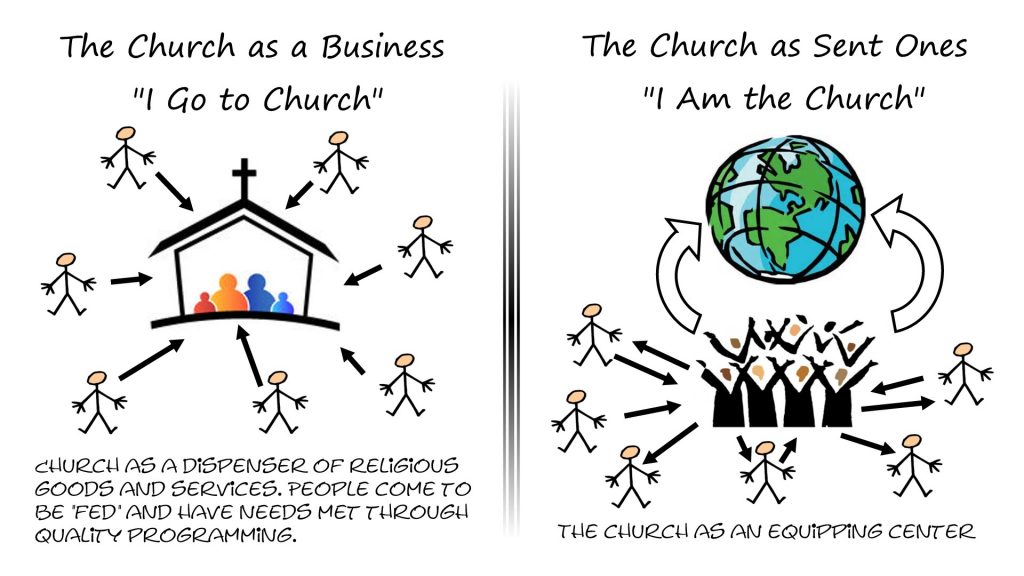
  • Being missional means that the church sees itself as being missionaries, rather than having a missions department, and that we see ourselves as missionaries right where we live.
  • Being missional means that we see ourselves as representatives of Jesus “sent” into our communities, and that the church aligns everything it does with the missio dei (mission of God).
  • Being missional means we see the church not as a place we go only on Sunday, but as something we are throughout the week.
  • Being missional means we understand we don’t “bring Jesus” to people but that we realize Jesus is active in our culture and we join him in what he is doing.
  • Being missional means we are very much in the world and engaged in culture but are not conforming to the world.
  • Being missional means we serve our communities, and that we build relationships with the people in them, rather than seeing them as evangelistic targets.
  • Being missional means being all the more dependent on Jesus and the Spirit through prayer, the Scriptures, and each other in community. 

Authentic followers of Christ would seem to be missional in their mindset as described here. It’s more than being involved in missions activities; it’s a way of life! Check out this image…

On a wider level. people just might consider the claims of Christ or at least view Christianity with some mention of respect if they could just see more people actually living out what they profess to believe. A lot of people may be into spirituality but they are certainly not into the church. How can we grow into authentic followers of Christ? How can we embrace what it means to be missional?

“An authentic life is the most personal form of worship. Everyday life has become my prayer.” –Sarah Ban Breathnach