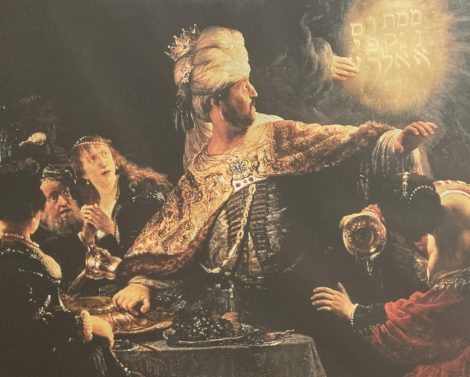
Mene Mene Tekel Upharsin

This picture is on display in Room 5 at our church. It comes from the Book of Daniel. As the drunken king Belshazzar was at a feast, God sent him a sign: a human hand appeared, floating near the lampstand and writing four words in the plaster of the wall: “Mene Mene Tekel Upharsin.” Then, the hand disappeared (Daniel 5:5, 25).

The king paled and was extremely frightened; he called his wise men and astrologers and enchanters to tell him what the writing meant, but none of the wise men of Babylon could interpret the words.

Daniel was eventually brought before the king and Daniel rebuked Belshazzar’s pride: although the king knew the story of how God humbled his grandfather, he did not humble himself. Instead, he dishonored God by drinking from the sacred items of the temple (Daniel 5:22–23).

Then, Daniel interpreted the words on the wall. Mene means “God has numbered the days of your kingdom and brought it to an end.” Tekel means “you have been weighed in the balances and found wanting.” Parsin means “your kingdom is divided and given to the Medes and Persians” (Daniel 5:24-28).

Will you pray this prayer over King’s Grant? Lord Jesus, may this not be prophetic and applied to King’s Grant. Pray that our days are not numbered. Pray that God is not finished with us yet. Pray that we can do honest self-reflection to see where we are found wanting and deficient. Pray that God’s kingdom here will not be divided. Father, convict us toward repentance and help us to walk in obedience; exhibiting behavior, attitudes, and speech that are worthy of the God we serve.


Identifying with the Weeping Prophet

Jeremiah the prophet lived in the final days of the collapse and deportation of the southern kingdom, the nation of Judah. He was, in all likelihood, the last prophet that God sent to preach to the southern kingdom. The two tribes of the southern kingdom were Judah and Benjamin. God had repeatedly warned Israel to stop their idolatrous behavior, but they would not listen, so He tore the 12 tribes apart, sending the 10 northern tribes into captivity at the hands of the Assyrians, in 722 BC. Then God sent Jeremiah to give Judah the last warning before He cast them out of the Promised Land, sending them into the Babylonian captivity, in 587 BC. Jeremiah was called to tell Judah that, because of their unrepentant sin, God had turned against them and was now prepared to remove them from the land He gave to Abraham.

No doubt Jeremiah stressed over the fate of his people, and he begged them to listen. He is known as “the weeping prophet,” because he cried tears of sadness, not only because he knew what was about to happen, but because, no matter how hard he tried, the people would not listen. Furthermore, he found no human comfort. God had forbidden him to marry or have children (Jeremiah 16:2). His friends even turned their backs on him. God knew this was best course for Jeremiah, because He went on to tell him about the horrible conditions that would arrive in a short time, with babies, children, and adults dying “grievous” deaths, their bodies unable to even be buried, and their flesh devoured by the birds (Jeremiah 16:3-4).

Obviously, the people of Israel had become so hardened by the numbing effects of sin that they no longer believed God, nor did they fear Him. Jeremiah preached for 40 years, and not once did he see any real success in changing or softening the hearts and minds of his stubborn, idolatrous people. The other prophets of Israel had witnessed some successes, at least for a little while, but not Jeremiah. He was speaking to a brick wall; however, his words were not wasted. They were pearls being cast before swine (Matthew 7:6), so in a sense, his words were convicting every person who heard them and they refused to heed the warning.

Jeremiah tried to make the people understand their problem was a lack of belief, trust, and faith in God,. They had an absence of fear that caused the people to take God for granted. They stopped putting God first and had replaced Him with false gods, those that would not make them feel guilty or convict them of sin. God had delivered His people from bondage in Egypt, had performed miracles before them, and had even parted the waters of the sea for them. In spite of all these displays of God’s power, they returned to the false practices they had learned in Egypt, even making vows to the false “queen of heaven,” along with performing the other rites and rituals that were part of the Egyptian culture and religion. God finally turned them over to their idolatry, saying, “Go ahead, then; do what you promised! Keep your vows!” (Jeremiah 44:25).

Jeremiah became discouraged. He sank into a deep depression. This can happen to us when we sense our efforts are not making a difference and time is fleeting. Jeremiah was emotionally spent, even to the point of doubting God (Jeremiah 15:18), but God was not done with him. Jeremiah 15:19 records a lesson for each believer to remember in those times when he feels alone, useless, and discouraged and whose faith is wavering: “Therefore this is what the LORD says: ‘If you repent, I will restore you that you may serve me; if you utter worthy, not worthless, words, you will be my spokesman. Let this people turn to you, but you must not turn to them.’” God was saying to Jeremiah, come back to Me, and I will restore to you the joy of your salvation. These are similar to the words penned by David when he repented of his sin with Bathsheba (2 Samuel 11:1-12:15, Psalm 51:12).

What we learn from the life of Jeremiah is the comfort of knowing that, just like every believer, even great prophets of God can experience rejection, depression, and discouragement in their walk with the Lord. This is a normal part of growing spiritually, because our sinful nature fights against our new nature, that which is born of the Spirit of God, according to Galatians 5:17: “For the sinful nature desires what is contrary to the Spirit, and the Spirit what is contrary to the sinful nature. They are in conflict with each other, so that you do not do what you want.” But, just as Jeremiah found, we can know that the faithfulness of our God is infinite; even when we are unfaithful to Him, He remains steadfast (2 Timothy 2:13).

Jeremiah was given the task of delivering an unpopular, convicting message to Judah, one that caused him great mental anguish, as well as making him despised in the eyes of his people. God says that His truth sounds like “foolishness” to those who are lost, but to believers it is the very words of life (1 Corinthians 1:18). He also says that the time will come when people will not tolerate the truth (2 Timothy 4:3-4). Those in Judah in Jeremiah’s day did not want to hear what he had to say, and his constant warning of judgment annoyed them. This is true of the world today, as believers who are following God’s instructions are warning the lost and dying world of impending judgment (Revelation 3:10). Even though most are not listening, we must persevere in proclaiming truth in order to rescue some from the terrible judgment that will inevitably come.

So, Here is a Little Personal Context:

I’ve been at my church for 15 years. In 2007, the mission statement of the church was, “Knowing Christ and Making Him Known,” which was a worthy goal of discipleship that leads followers of Jesus to engage a lost and dying world with the claims of Christ. As disciples, our mission is to reach those who are far from God, share the light and life that Jesus offers, and bring them into the local family of God. The church literally exists for those who are not yet members. Since we have this everlasting life, our destiny is secured, and we want to bring others into the family of faith. Our mission is to do all we can to populate heaven. While we share the gospel with those we know that do not know Christ, we gather as a church to worship and praise our Lord and Savior, and to be equipped for the task that is set before us (Ephesians 4:11-13), which is to help fulfill the Great Commission (Matthew 28:18-20) and live out the Great Commandment (Matthew 22:36-40). Anything short of that, we become just another social organization that has membership, dues, and social events (like the Tennis and Racquet Club or the YMCA).

In 2017, under the leadership of a new lead pastor, we focused our mission on three key values: community, faith, and love. Here is the statement that was developed, “We exist as a community of faith to extend the love of Christ and His Kingdom in Virginia Beach and to the world.” [ Read More Here ] The three step process included 1) Member (community: guiding people to become members of the family of God and this local church), 2) Minister (faith: stepping up to discover our giftedness and find a place of service to Jesus and people in the church and the community), 3) Living on Mission (Love: this value compels us to seek daily how to be the hands and feet of Jesus, focusing on those who are not yet members of God’s forever family).

Somewhere along the way, church has become more about “us” than it is about those who are not yet members. It’s about what I want, and what I want in a worship service, like hymns out of the hymnbook from 1975, a choir in the loft, wearing robes, with a communion table up front, the altar Bible on display, a deacon reading the Bible and praying each week, with preaching from behind a pulpit, but no longer than 18-20 minutes, and never forget about the flag of the United States of America on the stage and proper attire of coat and tie for leaders (staff, deacons, ushers). While we liked it this way in 1975, I dare say that today’s generation will not want to get involved here when our service and surroundings are so old school. It is as if a vocal few in this congregation are telling our local community, “you’re welcome here, but you need to enjoy old school services like us. Don’t come in here with your new ideas for reaching people and changing anything.” It’s like courting a potential spouse yet maintaining an adversarial relationship. Who wants to get involved with that?

Enter into these hallways of peace and fellowship… division, chaos and plotting for control, “to take back our church.” Somewhere along my 15 years, leadership has become an enemy to subdue or overthrow. [ By the way, three of our six ministerial staff members left us in 2022 (contemporary worship leader, lead pastor, and then pastor of worship), at some point, we all ask ourselves, “Why am I here and what difference does it make?” For me, I was called by God in 2007 to be here, and he has not yet released me from that calling. ]

The challenge we have before us is all about hearing God’s voice and recognizing God’s leadership in the life of our church. Our goal is to speak truth in the midst of misinformation and even disinformation and sabotage. I sense we can have a teaching lesson on each of these points, but I give only an initial observation, noting what happened in Jeremiah’s day and how there is a modern parallel in the American church.

Enter the Example of the Weeping Prophet, Jeremiah.

  • Jeremiah was called by God (Jeremiah 1:4-8) and never sensed a release from that calling. God had a plan from his very beginning, even though Jeremiah was a teenager at the time, and God let him know this was not going to be easy.
  • Jeremiah had a difficult message to tell the people (Jeremiah 2:11-13, 26, 32, 35, 37, 3:20, 25, 4:22, 5:2-3, 23, 26, 31, 6:8, 21, 9:13-16, 11:9-11, 11:22-23). It’s not easy to tell people that they have elevated their personal preferences into a place of idolatry. People don’t want to hear that message and will fight until the very end that their vision of church is all about God and not all about themselves. I have discovered when you try to remove their idols, they attack your character and motivation.
  • Jeremiah offers a word of hope (Jeremiah 3:12-15, 4:14, 7:23, 16:15, 24:5-7, 30:16-17, 31:8-9, 17, 23, 31:38-40, 33:1-3, 6-7). We envision a bright future for our church, one that is multi-generational, together in fellowship, serving together, growing into the image of Jesus together. To be a place of peace, acceptance, safety, and healing. Right now, there is fighting and factions that will drive good seekers away and young believers are now questioning what they have gotten into. Some actually believe that we’re trying to split the church, which was never on our to-do list.
  • Jeremiah dealt with those who did not tell the truth (Jeremiah 5:12-13, 9:8-9). We like to think the best of one another and cannot believe that one of our own would intentionally deceive others, but when someone has an agenda, kindness and civility often go out the window. As I have seen in politics, when the other side declares that you are something (racist, misogynistic, xenophobic), they are generally masking their own characteristics. Our local opposition claims the church staff’s next tactic is to engage in manipulation through deception and their narcissistic leader claims that he is the last obstacle to the staff’s hostile takeover of the church.
  • Jeremiah has people who refused to listen (Jeremiah 6:16-19, 7:24-27). God’s people refuse to listen to one another when they have their own agenda and demands. There have been plenty of conversations revealing little common ground. The USA has a policy of not negotiating with terrorists or considering their demands. What I have noticed over this past year, it doesn’t matter how much concession comes church leadership, it is still not enough, so why bother? If we can get the parties back to the table to have more conversation…
    1. On a side issue, let’s look at three examples in the life of Jesus. When Jesus told the truth to the rich young ruler and he looked over the options, the man chose to walk away. Jesus did not run after him to tell him he would lower the bar or make it easier for him. He didn’t give in to demands, Jesus told the truth and allowed the man to exercise his free will and walk away (Luke 18:18-27).
    2. How about the story of the invitation to the wedding feast? The feast was ready, invitations were sent, and the story is filled with people making excuses about why they could not come. So, since those invited people proved to be unworthy, the invitation went out to anybody who would come in (Matthew 22:1-10). Some grumblers even refuse to enter the sanctuary if a certain preacher has been invited for that week. Imagine for a moment our Savior looking at that behavior and saying, “I died on the cross for you and you can’t enter that sanctuary and worship me?”
    3. Then there is the older brother in the story of the prodigal son. He was disgruntled over the fact that he was at home the whole time (like a long-time church member) and there was such a fuss made over this sinner son who came back (reaching lost people for Jesus). While the father talked to that older son, we have no indication that the older son ever came in to the celebration (Luke 15:25-32).
  • Jeremiah had a word against the temple of the Lord (Jeremiah 7:2-5, 8, 11, 14-16, 30). The people in Jeremiah’s time were so far from God yet they still ran to the temple for God’s blessing. I suppose their hypocrisy was an insult to the living God. Perhaps they sought the gift more than the Giver. Perhaps they asked God to move over just a little bit so they can erect an idol that brought security, comfort, and familiarity.
  • Jeremiah spoke against their apostasy and lies and shame (Jeremiah (8:5, 8, 12, 13:22). I sense that God desires godly men and women speak up and defend the truth rather than allow the lies and misinformation to consume the hearts and minds of the congregation. Our focus has been on admonishing the unruly (1 Thessalonians 5:14) more than evangelism and discipleship.
  • Jeremiah spoke against their hypocrisy (Jeremiah 9:25, see Jeremiah 4:4). The prophet writes about the Jews who are behaving (or in reality), are not Jews. They say that they’re God’s people yet they have little to do with God and do not obey his commands.
  • Jeremiah wept for his people (Jeremiah 8:18, 9:1, 11:14, 14:11-12, 16:2-4, 31:16). I have not yet wept over my situation, but I have wept over the reputation of the church. When Christian people behave like non-christian people, the name of Jesus is diminished rather than magnified. People may give up on the church because of what they have experienced here. May all of us weep over souls who have been and continue to be damaged and abused by what we are experiencing in the congregation.
  • Jeremiah spoke again the idols of the people (Jeremiah 10:3-5, 8). Idols back in the day were these wooden and adorned statues set up to receive worship, which was a big no-no in God’s economy. The first two of the “big ten” commandments deal with having no other gods before YHWY and making an image of him. But today, idols come in all forms and enter into our hearts subtly. None are inherently bad, but we will take a good thing and elevate it to the status of idolatry. Try these on for size: it’s not really a worship service without… a pulpit, choir, robes, communion table, double passing of the communion trays, a deacon reading Scripture, leaders all wearing coats and ties, the large altar Bible up front, and the biggest push-back in worship so far has been the American flag standing in the corner. An idol is anything that comes between you and God. When someone says they will not enter the sanctuary unless the flags are in their regular place, that is a spiritual problem worthy of the prophet Jeremiah.
  • Jeremiah had people plotting against him and should be put to shame (Jeremiah 11:18-19, 21, 17:18, 18:18, 23). There is no place in the church for back-room, deals, meetings, and plots to overthrow it’s leadership. When God’s anointed are following God’s leadership and serving above reproach, with untarnished integrity, shame on those who stir up chaos and dissension over personal preferences that have risen to the level of unreasonable.
  • Jeremiah sets himself up as a righteous sufferer (Jeremiah 12:3) in contrast to the prosperous wicked (Jeremiah 12:1). The question is asked, “why we would stay in a situation that is so hostile?” While we at times question the ease and the prosperity of the wicked and the way of the righteous is often paved with adversity, I’m reminded that Jesus promised hardship in this life. The world will hate you (John 15:18), but we never expected this behavior from the church. Then, I have to come back to Jesus. His biggest critics, and those instrumental in his death, were “church leaders.” Why would I be exempt from hardship when my Lord went through so much for me?
  • Jeremiah has to tell the people that God is angry with their going backward (Jeremiah 15:6). God asked the question, “why have you forsaken Me? You keep looking backwards.” I sense this is at the heart of our situation, some vocal few in our congregation prefer worship to resemble 1975 and reject anything that might be considered modern. We like it the way we like it, and anyone coming here must understand that while they are welcome here, they need to act, dress, and worship the way we like it. New people coming in here have no right to change things; they must adapt to what we prefer here. After all, we are the ones paying the bills around here (that my friend is another topic all together).
  • Jeremiah endured reproach from rebellious people (Jeremiah 15:15). When God’s shepherds seek to lead God’s people, one might expect sheep to follow their shepherd. Rebellion against the God-ordained leader goes all the way back to Moses. It is shameful to be treated with such disrespect, but we endure reproach because of God’s call on our live (1 Peter 5:1-3, Hebrews 13:17).
  • Jeremiah took refuge in and rejoiced in God’s Word (Jeremiah 15:16). When things are at their worst, then God comes through with encouragement in his Word. God speaks truth through his Word and helps us through the adversity of life, even the adversity of ministry.
  • Jeremiah tells the people God is chastising the older generation who should know better (Jeremiah 16:11-12). This passage is condemning because of all the people present, the older ones should now better because they experienced God’s miracles, power, and presence through the stories of the Exodus. Then, they learned the lessons of the rebellious northern and southern kingdoms, seeing how the nations had forsaken the Lord and gone their own way. It should have been a warning to them about turning away from the Lord; they should have known better than end up here. We are similarly walking in the evil and stubbornness of our own hearts.
  • Jeremiah tells the people God has withdrawn his peace from them and he is not to console them (Jeremiah 16:5, 22:10). These verses are so sad, that these should not be consoled, we assume because they are getting what they deserve. Thank God for his grace, but this is a warning to heed.
  • Jeremiah says the heart (our emotion) is desperately wicked and cannot be trusted, so we must trust the Lord (Jeremiah 17:9-10). The worst advice anyone can give someone is to follow their heart. The heart tells you what you are doing is right when it very well might be fighting against God’s plan and design.
  • Jeremiah learns a lesson about God while at the potter’s house (Jeremiah 18:4-6). When the potter smashes the clay and starts over, the Creator of the universe can do the same with us. We are not too big to fail. God can remove his glory and watch us slowly die or start something new in another location.
  • Jeremiah is persecuted by the religious leaders (Jeremiah 20:1-2, 6, 26:7-8, 11) and imprisoned (Jeremiah 37:13-16) and held in a muddy cistern (Jeremiah 38:4-6). Pray that lawsuits will not be filed.
  • Jeremiah cries out and complains to God (Jeremiah 20:7-8) and wishes he was never born (Jeremiah 20:14-15). We all get depressed at times but there comes a point when we turn loose and trust God even more. Jesus tells us that he has overcome the world so we must take courage (John 16:33).
  • Jeremiah recognizes he cannot stop doing what God has called him to do (Jeremiah 20:9-10). If God has not yet released his servant from his calling and ministry, it is best to stay there and not run away. If God is moving someone to another ministry, he will make that clear at the right time. Moving TO something good is very different than moving AWAY from something bad.
  • Jeremiah warns that this house is going to fall (Jeremiah 22:5). If the vocal minority want worship to resemble 1975, this very well may be the preferred future they are embracing. Young families will visit and sense the church is too old school and not return. Existing young families will not feel accepted and will eventually find another church that wants them to be a part of their congregation. Then, with no young people coming into the church, older members will die off one-by-one over the next 10-15 years, until they come to the realization that they need to either adapt to bring in new members or slowly die and close the doors. How sad. This was not the vision of the founders or pastor Jerry. At the start, those planting this church did everything they could to reach people with the gospel. They made changes, sacrificed, adjusted their methods to reach more people, and they grew this church for the kingdom of God. Then somewhere along the way, we got it “just like we like it” and have rebelled and complained at changes that could bring in new families.
  • Jeremiah reminds them that God spoke to them in their prosperity but they had rejected him, so God will sweep away all of their shepherds (Jeremiah 22:21-22), and you will be ashamed and humiliated because of your wickedness. This church has had two recent pastors who challenged us to get out of our comfort zones and be all about the Great Commandment and the Great Commission. Both of those shepherds have moved on lead people and organizations who want to do great things for the kingdom of God.
  • Jeremiah says that God will gather a remnant and provide good shepherds over them (Jeremiah 23:3-4). I have always been fascinated with the concept of the remnant. When we hear about 20 percent of the people doing 80 percent of the work, service, attendance, giving, and teaching, I sense the reason is the remnant, the 20 percent. People sitting in the pews does not create a church; but disciples committed to the mission of the church, make the church. Too many people sit on the sidelines watching others and criticizing; they’re not in the game, they are arm-chair quarterbacks. Church is a team sport and we all need to be at practice and in the game.
  • Jeremiah says the people should not listen to the false prophets (Jeremiah 23:16, 30-31) because they are making stuff up, not speaking for God (and he’ll put on them an everlasting reproach that cannot be forgiven – Jeremiah 23:40). When darkness comes over the house of God, the only way to dispel the darkness is to shed light on it. Truth will win over deception, manipulation, and agendas.
  • Jeremiah says that being a false prophet is dangerous (Jeremiah 28:15-17). This is a sobering passage. Don’t go there.
  • Jeremiah teaches about the New Covenant (Jeremiah 31:31-34). This is the whole reason we do what we do. When people get it, they get it, and it makes all the difference in their lives and in the church. The hearts of the people are transformed. Motivation to follow, serve, and reach out is internal rather than external.
  • Jeremiah writes down what God tells him and the king burns it (Jeremiah 36:23), which is replaced (Jeremiah 36:27-28, 32). Basically, the lesson may be, “the truth hurts” (Jeremiah 36:29-31). Jeremiah is tenacious in getting the message of God to the people. If he can’t be there to speak it, he’ll send his friend to read it. He had an attitude of, “whatever it takes, I’m willing to do it, even if it leads to imprisonment or death.”
  • Jeremiah gets respect for speaking God’s Word and they will listen to it, whether good or bad (Jeremiah 42:4-6). At some point, the people will listen to the prophet’s message from God and receive it, even if they don’t like what God has to say to them.
  • Jeremiah says to Baruch that God has built up this house and can also tear it down (Jeremiah 45:2-5). To me, this is a sober reminder that God is sovereign and can literally do whatever he wants.

Initial Research on Jeremiah is from gotquestions.org, with added personal context

Biblical Vocabulary for Evangelism

What is Evangelism?

Evangelism is the first step toward fulfilling the Great Commission.

  1. Matthew 28:19-20 is the all-inclusive Great Commission – “make disciples” (Matthew 28:19).
  2. The main verb is to “make disciples” supported by three participles (go, baptize, teach).
  3. Mark, Luke, John, and Acts stress the evangelistic facet of the Great Commission.
  4. Mark 16:15 tells us what to do when we go – go into all the world and preach the gospel to all creation.
  5. Every believer is to go but all are not sent into a cross-cultural situation. We may go across the ocean or across the back fence to share our faith (try the grocery store, gas station, gym, ball field).

Evangelism involves telling the gospel to lost people who haven’t transferred their trust in Christ alone as their Lord and Savior.

  1. The word preaching (euangelizo) literally means “to bring or to announce good news, to gospelize.” (Acts 8:4, 12, 25, 35, 40, 10:36, 11:20, 13:32, 14:7, 15, 21, 15:35, 16:10, 17:18).
  2. Evangelism involves information and an invitation. It more than sharing historical facts about the death and resurrection of Christ. It involves inviting them to repent of their sin and transfer their trust in Christ alone as their Lord and Savior.
  3. J. I. Packer tells us that evangelism is not just preaching the gospel, it is not simply a matter of teaching, and instructing, and imparting information to the mind. Evangelism must include the endeavor to elicit a response to the truth taught. It is communication with a view to conversion. It is a matter, not merely of informing, but also of inviting.
  4. We cannot evangelize without God’s Word (Romans 10:13-15, Ephesians 1:13-14, 6:19-20).
  5. Saint Francis of Assisi said to “preach the gospel at all times and if necessary, use words.” While it may sound good, it may be similar to, “feed starving children, and if necessary, use food.”
  6. We can model the Christian life, be filled with Joy, have a sincere faith, serve like nobody’s business, but until the gospel is shared, no one will get saved.
  7. The verbs of evangelism require words to be spoken: preach, proclaim, herald (Matthew 24:14, Mark 13:10, 14:9, 16:15, Luke 8:1, 9:2, 24:27, Acts 8:5, 19:13, 28:31, Romans 10:14-15, 1 Corinthians 1:23, 15:11-12, 2 Corinthians 1:19, 4:5, 11:4, Galatians 2:2, Philippians 1:15, Colossians 1:23, 1 Thessalonians 2:9, 1 Timothy 3:16, 2 Timothy 4:2).

Evangelism is a process.

  1. Salvation happens when a repentant sinner transfers trust on Christ alone as Lord and Savior, but evangelism is a process that starts with planting the seed, watering it, and patiently waiting for the harvest.
  2. Faith comes by hearing God’s Word (Romans 10:17).
  3. One plants, one waters, and God causes growth (1 Corinthians 3:5-8).
  4. The fields are ripe for the harvest, some sow, others reap (John 4:35-38).
  5. If we reap during an evangelistic encounter, we can be sure that someone else did the sowing before we showed up. We might plant many and someone else will reap the harvest down the road.

What’s the difference between evangelism and outreach?

  1. Some people use the words anonymously, but most don’t. Some confuse gospelizing people with acts of compassion like food pantry, operation inasmuch, disaster relief, winter shelter, adopt-a-block, Thanksgiving baskets).
  2. Jesus said his mission and purpose was to seek and save the lost (Matthew 20:28, Mark 1:38, 10:45, Luke 4:43, 9:55, 19:10). Meeting physical needs is fine but our mission is to address spiritual needs.
  3. When we s to build common ground with lost friends, serving them in some practical way, we are doing pre-evangelism. They are evangelized until we share the gospel with them. Providing temporal relief is a good thing but our purpose is to provide eternal relief.
  4. Don’t confuse doing good works with evangelism; good works point to Jesus (Matthew 5:13, Ephesians 2:10, 1 Peter 2:11-12, Titus 3:1).
  5. Good works allow us to live out what we believe, to be a living gospel, but remember that the gospel has not been shared if we don’t speak it.
  6. Don’t confuse the gospel with causes that we embrace (humans, right, world, hunger, pro-life, social justice). These are not the gospel. The evidence of the gospel lies in the vertical relationship more than the horizontal relationship. The gospel deal with how mankind can be made right with God.
  7. The church must fulfill the Great Commission (Matthew 28:19-20, Mark 16:15) in a Great Commandment way (Matthew 22:36-40, Mark 12:30-31). Don’t confuse the eternal mission with temporal relief. We desire for mankind to escape the coming wrath of God (Romans 5:9). People come to Christ on his terms, not our own terms. The church must address our neediness and our fallenness.
  8. Building a house for the homeless or feeding at a soup kitchen is rewarding because it is concrete and tangible. You can measure the progress. Measuring progress in a spiritual realm is more difficult; it’s three steps forward and two steps back. The one who is saved will willingly go public, submit to believer’s baptism, repent of sin, desire to live differently — which is all easier to see in the physical realm.
  9. Christians don’t settle for temporal relief when we can offer eternal relief (Luke 9:59-60). Jesus told this guy to let spiritually dead people bury physically dead people, and you go proclaim the gospel. Spiritually dead people make good morticians. They can make a dead person look alive, but only Christians can share the Words of Life and the transforming power of the gospel. Why settle for a make-up artist when you can do heart surgery?

What’s the difference between evangelism and witnessing?

  1. The word witness is actually the same as martyr, one who bear witness, one who can testify what he has seen, heard, or know.
  2. The apostles were commanded to be witnesses (Luke 24:48, John 15:27, Acts 1:8).
  3. There were many eyewitnesses of the resurrection (these ten post-resurrection appearances).
    1. Mary Magdalen (Mark 16:9-11, John 20:11-18).
    2. The women (Matthew 28:9-10).
    3. The two on the Emmaus Road (Mark 16:12-13, Luke 24:13-32).
    4. Peter (Luke 24:33-35, 1 Corinthians 15:5a).
    5. The ten disciples (Mark 16:14, Luke 24, 36-43, John 20:19-25).
    6. The eleven disciples (John 20:26-31, 1 Corinthians 15:5).
    7. The seven disciples fishing (John 21:1-23).
    8. More than 500 gathered in Galilee (Matthew 28:16-20, Mark 16:15-18, 1 Corinthians 15:6).
    9. James, the brother of Jesus (1 Corinthians 15:7).
    10. The disciples in Jerusalem (Luke 24:44-49, Acts 1:6-8).
  4. Luke records the historical importance of eyewitness testimony in apostolic preaching (Acts 1:3, 2:32, 3:15, 4:33, 5:30, 32, 10:38-42, 13:28-30, 1 Corinthians 15:6, 14-17).
  5. Josh McDowell tells us that the followers of Jesus could not have faced torture and death unless they were convinced of the resurrection. The unity of their message and the course of the conduct was amazing. if they were deceivers, it’s hard to explain why one of them didn’t break under pressure.
  6. We can witness to what has happened in our lives but we cannot be eye-witnesses like the apostles.
  7. Here is the difference: when we witness, we share OUR story (our testimony). When we evangelize, we share HIS Story (the gospel).

Who did evangelism in the early church?

  1. At the beginning, the apostles were in Jerusalem, but they were scattered under the persecution of the day. When the church scattered, as they went, they evangelized (Acts 8:1, 4).
  2. We cannot keep the task of evangelism in the hands of trained professionals, it is the task for followers of Jesus. You cannot cop out just because you have never been to seminary. This attitude is the greatest tragedy of the church. The results are devastating to the mission of the church. Just reflect on the damage done by this shift in responsibility from believers to the elders/pastors.
  3. No one has to be called or gifted to do evangelism since we are commanded to do it as followers of Jesus (Mark 16:15).

Isn’t evangelism the job of the evangelists?

  1. We tend to stereotype evangelists (three-piece suit, sweating as he preaches about hell, fire, and brimstone during an evangelistic crusade. But the New Testament teaches that an evangelist equips church members to do evangelism (Ephesians 4:11-12). Shepherd don’t have sheep; sheep have sheep.
  2. The word equip means to outfit or prepare God’s people for the work of service. We gather as the church to be equipped. We scatter to evangelize.
  3. Paul tells us to do the work of an evangelist (2 Timothy 4:5).
  4. The word preaching (euangelizo) literally means “to bring or to announce good news, to gospelize.” (Acts 8:4, 12, 25, 35, 40, 10:36, 11:20, 13:32, 14:7, 15, 21, 15:35, 16:10, 17:18).

What is the message of evangelism? – the Gospel

  1. The gospel is NOT…
    1. A different or distorted gospel (Galatians 1:6-9, 2:16, 2 Corinthians 11:4)
    2. Vines says that Galatians 1:8-9 literally means, let him be accursed or condemned, like saying to hell with him. Paul uses the strongest language possible to denote the seriousness of distorting the gospel.
  2. False gospels that are distorted:
    1. Baptismal regeneration: that water baptism bring salvation. Infant baptism saves the child and they are reborn. Paul tells us that Christ did not send him to baptize but to preach the gospel (1 Corinthians 1:17). If water baptism had redemptive significance, Paul would never be happy that he did not baptize more Corinthians (1 Corinthians 1:14-16).
    2. Prosperity gospel: the good news is that if you accept Jesus you will be healthy and wealthy.
    3. Sacramental gospel: the Lord affirms that baptism is necessary for salvation (Catholic Catechism, VI, the necessity of baptism, 1257).
    4. Works gospel: any gospel that says you can earn, deserve, or merit heaven through your own good deeds is a heresy (2 Peter 2:1, Ephesians 2:8-9, 2 Timothy 1:9, Titus 3:5).
  3. The gospel IS…
    1. Biblical (1 Corinthians 15:1-8). Of first importance.
    2. Christological – about Christ and all the statements about HIM or HE.
    3. Scriptural – according to the Scriptures (1 Corinthians 15:3-4).
      1. Died (Isaiah 53:5, Acts 8:30-35, Matthew 16:21, 17:22, 20:18-19, 26:2, 27:31, 35, Mark 15:20, 24-25, 16:6, Luke 9:22, 23:33, 24:46, John 19:16, 18, 20, 23, Acts 2:23,-24, 29, 3:15, 4:10, 5:30, 13:28-29, Romans 5:6, 8, 10, 6:6-7, 10, 1 Corinthians 2:2, 8, 15:3, Galatians 2:21, Philippians 2:8, 1 Thessalonians 4:14, 5:10, Hebrews 2:9-10, 12, 1 Peter 3:18, Revelation 5:9).
      2. Raised (Psalm 16:10, Acts 2:27, 13:35, Matthew 16:21, 17:23, 20:19, 26:32, Luke 9:22, 24:46, John 2:19-22, 21:14, Acts 2:24-28, 3:15, 4:10, 5:30, 10:40, 13:30, 33-37, 17:18, Romans 4:24-25, 8:11, 34, 10:9, 1 Corinthians 14:4, 12-17, 2 Corinthians 4:14, 5:15, Galatians 1:1, Ephesians 1:20, 1 Thessalonians 1:10, 4:14, 1 Peter 1:21).
    4. Theological – he died for our sins, which are an affront to God’s holiness and cuts us off from him.
    5. Historical – he appeared to many people after he rose from the dead.
    6. Personal – the gospel was preached to YOU, YOU received, YOU stand, YOU are saved, YOU believed, delivered to YOU, Christ died for OUR SINS (1 Corinthians 15:1-2, John 1:12, Romans 5:17).
      1. Preached = to tell the good news to you (euangelisanmen humin)
      2. Received = receive + believe = become a child of God (ho kai parelabon). Hand-me-down faith is no good until you make it your own (Matthew 3:7-10). Beware of universalism that teaches the well-being of all people, and the universality of the redemption of Christ. Jesus taught that those who reject him will die in their sin (John 8:21), be the object of God wrath (John 3:36, Romans 5:9), and will be cast into eternal punishment (Matthew 25:41, 46, Luke 12:4-5, 2 Thessalonians 1:7=8, Revelation 21:8). Paul taught that while sin and death is imputed to every person, the free gift of salvation must be personally received (Romans 5:15-17).
      3. Stand = means to be established and continuing firm in faith, like a tree well rooted (en ho kai estekate).
      4. Save = (sozo) from the consequences of sins (Matthew 1:21) and his wrath (Romans 5:9). See also Acts 2:21, 40, 47, 11:14, 15:1, 11, 16:30-31, Romans 1:16, 5:9-10, 10:9-10, 13, 1 Corinthians 1:18, 15:2, Ephesians 1:13, 2:5, 8, 1 Thessalonians 2:16, 2 Thessalonians 2:10, 1 Timothy 1:15, 2 Timothy 1:9, 2:10, Titus 3:5).
      5. Hold fast = examine yourself to see whether you are of the faith; a possessor and not merely a professor.
      6. Believed = we must have to acknowledge the balance between assurance and presumption. True believers give evidence they are saved by continuing in the faith (John 15:1-11). True faith produces fruit. Fake faith has not commitment (John 6:66). Some have shallow faith (Matthew 7:13-14). Some have faith similar to the demons (James 2:19).
      7. In vain = there is an assumption that true faith will elicit a faith response (Mark 1:15, 16:16, John 1:12, 3:15-16, 18, 36, 5:24, 6:29, 35, 40, 7:38, 11:25-26, 12:36, 46, 20:30-31, Acts 8:37, 10:43, 13:39, 15:7, 9, 11, 16:30-31, 20:21, Romans 1:16, 3:22, 28, 4:4-5, 5:1, 9:33, 10:9-11, 14, 1 Corinthians 1:21, 15:2, Galatians 2:16, 3:2, 6-13, 22, 24, 26, Ephesians 1:13, 2:8, Philippians 1:27, 3:9, 1 Timothy 1:16, Hebrews 6:1, 1 Peter 2:6-7, 1 John 5:1, 5, 10, 13).
      8. Repentance = the flip side of faith, they go together (Mark 1:15, Luke 15:7, 10, 24:47, Acts 2:38, 3:19, 5:31, 11:18, 17:30, 20:21, 26:20, 1 Thessalonians 1:9, 2 Timothy 2:25, 2 Peter 3:9).
  4. On judgment day, everyone will be held accountable for what they did with the gospel. It will determine their eternal destiny. Romans 2:16 says, “on the day when, according to my gospel, God will judge the secrets of men through Christ Jesus.”

How to Teach the Bible

Dr. Lucien Coleman, Jr. has a book by this same title (How to Teach the Bible, 1979) and this page contains my personal notes and observations on Bible teaching.

Bible Basics for Teachers:

  1. Christian teaching is a divine calling. It is ministry and a practice that has been passed down for centuries. Teachers of the Bible are a part of a noble crowd. It is for everyday church members, not just for the well-trained professionals.
  2. God-called teachers need training. There is no substitute for competence (2 Timothy 2:15). The Bible teacher needs an arsenal of resources that will help one dig into the text, draw out the meaning, and relate it to life.
  3. Teaching skills are improved with practice. We learn by doing. We learn best by teaching. The teacher always gets more out of the lesson that the students can absorb.
  4. There is no substitute for basic training in the craft of teaching. We must walk before we can run. We must take piano lessons and practice before we can perform a recital. We cannot go to war without basic training, which is the key to competence, confidence, and effectiveness.
  5. The Bible is central to Christian teaching. Bible teaching is more than Christian ethics, morality, doctrine, theology, church history, missions, and holy living. All of these are rooted in the Bible itself. We will not understand these topics without understanding the Bible.
  6. Teaching is a combination of knowing, being, and doing. Bible teaching is more than just knowing your textbook or the subject matter. The teacher enthusiasm for the task, warmth in relationships, and sesitivity to personal needs are as important as the lesson itself.

What is Bible Teaching?

  1. Teaching is guiding. The teacher is not the one who has all the answers and knowledge of the subject, but more of a guide along the journey.
  2. Teaching is gardening. Rather than growing plants, the Bible teacher is growing people. The teacher will create an environment to stimulate growth. The teacher will till the soil and make it ready to receive the seed. God is the one who causes the growth (1 Corinthians 3:7), so, 1) God has created human being with a remarkable capacity for learning; the gardener must understand basic laws of nature. 2) God provides a rich resource for Christian learning in this biblical revelation, the Bible; it is our only source for faith and practice. 3) God functions as our guide, in the Holy Spirit, to motivate, illuminate, and provide insight.
  3. Teaching as biblical interpretation. If we continue in his Word, we will be his disciples, and we will know the truth, and the truth will make us free (John 8:31-32). Biblical knowledge is mandatory for the Christian. When did we make spiritual growth optional? So, interpretation is essential; understanding what the text says, what did it mean to the first readers, and what does it mean for us today?
  4. What Bible teaching is NOT. 1) Presenting lessons. 2) Imparting information. 3) Telling students what the teacher knows. 4) The performance of a teacher.
  5. Teaching and learning are inseparably related (like a carpenter’s work results in a structure of some kind, a chef work results in food on the table). No teacher can transmit learning (the teacher does all he can to encourage learning – the learner learns on his own). Teachers are co-laborers with God (We partner with God to enhance learning of our students).

What Do Teachers Do?

  1. Building a learning climate.Learning can be influenced by our surroundings and our mood.
  2. Planning and preparing learning activities. Just like we prepare a grocery list for our meals, the Bible teacher prepares ahead of time for anticipated learning. 1) Decide what is to be taught (the lesson may emphasize one thing but you know your students better than the curriculum’s author). Look for the take-away or main point you want your students to get. 2) Plan the learning activities (like starting on a journey, your first decide on the destination, and then everything is done to get you there).
  3. Leading class sessions. How? 1) Motivating learners (build interest by making the information relevant). 2) Guiding learning activities (carefully drafting questions, using visual aids, exploring hands-on activities, maximizing case-studies, finding newspaper articles, telling stories and modern parables). 3) Evaluating learning (always check the target to see if you hit it. What changes can be made? How can we make this better?).

The Teacher’s Knowledge of the Bible

  1. Rightly handling the Word of truth (2 Timothy 2:15). Be a student of the Bible. Read it. Know it. Get into it and let it get into you.
  2. The historical approach to biblical interpretation. Anchor the text in the context of the original writer and reader.
  3. Look at the forest, then the trees. We must understand the context of the book (written by whom, for whom, when, cultural context, historical context, main doctrinal themes).
  4. Use the Bible to interpret the Bible. We are not dependent on outside source, the Bible has great commentary on itself, and we have other tools to help us dig out relevant truth with cross-references and study Bible notes.
  5. Developing a reservoir of Bible knowledge. Don’t just study up on the latest lesson, but build your repertoire of knowledge.

The Teacher’s Knowledge of the Learners

  1. The teacher-learner transaction. I’ve heard it said that we don’t teach the Bible, we teach persons. The author says this is a half-truth; we teach Bible truths to persons.
  2. Meeting learners where they are. Remember your classroom participants (educated or not, young or old, long-time believers or not, Christian background or not, know their needs, hopes, desires, dreams, values).
  3. Where the Bible touches life. What is the take-away? Where does the lesson connect to life? What is the objective of the lesson? Ask at the end of each lesson, “So what?”

The Teacher’s Knowledge of Teaching – Principles

  1. People will try harder to learn when the learning gives them pleasure, satisfied needs, or promises to be useful.
  2. In learning groups, the level of participation is higher when teaching activities are directed to the whole person. People are more than just ears and mind and heart. Learning does not happen apart from the total person and their experiences.
  3. Goal-centered teaching is more efficient than teaching that has no particular purpose. A study on the Ten Commandments is not as effective as application of the principles presented.
  4. Learners are more likely to participate in learning activities when the teacher establishes an appropriate, “ready, set…” to get them ready for the lesson. Ask questions designed to grip the imagination. Pose a hypothetical situation. Introduce conflicting ideas. Tell a dramatic story. Play
  5. When a teacher uses questions, they should vary in form, scope, and level of difficulty. I like the opening, dig, and apply sections the “devil’s advocate.” I like using the method of open, dig, explore, and apply.

How to Study for a Lesson

  1. Blessed is the early starter. Why wait? Read the passage early in the week and let God work on you all week. Don’t just study the lesson, get into the Word and connect with it and with God. 1) Few of us can do our best work under pressure or at the last minute. 2) We can never estimate how long it will take to prepare a lesson and gather supplies for the experience. 3) Starting early lets you search for examples and resources that are unavailable to the tardy. 4) When we don’t have time to prepare, we tend to fall back to our familiar teaching patterns and methods. 5) Creative teaching requires time.
  2. Tools of the trade. 1) The Bible of course, since it is our only source for faith and practice. Utilize the chain-references and study notes. 2) Bible study helps. Bible dictionaries and commentaries and great tools. Online reference like Blue Letter Bible and Got Questions are wonderful. 3) Church supplied curriculum. Much of this is good and doctrinally sound, but it takes work to make the lesson prepared months ago by someone who does not know our people and our situation, to make it relevant to the events of today.
  3. Studying the lesson. 1) Read the passage devotionally. what does it say to you? How is God speaking to you? 2) Read the passage analytically. Go through the passage with a keen eye, looking for things that jump off the page. Mark up the text, underline words, put notes, cross-references, and observations in the margin, look up parallel passages, be familiar with the context information. 3) Use study tools. Concordance, commentaries, dictionaries, reputable websites, word studies, names and meanings, Bible atlas. Don’t rely totally on the curriculum materials. 4) Then pull it all together.

Teaching With Purpose

  1. Acquiring simple factual Bible knowledge. Beatitudes. Ten Commandments. Who was the father of King Solomon? Name a synoptic gospel.
  2. Acquiring systematic factual Bible knowledge. Know Bible history. Knowing Elijah was a prophet is one thing, but knowing where he fit into Israel’s history of the divided kingdom is quite another. We should understand the genre of literature found in the Bible.
  3. Understanding doctrinal themes. The Bible has a remarkable unity, even though written over 1500 years, by 40 writers from kings to tax-collectors, in three languages. Doctrine includes theology about God, mankind, salvation, the Spirit, the church, spiritual beings, even revelation itself.
  4. Mastering techniques of the Bible. The teacher will train students in Bible knowledge so they become competent in biblical understanding. Help your students to use the available tools.
  5. Learning principles of interpretation. We will interpret prophecy, parables, history, and poetry differently.
  6. Drawing rules of conduct from the Bible. We must understand cultural ways of biblical times. The danger is that we can embrace faulty behavior by looking at negative examples in the Bible as normative. Since Paul does not condemn slavery, are we to assume that slavery is then biblical? In Christ we know that owning another person is not right although it is biblical. Polygamy is not right even though it is biblical. Sacrificing your children to Molech is not right even though it is biblical.
  7. Developing biblical attitudes. I call this developing a biblical worldview. It is primarily recognizing there is a creator God, who is one God in three persons, the Bible is our only source for faith and practice, there are only two genders, marriage from the start was one man and one woman for a lifetime, Jesus paid the penalty for the debt we could not pay. We take seriously the sermon on the mount, the great commandment, and the great commission. We take seriously Romans 12. We take seriously Philippians 2.

Essential Ingredients

  1. Stimulating interest in the lesson.
  2. Leading the Bible study.
  3. Highlighting eternal truths.
  4. Applying the lesson to life.
  5. Previewing the next lesson.

Teaching Methods

  1. Expository and inquiry. Expository seeks to pull out the meaning from the text, putting out information and setting forth ideas. Inquiry is different since learners will conduct and inquiry of the text, to seek into the passage to see what they might discover. The first method is where the teachers has the information to be shared and the latter has the seekers discovering the information together.
  2. Cognitive and affective learning. Cognitive learning takes place through teaching methods which stimulate thinking, remembering, evaluating, and reasoning. Affective learning has to do with attitudes we learn from other people. We catch attitudes from other people.

Generating Enthusiasm for Bible Study

  1. Build a spirit of fellowship. Christian fellowship and Bible study go hand in hand (Acts 2:42, 2 Corinthians 8:4, Philippians 1:5, 3:10, 1 John 1:3). So, class size will either help or hinder this dimension.
  2. Personify enthusiasm. A group tends to take on the characteristics of the leader. There is something contagious about someone who is excited about the study and the topic!
  3. Get class members involved. 1) Can we involve member in class administration, like create ministry assignments, for outreach, refreshments, phone list, fellowship, service projects? 2) Can we involve members in the learning activities, like divide into micro-groups to discuss a topic? 3) Can we involve members in class projects? This is certainly outside of the Bible study hour, and promotes fellowship, outreach, and service. 4) Magnify persons. Recognize accomplishments and events in the lives of members.
  4. Old fashioned public relations. Communicate by every means (telephone, text, posters, e-mail, cards, social media, announcements, newsletter).
  5. Let’s not grow weary (Galatians 6:9). We all get tied but press on toward the goal, the prize of the upward call of God (Philippians 3:13-15).

Summary

  1. It is a sin to bore your class. Be enthusiastic about what this study means to you and to them.
  2. The spread of Christianity and the teaching of Scripture have been connected to the outward expansion of the gospel and the inner vitality of the church.
  3. As teachers, you have been called to an extremely important mission. It’s more than teaching a class; you are fulfilling the great commandment and the great commission, helping people to love God, love his Word, and love others.
  4. This calling requires a high degree of commitment, which is the price tag on Bible teaching.
  5. This calling is significant, since it transforms lives.
  6. This calling requires us to be faith, not necessarily successful.

9 Things a Leader Must Do

These are my notes from reading Henry Cloud’s book called, “9 Things a Leader Must Do.” Get the book – it is brief, concise, full of illustrations and practical tips on becoming a more effective leader.

Why do some leaders get and accomplish what they want as a matter of routine, while others seem to regularly experience frustration and setbacks? Why do some leaders achieve their goals and reach new heights, while others barely “hang in there” and survive? Based on his groundbreaking psychological study of the ways that successful individuals think and behave, Dr. Henry Cloud presents a simple yet profound road map to help leaders, and those who want to become leaders, arrive at greater levels of personal growth and corporate influence than they previously thought were possible. The good news for all of us is that leadership success is not limited to vague notions of “charisma” nor traditional advantages like graduate degrees and connections, but much more to a pattern of thinking and moving forward that learns from mistakes and stays focused on goals. – Amazon Description

  1. Excavate Your Soul – Thing One: Déjà vu leaders explore their deep hearts and invest in their inner desires and drives.
    1. Leadership success is the process of digging up the treasures of the invisible soul in order to bring dreams, desires, and talents into the visible world.
    2. Those who take what they possess, invest it in life, and are diligent and faithful with it over time, grow and build something good. But those who allow fear to keep them from stepping out, not only fail to increase what they have, they actually lose it.
    3. Success and failure alike arise from what is going on inside, and the wise person is the one who pays attention.
    4. Healthy risk is calculated, integrated, and then executed with diligence and thoughtfulness.
  2. Yank the Diseased Tooth – Thing Two: Déjà vu leaders do not allow negative things to take up space in their lives.
    1. If they can’t fix the bad stuff, they get rid of it. Sometimes quickly and sometimes through a process, but if a tooth is infected, they yank it out. They get rid of negative energy.
    2. We need to clear out clutter, dead weight, things we keep around that don’t help us but take up space or drain resources.
    3. Get rid of the things you are not using.
    4. Avoidance is really not helping anything, because you still expend the energy and feel the hurt. If you had simply yanked the bad tooth when it started bothering you, you would be over the pain by now. Avoidance always prolongs pain.
    5. New things that actually have hope for the future cannot appear until you get rid of what was taking up the space that the new thing needs.
    6. The cringe factor: “My rule is this: Anytime I have to cringe or take a big gulp to agree to do anything substantial with anyone, whether to hire him, work with him, or anything significant, I don’t do it. Period.”
  3. Play the Whole Movie – Thing Three: Déjà vu leaders evaluate their decisions in the present based on how they will affect the future.
    1. I’ll be hanged if I’m going to let my daughter marry any man who doesn’t own a watch!”
      Déjà vu leaders evaluate almost everything they do in this way. They see every behavior and decision as links in a larger chain, steps in a direction that has a destination.
    2. So here’s the question: On that day three years from now, do you want to have a law degree, enabling you to do something you love? Or do you want to still hate your life?”
    3. “We’re having a week of what we call war games,” he replied. “We play out future bad scenarios and make sure we’re in a position to handle them.
  4. Put Superman out of a Job – Thing Four: Déjà vu leaders continually ask themselves, “What can I do to make this situation better?”
    1. Why doesn’t somebody else step up and do something to save the day? It’s like everybody else is powerless even to try to intervene. The people seem resigned to the fact that if Superman doesn’t show up, they’re all doomed. So nobody even tries.
    2. Even if someone else is at fault, they take initiative to address the problem and seek a solution. Whatever the answer may be, déjà vu leaders make a move.
  5. Embrace Your Inner Insect – Thing Five: Déjà vu leaders achieve big goals by taking small steps over time.
    1. The lessons from the ant farm – This entire feat was really no more complex than one step at a time, one grain of sand at a time. If an ant could do it, so could I.
    2. The biggest enemy of the small-steps-big-results principle is our craving for having it all. If the ant picks up a grain of sand, the city will be built. But if the ant looks at the grain and says, “That is not a city! What a waste of time!” there will be no city in the end.
    3. Wanting it all keeps you from having any.
  6. Earn a Black Belt in Hate – Thing Six: Déjà vu leaders develop the ability to hate the right things well.
    1. “I don’t mind problems, because business is about solving problems,” he began. “But, I hate surprises. This new information was not disclosed to me in the purchase process. If I had known earlier, it would not have mattered. It is just a problem to be solved.”
    2. What we hate says a lot about who we are, what we value, what we care about. And how we hate says much about how we will succeed in business and life.
    3. When we hate the evil around us, we move to get rid of it as an act of love.
    4. Déjà vu leaders hate in ways that solve problems as opposed to creating problems.
    5. Transform it to the kind of hate that solves problems, protects things that you value, and stands against the things that you do not want in your life and work.
  7. Forget about Playing Fair – Thing Seven: Déjà vu leaders give back better than they are given.
    1. That means that if I make a mistake, I want you to help me, not get back at me.
    2. The fault with fairness is that all it takes for any relationship to go sour is for one person not to perform, and then the other one will do the same. There is an interlocking dependency: The other person must be good so I can be good.
    3. The other’s benefit is their utmost concern. That does not mean they have no interest in their own benefits. It simply means that in their treatment of others, their goal is to do well by them regardless of how they are treated. They don’t play fair; they play right.
  8. Quit Self-Exaggerating – Thing Eight: Déjà vu leaders do not strive to be or to appear more than they really are.
    1. A déjà vu leader is a human being like everyone else, avoiding the need to be more than that.
    2. People who learn from failure are motivated to do better. Self-confidence does not come from seeing oneself as strong, without flaws, or above making mistakes. Self-confidence and belief in yourself come from accepting flaws and mistakes and realizing that you can go forward and grow past them, that you can learn from them.
    3. Closely related to admitting our own mistakes is responding constructively when the news of our imperfections comes from others. The way of the déjà vu leader is to receive correction as a gift, not to be defensive.
    4. Successful leaders fail just like everyone else. But it’s the way they handle their failure and imperfections that sets them apart.
    5. Humility means giving up thinking that we know it all, giving up thinking we can do it all, giving up thinking we have to do it well all the time, giving up thinking that we are better than others when they do not do it well, giving up needing to be seen as right or good all the time, and giving up defensiveness. In all these cases, the way of the déjà vu leader is basically to be real.
  9. Ignore the Popularity Polls – Thing Nine: Déjà vu leaders do not make decisions based on the fear of other people’s reactions.
    1. Successful leaders are sensitive to the reactions of others, but when weighing whether or not a given course is right, whether or not someone else is going to like it is not a factor that carries any weight. Concern, yes; but weight, no. Déjà vu leaders decide to do what is right first and deal with the fallout second.
    2. One of the important distinctions that déjà vu leaders make in these situations is between hurting someone and harming him. Hurt is a normal part of life, harming is optional.
    3. Learn the old saying, I am not doing this to you. I am doing it for me. That is not inflicting harm at all, even if the person on the receiving end acts as if it is.
    4. The responses you get may be along the lines of, “After all I’ve done for you and the company, this is the thanks I get?” or “I’ve done nothing wrong; why am I getting the shaft on this deal?” Stay fixed on your heading to do the right thing and do not allow the guilt messages to blow you off course.
    5. If you let the anger of other people decide your course of action for you, then you have just trained them in how to get what they want out of you. You have set yourself up for the same experience again.
    6. I’m often asked by leaders, “How do you deal with controlling people?” My answer is that you convert them from being controlling to being frustrated. The only way people can be controlling is when we make them that way by doing what they want.
    7. Don’t try to avoid upsetting people; just make sure you are upsetting the right ones. If kind, loving, responsible, and honest people are upset with you, then you had better look at the choices you are making. But if controlling, hot and cold, irresponsible, or manipulative people are upset with you, then take courage—it might be a sign that you are doing the right thing and becoming a déjà vu leader!
    8. On that day I discovered four things that changed my life. They were the same four things that I have heard other people affirm countless times:
      1. God is there to help us if we ask Him.
      2. He not only helps us directly, He gives us others to help us.
      3. He designed life to work according to certain truths and principles.
      4. As we practice those truths and principles, good things are given.

The Bronze Serpent

The message form this past Sunday, while long and detailed, was a great passage to study. I would have gone in a different direction, but hey, he was our guest preacher. The passage came from Numbers 21:4-9.

The people grumbled again, after 38 years of wandering, which only proved that they were still not ready to enter the promised land. God provided for them but they did not appreciate it (they actually loathed God’s provision of manna, Numbers 21:5).

There is something else about this manna: Wiersbe writes, “According to John 6, the manna was much more than daily food for Israel: it was a type of Jesus Christ, the Son of God, the “Bread of Life” (John 6:32–40). The manna came only to Israel, but Jesus came to be the Savior of the world. All the manna could do was sustain life, but Jesus Christ gives life. When the Jews despised the manna, they were actually rejecting the Son of God. Once more, God had tested His people, and they had failed the test (Deuteronomy 8:15–16).”

Enter the fiery serpents, which bit people and they died (Numbers 21:6). So, what’s up with such a strange story?

God was teaching the people something about faith. It is fairly illogical to think that looking at a bronze image could heal anyone from a snakebite, but that is exactly what God told them to do. It took an act of faith in God’s plan for anyone to be healed, and the serpent on the pole was a reminder of their sin, which brought about their suffering.

Faith was also put into action because in such a large crowd, the whole camp of Israel, it likely took a huge amount of effort to position oneself to even SEE the serpent on the pole. I don’t imagine that it took a casual glance, but rather it took a lot of effort to be in the right position to see it.

While the people did get healed when they looked at the serpent, the serpent on the pole eventually became a problem. Who needs God when you can get healing with this magical serpent? The people kept it for many years and when the Israelites were in the Promised Land, the serpent became an object of worship that needed to be destroyed (2 Kings 18:4). The lesson here reminds us how easy it is for people to take the good things of God and twist them into something bad. Don’t be that guy who worships the creation rather than the creator.

This passage directly points toward John 3:14-15, where Jesus tells us that this bronze serpent was a foreshadowing of himself. It is actually an illustration of the vicarious death of Christ on the cross and the necessity of personal faith in him for salvation.

The serpent was a symbol of sin and judgment, and when it was lifted up and put on a pole (or tree), it became a symbol of a curse (Galatians 3:13). Paul is teaching the Galatian Christians that Jesus became a curse for us, even though he was a man without sin (the spotless Lamb of God). Paul clearly taught the Corinthians, “God made him who had no sin to be sin for us, so that in him we might become the righteousness of God” (2 Corinthians 5:21).

The observation that I have on this passage in Numbers 21:4-9 is that God did not remove the snakes, but provided a remedy; way of healing and life in the midst of the snakes. I imagine that the venom remained in their bodies but did not lead to death. Romans 6:23 tells us that “the wages of sin is death, but the free gift of God is eternal life in Christ Jesus our Lord.” We remain sinners but have received new life in Christ.

[print_link] [email_link]

No More Facilitators

I just read this from Josh Hunt and had to pass it along!

I wish I had a nickle for every time I have heard this: “We don’t really need teachers; we need facilitators.”

I disagree.

  • Jesus said to, “Teach all nations” (Matthew 28.19). He didn’t say to facilitate discussions of all nations.
  • In the introduction to the Sermon on the Mount (Matthew 5:1-2) we read that Jesus began to teach them. We don’t ever read that He facilitated a discussion.
  • In Acts 2.42 we do not read that the early church devoted themselves to the apostles’ facilitation of discussion. We read they devoted themselves to the apostles teaching.
  • In 2 Timothy 2.2 Paul admonished Timothy to entrust the truth he had heard to reliable men so that they would be able to teach others. Teach—not facilitate discussions.

Perhaps it is time we defined our terms. Wikipedia defines a facilitator this way: A facilitator is someone who helps a group of people understand their common objectives and assists them to plan to achieve them without taking a particular position in the discussion.

I draw your attention to that last phrase: “without taking a particular position in the discussion.” I can’t imagine Jesus ever doing that.

Paul said, “Since, then, we know what it is to fear the Lord, we try to persuade others” (2 Corinthians 5:11). Persuade. It sounds like he took a particular position as well.

This is not to say that we should not use a question-and-answer approach. Jesus did. We have 100 recorded examples of Jesus using questions to teach. But, when he asked questions, He had an agenda. He was teaching through using questions, not facilitating a discussion about who knows what.

When I write Good Questions Have Groups Talking, I don’t do it so that teachers can facilitate discussions. I do it so that teachers can teach using questions. There is a world of difference. We don’t need facilitators of discussion; we need teachers who teach.

[print_link] [email_link]

To Be Like Jesus

Have you ever considered what it means to be like Jesus? Is that our goal in life?

Jesus’ statement in Matthew 10:25 implies that His disciples will be like Him. To His first-century followers, that included the prospect of persecution and martyrdom. But what else does it mean to “be like Jesus,” especially for Christians in today’s culture? I see eight portraits of Jesus in Matthew’s eyewitness account that give us some clues:

  1. To be like Jesus means to accept our roots (Matthew 1:1–17).
  2. To be like Jesus means to engage the world’s pain and struggle (Matthew 1:18–2:23).
  3. To be like Jesus means to commit ourselves to other believers, no matter how “weird” they appear to be (Matthew 3:1–17).
  4. To be like Jesus means to admit our vulnerability to temptation (Matthew 4:1–11).
  5. To be like Jesus means to openly proclaim the message of Christ (Matthew 4:12–25).
  6. To be like Jesus means to commit ourselves to changed thinking and behavior (Matthew 5:1–7:27).
  7. To be like Jesus means to serve others, especially those who are oppressed or without Christ (Matthew 8:1–9:38).
  8. To be like Jesus means to affirm others in leadership (Matthew 10:1–42).

[print_link] [email_link] [Warren Wiersbe’s Word in Life Study Bible]