Present Your Body

We live in a physical world and need biblical counsel and guidance on how to live this Christ life in a fallen world, so we must be able to …

  1. Know the function of the body in the human personality.
  2. Understand three facts about the nature of your body.
  3. Discern between the body and the flesh/
  4. Understand the incarnation, crucifixion, and resurrection to use your body.
  5. Know how to use your body for God’s glory.

ADAM’S BODY:

  1. Made form the dust of the ground (Genesis 2:7)
  2. Three essential functions of his body:
    • Identification as a unique personality.
    • Participation in the created order.
    • Communication with the creation and other beings.

Humans decided to disobey the ONE RULE God had, leave the fruit of that one tree alone (Genesis 2:15-17). The man’s good body was invaded by a sinful nature (Genesis 3:6).

  1. The physical body
  2. The sinful nature
  3. These verses describe which? Matthew 19:6, 2 Corinthians 4:11, Galatians 6:8, Ephesians 2:3

YOUR BODY:

Your body allows you to influence the created order (Genesis 1:27-28) What are three things God intended for man to do in this created world.

  1. Replenish the earth, be fruitful and multiply.
  2. Subdue the earth.
  3. Rule over the earth.

The body is not evil, however, the flesh is evil. The body has the capacity to do good if the flesh is not in control. These verses tells us about the possibility of the body being used for good.

  1. Ephesians 1:31
  2. Genesis 1:31
  3. John 1:14
  4. Romans 8:23

BODY FACTS:

  1. The creation of the body: good.
  2. The condition of the body after the flesh took over: fallen
  3. The capacity of the body to be used by God: submission (Luke 9:23)
  4. The conflict of the body is real and powerful: obedience (Romans 7:18-24)
  5. The conduit of the body for evil is through the senses = food, money, sex, sports, beauty, entertainment, education, recreation, possessions.
  6. The control of the flesh can be broken or overpowered:
    • Romans 8:3
    • Romans 6:6-7
    • Romans 8:11-13

WHO IS YOUR MASTER: 1 Corinthians 6:19-20

  1. The incarnation was Jesus having a physical body (John 11, 14).
  2. The incarnation led to the crucifixion (Galatians 2:20).
  3. The crucifixion was us to be saved for good works (Ephesians 2:10).
    • Romans 6:6
    • Colossians 3:3-5
    • Galatians 5:24-25

MY PURPOSE ON THE EARTH:

  1. Identification as a distinct personality.
  2. Participation in the world.
  3. Communication with others.
  4. Does this make you mad, sad, or glad?
  5. Will you present your body as a living sacrifice for God’s glory? (Romans 12:1-2)
Renew Your Mind

Jesus has been called the greatest teacher who has ever lived (John 3:2), but have you ever asked him to be your personal teacher who guides your thoughts in all of life? It takes a renewed mind.

OVERVIEW:

  1. The difference between the natural mind and the renewed mind.
  2. What it means to have the mind of Christ.
  3. Discover the process of renewal for the mind.
  4. Discover three ways to be more spiritually minded.

The Natural Mind: refers to the thinking process that is limited to human reason and resources (1 Corinthians 2:14). What does Paul write about people who live according to their natural minds? (Ephesians 4:17-18)

The natural mind inevitably becomes enslaved to other masters (Romans 1:18-32).

  1. 2 Corinthians 3:14, 4:4
  2. Romans 1:28
  3. 1 Timothy 6:5
  4. Colossians 2:18

A renewed mind is able to know with certainty how trustworthy and how correct the will of God is (Romans 12:2).

  1. The natural and renewed mind has basic similarities: thinking, judging, reasoning, evaluating, but the difference is control.
  2. The renewed mind is obedient to Christ, thinking from the viewpoint of Jesus, freeing the personality by enlarging it to encompass the world of the spirit as well as the senses.

The Carnal Mind: is ruled by fleshly thoughts and desires (Romans 8:1-14).

  1. Jesus wants to be to your mind what a compass is to a ship (2 Corinthians 10:5).
    • Demolish worldly imaginations or arguments that obstruct the knowledge of God.
    • Take every thought captive and make them obedient to Christ’s control.
  2. Paul’s reasoning about thoughts is to ask Jesus to take control of them.

The Mind of Christ: is the disciple’s goal (Philippians 2:5). This is all about filling your mind with the thought of Christ.

  1. To remove all obstacles to your knowledge of God.
  2. To make every thought captive obedient to Christ.
  3. To possess the mind of Christ.
  4. To renew your mind.

How to Renew Your Mind:

  1. Romans 8:5-6
  2. John 16:13
  3. Colossians 3:2
  4. Philippians 4:8
  5. Psalm 1:2-3
  6. John 8:31-32
    • What term does Jesus use for someone who continues in his word?
    • What does living in God’s truth do for the enslaved mind?

Evaluate the Degree to Which Your Mind is Being Renewed:

  1. Are you really a disciple of Jesus? If so, how? (John 8:31, 1 Corinthians 2:12)
  2. If you are a disciple, what source of power is renewing your mind daily?
  3. Are you willing to make a commitment to get God’s Word into your daily life? How? What is your goal?
  4. What actions are you going to take to renew your mind?

Do the Will of God

OUR CALLING:

  1. To distinguish between God’s will and our own will.
  2. To discover God’s purpose for my life.
  3. To understand the process and provision by which we accomplish his will.
  4. To apply the teachings about God’s will to my life.

HUMAN WILL: Deuteronomy 30:19-20, Romans 7:18, 1 Timothy 2:3-4

GOD’S WILL: Every person is included in the scope of God’s will (2 Peter 3:9)

  1. Matthew 12:50
  2. John 4:34
  3. Romans 12:2
  4. Colossians 1:9

THE DIFFERENCE: is in capacity and in purpose.

  1. Our purposes are varied and can be corrupted.
  2. God’s capacity to carry out his will is unlimited and his purpose is consistent and holy.

GOD’S PRIMARY PURPOSE: (Ephesians 1:5-6, 12, 14)

  1. To bring glory to God.
  2. To win the lost.
  3. To be a good example.

BRINGING GLORY TO GOD: John 5:30, John 6:38, John 17:4, Luke 22:42

COMMITTING YOUR WHOLE PERSONALITY TO GOD:

  1. Hindrances to doing God’s will (1 John 2:15-17)
  2. Temptation is a real struggle (Hebrews 4:15, Matthew 26:38-44)
  3. Every part of your personality must be committed to God
    • Will (Philippians 2:13)
    • Mind (Romans 12:2)
    • Body (Romans 12:1, Matthew 26:41)
    • Emotions (Galatians 5:18-25)
    • Life (Galatians 2:20)

GOD’S PROMISES: Philippians 4:19, Romans 8:28

GOD’S PROCESSES: Philippians 1:6, 2:13, 1 Thessalonians 5:24

GOD’S EXAMPLES:

  1. Moses (Hebrews 11:24-27)
  2. Jesus (John 6:38, Hebrews 10:5-7, 12:2)
  3. Paul (Philippians 3:7-14, 4:13)
  4. Me (Hebrews 13:21)

Take Up Your Cross

The Essence of Luke 9:23

  1. Self-denial
  2. Cross-bearing
  3. Following Jesus

The First Commitment:

  1. While family relationships are important, they cannot be in the primary spot (Luke 14:26-27). Family commitment are subject to his lordship.
  2. Those insistent on self-love and self-interest will lose the very essence of life.
  3. We are put to death with Christ, and we allow him to live through us every day (Galatians 2:20).

The Second Commitment:

  1. Jesus explained the purpose of his death (John 12:24). Death to the old way of life brings forth new life.
  2. We must move from self-commitment to being committed to Christ.
  3. What happens to a person who refuses to be a cross-bearer? (Luke 14:26)
  4. This involves sacrificial, loving service to others.
  5. Paul explained why Jesus was willing to take up his cross (Philippians 2:8)
    • A voluntary commitment.
    • An act of obedience.

The Third Commitment:

  1. The Father revealed his will to Jesus (John 5:19-43)
  2. As Jesus followed the Father, we are to follow Jesus.
    • Matthew 11:28
    • Mark 1:17
    • Luke 9:1-2
    • John 12:26
  3. The results of following Jesus.
    • Knowledge of the truth.
    • Understanding of God’s will.
    • Rest for the soul.
    • Power to do his work.
    • The authority to represent Jesus.
    • Equipping others to be disciples.
  4. The word translated “life” is Greek, psuche (Luke 9:24, John 12:25) and “soul” in Matthew 11:29. What happens to the soul of a disciple of Jesus?
    • The soul will be purified.
    • The soul will be separated from the body.
    • The soul will be saved.
  5. The meaning of the word “salvation” in the New Testament.
    • To become whole, or to make whole.
    • When the soul of a disciple is lost or given up (Luke 9:23), the disciple is saved or made whole.
    • Placing Jesus in first place in life produces harmony or wholeness in life. We are made complete.
  6. Maturity is the degree to which we experience harmony or wholeness in relationship to God and to others.

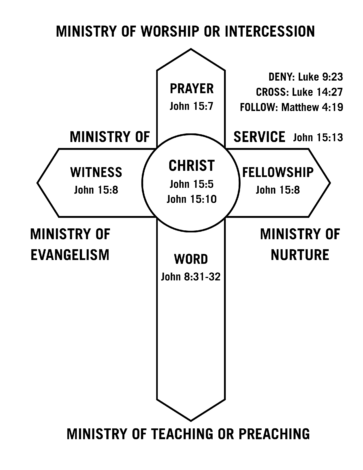
The Disciples Cross

  1. One Lord: Christ at the Center
    • Your LIFE is the Circle
    • Christ is at the Center Living in and Through You
  2. Two Relationships: with God and Others (Matthew 22:36-40)
  3. Three Commitments: Luke 9:23
    • Deny Self
    • Take up Your Cross
    • Follow
  4. Four Disciplines:
    • The Word of God
    • Praying in Faith
    • Fellowshipping with Believers
    • Witness to the World
  5. Five Ministries:
    • Teaching or Preaching
    • Worship or Intercession
    • Nurture
    • Evangelism
    • Service

Your Quiet Time

We are to engage is practices of Bible reading, meditation, and prayer. There is no substitution for communing with God and practicing private worship. We should the reasons for having a devotional time, know the requirements for an effective devotional time, and express a commitment to have a daily quiet time with God.

  1. People communicate with those whom they love, so we should have a desire to spend time with our heavenly Father.
    • Why do you love God? (1 John 4:19)
    • How do you know that God loves you? (1 John 4:9-10)
  2. The first reason for having a quiet time is to get to know God: Fellowship with others is based on fellowship with who? (1 John 1:3)
  3. The second reason for having a quiet time is to receive direction and guidance in daily decisions.
    • What did the psalmist ask God to do for him? (Psalm 143:8)
    • What happens when we pray in accordance to God’s will? (1 John 5:14)
  4. The third reason for having a quiet time is to bring needs before God; he wants to supply our needs.
    • Philippians 4:6-7
    • Psalm 34:17
    • Hebrews 4:16
    • Isaiah 40:31
  5. The fourth reason for having a quiet time is to enable ourselves to bear fruit (John 15:4-5).
  6. Jesus enjoyed a unique relationship with the Father.
    • Mark 1:35
    • Luke 6:12
    • Matthew 14:23
    • Mark 6:46
  7. If it was important for Jesus, we also should schedule our times with God.
    • Psalm 5:3
    • Psalm 57:7-8
    • Genesis 19:27
  8. How about you? (time, place, and procedure)
    • What time of day is best for you?
    • What place is best to communicate with God?
    • What must you give up to add these times of devotion into your day?
    • What distractions prevent you for encountering God in your quiet time?
    • What pattern have you developed for having a meaning quiet time?
    • How do you stay focused during your quiet time?
  9. What should I include in my quiet time with God?
    • Psalm 66:18
    • Mark 11:25
    • John 14:13
    • 1 John 3:22
    • John 8:31
    • 1 Peter 2:5
  10. How might God’s Word give me direction in my life?
    • Psalm 119:11
    • Psalm 119:130
    • Psalm 40:8
    • Colossians 3:16

Follow Me

Disciple in the New Testament:

  1. A general term used for a committed follower of a teacher or group (Mark 2:18).
  2. A term used for the twelve apostles (Mark 3:14).
  3. A term for those who met the requirements of Jesus (Luke 14:26-33)
  4. Additional insights: Luke 9:57-62, 14:25-26, John 6:64-66
  5. Jesus taught that his disciples must love him more than any other…
    • Person (Luke 14:33)
    • Purpose (Luke 14:27)
    • Possession (Luke 14:26)
  6. List occurrences that illustrate that Jesus’ disciples love Christ more than anything (Acts 4:18-37).
  7. A disciple must count the cost of following Jesus, so what is presently taking priority in your life?
  8. The secret of discipleship is lordship. Without Jesus in our lives, what can we do to bear fruit without him? (John 15:5)
  9. Three things will characterize our lives when we are abiding in Christ.
    • Luke 6:16
    • John 15:8
    • John 13:34-35
  10. What are the benefits of obeying the commands of Christ?
    • John 15:10
    • John 14:21
    • John 13:17
    • John 13:34-35
  11. To obey the command of Christ, two things are required: To know them and to do them. Read these verses and discover where Jesus puts the emphasis:
    • Matthew 5:19-20
    • Matthew 7:21, 24-27
    • Matthew 28:19-20
    • John 1:22
  12. Jesus called his disciples to leave what they were doing and follow him.
    • Matthew 4:18-22
    • Matthew 9:9
    • Matthew 17:27 – what is Jesus asking you to do?
    • Mark 11:3 – what does the Lord need from you?
    • John 6:5-11 – what might Jesus ask you to do?
  13. Jesus committed himself to providing resources for his disciples by…
    • John 17:6-19, 20-26
    • John 14:15-21, 26, 15: 26-27, 16:7-11
    • John 14:25-26, 1 John 5:13

Abiding in Christ

Read John 15:1-17

  1. What is your first impression of this passage?
    • What do you find confusing?
    • What do you find challenging?
    • What do you find comforting?
    • What do you find scary?
  2. Imagine Jesus is speaking directly to you, what is he saying?
    • John 15:5
    • John 15:9
    • John 15:9
    • John 15:15
    • John 15:16
  3. How do you feel as you read this passage?
  4. How does it feel to read that if we are to abide in his love, we must keep his commandments?
    • Bribery into obedience?
    • Sharing the secret to knowing the Father’s love?
    • Asking too much?
    • He doesn’t love me?
    • That’s how I show my love for him?
  5. How do you feel about Jesus ordaining that I bear fruit that will last?
  6. For me to abide in Christ, I need to do what?
  7. In response to Jesus speaking to me through this passage, how will I behave differently than I have been?

Additional Question for Further Study:

Open It
1. What are the marks of a true friendship?
2. What do you do to maintain your friendships?

Explore It
1. How are Jesus and the Father related? (15:1)
2. What is Jesus and who is the Father? (15:1)
3. How does the gardener tend to the branches that bear fruit and the branches that do not? (15:2)
4. What did Jesus say the branches must do in order to bear fruit? (15:4)
5. Who are the branches? (15:5)
6. What did Jesus say would happen to the branches that did not remain in Him? (15:6)
7. What privilege was given to the branches that remained in the vine? (15:7)
8. What would be demonstrated by the disciples’ bearing much fruit? (15:8)
9. What did Jesus urge His disciples to do? (15:9)
10. How were Jesus’ disciples to remain in His love? (15:10)
11. Why did Jesus talk with His disciples about vines and branches? (15:11)
12. What command did Jesus give His disciples? (15:12)
13. What is the greatest manifestation of love? (15:13)
14. Who did Jesus say were His friends? (15:14)
15. Why did Jesus call His disciples friends? (15:15)
16. Why did Jesus choose His disciples? (15:16)
17. What was Jesus’ command? (15:17)

Get It
1. How are we to remain in Jesus? Why?
2. What does it mean to bear fruit as a Christian?
3. How are we to bear fruit?
4. When is it difficult to develop and maintain a personal relationship with Jesus?
5. In what way has God been removing “dead” or useless pieces from your character?
6. In what way is your joy complete?
7. When do you struggle with loving others the way Jesus has loved you?
8. What kind of friend are you to Jesus?
9. Why is it hard to be Jesus’ friend?

Apply It
1. What steps can you take to develop a more intimate relationship with Christ?
2. How can you be a better friend to Jesus beginning today?