Real Church Growth

The church is an organism (a living thing) more than an organization, and since all living things grow, what does that same about a church that doesn’t grow? Growth is called discipleship. It is a life-long process we call sanctification, becoming more like Jesus over a lifetime.

The Meaning of Discipleship: Listen Watch, and Follow (Acts 9:10, 26, 36).

  1. Listen to Jesus’ teaching (Luke 6:40, Mark 1:14-15, John 16:12-15, 5:39).
  2. Watch Jesus’ life (Matthew 9:35-38, 10:5-9).
  3. Follow Jesus’ footsteps (Luke 9:23-25, 1 Peter 2:21-25) We follow his life but also his suffering.

How to Grow as a Disciple: Instruction

  1. Why learning is crucial to discipleship: (Acts 20:32, John 17:17, Romans 12:1-2) God’s Words builds us up and sanctifies us. Our mind leads the way for our actions. It is God who speaks to us, bringing conviction, comfort, corrections, and encouragement.
  2. Who does the teaching? (1 Timothy 5:17, Titus 1:7-9, Romans 15:14).

How to Grow as a Disciple: Imitation

  1. Some things are better caught than taught.
  2. Timothy’s Models (2 Timothy 3:10-17, 1:5, 2 Timothy 2:2).
  3. The benefit of multiple models (Philippians 3:17-4:1).

A Culture of Discipleship: Culture defines what we think is normal; habits, expectations mores.

  1. Older teaching the younger (Titus 2:1-10)
  2. The centrality of the church in discipleship (Ephesians 4:11-16) There are many ways and functions but we cannot do everything outside of the local congregation. The main way to grow in Christ is through the church body. Church relationship should be as normal as breathing. The church permeates everything, it is not a club or a program.
  3. Ar you making disciples? (2 Peter 1:5-8) Are these yours and increasing? Everyone called by Jesus is to be used by Jesus to reach others.

Others-focused Growth and a Focus on Growing Others: The New Testament is other-focused. We must seek to serve others, especially those in the faith (Galatians 6:10). Every Christian has a part to play on this team.

  1. How does Jesus define greatness (Mark 10:42-45)?
  2. How do we embody the fruit of the Spirit (Galatians 5:22-23)?
  3. Who must we strive to please (Romans 15:1-2)?
  4. Disciples made simple: it doesn’t take a super-Christian, and you can’t make the excuse that you have nothing to offer someone else. We are gifted to serve (1 Corinthians 12:7).
The Church’s Front and Back Doors

A building has bricks. A flock has sheep. A vine has branches. A body has members. Being a Christian means being joined to a church. Christianity is a team sport. Every team has a roster to know who is in and who is not. Members have privileges and responsibilities. The group has leaders who have charge over our growth.

Why Join a Church? The church is not just any social club. The church is a battleship, not a cruise ship. The church has eternal goals. Basically, the church exists for those who are not yet members.

The Embassy of Jesus: An embassy represents the king or president or people of another country. When people see us, we represent the Lord Jesus Christ (Matthew 16:13-20, 18:15-18, 19). The church has authority. One way for Christians to submit to the authority of Jesus is to submit to the authority of the church. When you are drafted in the NFL, you report to the new coach and receive the team’s playbook and jersey. You are not identifying as being on this new team.

  1. All those who believed were baptized into the church (Acts 2:37-41).
  2. It is assumed that every member is going to participate in a local church (1 Corinthians 5:9-13, Ephesians 2:19),
  3. It is assumed that members will submit to their leadership (Hebrews 13:17).
  4. It is assumed that members will submit to the church, not just join the church.

More Than a Name on a List: Many people don’t think much about church membership because they assume it is just your name on a list.

  1. Membership defines the church: every team has a roster to know who is in and who is not (1 Corinthians 5:9-13). Some people are on the outside and we don’t expect that person to live for Christ. Membership carries implications that members will change their behavior. Membership defines the boundaries of the church, who is in and who is not.
  2. Membership defines the Christian life: Don’t give up meeting together (Hebrews 10:24-25, Colossians 3:12-17). Never forget the “one another” passages; they cannot be done outside of the community. To have the greatest impact, there must be close proximity.
  3. Discipline yourself for the purpose of godliness: these are promises for now and for eternity (1 Timothy 4:7-8, 1 Corinthians 15:10).
  4. God disciplines us for our good: that we might share his holiness (Hebrews 12:3-11). Discipline may be hard in the moment but pays off in the end.

Run Well, Stay on Track, Get Back on Your Feet: we discipline ourselves when training for an event, or learn to do something the right way. We must exercise to behave like a follower of Jesus.

  1. Help each other run well (Ephesians 4:11-13, 15-16)
  2. Help each other stay on track (Hebrews 3:12-13) don’t make the wrong turn (this is preventative discipline).
  3. Help each other get back on your feet (Galatians 6:1-5).
  4. The goal is to finish well (2 Timothy 4:6-8, Hebrews 12:1-2).

Dealing With Sin in the Church: what do we do with someone who claims to be in the church yet lives as though they don’t know God?

  1. Jesus’ instructions (Matthew 18:15-17). This is regarding sin against ourselves. The goal of this process is to bring repentance and restoration. When someone repents and asks for forgiveness, case closed (Ephesians 4:25). Other apostles carrying out the teaching of Jesus…
    1. Paul’s experience in Corinth with a sinning man (1 Corinthians 5:6-7) to exclude him from the fellowship.
    2. Paul commands us to warn a divisive person many times and then have nothing to do with him (Titus 3:10-11).
    3. John warns about having any fellowship with those who teach a false gospel (2 John 10-11).
    4. What about elders who persist in sin (1 Timothy 5:20)?
  2. The goal of discipline is repentance and restoration, not punishment (2 Corinthians 2:5-8).

Connecting Purity and Witness

What does it mean to become a Christian? Are we making disciples or simply converts? How does one understand salvation mean justification, sanctification, and glorification? Conversion is not reciting a creed, it is a conversation. It is not reaching some milestone or rite of passage but walking on a life-long journey of becoming more and more like Jesus.

What Makes Someone a Christian?

  1. Being born in America?
  2. Not being something else, like a Muslim or Hindu?
  3. Simply believing there is a God?
  4. Being a nice person or good citizen?
  5. Someone who prayed a prayer or walked an aisle?

Authentic Christianity: trusting in Jesus alone for save them from their sin. It is about God’s grace, our response of faith, and repenting of sin that has been forgiven.

  1. As Savior (Acts 2:21, 4:12, 16:31).
  2. As Lord (Acts 2:36-38, Romans 10:9-10).
  3. Proof – a transformed life (John 8:31-32, 14:15, Matthew 7:21-25) following his commands.

Are You Sure You’re a Christian? (Matthew 7:22-25, 2 Corinthians 13:5, 1 John 5:13). There are two tests to be certain.

  1. Belief (1 John 4:15, 5:1).
  2. Life (1 John 3:1-10, 11-18, 4:7-21).
  3. Patterns, not perfection (1 John 3:6, 1:8-10, John 14:15)

Christians Aren’t Born, They’re Made – meaning it is a process.

  1. By God (John 3:1-8, 1:12-13, Ephesians 2:1-3, 4-5)
  2. Through the gospel (1 Peter 1:23, Romans 10:9-17)
  3. Our response (Mark 1:15, Acts 16:13-14) repent, believe, baptism.

Evangelism 101: This is a privilege, not intended to produce guilt. Let’s define evangelism…

  1. Evangelism is telling non-Christians the good news about what Jesus did on the cross to bring salvation, forgiveness, and reconciliation.
    1. God is holy (1 John 1:5) and creator of all things (Genesis 1:1).
    2. All people are sinners who deserve God’s wrath (Romans 3:10-19, Mark 9:48, Revelation 14:11).
    3. Jesus is fully God and fully man, lived a sinless life, died on the cross to bear God’s wrath in the place of those who trust their salvation in him, who rose from the dead (John 1:1, 1 Timothy 2:5, Hebrews 7:26, Romans 3:21-26, 2 Corinthians 5:17, 21, 1 Corinthians 15:20-22).
    4. The only way to be saved from eternal punishment and be reconciled to God is to repent of sin and trust Jesus alone for salvation (Mark 1:15, Acts 20:21).
  2. Examples of evangelism (Acts 8:1-4, 26-40).
  3. Mandate to evangelize (Matthew 28:16-20). We preach and God works out the details. We can’t force people to respond, that is the work of the Holy Spirit (Isaiah 55:10-11).

The Church is God’s Evangelism Program: It is not up to individuals or para-church organizations, but the mandate of the church (the body of Christ). We faithfully preach the gospel, gather for worship, and grow in faith.

  1. City of a hill (Matthew 5:13-16).
  2. Displaying the gospel (John 13:34-35, 17:20-21).

The Truths on Which Churches Build

It is important to read the Bible, but HOW do you read the Bible? Find a random page and point to a verse? Chapter by chapter in a certain book? Following a devotional book that jumps from topic to topic? Word studies? Doctrine studies? Topical studies? Understand a passage in the Bible ids all about context of who wrote it, where it is in the Bible, what precedes or comes after the passage, and letting the passage drive the message rather than seeking support for what we already believe.

Listening to the God Who Speaks: Theology may be intimidating but it is all about “God Talk.” It’s about the knowledge of God. A couple of problems with theology include:

  1. Christians can’t agree on details of theology, so why bother?
  2. Doctrine divides, mission unites.
  3. Studying theology waits time we could be telling people about Jesus.
  4. Theology fills us with pride: we are to love people not correct their doctrine.

Since God is the one who has revealed himself to us through the Bible, what can we know about him?

God Spoke Creation into Existence: When God speaks, things happen (Genesis 1:3, 5, 9, 11, 14, 20, 24, 26, Psalm 33:6, 9, Hebrews 11:3). Our God is powerful and spoken words brought things into existence.

God Speaks His People into Existence: God reveals himself to his people (Genesis 12:1-3, Ezekiel 37:1-11). God creates people anew through his Word.

God Reveals Himself Through Speaking: What we know about God is through what he has revealed and spoken (Exodus 33:18-19, 34:6-7, 2 Timothy 3:16-17). Through his self-revelation and people writing it down, we know about God’s character, desires, plans, and mission for the church.

Listening to the God Who Speaks: When we hear him speak, are we listening for what to do with what we hear? In the Bible we read about the wonderful things he has done for us in Christ. Theology is really the careful listening to and reflecting on what God said, in order to respond rightly in our lives.

The Lifeblood of the Church: This is not the books, Bibles, classrooms, lectures, and sermons. Theology is also not a sideshow in the church, limited to an occasional seminar or class.

Theology is for Life: To get healthy, we feed on God’s Word. Theology is not just information on a page but becomes our marching orders in this life (Romans 12:1-2). Read the theology of Ephesians 1-3 and immediately after the lessons comes the practical application of Ephesians 4-6. How are we to be imitators of God and how should walk in this life (Ephesians 5:1-2)? Truth is for transformation. Listen and follow.

The Lifeblood of the Church: Breaking news, it is theology. What is a requirement of a pastor (Titus 1:9-10)? Upon what does Paul insist (Titus 3:4-8)? Sound doctrine is the bread and butter of the church. This makes the church different from any other social gathering. We are not a club, we have a mission and a textbook (Colossians 3:16-17). We come together to worship God and to build up one another. Theology spills over into everyday life. We help each other grow into maturity (Ephesians 4:16).

The Greatest Story that Ever Happened: The Bible is a big book, so where do we start? The Bible is not like reading a novel but it is a running narrative; the scarlet thread through it all is Jesus. God is revealing himself through the whole Bible, leading his people toward the cross and redemption of mankind. This is one epic story.

The Grand Overview of the Bible: Jesus is on every page… (Acts 7:2-53, 13:16-47)

  1. Historical Books: the beginnings, creation, choosing a people, God interacting with his people, and how sin earned God’s judgment.
  2. Wisdom Literature: how to rightly relate to God and live in a world broken by sin and brightened by God’s promises.
  3. The Prophets: these convict the people of sin and point them toward God’s future provision of salvation and restoration, and how God will save the nations.
  4. The Gospels: these are the stories of Jesus and how God provided the Messiah to fulfill the prophetic expectations for his people. The story of Jesus tells us about the sin-bearing Messiah Deliverer, and the death and resurrection of Jesus. These books present the teaching and example of the sinless one who came as a ransom for the world.
  5. The Acts: how the story spread cross the empire and how the church was birthed, established, and grew.
  6. The Epistles: these letter teach believers how to live out their faith in a world that opposes the gospel.
  7. The Revelation: like the prophetic books of the Old Testament, this one reveals that which is hidden, and what will happen in the future, bringing eternal destinies to fruition for the righteous and the wicked.

What Difference Does the Story Make? Since the Bible is one interconnected story, how we interpret it and apply it to life is of utmost importance (Luke 24:25-27, 47, John 5:39, 2 Corinthians 1:20). The Bible is the main witness to God’s saving work in Christ and invites us into that story. This book is much more than a divine rule book, but the story of how God redeems us from sin and death.

Living Inside the Bible Story: While the Bible is not about us, it is certainly FOR us, and we are to live within that story. Future promises are OUR promises. The Bible explains why things are the way they are. We see God’s plan for salvation throughout the pages. From Genesis to the Revelation, this is about new creation and how to be saved from the effects of fallen humanity.

The Best News Ever Told: At the heart of every story is a bit of good news, the best news. The gospel means good news. Why is this good news?

Gospel Confusion: Even among fellows believers, they don’t agree on what the gospel really is.

  1. A message on how to live a better life.
  2. The message of God wanting to be your friend.
  3. That God wants us to be happy, healthy, and wealthy.
  4. That God wants us to transform the world through us.

The Gospel in HD: We don’t have to figure out what the gospel is, God tells us in the Bible. Here is the best definition ever (1 Corinthians 15:1-4). Note the phrase, “first importance.”

  1. The gospel is missional: it was preached to others.
  2. The gospel is Christological: it’s about Jesus, notice the words HE.
  3. The gospel is Scriptural: notice the phrase, “according to the Scriptures.”
  4. The gospel is Theological: notice the he “died for our sins” bringing salvation and reconciliation.
  5. The gospel is Historical: Jesus appeared to many in this passage, it was an historical event.
  6. The gospel is Personal: notice the repeated word, YOU.

The Gospel at Work: How does one deal with sin in their life? How is one made right with a holy God? How does one share this good news with others?

Growing Gospel Fruit: How do we define fruit? Consider these types of fruit…

  1. Character (Galatians 5:22-23)
  2. Conduct (Philippians 1:11, Colossians 1:10)
  3. Contributions (Romans 15:28)
  4. Converts (John 4:36, Romans 1:13, 1 Corinthians 16:15, Colossians 1:6)

Growing Gospel Fruit in the Church: corporate fruit may look like this…

  1. The gospel grows forgiveness: (Ephesians 4:32, Matthew 18:21-35).
  2. The gospel grows unity: (Philippians 2:1-11).
  3. The gospel grows generosity (2 Corinthians 8:8-9)
  4. The gospel plants seeds: through preaching, teaching, worship, and discipleship.

A Vision for Healthy Churches

Christianity is not simply a personal relationship with Jesus because there are implications about how we should live as followers of Jesus. Most visible is the relationship we have to the body of Christ.

There is an ongoing participatory relationship in Christianity, and simply put, church is not optional.

Church Matters: for some people, church attendance is boring and unpleasant, like a chore one must do. Other people sense the church is a buffet of programs and events (Bible study, camps, retreats, podcasts, sermons) that seek to help them in their spiritual growth. For the former, church doesn’t matter, but for the latter, church has a purpose, but it doesn’t matter if you drop in and out of some items, there are plenty of other options from which to choose.

According to the Bible, church matters. Participation is not simply a side dish we skip if we already have a full plate. The church should be central in our lives because God made his plan of salvation clear, and his way of developing spiritual maturity is also very clear.

The Church, at the Center of God’s Saving Plan: From the beginning, God’s created people to be in community, just look at Adam and Eve, it is not good for man to be alone. Abraham was promised to be the father of many children and nations. When Jesus walked the earth, did not not call individuals but the Twelve to be his disciples (Mark 3:14). The book of Acts is full of stories about God not calling individuals, but gathering people into a community called the church. Notice God’s purpose for the church in Ephesians 3:10-11.

The Church, at the Center of Christian Growth: Take a look at Ephesians 4:11-16 and notice the purpose of pastors and teachers. We grow as we connect to others through the church. What might you do to better connect to a local congregation?

Image is Everything: How might we detect when a church is healthy or unhealthy? When we talk about image, it is not about physical appearance, but the image of God. We are created to reflect God’s kingdom, his rule and reign over the earth (Genesis 1:26-28). After the fall, Christ came to restore the true image of God (Colossians 1:15) and we are to grow into the image (2 Corinthians 3:18).

A Healthy Church is therefore a congregation that increasingly reflects God’s character as his character has been reveal in the Bible. This means we are constantly growing into the image of Christ (Romans 8:29, 2 Corinthians 3:18). This is a life-long process called sanctification. All that we know about God we learn through his self-revelation, we call the Bible. It is our only source for faith and practice. We learn who God is and what he is like by reading the Word of God. Read Isaiah 6:1-7 and discover what we know about God’s character.

The Two-step Plan to a Healthier Church: the answer is simple. We are to LISTEN to God’s Word and FOLLOW after Jesus. Read the Word and put it into practice (James 1:22-25, Matthew 7:24-27). Either we build our lives on God’s Word or we don’t; we’re just playing theological games. Mere hearing is not enough.

The Most Important Thing About the Church: Some might say it’s their Sunday School class, youth group, worship, music, missions efforts, food pantry, activities, or even the family life center. Really, the most important thing we must do is expose people to God’s Word every week, and according to the author, that involves expositional preaching.

So, what is expositional preaching? It is preaching that exposes God’s Word, getting the meaning out of the text, explaining it, and helping us to apply its truths. It reveals God’s Word to God’s people. What inspired the author to write this passage? How does it apply to them and then apply to us? (2 Timothy 3:16-17, 4:1-5).

Without God’s Word preached or explained, there will be no faith (Romans 10:17) and sinners won’t experience death to life (1 Peter 1:23). Everything else the church does should flow from the preaching of God’s Word. We will grow to love what God loves and hate what God hates. All of this will spill over into everyday life.

So, listen up! How often do we leave church only to fail at remembering what we just heard? Take notes. Pray over the text and what was preached. Actively and attentively listen. How we listen reveal something about what we believe about God and his Word. God expects us to listen, trust, and obey. Consider what you expect to hear (2 Timothy 4:3-4). How might you respond to what you hear (Acts 17:10-11). How might you discern between truth and error? Listen in order to be transformed and obedient (James 1:22-25, Luke 13:17).

Responding to Conflict Biblically

These are my notes from a seminar on resolving conflict, based on a book by Ken Sande, available at Amazon.

The Peacemaker’s Pledge:

  1. Glorify God – instead of focusing on our own wants and desires, let’s focus on seeking to please God and honoring and obeying him.
  2. Get the log out of your own eye – instead of focusing solely on the faults of the other person, focus on my part in all of this and how I might grow and change my attitudes and behavior.
  3. Go and show your brother his fault – instead of pretending the other person does not exist or overlook his offenses, focus on talking directly to the other person in a biblical manner.
  4. Go and be reconciled – instead of accepting premature compromise or allow the relationship to wither, focus on pursuing peace and reconciliation, forgiving as Jesus would.

Understanding Conflict and Our Responses to it:

  1. What is conflict?
    1. A difference in opinion or purpose that frustrates someone’s goals or desires.
    2. In a fallen world, conflict is inevitable and should be expected (Romans 3:10-18, James 4:1-3, Acts 15:1-2, 36-39).
  2. What causes conflict?
    1. Misunderstandings (Acts 15:22-29)
    2. Differences in values, goals, gifts, calling, priorities, expectations, interests, or opinions (1 Corinthians 12:12-31).
    3. Competition over limited resources (Genesis 13:1-12).
    4. Sinful or selfish attitudes and desires that lead to sinful words and actions (James 4:1-3).
  3. God provides a way to deal with conflict.
    1. Many believers have only a devotional theology for conflict resolution.
    2. To be a peacemaker, we need a systematic theology that resolves conflict in a biblical manner.
    3. We are guided by the Peacemaker’s Pledge, the four G’s.
    4. We are inspired and empowered by what God has already done and continues to do for us.
      1. We are powerless in our own strength (Romans 7:15).
      2. The foundation for peacemaking and reconciliation is our justification by God’s grace through faith in Christ (Romans 3:24, John 14:27, 2 Corinthians 5:17-21, Ephesians 2:8-9, Philippians 2:1-4, Colossians 1:20, 3:12-15).
      3. Jesus is our perfect model of a peacemaker: he died for us while we were yet sinner (Romans 5:8, Philippians 2:5-11), he suffered wrongs without retaliation (1 Peter 2:23), he confronted others for their good (John 4:1-26), he loved and forgave even his enemies (Luke 23:34). He promises to work in us so that we may do the same things (Philippians 2:13, Colossians 3:15).
  4. How do we respond to conflict?
    1. Escape response – on one end of the spectrum (designed to get away from the pressure).
      1. Denial – pretend the conflict does not exist or refuse to deal with it properly.
      2. Flight – run away from the person with whom you have conflict (which is appropriate if someone is in danger).
      3. Suicide – which is always the wrong response to conflict.
    2. Attack responses – on the other end of the spectrum (designed to bring pressure on your opponent to defeat them).
      1. Litigation – a matter is taken to civil authorities for a decision.
      2. Assault – use force or intimidation to force submission.
      3. Murder – which is always the wrong response to conflict.
    3. Conciliation responses – on the middle area of the spectrum (designed to find just and mutually agreeable solutions to conflict). The first three are personal, the latter three are communal.
      1. Overlook an offense – walk away and forgive (Proverbs 19:11, 12:16, 17:14, 1 Peter 4:8, Colossians 3:13).
      2. Discussion – personal offenses are resolved through confession or confrontation, leading to forgiveness and reconciliation (Matthew 18:15, 5:23-24, Galatians 6:1-3, Proverbs 28:13).
      3. Negotiation – substantive offenses are resolved through a bargaining process to reach a mutually agreed upon settlement, involving compromise and collaboration (Philippians 3:3-4).
      4. Mediation – one or two others will meet with the parties to improve communication and facilitate a resolution (Matthew 18:16). Solutions can only be suggested.
      5. Arbitration – When the parties cannot come to a voluntary solution, the arbiter has the power to render a binding solution.
      6. Church discipline – When a Christian party refuses to do what is right and just, the church family intervenes to promote repentance and reconciliation (Matthew 18:17-20). Note that relationship is more important than worship (Matthew 5:23-24).

Conflict Provides Opportunities:

  1. To glorify God – show him honor and respect, bring him praise, to be a witness for what he has done in your life.
    1. Trust him (Psalm 37:5-6).
    2. Obey him (John 14:15).
    3. Imitate him (Ephesians 5:1-2).
  2. To serve other people.
    1. Help carry their burdens (Galatians 6:2, 10).
    2. Help them change through constructive confrontation (Galatians 6:1).
    3. Teach and encourage others by example (1 Timothy 4:12, Titus 2:7).
  3. To grow into the image of Christ (Romans 8:28-29, 2 Corinthians 3:18, James 1:3-4, Romans 5:3-4, Hebrews 12:7-13).
    1. Conflict humbles us to remember our need for God (2 Corinthians 12:7-10).
    2. Conflict confronts us to uncover sinful attitudes and habits (Psalm 119:67, 71).
    3. Conflict provides an opportunity of cast off the old self through repentance and faith, and put on the new self created to be like Jesus (Ephesians 4:22-24).
    4. Conflict helps us practice godly habits (1 Timothy 4:7, Hebrews 5:14). Remember the ABC’s (Adversity Builds Character).
  4. Opportunity, leads to Responsibility, which leads to Stewarding (a biblical approach to conflict). Stewarding requires an accurate view of God.
    1. If you believe that God is limited in power or his love is inconsistent, you will find it difficult to trust and obey his commands. Now you will take matters into your own hands.
    2. Since God is omnipotent, omniscient, immutable, and omnipresent, he is unlimited and in charge. (Isaiah 46:10, Daniel 2:20-22, 4:34-37).
    3. God is also all-loving, holy, just, gracious, good, merciful, and faithful. He is for us (Psalm 62:11-12, Isaiah 43:2-3, Matthew 10:30-31).
    4. Therefore, all that happens does not take God by surprise (Matthew 10:29-30, Exodus 4:10-12, Proverbs 16:4-5, Acts 2:23, 1 Thessalonians 3:3, 1 Peter 4:12-19, Genesis 45:5, 50:20, Daniel 3:16-18).
    5. Stewarding means trusting that God is always up to something good, even when his purposes are not clear (Deuteronomy 29:29).
    6. Stewarding views conflict as an assignment, not an unfortunate accident.
    7. Stewarding focuses on faithfulness more than results (Matthew 25:21, Luke 12:42-47, John 12:24-26).

Peacemaking is Not Optional: (Romans 12:18)

  1. Three dimensions of peace.
    1. Peace with God (Colossians 1:19-20, Romans 5:1-2).
    2. Peace with other people (Romans 12:18).
    3. Peace within ourselves (Isaiah 32:17, 48:18, 26:3, Romans 3:20-22, Matthew 22:39).
  2. Jesus’ reputation depends on peace and unity.
    1. The priestly prayer of Jesus (John 17:20-23).
    2. The command of Jesus (John 13:34-35).
    3. The worship of Jesus (Matthew 5:23-24).
  3. Make every effort – Ephesians 4:1-3, Romans 15:5-7, 1 Corinthians 1:10, Galatians 5:19-22, Colossians 3:13, 15, 1 Thessalonians 5:13-15).
  4. Conflict resolution inside the church, not the courts (1 Corinthians 6:1-8).
    1. It’s a bad witness.
    2. It ignores the root problem.
    3. It does not bring peace or reconciliation.
  5. Peacemaking is not optional (Matthew 5:9).

Is This Really Worth Fighting Over? (Proverbs 19:11)

  1. Two kinds of “logs” to remove.
    1. A critical negative attitude that leads to unnecessary conflict.
    2. An actual sinful words and actions.
  2. Overlooking minor offenses (Proverbs 12:16, 19:11, 17:14, 1 Peter 4:8, Colossians 3:13).
    1. Why? To imitate the Lord (Psalm 103:8-10)
    2. When? If the offense is not dishonoring to God, if your relationship has not been permanently damaged, if others are not being hurt.
  3. Change your attitude (Philippians 4:2-9).
    1. Rejoice in the Lord always (Philippians 4:4).
    2. Let your gentleness be evident to all (Philippians 4:5).
    3. Replace (cover or control) anxiety with prayer (Philippians 4:6-7).
    4. See things as they truly are (Philippians 4:8).
    5. Practice what you have learned (Philippians 4:9).
  4. Count the cost (Matthew 5:25-26).
  5. Remember the rights and privileges given by God (1 Corinthians 10:31-11:1, Matthew 25:24-27). This R does not stand for rights, but responsibility (to glorify God, serve others, to grow into the likeness of Christ).

Examine Yourself: (Proverbs 28:13)

  1. Take an honest look at yourself (Psalm 139:23-24)
  2. Repentance is more than a feeling.
    1. Mere remorse leads to further grief (2 Corinthians 7:10).
    2. Godly sorrow comes when we see sin for what it is, a personal offense against God (Luke 15:18, Genesis 39:9, Psalm 51:3-4).
    3. Genuine repentance involves a change of heart and a new way of thinking (Luke 15:17, Isaiah 55:7-8).
    4. Genuine repentance leads to changed behavior (Acts 26:20, Matthew 3:8) resulting in confession, repair, and change.
    5. The benefits of confession and genuine repentance.
      1. Clear conscience before God.
      2. The first step toward constructive change.
      3. Sets an example for others to follow.
  3. The seven A’s of confessions – never make a confession just to get a burden off your shoulders.
    1. Address everyone involved (Psalm 41:4, Luke 19:8).
    2. Avoid if, but, and maybe (Psalm 51).
    3. Admit specifically what you did.
      1. Sinful attitudes (Matthew 15:19, James 3:13-4:12, 1 John 2:15-17).
      2. Sinful words – reckless words (Proverbs 12:18, 15:1), complaining or grumbling (Philippians 2:14, James 5:9), Deception or twisting (Exodus 20:16, Proverbs 24:28), gossip (Proverbs 11:13, 16:28, 20:19, 26:20, 1 Timothy 5:13), slander (Leviticus 19:16, 2 Timothy 3:3, Titus 2:3), worthless talk (Ephesians 4:29).
      3. Sinful actions – not keeping your word (Matthew 5:37, Psalm 15:1, 4), not respecting authority (Mark 10:42-45, Romans 13:1-7, 1 Peter 2:18-25), not treating others like you want to be treated (Matthew 7:12).
    4. Apologize expressing sincere sorrow for how you affected the other person.
    5. Accept the consequences (Luke 15:19, Numbers 5:5-7, Luke 19:8).
    6. Alter your behavior (Ephesians 4:22-32).
    7. Ask for forgiveness (Genesis 50:17).
    8. Allow time – OK, there’s an eighth A.

When Should You Go and Confront Someone?

  1. When someone has something against you (Matthew 5:21-24)
    1. You may be able to clarify a misunderstanding.
    2. You may learn that you were actually wrong.
    3. You may help to deliver the other person from the bitterness of unforgiveness.
  2. When someone’s sins are too serious to overlook (Matthew 18:15)
    1. Is it dishonoring to God? (Romans 2:21-24).
    2. Is it damaging to your relationship?
    3. Is it hurting other people (including you – Luke 17:2-3, 1 Corinthians 5:6)?
    4. Is it hurting the offender?
  3. Issues of confrontation.
    1. You are not to be a busybody (2 Thessalonians 3:11, 1 Timothy 5:13, 2 Timothy 2:23)
    2. You should not listen to excuses for not confronting someone.
      1. The Bible says not to judge (Matthew 7:1-5)
      2. Isn’t God the one who will show someone they are wrong? (2 Samuel 12:1).
      3. Confrontation is needed when someone is caught in a sin (Galatians 6:1).
      4. The purpose of confrontation is to restore the offender to usefulness to God (Galatians 6:1).
    3. The same principles apply to non-believers (Galatians 6:10).
    4. The same principles apply to persons in authority (2 Samuel 12:1).
  4. Communication skills.
    1. Speak only to build others up (Ephesians 4:29).
    2. Listen carefully – waiting (Proverbs 18:13), concentrating (Matthew 7:12), clarifying (Are you saying? Would you give me an example?), reflecting (From your perspective, I was wrong. You really care about this issue), agreeing (You’re right, I should have… A lot of what you say is true. I understand how you feel).
  5. Elements of effective confrontation (Proverbs 12:18).
    1. Prayer.
    2. Choose the right time and place.
    3. Believe the best about the other person until you have the facts that prove otherwise (1 Corinthians 13:7).
    4. Talk in person whenever possible (Matthew 18:15).
    5. Plan your words.
    6. Use a gracious tone of voice and friendly body language.
    7. Be objective (facts vs. personal opinions or conclusions).
    8. Use the Bible carefully (don’t preach).
    9. Ask for feedback.
  6. Recognize your limitations (Romans 12:18, 2 Timothy 2:24-26).
    1. Your job – speak the truth in love as clearly and persuasively as possible.
    2. God’s job – to change the hearts and minds of other people.

When Should I Involve Other People? (Matthew 18:16)

  1. After you have attempted step one – to overlook minor offenses.
  2. After you have exhausted step two – to talk in private.
  3. Step three: take one or two others with you. The key is “refuses to listen.”
    1. Mutual agreement.
    2. Unilateral request.
    3. What do conciliators do?
      1. They encourage self-control and courtesy.
      2. They ask questions and clarify facts.
      3. They counsel and admonish by God’s Word.
      4. The expand resources.
      5. They observe and report to churches.
    4. What is the opponent is not a believer? (Galatians 6:10).
  4. Step four: tell it to the church (Matthew 18:17).
  5. Step five: treat the other person as a non-believer (Matthew 18:17-20, 1 Corinthians 5:1-6, 2 Corinthians 2:5-11, 2 Thessalonians 3:14-15, Titus 3:10-11).
    1. “As” means a functional decision, not a heart decision.
    2. Treat sinners like Jesus treated sinners – love them enough to tell them the truth.
    3. The purposes of church discipline:
      1. To prevent dishonor to God (Romans 2:23-24).
      2. To protect the purity of the church, preventing the offender from leading others into sin (1 Corinthians 5:1-13, Matthew 18:16).
      3. To restore the offender, leading them toward repentance (Galatians 6:1, Matthew 12:20, Acts 3:19).
    4. When to go to court?
      1. If you have exhausted church remedies (Matthew 18:15-20, 1 Corinthians 6:1-8).
      2. If you are asserting biblically legitimate rights (not all rights are right).
      3. If you have a righteous purpose (so count the cost). Will it glorify God, benefit others, and is it necessary?

Forgive As God Forgave You (Ephesians 4:32)

  1. Forgiveness is not a feeling, nor forgetting, nor excusing (at first).
  2. Forgiveness is a decision.
    1. The major penalty of sin: personal separation (Isaiah 59:2, Romans 6:23).
    2. Forgiveness releases us from this penalty (Ephesians 2:13, Jeremiah 31:34, Psalm 103:12).
    3. Four promises modeled after God’s forgiveness (Matthew 6:12, Colossians 3:13, Ephesians 4:32, 1 Corinthians 13:5, Psalm 130:3-4).
      1. I promise I will not think about this incident.
      2. I promise I will not bring up this incident and use it against you.
      3. I promise I will not talk to others about this incident.
      4. I promise I will not allow this incident to stand between us hinder our personal relationship.
    4. When you forgive, you tell them the real source of their forgiveness is Jesus Christ, and promised to forgive when we confess (1 John 1:9).
  3. When should you forgive? (Luke 17:3, Mark 11:25, Luke 6:37).
    1. The ideal biblical response to sin: repentance, confession, restitution, and change.
    2. Promise #1 – forgiveness
      1. Conditional – a commitment made to the offender.
      2. Ideally, after repentance and confession.
      3. Minor offenses may be forgiven even if there is no confession or repentance.
      4. Major offenses – these promises may be delayed until the problem is resolved following Matthew 18.
  4. What are the consequences?
    1. There is a time for mercy (Matthew 18:21-25, Luke 15:21-32).
    2. There is a time for consequences (Psalm 99:8, Proverbs 19:19, Numbers 14:20-23) Forgiveness of personal offenses does not necessarily release a person from the material consequences of their actions.
  5. Overcoming unforgiveness.
    1. Unforgiveness will separate you from God (Matthew 18:35, Mark 11:25).
    2. Renounce sinful attitudes and unrealistic expectations (Ephesians 4:32, Colossians 3:13).
      1. Expecting the offender to earn or deserve forgiveness.
      2. Desiring to punish the offender.
      3. Demanding a guarantee.
    3. Remember that our baptism into Christ and experience God’s daily forgiveness (Matthew 18:21-35).
    4. Draw on God’s strength (Philippians 2:13).
  6. Reconciliation and the replacement principle.
    1. Reconciliation means that the relationship is restored at least to the condition it was before the conflict arose (Matthew 5:23-24, 6:12, 2 Corinthians 2:5-11, 5:18-21).
    2. Reconciliation usually take deliberate work.
    3. The replacement principle (Luke 6:27-28, Leviticus 19:18, Ephesians 4:22-24).
      1. In thought (Philippians 4:8).
      2. In word (Romans 12:14).
      3. In deed (Romans 12:20).
    4. It’s not forgive and forget, but forgive TO forget.

A Biblical Approach to Negotiating (Philippians 2:1-4)

  1. Cooperative vs. competitive negotiation.
    1. Competing is appropriate in some cases, but neglects the problems and needs, results in inadequate solutions, is inefficient, and damages relationship.
    2. Cooperating is preferred (Matthew 7:12, 1 Corinthians 10:24, 13:4-5, Matthew 22:39).
  2. When you negotiate – PAUSE.
    1. Prepare.
    2. Affirm relationships.
    3. Understand interests.
    4. Search for creative solutions.
    5. Evaluate options objectively and reasonably.
  3. Prepare (Proverbs 14:8, 22) – Pray, get the facts, identify issues and interests, study the Bible, seek godly counsel, anticipate reactions, pick a good time and place, and plan your opening remarks.
  4. Affirm relationship (show respect and concern) – communicate in a courteous manner, spend time on personal issues, exercise authority with restrain, submit to authority in a godly manner, seek to understand the other’s point of view, look out for the interests of others, confront in a gracious manner, allow face saving, and give sincere praise and encouragement.
  5. Understand interests (1 Samuel 25:24-31, 32-35) Issue (an identifiable and concrete question), position (a desired outcome or definable perspective on an issue), and interest (what motivates people and gives rise to positions; a concern, desire, need. limitation, and something the person values).
  6. Search for creative solutions (Proverbs 14:8, Daniel 1:11-13)). When brainstorming, separate inventing from deciding, no idea is out of bounds.
  7. Evaluate options, don’t argue – look for God’s truth (Psalm 19:7, 111:10), get objective facts (Daniel 1:11-16), seek objective opinions from trusted advisors (Proverbs 12:15, Matthew 18:16), look behind the opinions of others and deal wisely with their opinions and objections, and the last resort (Matthew 18:15-20, 1 Corinthians 6:1-8, Romans 12:17-13:7).

Dealing with Unreasonable People (Romans 12:21)

  1. We have supernatural weapons (2 Corinthians 10:3-5, Luke 6:27-28, Ephesians 6:10-18).
  2. Control your tongue (Romans 12:14, 1 Peter 2:15).
  3. Seek godly advisors (identify with others, avoid being isolated – Romans 12:15-16).
  4. Keep doing what is right (Romans 12:17, 1 Peter 2:12, 15, 3:15-16, 1 Samuel 24).
  5. Recognize your limits (Romans 12:18-19).
  6. The ultimate weapon: deliberate, focused love (Romans 12:20-21, Luke 6:27-36).
    1. Demonstrate love (Romans 5:8, 1 John 3:16).
    2. Doing good can protect you from your own bitterness and resentment.
    3. Doing good can help to bring another person to repentance.

How to BLESS Other People

On November 7, 2021, Scott talked about how we can be a blessing to other people. The base passage was Genesis 12:1-3 but we found a lot of Scripture to support this blessing lifestyle. Here is the gist…

1 Go forth from your country, And from your relatives And from your father’s house, To the land which I will show you; 2 And I will make you a great nation, And I will bless you, And make your name great; And so you shall be a blessing; 3 And I will bless those who bless you, And the one who curses you I will curse. And in you all the families of the earth will be blessed.” – Genesis 12:1-3

The B in BLESS means Begin with Prayer – make a list of those for whom you are praying on a regular basis – And He was saying to them, “The harvest is plentiful, but the laborers are few; therefore beseech the Lord of the harvest to send out laborers into His harvest.” – Luke 10:2

The L in BLESS is for Listen – discover who they are and where they are by asking questions and listening – This you know, my beloved brethren. But everyone must be quick to hear, slow to speak and slow to anger; – James 1:19

The E in BLESS is for Eat – share a meal with someone each week in hopes of getting to know them better – And it happened that He was reclining at the table in his house, and many tax collectors and sinners were dining with Jesus and His disciples; for there were many of them, and they were following Him. – Mark 2:15

The First S in BLESS is for Serve – seeks ways to serve them in some way, demonstrating your love for them – For even the Son of Man did not come to be served, but to serve, and to give His life a ransom for many. – Mark 10:45

The Second S in BLESS is for Story – you have two stories to share: YOUR story (which is your testimony) and HIS story (which is the gospel, the plan of salvation) – but you will receive power when the Holy Spirit has come upon you; and you shall be My witnesses both in Jerusalem, and in all Judea and Samaria, and even to the remotest part of the earth. – Acts 1:8

THE FULL VIDEO SERIES:

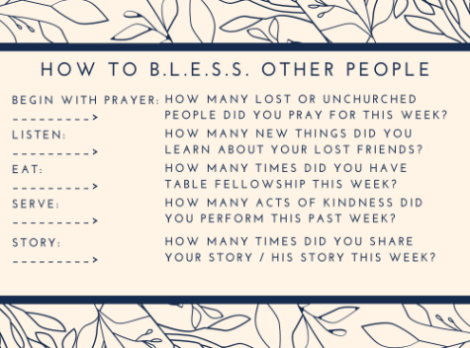
THE BLESS SCORE CARD:

Consider using this card in your small group to help encourage participation, intentionality, and accountability.

THE FULL B.L.E.S.S. STRATEGY DOCUMENT:

FULL DISCLOSURE ABOUT THE BLESS STRATEGY:

IN A NUTSHELL:

God’s way of reaching and restoring the world to his original design has always been through a “blessing” strategy. In Genesis 12:1-3, Abraham was blessed by God so that he might be a blessing to the nations. The theme of “blessed to be a blessing” runs throughout all of Scripture.

Evangelism isn’t just a spiritual discipline. It’s a means of blessing others with the blessings we’ve received in Christ. I want to challenge you to start doing one of these five practices every single day. Imagine what could happen if you did? It starts slow but you can act your self into a new way of thinking.

When’s the last time you were even bothered by the fact that there are thousands of unreached people all around you in this city?

If it’s been a while, it’s because these kinds of things aren’t on your mind. The B.L.E.S.S. strategy will help God’s mission stay fresh in your own thinking. At the end of the day, this is what’s MOST important! Most of the things we spend our time thinking about don’t really matter in the light of eternity.

God’s mission matters. He wants you to join him in what he’s doing around the world. Not just “converting” but blessing people whom he loves with an everlasting love. You were made for this kind of living. Don’t live another day pursuing some other lesser cause.

BLESS is an easy and effective way to share your faith with others.

It is an acrostic which stands for:

B. Begin with prayer.
L. Listen. And be aware of the needs of those around you.
E. Eat. With your neighbors, co-workers and friends.
S. Serve. Look for ways to be a servant to others.
S. Share YOUR story. Share HIS story. (after you have prayed, listened, had a meal, and served).

WHY ARE WE DOING THIS?

We are doing this to accomplish the mission Jesus gave us to “go make disciples.” We are blessed and we are called to be a blessing. A large part of how we bless others is to share the good news of Christ with our friends, co-workers, and neighbors. Our hope is that our Image family would embrace the B.L.E.S.S. lifestyle and understand that it is not only easy to understand, it is something everyone can do. By actively thinking in terms of blessing others daily, it will become a natural overflow of our lives that draws our neighbors, coworkers and relatives to know Jesus Christ as Lord and Savior.

BEGIN WITH PRAYER:

Sharing your faith with other people can often seem hard or best left for those with a special gift from God, the pastor of the church, or someone…ANYONE other than yourself! It may be surprising to learn that the first part of sharing Jesus is prayer. You begin this process by making a list of people who don’t know Jesus that you might BLESS. Making this list may not seem important, but it is! Things get done when we are focused and intentional. List-making is a very helpful technique used by successful people in all walks of life. For us, it can help focus our attention upon those we hope to reach for the Lord. Start with those in your sphere of influence.

  • Where you live
  • Where you work
  • Where you study
  • Where you play
  • Where you shop

 Pray for the people on your list daily.

One very powerful truth is that what we bind on earth will be bound in heaven and what we loose on earth will be loosed in heaven (Matthew 18:18). What this “binding” and “loosing” refers to is all the unseen things that hinder people from accepting the gospel. As believers, Jesus has given us authority to “bind” all the unseen hindrances which keep people from the truth. Likewise, He has given us authority to “loose” the power of God through the Holy Spirit. We bind hindrances and we loose the Holy Spirit. In other words, prayer helps make the soil fertile before we start planting seeds. Be sure to pray each day for the three people you’ve chosen. We are responsible for prayer and sowing the seeds of truth, but it’s God who makes things grow.

Here are some additional things you can pray for.

  • That God would give you opportunities to do good for them. (1 Corinthians 3:5-7; Colossians 4:3)
  •  That God would give you wisdom to make the most of these opportunities. (Colossians 4:4-6)
  • That God would give you boldness to say what needs to be said. (Ephesians 6:18-20; Romans 1:16)
  • That those you are relating to will have opportunities to hear the truth.
  • That, as you share your story, those whom you are telling will have open hearts, receptive to hearing your story. (Matthew 13)

LISTEN INTENTIONALLY:

“Know this, my beloved brothers: let every person be quick to hear, slow to speak, slow to anger. (James 1:19)

A key to being a blessing is learning the art of listening. To help someone to Jesus you must first understand who they are and where they are. Once you know that, you’ll gain a sense of where they still need to go on their journey. It’s through listening that we gain an understanding of many things, including their spiritual understanding, their background, the possible ways in which we can serve them, fears, wants, desires, etc. Remember, at this point you are just listening and learning more about them. This builds trust and comfort into the relationship. It is very difficult to be effective in sharing your story if you have not first listened. Sharing your story starts with listening to others. It’s helpful to have some open-ended questions in mind. You can find some good examples here.

  • What is your favorite memory from childhood?
  • What was your high school experience like?
  • How do you manage to raise those children alone?
  • What do you want to be doing in five years?
  • If you could have the perfect job, what would it be?
  • What do you believe about God?

EAT TOGETHER:

“Sharing meals together on a regular basis is one of the most sacred practices we can engage in as believers. Missional hospitality is a tremendous opportunity to extend the kingdom of God. We can literally eat our way into the kingdom of God! If every Christian household regularly invited a stranger or a poor person into their home for a meal once a week, we would literally change the world by eating!”
– Alan Hirsch and Lance Ford from Right Here, Right Now

Many are surprised to find that sharing a meal with people has a lot to do with sharing Jesus. So whether you are at your favorite vacation spot, eating at a restaurant or having neighbors over for a long winter evening at home, people share the most interesting things about themselves in the context of eating a meal. We have found that one of the biggest obstacles to people sharing meals together is time. Many people feel the pressure to be elaborate and give them the best. While this is appropriate at times, this is not the goal. We suggest keeping things simple. The goal is really about having fellowship around a meal, not the meal itself.

SERVE OTHERS:

We understand our call to be like Jesus. And Jesus was a servant. His entire ministry is a stunning example of serving wherever He went from His first miracle in Cana, to the feeding of the 5,000, to the simple expression of washing the feet of His disciples, Jesus served, that’s how He lived life. Given the fact that you are reading a booklet about how to live a B.L.E.S.S. lifestyle, chances are you are already serving in many ways at church, with charitable organizations, or volunteering in numerous other ways.

So are there more ways to be intentional about how and where we serve? Absolutely! Here are 4 strategic ways to think and act in serving others.

1. Proximity

The first place to start serving is with those in close proximity to us. Look around – to your neighbors, to the people you work with, or how about the parents you site on the sidelines with while watching soccer? Or serving people in a shelter in the inner city? Start there.

2. Perceptively

Seek to understand the people God has put in close proximity to you. Isaiah 50:4 says, “The Sovereign LORD has given me his words of wisdom, so that I know how to comfort the weary.” Listen and then ask the Lord to show you how to perceptively speak into people’s lives.

3. Powerfully

John 14:12 says, “Most certainly I tell you, he who believes in me, the works that I do, he will do also, and he will do greater works than these…” We can take Jesus at His word and believe that people will, in time, give their lives to Christ. We need to claim that power to share our faith, and to see people drawn to Him.

4. Personally

One of the great miracles of the bible was when Jesus raised Lazarus from the dead. Lazarus was more than a project, he was Jesus’ friend and it was obvious to others. As we share our lives with people, we will hurt when they hurt and rejoice when they rejoice.

STORY PART 1: SHARE YOUR STORY – YOUR TESTIMONY

Perhaps, by now, you have already been asked what makes you different. Maybe you have already mentioned Jesus in conversation. Whatever the case, it is important that you recognize and act on the opportunity to share your faith story. When thinking about how to share your story, begin by asking God to bathe the process in His Spirit and give you wisdom as you write it down. When thinking about sharing your story with others, we suggest taking this three step process.

Step 1. Write down your story

Start by asking God to give you wisdom and clarity as you write down your story. The goal here is not to have a perfectly written document but to get your thoughts down on paper. This will help you clarify it in your mind. When writing your story there are three distinct areas you need to think through.

Life Before Christ

  • What was your life like before you trusted Jesus Christ as your Savior and Lord?
  • What were your attitudes, needs and problems?
  • What did your life revolve around? What was most important to you?

Life With Christ

  • How did you come to accept Christ and give Him complete control of your life?
  • When did you first hear the gospel?
  • What were your initial reactions to Jesus Christ?

Life After Receiving Christ

  • What happened after you trusted Christ?
  • What changes did you see in your life?
  • What does Jesus Christ mean to you now?

Step 2. Threading it Together

Once you have thoughts on paper, it’s time to get selective. Read through your ideas and, using a highlighter, underline the most important feelings, examples or incidents that relate to each of the three points in the outline at left. Use the ideas you highlight to begin writing your story, and make sure you explain what your life was like before you knew Christ, how you came to know Him, and what your life is like now.

Here are some guidelines when writing down your story:

  • Be positive throughout; don’t criticize people or the church.
  • Stay away from vague terms or religious language that confuse or polarize. Ex. Denominations.
  • Don’t glamorize your sin but Be realistic – Christ has not removed all your problems, but he does walk with us through them.
  • Try communicating biblical principles without using too many verses unless they relate directly to your experience.
  • Set aside your story for 24 hours after you have written it. After 24 hours, pick it up again see if you can communicate it to others clearly.
  • Practice communicating it to a friend and get feedback.

Step 3. Telling Your Story

Now that you have thought through your story, it’s time to share it with the individual with whom you have cultivated a relationship. Here are some helpful thoughts:

  • Be prayerful. Respond to God promptings about the right time and place for sharing your story and ask the Holy Spirit to help you share effectively.
  • Be positive and confident. Smile often and share with enthusiasm, knowing you do so in the power of the Holy Spirit.
  • Be natural and conversational. Never argue about faith or pressure your friend for a decision – the results are up to God!

Thanks for reading and implementing the B.L.E.S.S. strategy into your life. As we continue to be disciples who make disciples, we believe the B.L.E.S.S. strategy is going to be a core and central practice of our church. We would love to celebrate and hear how you are making a difference by blessing others around you.

STORY PART 2: SHARE HIS STORY – THE GOSPEL

IDEAS FOR LIVING OUT THIS STRATEGY:

Over the next few months, you are cordially invited to “Bless Your Neighbors” using any of the following creative ideas (or others inspired by these). May they help you both get to know and bless your neighbors with simple acts of kindness, so that you can have opportunities to invite them to my “party” (a relationship of faith with me!). Love, GOD

  • Learn the names of five neighbors on your street who you don’t presently know. Introduce yourself and ask your neighbors’ names when you run into them at the mailbox, in the yard, etc. Then call them by name and say “hello” the next time you see them. Also, pray for these neighbors on your own for at least a month.
  • Make an effort to smile and wave to neighbors whenever you are driving or walking in your neighborhood. Be the friendly face to your neighbors.
  • Take a “Prayer Walk” in your neighborhood. Say hello and even stop to chat with any neighbors you encounter. As you walk, silently pray for each of your neighbors. You can also take a trash bag with you and pick up litter.
  • Sponsor a Block Party for your neighborhood. “You learn a lot about a person by the kinds of parties they throw” – Pastor Dan Mason.
  • During back-to-school month, look for a way to bless a school crossing guard who works in or near your neighborhood. You could drop off some cookies with a note of appreciation, then pray on your own for God to bless that individual. Also, pray for each school that you drive past during the day.
  • Look for people in your neighborhood who are going through life changes, such as a retirement, birth of a baby, death in the family, etc. Send this person an appropriate card and pray for them on your own during their time of transition.
  • Invite a few neighbors that you have been getting to know over to watch a baseball or football game and eat hot dogs, burgers, chili, or nachos.
  • Take something to your neighbors that was either cooked or grown by you (such as cookies, tomatoes, flowers, bread, etc.), along with simple note in a friendship card. Consider including a simple Bible reference to a verse about loving and serving your neighbor (like John 13:34, Romans 12:10-12, or 1 Peter 4:10).
  • In the weeks leading up to Thanksgiving, give a neighbor a loaf of pumpkin bread. Focus on a neighbor who might not have Thanksgiving plans (the elderly, single folks, families with extended family who are out of town, etc.) and invite them to share your Thanksgiving meal. Enclose a note saying that in this season of thanksgiving, you give thanks for them as a neighbor.
  • In December, go Christmas caroling in your neighborhood with your family or a few neighbors you already know. Pass out a bag of hot chocolate mix with a note at each house. Then invite each neighbor that you serenade to meet at your house in an hour for Christmas cookies and coffee. Also, invite them to grab their coat and join you in caroling if they can.
  • Ask God for other creative ideas and things that might bless your neighbor and then try them out! (A good test is: would such an act/action bless you? If so, it will probably bless your neighbor, too).
  • One of the things I love most about the holidays is getting to do something nice for my neighbors. Oh sure, I could do it year ’round, but I am sorry to say that I really don’t think enough about it.  Then the weather cools down, the Christmas lights go up on the house and I am reminded to stop by and say hello to my precious neighbors. But we don’t want to just breeze through their lives. The Christmas season is a great opportunity to go deeper and show the love of Christ to those around us.

10 SIMPLE WAYS TO BLESS YOUR NEIGHBORS:

  1. A personal visit: Instead of calling, knock on the door and say hello.  It can feel awkward, but people love it.  Just say that you wanted to wish them a Merry Christmas in person.
  2. Baking: Try a new recipe and take some of it over to a neighbor, “Here!  We thought you might want to try what I just made!”  This is a good one for the older widow and widowers.  They enjoy encouraging the kids!
  3. Yard work: Most of my neighbors don’t need work done in their yard – in fact they would probably like to come over and do something about ours! But if we stop by their house and notice leaves on the sidewalk or dirt that needs to be swept we can go back over later and take care of it.
  4. Notes: We make cards and notes for our neighbors each holiday season and either leave them in the mailbox or on the door.  Who doesn’t feel loved by a hand written note?  You can add a favorite scripture or “we’re praying for you” message into your note without seeming too pushy.
  5. Love their pets: Some of your neighbors are very attached to their pets, so take a cat toy or dog bone over to let them know we care about their pets too!
  6. Share a recipe: If your neighbor is having family visit for the holidays, take them a few of your favorite recipes written on pretty note cards (even better if you have a sample for them to try).  Recipe cards are another great place to add a Bible verse.
  7. Watch their house: If they are headed out of town, offer to keep an eye on things while they are gone.  Be sure you have their contact information and make sure that they have yours.
  8. Take them a book: If your neighbor has children or grandchildren that like to visit, take over a good book to add to their library. 
  9. Let them know that you are praying for them: Neighbors should know we pray for them because we tell them!  When you stop by for the holidays, listen for ways to pray for them specifically.  Just tell them, “That’s good to know!  I will pray for that.”
  10. Check back later: If they shared with you some struggle or problem they are having, it’s really nice if you stop by a week or so later to check on how they are doing.  Remembering details is a great way to show someone you care. It’s such a great time of year to let your neighbors know that you care about them.  When we take the time to make sure everyone’s Christmas is a little more merry, we often end up more blessed than the people we’re trying to bless.

The Masks We Wear

On October 31, Scott talked about the Masks We Wear, from Romans 12:9-13. It’s fun to pretend to be something we know we are not in real life. However, pretending to be someone or something we are not must never be a way of life, especially in the church. We tend to hide behind the masks we wear, because if you knew the real me, you wouldn’t like me, and I’m not ready to take the risk of the pain of rejection.

M is for MEETING – we must be connected to one another relationally, socially, emotionally, and spiritually, and this is best done in the context of a small group experience.

A is for ACCOUNTABILITY – we must be connected to other followers of Christ who will hold us accountable for our spiritual life, marriage, and integrity.

S is for SACRIFICE – we know it will cost us something to live out our Christian faith. We live out our faith inside the church and outside in the community.

K is for KNOWLEDGE – we must seek to know all we can about living faithfully as a member of the body of Christ rather than believing that old saying, “ignorance is bliss.”

S is for SALVATION – we must embrace the fact that when we are saved by grace through faith in the finished work of Christ on the cross, we now have a responsibility to act on that faith (to live it out) in front of a lost and dying world.

We showed this video at the beginning of the message: