How to Have Faith

Today we are looking into the gospel of John 14:1-14, 27 – section 218 in Thomas and Gundry’s Harmony of the Gospels.

Purpose: The purpose of this study is to explore the importance of possessing a faith that trusts Christ despite the circumstances that we may face. This is in contrast to falling away from the faith (Matthew 12:21; Mark 4:17; Luke 8:13). We are not to be fair weather Christians. Our faith must persevere to be saving faith.

Historical Background: This is Jesus’ farewell discourse. In the next four chapters (John 14-17), Jesus must drive home three critical facts:

  1. He is leaving (John 13:1, 31-33, 36; 14:1-4, 18, 25, 27-29; 16:5, 11-19, 28; 17:11).
  2. The Apostles will continue Jesus’ mission with opposition from the world (John 13:13-17, 20, 34-35; 14:12-14, 18-21; 15:1-21, 27; 16:1-4, 23-24; 17:12-22).
  3. The Holy Spirit will assist them in their mission (John 14:15-18, 26; 15:26-27; 16:6-11, 13-14).

This is one of those “good news/bad news” scenarios. What lies ahead is difficult, but Jesus’ promises are simply out of this world!

This has been unlike any other meal the disciples shared with Jesus. He seemed so solemn. An ominous finality lingered over the Passover “celebration” and the words “one of you will betray me” kept echoing in their minds. Jesus has just told Peter that he would deny him three times and the other ten would scarcely fare any better. They are visibly shaken. So Jesus tells them to stop being troubled. With two more imperatives, Jesus gives the solution: “Trust in God; trust also in me!” (John 14:1)

While the crucifixion and ascension will be devastating losses for the disciples, their faith can be sustained in the midst of this present suffering by the assurance of three glorious realities:

  1. The enduring presence of the Holy Spirit
  2. The promise of Jesus’ return
  3. The hope of a heavenly home

The setting is very similar to a modern board room where the once highly charged management team of a new enterprise with worldwide aspirations just receives news that the CEO is leaving; the treasure was fired, and the CEO’s personal apprentice was going to distance himself from the organization. How would you feel? Troubled? Trusting? Hopeful? Like an orphan? Jesus was totally in touch with what His disciples were feeling.

Commanded in the Gospels: John 14:1 “Do not let,” “believe” (2x); John 14:11 “believe” (2x); John 14:27 “Do not let your heart be troubled,” “nor let it be fearful.” (The word “faith” occurs 39 times in the Gospels; “believe” 119 times).

Illustrated in the Book of Acts: the word ‘faith” occurs 218 times in the epistles and 11 times in the Book of Revelation; “believe” occurs 74 times.

Amplified in the Epistles: The word “faith” occurs 14 times in the Book of Acts; “believe” 39 times.

Do not let [Present Imperative] your heart be troubled; believe [Present Imperative] in God, believe [Present Imperative] also in Me. (John 14:1)

The scene is in the upper room where the disciples gathered for the Passover meal with Jesus on the night before his death. In a very short time the world of these eleven men is going to collapse in unbelievable chaos. They have been informed that Jesus is going away and they are filled with fear. Jesus anticipates their already broken hearts and here commands them to keep trusting in him. Jesus promises that he will come back to get them, but in the meantime consoles them with the promise of the coming of the Comforter, the Holy Spirit (John 14:16-26; 16:5-15).

Instead of the disciples offering support to Jesus in the hours before the cross, he had to support them spiritually as well as emotionally. This reveals his love for them. Faith in Jesus can stop the heart from being agitated. The verb “troubled” [tarasso] means, “to agitate, trouble (a thing, by the movement of its parts to and fro), to cause one inward commotion, take away his calmness of mind, disturb his equanimity, to disquiet, make restless, to stir up, to trouble, to strike one’s spirit with fear and dread, to render anxious or distressed, to perplex the mind of one by suggesting scruples or doubts. – Strong’s Exhaustive Concordance.

We all experience trouble, suffering, pain, anxiety, disappointment, and losses. These circumstances don’t have to trouble us if we know Jesus. He is bigger than our needs and circumstances. So, when you are feeling anxious, take your eyes off your troubles and put them on Jesus.

In fact Jesus commands us “do not let” your heart be troubled; “believe” in God “believe” also in Me. All three of these verbs (“do not let,” “believe,” “believe”) are present tense imperatives.

“Let not your heart continue to be agitated. Be putting your trust in God. Also be putting your trust in Me.” The New Testament – An Expanded Translation by: Kenneth S. Wuest, William B. Eerdmans Publishing Company, 1961

Faith in Christ can stop the heart from bring agitated – John MacArthur

The verb “believe” [pisteuo] occurs 248 times. The KJV translates it as “believe” 239 times, “commit unto” four times, “commit to (one’s) trust” once, “be committed unto” once, “be put in (trust with” once, “be commit to one’s trust” once, and “believer” once. The word “believe” means, “to think to be true, to be persuaded of, to credit, place confidence in.” It is used in the New Testament of the conviction and trust to which a man is impelled by a certain inner and higher prerogative and law of soul. Faith involves trusting in Jesus as able to aid either in obtaining or in doing something. True saving faith is more than mere intellectual assent.

Wuest points out that the use of the verb is pisteuo in classical Greek – “In classical Greek pisteuo meant to believe, trust, trust in, put faith in, rely upon a person or thing. In the papyri, [Moulton and Milligan] we find the following illustrations of the use of these words; Whom no one would trust even if they were willing to work; (confidence in the person’s character and motives); I have trusted no one to take it to her, (confidence in the ability of another to perform a certain task). Pisteuo in every instance is translated by the word “believe,” except in the following places; Luke 16:11; John 2:24; Romans 3:2; 1 Corinthians 9:17; Galatians 2:7; 1 Thessalonians 2:4; 1 Timothy 1:11; Titus 1:3, where the idea is that either of entrusting one’s self or something else into the custody and safe keeping of another.

When these words refer to the faith which a lost sinner must place in the Lord Jesus in order to be saved, they include the following ideas; the act of considering the Lord Jesus worthy of trust as to His character and motives, the act of placing confidence in his ability to do just what he says he will do, the act of entrusting the salvation of his soul into the hands of the Lord Jesus, the act of committing the work of saving his soul to the care of the Lord. This means a definite taking of one’s self out of one’s own keeping and entrusting one’s self into the keeping of the Lord Jesus.

In Acts 8:13; 26:27; James 2:19, the word refers merely to an intellectual assent to certain facts, in Acts 15:11, to a dogmatic belief that such and such is the case.

“The New Testament conception of faith includes three main elements, mutually connected and requisite, though according to circumstances sometimes one and sometimes another may be more prominent,

  1. A fully convinced acknowledgement of the revelation of grace
  2. A self-surrendering fellowship (adhesion)
  3. A fully assured and unswerving trust (and with this at the same time hope) in the God of salvation or in Christ.

None of these elements is wholly ignored by any of the N.T. writers” [Cremer, Biblico-Theological Lexicon of New Testament Greek]. Thus, the word sometimes refers to an acknowledgment that a certain statement is true (Matthew 21:25), and sometimes to a definite commitment of one’s soul into the keeping of another (John 5:24). Word Studies in the Greek New Testament Vol.3, Kenneth S. Wuest, Wm. B. Eerdmans Publishing Company, 1973, pgs.28-30

Truly, truly, I say to you, he who hears My word, and believes him who sent me, has eternal life, and does not come into judgment, but has passed out of death into life. (John 5:24)

The disciples first transferred their trust on Christ as their Messiah in John 2:11. The aorist tense of the verb “believed” points to the moment of salvation but for faith to be true saving faith it must persevere.

John MacArthur writes “But it is not a biblical view of faith to say one may have it at the moment of salvation and never need to have it again. The continuing nature of saving faith is underscored by the use of the present tense of the Greek verb pisteuo (“believe”) throughout the gospel of John (John 3:15-18, 36; 5:24; 6:35, 40, 47; 7:38; 11:25-26; 12:44, 46; 20:31; also Acts 10:43; 13:39; Romans 1:16; 3:22; 4:5; 9:33; 10:4, 10-11). If believing were a one-time act, the Greek tense in those verses would be aorist.”- The Gospel According to Jesus, pg.172

John MacArthur cites Hodge who writes, “It is widely held in modem Christendom that the faith of a genuine Christian cannot fail. But this is not an assertion that can be verified from the New Testament” (pg.68); and, “There is nothing to support the view that perseverance in the faith is an inevitable outcome of true salvation” (pg.83). Contrast that statement with Paul’s inspired words in Colossians 1:22-23: “He has now reconciled you… if indeed you continue in the faith firmly established and steadfast, and not moved away from the hope of the gospel” cp. also 1 Corinthians 15:1-2; 2 Timothy 2:12; Hebrews 2:1-3; 3:14; 4:14; 6:11-12; 12:14; James 1:2; 1 John 2:19. – The Gospel According To Jesus.

Jesus in John 14:1 is commanding his disciples to continue believing in Him despite the trouble they are facing.

“In My Father’s house are many dwelling places; if it were not so, I would have told you; for I go to prepare a place for you.” (John 14:2)

“Have you ever decorated a room for someone special? If you have, you know what it is like to make a room suit one particular personality. If it is a daughter, you make the room pretty…. If it is a son, the room might have airplanes or model cars. If it is for Grandma, the room might have her favorite books; and it might be far from the playroom or the children’s bedrooms. We take care in such preparation. Are we to think that Jesus will take less care for those whom he loves, who are to spend eternity with him?” – The Gospel of John, Boice, pg.95

This verse teaches that heaven is under construction. Jesus has gone to heaven “to prepare” or “to make ready” [hetoimazo] our dwelling place for us.

John’s readers would have pictured a first-century house in Palestinian when they read these words. The “dwelling place” [mone] was built around a central courtyard and designed for sons to bring their spouses to live there as well and raise their families there. Each household had its own room or apartment within the house that provided privacy. Members also had (closeness to the father of the family by gathering in the courtyard. The “dwelling place” may have been quite modest even though the house was huge. The KJV translation “mansion” today conjures up the wrong idea. The glory of our future dwelling is not in its size or prestige but in the presence of Christ.

“If I go and prepare a place for you, I will come again and receive you to myself, that where I am, there you may be also.” (John 14:3)

Jesus here spoke of the rapture as he began his closing message to his disciples. The passage reveals several things regarding the rapture.

“One is that it is a planned event; at the time of his departure Christ anticipated returning for the disciples. Another is that it concerns Christ’s own followers. Christ was speaking only to when he gave the promise. Third, Christ’s return for his own will be personal. He himself will come for them, not by sending some angel, for instance, nor merely giving a general permission for the church finally to come to him. Fourth. the rapture results in the church being taken out of the world. Jesus said that he would come and “receive” the disciples, that where he had made the preparations, they might be also. The church will not remain here on earth, then, merely in some improved status, but will be taken away from the earth to heaven.” ­ – The Bible and Future Events, pgs.40,41

“Many signs were given to the nation Israel, which would precede the second advent, so that the nation might be living in expectancy when the time of His corning should draw nigh. Although Israel could not know the day nor the hour when the Lord will come, yet they can know that their redemption draweth nigh through the fulfillment of these signs. To the church no such signs were ever given. The church was told to live in the light of the imminent coming of the Lord to translate them in his presence (John 14:2-3; Acts 1:11; 1 Corinthians 15:51-52; Philippians 3:20; Colossians 3:4; 1 Thessalonians 1:10; 1 Timothy 6:14; James 5:8; 1 Peter 3:3-4). Such passages as 1 Thessalonians 5:6; Titus 2:13; Revelation 3:3 all warn the believer to be watching for the Lord himself, not for signs that would precede his coming. It is true that the events of the seventieth week will cast an adumbration before the rapture, but the object of the believer’s attention is always directed to Christ, never to these portents.” – Things to Come, pgs.202-203

This passage teaches the doctrine of imminence, or “at any moment coming.” The rapture reflects the traditions of a Jewish wedding. Although the Jewish bride was expecting her groom to come for her, she did not know the exact time of his coming.

The Jewish bridegroom took the initiative in marriage by leaving his father’s house and traveling to the home of the prospective bride. So Jesus left his Father’s house in heaven and traveled to the earth; the home of his prospective church (bride). Jesus came to earth to obtain the church (bride) through the establishment of a covenant.

At the home of the prospective bride, the Jewish bridegroom would negotiate with her father to determine the price [mohar] that he must pay to purchase his bride. On the same night Jesus made his promise in John 14, he instituted communion. In this communion, he passed the cup of wine to the disciples saying: “This cup is the new covenant in my blood” (1 Corinthians 1:25). Jesus established an eternal covenant through his blood. His Holy Spirit is the “ring” sealing the bride with a guarantee that he will return for her (Hebrews 13:20; Luke 22:20; Ephesians 1:13).

Once the bridegroom paid the purchase price, the marriage covenant was established, and the young man and woman were regarded as husband and wife. From that moment on, the bride was declared to be consecrated or sanctified; set apart exclusively for her bridegroom. Jesus paid a price to purchase the church (bride). The price he paid was his life blood (Acts 20:28, 1 Corinthians 6:19-20). So the church is said to be sanctified and set apart exclusively for Christ (Ephesians 5:25-27; 1 Corinthians 1:2; 6:11; Hebrews 10:10; 13:12).

As a symbol of the covenant relationship, the groom and bride would drink from a cup of wine over which a betrothal benediction had been pronounced. The cup of communion serves as the symbol of the covenant through which Christ has obtained the His bride the church (1 Corinthians 11:25).

After the marriage covenant was established, the groom would leave the bride’s home and return to his father’s house. There he would remain separate from his bride for usually at least a period of 12 months. Just as the Jewish groom left the home of his bride and returned to his father’s house, so Jesus left the earth, the home of the church (bride) and returned to his Father’s house in heaven after he’d established the new covenant and risen from the dead. The church is currently living in this period of separation awaiting Christ’s return (John 6:62; 20:17).

During this period of separation between the Jewish bride and groom, the bride would use this time to gather her trousseau and prepare for her married life. The groom occupied himself with the preparation of living accommodations in his father’s house where he would bring his bride. Parallel to the custom of the Jewish groom preparing living accommodations for his bride in his father’s house, Christ as been preparing living accommodations for the church in His Father’s house in heaven. (John 14:2)

Dr. Dwight Pentecost writes, “In relation to the eternal destiny of the church saints, it is to be observed that their destiny primarily is related to a Person rather than a place. While the place looms with importance (John 14:3), the place is overshadowed by the Person into whose presence the believer is taken.

  • John 14:3, If I go and prepare a place for you, I will come again and receive you to Myself, that where I am, there you may be also.
  • Colossians 3:4, When Christ, who is our life, is revealed, then you also will be revealed with Him in glory.
  • 1 Thessalonians 4:16-17, For the Lord Himself will descend from heaven with a shout, with the voice of the archangel and with the trumpet of God, and the dead in Christ will rise first. 17 Then we who are alive and remain will be caught up together with them in the clouds to meet the Lord in the air, and so we shall always be with the Lord.
  • 1 John 3:2, Beloved, now we are children of God, and it has not appeared as yet what we will be We know that when He appears, we will be like Him, because we will see Him just as He is.

It is the Person who is emphasized in all the passages dealing with the glorious expectation of the church rather than the place to which they are taken.” Things to Come, pgs.562

“And you know the way where I am going.” 5 Thomas said to Him, 0 Lord, we do not know where You are going, how do we know the way?” (John 14:4-5)

They didn’t even know where he was going, much less how to get there. So Jesus explained that he is the only way to God and heaven. They may not have fully understood Jesus’ teaching at that time, but after the resurrection, they got it. A couple of months later, when Peter was preaching, he said, “Salvation is found in no one else, for there is no other name under heaven given to men by which we must be saved” (Acts 4:12).

Jesus said to him, “I am the way, and the truth, and the life; no one comes to the Father but through Me.” (John 14:6)

“A man who was merely a man and said the sort of things Jesus said would not be a great moral teacher. He would either be a lunatic (on a level with the man who says he is a poached egg) or else he would be the Devil of Hell. You must make your choice. Either this man was, and is, the Son of God: or else a madman or something worse.” – C.S. Lewis

Our Lord in John 14:6 says, “I am the way, the truth, and the life.” The word “way” is from a Greek word which has two uses, a literal and a metaphorical. It was used to speak of a road and also to refer to a method or manner of accomplishing something. These uses are closely intertwined and cannot be disassociated. The road leading to a certain place is the method of getting there. Our Lord is the literal road which a sinner must take if he is to reach heaven, and Jesus thus becomes the method by which he is saved. Missing the glory of God is evidence of the fact that the sinner has not gone in the right direction, and that shows that he has not been on the right road. He has missed the road. To reach heaven, the sinner must put himself on the road to heaven. Jesus is that road. – Word Studies in the Greek New Testament Vol.3, pgs.88,89

The way to the Father is not a road but a relationship.

  1. “Let there be no mistake, while Christianity is open to all people, heaven is not! Call it narrow-minded, call it intolerant, call it what you like as long as you call it truth from the lips of Jesus.” – Mark Moore
  2. Acts 4:12, “And there is salvation in no one else; for there is no other name under heaven that has been given among men by which we must be saved.”
  3. 2 Timothy 2:5-6, For there is one God, and one mediator also between God and men, the man Christ Jesus, 6who gave Himself as a ransom for all, the testimony given at the proper time.”
  4. “Jesus made it clear that the destination was the Father. He did not say that he came to show the way, but that he himself was the actual means for bringing men to God. An illustration might be a flowing river whose current actually conveys the boat to its destination, or the modern escalator which is not only the route but is also the conveyor from one level to another.” -­ Homer A Kent Jr.

This is the sixth of seven “I AM” statements in John (John 6:48; 8:12; 10:9; 10:11; 11:25; 14:6; 15:1). The first description of Jesus, “The Way,” became one of the names of the early church (Acts 9:2; 19:9, 23; 22:4; 24:22). The second and third descriptions of Jesus (truth and life) are found in a number of other places in John:

“If you had known Me, you would have known My Father also; from now on you know Him, and have seen Him.” (John 14:7)

God has revealed himself through His Son. John 1:18, No one has seen God at any time; the only begotten God who is in the bosom of the Father, He has explained Him. Philip said to Him, “Lord, show us the Father, and it is enough for us.” (John 14:8)

We get three glimpses of Philip in John. He was one of the first to follow Jesus clear back in the days of John the Baptist (John 1:43-46). His first act of devotion to Jesus was to lead him to Nathanael. A couple of years later it was Philip whom Jesus tested at the feeding of the five thousand by asking how they would feed all these people (John 6:5-7). Finally, in John 12:21, the Greeks who wanted to see Jesus petitioned Philip to take them to him.

Here we find Philip making a request. Philip wants a visual glimpse of God. He is probably thinking in terms of a vision like Ezekiel’s (1-2) or Isaiah’s (6) or even Moses’ (Exodus 33:18-23). But Jesus gives him nothing more than he needs and nothing less than himself. To see Jesus is to see the Father (Hebrews 1:3). Granted, Jesus’ incarnational form is not nearly as striking as these visions of God. Then again, his incarnational form was not nearly as striking as his own non-incarnational visions (Isaiah 11:3-5; Ezekiel 40:3; Daniel 10:6; Revelation 1:12-16). Nevertheless, what is needed here is not a striking vision but an accurate revelation of the character, purpose, and acts of God. These are represented with striking clarity in Jesus’ incarnational ministry through his words (John 14:10) and his works (John 14:11), both of which come directly from the Father (John 5:18-23, 36-39; 8:41-42; 10:30-32, 37-38; 12:49-50).

Dr. Ray Stedman writes, “Everyone was surprised when Philip spoke up. It was as if the table had suddenly spoken. He was the quiet, mousy disciple who never said anything. Yet all the sob and agony of man’s hunger for God is heard in this cry, “Show us the Father and we’ll be satisfied.” Our Lord’s answer is a quiet rebuke: “Philip, after three and a half years haven’t you yet found out who I am? I came to reveal the Father. When you know me you have known the Father.”

These are, confessedly, words of mystery. They reveal what theologians have called the “Doctrine of the Trinity”; that three distinct Persons can still exist as only one God. It is beyond our human comprehension. We have nothing to compare it with, thus we struggle to grasp it.” (pg.5)

Jesus said to him, “Have I been so long with you, and yet you have not come to know Me, Philip? He who has seen Me has seen the Father; how can you say, ‘Show us the Father’? (John 14:9)

Paul in Colossians 1:15 spoke of Christ as “the image of the invisible God.” “The word “image” has the obvious idea of likeness, but the Greek word does not refer to an accidental likeness, as one egg is like another. It implies an original of which the image is a copy. But the image in this case is not the result of direct imitation as the head of a king on a coin, but is derived, like the features of the parent in the child. In John 3:16 our Lord is the only begotten Son of God. John 1:18 refers to him as the only begotten God, the word “God” appearing in the best manuscripts. It is a tremendous thought. The word ‘only begotten’ does not only mean that our Lord was the only Son of God, but that he as God the Son is alone of his kind, unique, be­ gotten of God through eternal generation. He is the image of God in the sense that he is a derived representation of God the Father, co-existent eternally with him, possessing the same essence, deity himself. Being the representative of God, he is also therefore the manifestation of God. He said to Philip, “He that hath seen me hath seen the Father” (John 14:9). – Word Studies in the Greek New Testament Vol.3, pgs.83

John 1:18 says, “No one has seen God at any time; the only begotten God who is in the bosom of the Father, He has explained Him.” This verse teaches us that our Lord never started to be God’s only begotten Son. He always was his Son. He possesses the same essence as God the Father, and therefore he can in his incarnation fully explain God. The verb “has explained” in John 1:18 is a Greek word which means “to lead out.” “God the Son in his incarnation led the Father out from behind the curtain of his invisibility into full view. The Greek word here comes into the English language in the word ‘exegesis.’ Exegesis is the method of Bible study in which we fully explain every detail of the text. Jesus Christ has in his incarnation, fully explained in finite terms so far as finite minds can grasp, all the details of the Person of God the Father. He said, ‘He that hath seen me hath seen the Father.’ Thus Jesus Christ is the exegesis of God.” ­- Word Studies in the Greek New Testament Vol.3, pgs. 85-86

The Bible teaches that the Godhead exists eternally in three persons: the Father, the Son, and the Holy Spirit, and these three are one God. (Genesis 1:1, 26; Deuteronomy 6:4; Matthew 28:19-20; John 4:24; 2 Corinthians 13:14).

John 14:9 (“He who has seen Me has seen the Father”) and John 14:10 (“I am in the Father, and the Father is in Me”) have been misused to teach the heresy of Modalism.

Modalism -A Third Century Heresy

“Modalism claims that there is one person who appears to us in three different forms (or “modes”). At various times people have taught that God is not really three distinct persons, but only one person who appears to people in different “modes” at different times. For example, in the Old Testament God appeared as “Father.” Throughout the gospels, this same divine person appeared as “the Son” as seen in the human life and ministry of Jesus. After Pentecost, this same person then revealed himself as the “Spirit” active in the church.

This teaching is also referred to by two other names. Sometimes it is called Sabellianism, after a teacher named Sabellius who lived in Rome in the early third century A.D. Another term for modalism is “modalistic monarchianism,” because this teaching not only says that God revealed himself in different “modes” but it also says that there is only one supreme ruler (“monarch”) in the universe and that is God himself, who consists of only one person.

Modalism gains its attractiveness from the desire to emphasize clearly the fact that there is only one God. It may claim support not only from the passages talking about one God, but also from passages such as John 10:30 (“I and the Father are one”) and John 14:9 (“He who has seen me has seen the Father”).

However, the last passage can simply mean that Jesus fully reveals the character of God the Father, and the former passage (John 10:30), in a context in which Jesus affirms that he will accomplish all that the Father has given him to do and save all whom the Father has given to him, seems to mean that Jesus and the Father are one in purpose (though it may also imply oneness of essence).

The fatal shortcoming of modalism is the fact that it must deny the personal relationships within the Trinity that appear in so many places in Scripture (or it must affirm that these were simply an illusion and not real). Thus, it must deny three separate persons at the baptism of Jesus, where the Father speaks from heaven and the Spirit descends on Jesus like a dove. And it must say that all those instances where Jesus is praying to the Father are an illusion or a charade. The idea of the Son or the Holy Spirit interceding for us before God the Father is lost. Finally, modalism ultimately loses the heart of the doctrine of the atonement that is, the idea that God sent his Son as a substitutionary sacrifice, and that the Son bore the wrath of God in our place, and that the Father, representing the interests of the Trinity, saw the suffering of Christ and was satisfied (Isaiah 53:11).

Moreover, modalism denies the independence of God, for if God is only one person, then he has no ability to love and to communicate without other persons in his creation. Therefore it was necessary for God to create the world, and God would no longer be independent of creation.

One present denomination within Protestantism (broadly defined), the United Pentecostal Church, is modalistic in its doctrinal position. Some of the leaders who formed this group had earlier been forced out of the Assemblies of God.”- Systematic Theology, pg.242

“Do you not believe that I am in the Father, and the Father is in Me? The words that I say to you I do not speak on My own initiative, but the Father abiding in Me does His works.” (John 14:10)

The word “abide” [meno] is one of John’s favorite words. Its classical usage will throw light upon the way it is used in the N.T. It meant “to stay, stand fast, abide, to stay at home, stay where one is, not stir, to remain as one was, to remain as before.” In the N.T., it means “to tarry, to dwell at one’s own house, to tarry as a guest, to lodge, to maintain unbroken fellowship with one, to adhere to his party, to be constantly present to help one, to put forth constant influence upon one.” In this verse God is said to meno in Christ… to be constantly present with him, to be continually operative in him by his divine influence and energy. – Word Studies in the Greek New Testament Vol.3, pgs.64,65

“Believe [Present Imperative] Me that I am in the Father and the Father is in Me; otherwise believe [Present Imperative] because of the works themselves.” (John 14:11)

The proof of the union of Jesus and His Father is threefold. They should believe Jesus

  1. Because of his character (“I am in the Father [John 14:20] and… the Father is in Me”)
  2. Because His words are the Father’s (“The words I say to you are not just My own” (John 7:16; 12:49-50; 14:24)
  3. Because the miracles reveal God’s working through Him (the Father, living in Me… is doing His work…. believe on the evidence of the miracles themselves; John 5:36). One of the key elements in John’s Gospel is the stress on the signs as gracious pointers to faith (John 5:36; 10:25, 38; 11:47; 12:37; 20:30-31).

Greater Works Than Jesus?

“Truly, truly, I say to you, he who believes in Me, the works that I do, he will do also; and greater works than these he will do; because I go to the Father.” (John 14:12)

Jesus did not mean greater works in power, but in extent. They would become witnesses to all the world through the power of the indwelling and infilling of the Holy Spirit (Acts 1:8) and would bring many to salvation because of the Comforter dwelling in them. The focus is on spiritual rather than physical miracles.

What are the “greater works” that Jesus promised that those who believe in him could do? The Gospel writers used the word “works” [ergon] to describe Jesus’ miraculous works (Matthew 11:2; Luke 24:19). “John accords them theological significance (John 5:36; 7:3, 21; 15:24). The works validate Jesus’ claims about himself and point to the Father who sent him. His works are intended to draw faith responses from those who witness them (John 14:11 ).” – Complete Expository Dictionary of Old and New Testament Words pg.807

  • John 5:20, For the Father loves the Son, and shows Him all things that He Himself is doing; and the Father will show Him greater works than these, so that you will marvel.
  • John 5:36, But the testimony which I have is greater than the testimony of John; for the works which the Father has given Me to accomplish – the very works that I do – testify about Me, that the Father has sent Me.
  • John 6:28, Therefore they said to Him, “What shall we do, so that we may work the works of God?
  • John 7:3, Therefore His brothers said to Him, “Leave here and go into Judea, so that Your disciples also may see Your works which You are doing.
  • John 9:3-4, Jesus answered, “It was neither that this man sinned, nor his parents; but it was so that the works of God might be displayed in him. 4We must work the works of Him who sent Me as long as it is day; night is coming when no one can work.
  • John 10:25, Jesus answered them, “I told you, and you do not believe; the works that I do in My Father’s name, these testify of Me.
  • John 10:32, Jesus answered them, “I showed you many good works from the Father; for which of them are you stoning Me?”
  • John 10:37-38, If I do not do the works of My Father, do not believe Me; 38but if I do them, though you do not believe Me, believe the works, so that you may know and understand that the Father is in Me, and I in the Father.
  • John 14:10-12, Do you not believe that I am in the Father, and the Father is in Me? The words that I say to you I do not speak on My own initiative, but the Father abiding in Me does His works. 11″Believe Me that I am in the Father and the Father is in Me; otherwise believe because of the works themselves. 12″Truly, truly, I say to you, he who believes in Me, the works that I do, he will do also; and greater works than these he will do; because I go to the Father.

How could we do more miracles than Jesus did? John 21:25 says, “And there are also many other things which Jesus did, which if they were written in detail, I suppose that even the world itself would not contain the books that would be written.”

The text literally says, “Most assuredly, I am saying to you, he who believes in me, the works which I am constantly doing, also that one shall do” – The New Testament: An Expanded Translation pg. 249

So what went wrong? Was this a false promise or have we failed in some way? God’s miracle working power through men was very rare over biblical history. There were no miracles

  • From creation until Moses – 2700 years (Exodus 4:8-9, 17, 28, 30; 7:3; 8:23; 13:9; 10:1,2).
  • From Moses until Elijah – 600 years (1 Kings 17:14-24; 18:24, 25; 2 Kings 4:8-37).
  • From Elijah to Christ – 900 years (John 20:30-31; 21:25; Acts 2:22).

The book of Acts gives us a historical narrative of the first 30 years of the church. During the first 20 years of the early church, the Book of Acts records eighteen miracles (Acts 1-18) and over the next 10 years five miracles are recorded (Acts 19-28). With the exception of a few cases of the miraculous that have not been verifiable the church hasn’t seen the miracles that Jesus promised. There has been a strange absence of miracles among Jesus’ disciples throughout the church age until the present. Is it a lack of faith on our part or has Christ failed to keep his promise? Don’t just think of the supernatural as physical phenomenon.

Homer Kent writes, “This certainly did not mean that believers would perform more amazing physical miracles that Jesus did (e.g., stilling the storm, feeding 5,000, opening the eyes of the blind, curing the lame, healing an amputated ear, raising the dead, etc.). The answer is indicated by the fact that Christ’s return to the Father is said to be the cause. Hence these greater works would be spiritual ones, in which the good news of Christ’s death and resurrection would be proclaimed as the transforming power for sinful men. As a consequence, Gentiles as well as Jews would be reached, and a new spiritual body, the New Testament church, would be created.” – Light in the Darkness pg.174

So when Jesus speaks of “greater works” he must mean “greater” in a spiritual dimension. When we look at both the record of Scripture and of church history we see how true this is: On the day of Pentecost, 40 days after our Lord uttered these words, Peter, filled with the power of the Spirit, preached with such effect that 3,000 people were converted in one day. That never happened during Jesus1 ministry. Perhaps a few hundred on occasion believed when he preached, but a mere handful was the usual response, never thousands as the book of Acts reports.

“…greater, not in power, but in extent or scope, due to the indwelling Spirit; the focus is on the spiritual, not physical miracles.” – John MacArthur

But it is unlikely that Jesus had miracles in mind when he says the Apostles will do greater works than he himself has done. After all, what greater miracle could there be than raising a person from the dead? And Jesus did three of these (excluding his own), while the “greatest” Apostles, Peter, and Paul, only had one each (Acts 9:40-41; 20:10). Certainly, the greatness of Jesus’s followers would not be in the number or character of their miracles but in the number and character of their converts. How great indeed are the works of those who break the barriers of geography and ethnicity to bring to Christ people from every tongue and tribe.

This is from John MacArthur on What It Means to Do Greater Works than Jesus:

“Many charismatic teachers look to the above verse to validate their teaching. They see it as a proof text for the notion that present-day believers can perform miraculous signs and wonders, even more spectacular than Jesus Himself. Reinhard Bonnke, who claims to have raised the dead, is one prominent charismatic who subscribes to that view, and has even written a book offering his interpretation of what Jesus meant by “greater works.”

But Bonnke’s view not only contradicts church history, it also defies Jesus’ teaching in Scripture. In the following audio clip, John MacArthur explains the true, and far more profound, meaning of John 14:12.

One of the great tragedies of the charismatic movement’s fixation on miracles is that it drags the focus away from biblical priorities. Rather than bring the life-transforming power of Scripture to bear on a lost and dying world, too many charismatics long for God’s power to manifest itself in and through their own experiences.

We don’t do things that are greater in power, how could we? I certainly cannot heal the sick, cast out demons from unbelievers, I can’t raise the dead, I cannot walk on water, I cannot pronounce curses on people, I can’t make food and feed people by the tens of thousands. I cannot know what people think, I cannot know what’s on their hearts, I cannot articulate their unasked questions, I cannot predict the future, those are things that Christ did and He did them routinely and regularly.

So when Scripture says that we will do greater works than Jesus, it’s not greater in kind, its greater in extent and what it means is, that the proclamation of the gospel which for Jesus was limited to one nation, one small piece of geography will go far beyond that. We who live in generation after generation since the life of our Lord are fulfilling the Great Commission and the Gospel is expanding and covering the whole earth. Not greater in kind but greater in extent, greater in world influence. These are the works that we are able to do because we know the truth and possess the Holy Spirit.” (Source: www.gty.org)

“Whatever you ask in My name, that will I do, so that the Father may be glorified in the Son. 14 If you ask Me anything in My name, I will do it.” (John 14:13-14)

“In their hour of loss at the departure of Jesus, he comforted them with the means that would provide them with the necessary resources to accomplish their task without his immediate presence which they had come to depend upon. To ask in Jesus’ “name” does not mean to tack such an expression on the end of a prayer as a mere formula. According to the MacArthur Study Bible, pg.1579, it means:

  1. The believer’s prayer should be for his purposes and kingdom and not selfish reasons
  2. The believer’s prayer should be on the basis of his merits and not any personal merit or worthiness
  3. The believer’s prayer should be in pursuit of His glory alone

“If you love Me, you will keep My commandments.” (John 14:15) The disciples’ love for Christ is revealed in their obeying his commands (John 14:21, 23; 1 John 2:3; 3:22, 24; 5:3).

“Peace I leave with you; My peace I give to you; not as the world gives do I give to you. Do not let your heart be troubled [Present Imperative], nor let it be fearful [Present Imperative].” (John 14:27)

The peace Jesus spoke of could not be exemption from conflict and trial. Jesus himself was “troubled” (John 12:27) by the impending crucifixion. The peace he spoke of is the calmness of confidence in God. Jesus had this peace because he was sure of the Father’s love and approval. The world can give only false peace, which mostly comes from the ignorance of peril or self-reliance. Jesus, fully aware of the distressing suffering confronting him, had such confidence in the purpose and power of the Father that he moved forward unhesitatingly to meet the crisis without fear. His peace would be the source of courage for the disciples. With his promise of peace, he repeated the words of comfort he had spoken in reply to Peter’s question: “Do not let your hearts be troubled and do not be afraid” (John 14:1). – The Expositor’s Bible Commentary

Sources: 

  1. Serendipity Bible for Groups by: Serendipity House, Zondervan Publishing House, 1998
  2. The Gospel Under Siege by: Zane C. Hodges, Redenci6n Viva, 1981
  3. The New Testament: An Expanded Translation by: Kenneth S. Wuest, William B. Eerdmans Publishing Company, 1961
  4. Expository Dictionary of Bible Words by: Lawrence 0. Richards, Zondervan Publishing House, 1985, pg.484
  5. The Gospel of John by: James Montgomery Boice, Zondervan Publishing House, 1978
  6. Light in the Darkness, by: Homer A. Kent Jr., Baker Book House, 1974, pg.173
  7. Mere Christianity, by: C.S. Lewis, Macmillan Publishing Co., 1960, pg.56
  8. The Gospel According To Jesus – The Nature of True Faith by: John F. MacArthur, Zondervan Publishing House, 1988, Pages 169-178
  9. The Chronological Life of Christ Vol.2 by: Mark E. Moore, College Press,1997, pages 230-234
  10. Word Studies in the Greek New Testament Vol.3, Kenneth S. Wuest, Wm. B. Eerdmans Publishing Company, 1973
  11. The NIV Serendipity Bible Study of John, Edited by: Lyman Coleman, Denny Rydberg, Richard Peace, Gary Chrisropherson, Zondervan Publishing House, 1986
  12. The Expositor’s Bible Commentary Vol.9, by: Frank E. Gaebelein, Zondervan Publishing House, 1981
  13. The Gospel of John by: John MacArthur, Word of Grace Communications
  14. John: God’s Word for the Biblically-Inept Series by: Lin Johnson & Larry Richards, Starburst Publishers, 2000
  15. Day Counter Bible Studies by: Thomas R. Lovejoy, 1989
  16. John – MacArthur Bible Studies by: John MacArthur, W. Publishing Group, 2000
  17. The Chronological Life of Christ Vo/.2 by: Mark E. Moore, College Press Publishing Company, 1977
  18. Vine’s Complete Expository Dictionary of Old and New Testament Words by: W. E. Vine & M.F. Unger & W. White, Nelson: Nashville, 1996.
  19. Systematic Theology by: Wayne Grudem, lnterVarsity Press, Zondervan, 2000, pg.242
  20. The Cure for Heart Trouble by: Ray Stedman, Message No: 38; Catalog No: 3868
  21. Complete Expository Dictionary of Old & New Testament Words by: William D. Mounce, Zondervan, 2006
  22. The Gospel According To Jesus- The Nature of True Faith by: John F. MacArthur, Zondervan Publishing House, 1988, Pages 169-178
  23. The Bible & Future Events by: Leon J. Wood, Zondervan Publishing House, 1973
  24. Things to Come by: J. Dwight Pentecost, Zondervan Publishing House, 1958

[Based on my classes with Richard D. Leineweber Jr.]
© Copyright 1994 Richard D. Leineweber Jr.
Celebrate the Lord’s Supper

This post is from Christopher J. Katulka, who is a Church Ministries representative for The Friends of Israel: Part 1 and Part 2.

Passover is full of ancient Jewish symbolism orchestrated in such a way to remind the Jewish people of God’s deliverance of the Israelites from the bondage of Egypt. If you’ve never celebrated a Passover Seder, I’d encourage you to find out where one is being held near you and attend. The Passover Seder will certainly enrich your walk with the Lord.

Jewish tradition that can be traced back even prior to Christ records that the Jews drank from four cups of wine during the Passover meal. Each of the four cups have a special name attached to them and act as fence posts holding together the seders sequence of events. The four cups are connected to sections of Exodus 6:6 and 6:7:

“Say, therefore, to the sons of Israel, ‘I am the LORD, and I will bring you out from under the burdens of the Egyptians, and I will deliver you from their bondage. I will also redeem you with an outstretched arm and with great judgments. Then I will take you for My people, and I will be your God; and you shall know that I am the LORD your God, who brought you out from under the burdens of the Egyptians.”

These two verses are called the “I will” passages, where God explains to Moses his course of action and reminds Moses he’s simply a servant. It’s the Lord who will complete the divine task of delivering the Israelites. We’re going to take a look at the meaning behind these four cups that are taken during the Passover Seder both then and now.

Cup of Sanctification:

The Passover Seder starts with the drinking of the first of four cups or wine. The first cup is called the Cup of Sanctification. The Cup of Sanctification is connected to Exodus 6:6 where the Lord tells Moses, “I will bring you out.”

The word “sanctification” is associated with the idea of being set apart and being made holy. Here in the book of Exodus the Lord promises the Israelites that He is going to separate them from the Egyptian empire and make them a special and holy people to be used for His purposes and glory (read Exodus 19:5,6).

The Cup of Sanctification is something that is very applicable to the Christian life today. Just as God separated His people from the Egypt, Jesus has separated the believer from this world, “… If you were of the world, the world would love its own; but because you are not of the world, I chose you out of the world”. Believers have been set aside, made holy, and sanctified by the blood of Christ. The writer of Hebrews says, “Therefore Jesus also, that He might sanctify the people through His own blood, suffered outside the gate.” (Heb. 13:12).

Cup of Praise:

As the Passover celebration continues the second cup of wine appears to remind the Jewish people to praise God, hence the name of the second cup is the Cup of Praise. The Cup of Praise is associated with the section in Exodus 6:6, “I will bring you out from under the burdens of Egypt.”

For more than 400 years the Israelites lived in the land of Egypt, and for a majority of those years they were considered slaves. The Israelites, who were once promised a land of their own, were forced to live in Egypt and build an empire that was not their own. They worked tirelessly doing backbreaking work probably wondering if the God of Abraham, Isaac, and Jacob had abandoned them. And then God called Moses and told him to tell the weary and worn Israelites, “I will bring you out from under the burdens of Egypt.” Those words alone should have caused every Israelite to jump out of their seats and PRAISE God for this amazing promise of freedom from the oppression of Egypt.

As Christians we cannot overlook the significance of the Cup of Praise. Just as God freed the Israelites from the control of the Egyptians, Christ released the believer from the bondage of sin. Paul tells us that for the believer, “sin shall not be a master over you” (Romans 6:14). We have been set free from shackles of Satan to live a life of freedom in Christ. As believers we should Praise God for His grace and mercy toward us. So lets “Praise Him for His mighty deeds; Praise Him according to His excellent greatness” (Psalms 150:2).

Cup of Redemption:

The Gospel writers really take the time to focus in on this particular cup of the Passover seder Jesus celebrated with His disciples. According to Scriptures the Cup of Redemption becomes the cup that Jesus will connect to His shed blood.

You have to imagine being in the upper room that evening as Jesus was leading His dear friends and followers, the disciples, through the Passover seder. I’m sure the disciples had their Passover routine down. As decent Jewish men the disciples would have celebrated Passover every year and many of them were probably over the age of thirty so they knew the drill. The disciples knew every element of the seder, and each elements meaning. Until Jesus gets to the Cup of Redemption.

Typically the disciples would have associated the third cup with Exodus 6:6, “I will also redeem you with an outstretched arm and with great judgments.” However, Jesus stops them and applies a new meaning to the cup. In the same way the God of Abraham, Isaac, and Jacob used the Passover Lamb to redeem the Israelites from the bondage of Egypt… Jesus’ shed blood would redeem those who believe in Him by His shed blood.

Cup of Acceptance:

As the Passover seder comes to a close the last cup that is taken is called the Cup of Acceptance which is connected to Exodus 6:7, “Then I will take you for My people, and I will be your God; and you shall know that I am the LORD your God, who brought you out from under the burdens of the Egyptians.” Did you know Jesus rejected this cup during the seder, His Last Supper!

Directly after Jesus takes the third cup of the seder, the Cup of Redemption, Jesus says these profound words… “But I say to you, I will not drink of this fruit of the vine from now on until that day when I drink it new with you in My Father’s kingdom.” Jesus rejection of the fourth cup actually makes sense. The passage connected to the cup, Exodus 6:7, highlights that as a result of God setting apart, removing, and delivering Israel from Egypt they would have an intimate relationship and God would accept them to Himself.

But what happens when the people reject God? Sadly, Israel never accepted Jesus as the promised Messiah so Jesus turned down the last cup. But notice, all is not lost. The Passover is designed to look ahead prophetically as well as look to the past. Even though Jesus denied the Cup of Acceptance He did promise to the disciples that He would drink it, “new with you in My Father’s kingdom.”

There is coming a day, a glorious day, when Jesus will accept the nation of Israel and the people of Israel will accept Jesus as King!

How to Love One Another

Today we are talking about Loving One Another, based on John 13:1-17; 34-35.

Purpose: The purpose of this study is to develop the character quality of agape love for fellow Christians. Jesus stooped to love His disciples by meeting a very practical need that they had – dirty feet.

Historical Background: John’s Gospel reports more of the content of Jesus’ instructions to His disciples than does the other three Gospels. Chapters 13-17 concentrate on His teachings on that fateful night in which He was arrested. Before the instruction,Jesus washed His disciples’ feet and predicted His betrayal.

The first 12 chapters of the Gospel of John cover approximately 3 years in the public ministry of Christ. In these chapters John records His earliest contacts with the disciples and how he moved among the people throughout these three years working miracles and preaching His message (John 20:30-31).

Chapters 13-17 are restricted to one evening in Christ’s life. The audience also is limited to the 12 men that He has experienced authentic biblical community with over the past three years. This one evening was the last night before the crucifixion. There are many things that happen on this final evening but John alone records the washing of the disciple’s feet.

There is a change in John’s vocabulary from this point on. In chapters 1-12 this gospel is marked by words like “life” (50 times) and “light” (32 times). In chapters 13-17 the word “life” only occurs 6 times and “light” not at all. In contrast, the word “love” is found only 6 times in chapters 1-12 and 31 times in chapters 13-1 7. Clearly love takes on a new prominence in this farewell discourse.

Historical Chronology: Triumphal Entry & the fig tree [from Bethany to Jerusalem to Bethany] (Thomas and Gundry Sections 128-131). Here we see growing popularity among the masses (John 12:12-16) culminating in his triumphal entry into Jerusalem. At the same time there is a growing hatred from the religious leaders (John 12:19). They were desperately threatened by his words that judged their hypocrisy, but also by the number of people who were attracted to Him and His teaching.

  1. Official challenge to Christ’s Authority [Jerusalem in the temple] Sec.132-135
  2. Christ’s response to His enemies’ challenges [Jerusalem in the temple] Sec.136-138
  3. The Olivet Discourse: Jesus speaks prophetically about the temple and his second coming [from the temple to the Mount of Olives] Sec.139
  4. Arrangements for betrayal and plot by the Sanhedrin to arrest and kill Jesus [Mount of Olives & the palace of the high priest] Sec.140-142
  5. The Last Supper [Jerusalem]
    1. Preparation for the Passover meal in Jerusalem (Sec. 143 – Matthew 26:17-19; Mark 14:12-16; Luke 22:7-13). The Passover Feast was an important event in Israel’s) history that commemorated their deliverance from slavery in Egypt. The preparations were incomplete because there was no servant at the door to wash dirty feet.
    2. Beginning the Passover meal & dissension among the disciples in the upper room in Jerusalem (Sec. 144 – Matthew 26:20; Mark 14:17; Luke 22:14-16, 24-30).
    3. Washing the Disciples feet in the upper room in Jerusalem (Sec. 145 – John 13:1-20).
    4. After returning to the table Jesus commands them to follow His example and love one another (Sec. 145-147 John 13:15,17,34,35). “By means of his words to his disciples, we are permitted here to enter into the thinking and emotions of Jesus just before his own crucifixion. Within hours of this event the Lord was hanging upon a cross. In less than twenty-four hours he was dead and buried. These therefore, constitute the last words of Jesus before his own death.” – Ray Stedman

Commanded in the Gospels: John 13:34; 15:12; 15:17

Illustrated in the Book of Acts: Jesus said, “By this all men will know that you are My disciples, if you have love for one another.” The early church in The Book of Acts was characterized by love in action. Their love for one another was expressed in practical ways within their Christian community and outsiders were well aware that they were disciples of Christ because of their love.

Amplified in the Epistles:

  • Love [agapao): Romans 13:8; 2 Corinthians 11:11; 12:15; 1 Thessalonians 4:9; 1 Peter 1:22; 2:17; 1 John 2:10; 3:10, 11, 14, 18, 23; 4:7, 11, 12, 20, 21; 5:1-2; 2 John 1:5; 3 John 1:1.
  • Love [agape]: Romans 14:15; 1 Corinthians 4:21; 8:1; 13:1-4, 8, 13; 14:1; 16:14; 2 Corinthians 2:4,8; 6:6; 8:7, 8, 24; Galatians 5:13, 22; Ephesians 4:2, 15, 16; 5:2; Philippians 1:9; 2:2; Colossians 1:4, 8; 2:2; 3:14; 1 Thessalonians 1:3; 3:12; 5:13; 2 Thessalonians 1:3; 1 Timothy 4:12; 6:11; 2 Timothy 1:7; 2:22; 3:10; Philemon 1:5, 7, 9; Hebrews 6:10; 10:24; 1 Peter 4:8; 5:14; 2 Peter 1:7; 3 John 1:6; Jude 1:12.
  • Love [phileo): Titus 3:15.
  • Brotherly love [philadelphia]: Romans 12:10; 1 Thessalonians 4:9; Hebrews 13:1; 1 Peter 1:22; 2 Peter 1:7.

Discussion Questions:

1 . What evening of the Passover week did Jesus give His disciples this command to love one another? (John 13:1-2; Matthew 26:20) The Passover feast began on the 15th Nisan at sunset, the Passover lamb being slain the afternoon of 14th Nisan. There seems no real doubt that this meal in John 13:1-30 is the real Passover meal described by the Synoptic Gospels (Mark l4:18-21; Matthew 26:21-25; Luke 22:21-23), followed by the institution of the Lord’s Supper.

Whether this meal was the actual Passover or not has been warmly debated, yet it seems that it occurred on the same night as the arrest and betrayal. If so, it was presumably Thursday night; and the Crucifixion occurred on Friday, the day before the Passover, which would have begun on Friday evening.

Luke states that when the day came on which the Passover lamb was to be sacrificed, Peter and John were sent to arrange the meal that the Lord and his disciples ate that evening (Luke 22:7-14). Matthew 26:17-20 and Mark 14:12-17 agree that the meal was on the day on which the Passover lamb was killed, which preceded the Passover itself. John stated later (John 18:28) that the Jewish delegates could not enter Pilate’s hall on Friday morning because they would be defiled and unable to eat the Passover. In that case, the last Supper must have preceded the Passover by twenty-four hours. If the Passover began on Friday night, the meal could have taken place on Thursday night, but would not have been the standard Passover Feast.

Jesus did celebrate the meal with his disciples on Thursday night, the hearing before Pilate and the Crucifixion took place on Friday, and his body was placed in the tomb before sunset late that afternoon.

John noted that it happened “before the feast of the Passover.” These words might suggest that this incident occurred while the evening meal was being served but before they actually came to the place where the Passover lamb would be eaten.

John alludes to the nearness of the Passover as if to remind his reader that Jesus had been introduced by John the Baptist as the “lamb of God, who takes away the sin of the world” (John 1:29). As the first Passover had been the turning point in the redemption of the people of God, so the Cross would be the opening of a new era for believers.

2. What does John 13:1 tell us about Jesus? The word “know” is in the perfect tense. Vines says that this verb, “signifies, primarily, to have seen or perceived; hence, to know, to have knowledge of.” This word “know” emphasizes the full consciousness of Christ, he was not stumbling into the dark as he faced “his hour.” Jesus had a thorough knowledge of the time schedule he was on to redeem the world.

3. How does John 13:1 describe Jesus’ love for his disciples? The apostles, having joined Christ at this feast, were overcome with selfish ambition (Luke 22:24). They also had given way to greed (Matthew 26:8). In contrast, Christ was filled with love for his disciples. A love [agapesas] that he was prepared to choose through an act of his will to give his life as a sacrifice for their sins and the sins of the entire world.

The opening verse of chapter 13 sets the scene for the whole of chapters 13-17. Love is one of the key terms in chapters 13-17, it occurs 31 times in these five chapters as compared to only six times in chapters 1-12.

Christ had already demonstrated his love for them; choosing them, teaching them, protecting them, and meeting their needs were all reflections of His love. The disciples at this point didn’t fully understand the extent of Christ’s love, but later the writer of this gospel expressed his fuller comprehension of his Savior’s love in the first epistle he wrote.

1 John 3:16 “We know love by this,that He laid down His life for us;and we ought to lay down our lives for the brethren.” The verb “loved” [agapao] describes the act of the will that gives to others’ basic needs without having as my motive personal reward. Agape love involves sacrificing myself and my comfort to meet another’s need.

Vines Expository Dictionary says: “Christian (Agape) love, whether exercised toward the brethren, or toward men generally, is not an impulse from the feelings, it does not always run with the natural inclinations, nor does it spend itself only upon those for whom some affinity is discovered. Love seeks the welfare of all, (Romans 15:2), and works no ill to any, (Romans 13:8-10); love seeks opportunity to do good to ‘all men, and especially toward them that are of the household of the faith,”‘ (Galatians 6:10).

Jesus loved his disciples “to the end” [eis telos] may be rendered “to the uttermost, completely, to perfection, utterly, to the fullest extent. Jesus’ love for His disciples was a perfect, saving, eternal love. With a full knowledge of his coming suffering and death, he was still totally preoccupied with an all-consuming, perfect, and full love for own His disciples.

One commentator writes, “Love is the laying down of one’s life, and therefore to love completely means to love to the end of one’s life (1 John 3:16). The love that has been evident throughout continues right up to the end. At the end, in the crucifixion, we will see the ultimate revelation of that love,that is,its full extent.

These disciples that are being loved are called, “his own” [tous idious]. These disciples were given to him by the Father (John 10:29). Jesus had accepted the responsibility for them and was obliged to instruct and protect them (John 17:6-12). He loved them.

4. What new commandment does Jesus give his disciples in this passage? John 13:34-35 says, “A new commandment I give to you, that you love [Present Imperative] one another,even as I have loved you,that you also love [Present Imperative] one another. 35 By this all men will know that you are My disciples, if you have love for one another.”

Love itself is NOT a new commandment (Leviticus 19:18). The new thing appears to be the mutual affection that Christians have for one another on account of Christ’s great love for them. Plummer says “the commandment to love was not new, for “You shall love your neighbor as yourself” (Leviticus 19:18) was part of the Mosaic Law, but the motive is new; to love one another because Christ has loved us” (1 John 4:19; John 15:12).

The word “new” [kainen] implies “freshness” or the opposite of “worn-out” rather than simply “recent or different.” Another source says, The word “new” signifies what is fresh, in contrast to that which is familiar and well known (1 John 2:7; 3:23; 2 John 1:5; John 15:12, 17).

The “badge of discipleship is love.” Love is to be the distinguishing mark of a Christ follower. In contrast, Jesus said to an unbelieving Jewish audience… in John 5:40-42, Jesus said, “and you are unwilling to come to Me so that you may have life. 42 but I know you, that you do not have the love of God in yourselves.”

Tertullian tells us that the heathen commented on the Christians: “See they say, how they love one-another!”

In verses 1-17 Jesus models the kind of love that He wants His disciples to practice.

5. What role does the devil play in this Passover meal? (John 13:2) The present participle “during” [ginomenou] tells us that the circumstances that follow happened while the supper was in progress. But before the dinner a Satanic suggestion had already been made to Judas.

One author writes, “The circumstances are listed in detail. Judas had already determined to betray Jesus (John 13:2). His specific motive is not stated, and the impulse is attributed to satanic suggestion. The casual allusion to the devil at this point implies a deeper significance to the conflict than a mere political or theological squabble. The conflict was basically actuated by a rebellion against God, the absolute opposite of the attitude of Jesus. It is possible that Judas, realizing that Jesus’ enemies were implacably hostile and that they were politically powerful, concluded that Jesus was foredoomed to lose in the struggle and so decided that he might as well gain immunity from sharing Jesus’ fate. Judas could compensate himself by claiming the reward for betrayal. His act, however, was more serious than an incidental piece of treachery; he sold himself to the power of evil. As John 13:27 states, “Satan entered into him,” and he came under the devil’s control.”

The text says,”the devil having already put into the heart of Judas Iscariot…” The perfect tense verb “having already (now) put” [ede beblekotos] denotes a thought that was literally, thrown or cast into Judas’ heart in the past which remains in his heart and is being exposed at this meal. Luke 22:3 says that Satan entered Judas when he offered to betray Jesus. Hence John’s “already” [ede] is pertinent. John repeats his statement in verse 27. In John 6:70 Jesus a year before had said that He had chosen one that was a devil.

We are told in John 13:27, “After the morsel, Satan then entered into him. Therefore Jesus said to him (Judas), ‘What you do, do quickly.”‘ This wasn’t demon possession but devil possession.

John MacArthur writes – “The fact that the devil entered the heart of Judas” does not exonerate Judas, because his wicked heart desired exactly what the devil desired, the death of Jesus. The devil and Judas were in accord.”

John notes that the devil had already prompted Judas lscoriot, son of Simon, to betray Jesus (John 13:2). It is extremely important to realize that Jesus is going to wash the feet of one who is considering betraying him. Judas has not yet given in to the temptation (John 13:27), but the devil has prompted him, or more literally, “put it into his heart.”

  • John 13:18 “I do not speak of all of you. I know the ones I have chosen; but it is that the Scripture may be fulfilled, ‘HE WHO EATS MY BREAD HAS LIFTED UP HIS HEEL AGAINST ME.”‘
  • Psalm 41 :9 “Even my close friend in whom I trusted, who ate my bread, has lifted up his heel against me.” David’s close companion betrayed him; he kicked him while he was “down.” The ultimate fulfillment of this verse is found in Judas (John 13:18, Matthew 26:21).

6. What does John 13:3 tell us about Jesus? The text says, “Jesus, knowing [eidos, repeated from verse 1] that the Father had given all things into his hands, and that he had come forth from God and was going back to God.” John emphasizes the fact that Jesus was not the innocent victim of a plot, unaware of what was transpiring around him. Jesus was fully aware of his authority, his divine origin, and his destiny. John says much more about the inner consciousness of Jesus than the Synoptic Gospels do, either because he was more observant or because Jesus confided in him.

Jesus plainly restates this concept in John 16:28 when He said, “I came forth from the Father and have come into the world; I am leaving the world again and going to the Father.”

John MacArthur writes, “He faced the betrayal, agony, and death because he knew he would be exalted to the Father afterward, where he would receive the glory and fellowship he had eternally enjoyed within the Trinity (see John 17:4-5, which says, “I glorified You on the earth, having accomplished the work which You have given Me to do. 5 Now, Father,glorify Me together with Yourself, with the glory which I had with You before the world was.”

Jesus is fully conscious of his deity and messianic dignity when he performs the humble act of John 13:4-11.

7. What humble act of service did Jesus perform on the night before his crucifixion? (John 13:4) The immediate situation was that they had come to the banquet room directly from the street. Ordinarily on such an occasion the host would have delegated a servant to the menial task of removing the sandals of the guests and washing their feet. Since the meeting was obviously intended to be secret, no servants were present. None of the disciples were ready to volunteer for such a task, for each would have considered it an admission of inferiority to all the others. John the Baptist had used the act of such a servant as his standard of the lowest and meanest kind of service that could be required of any man (John 1:27).

On the night before His crucifixion, Jesus’ patience must have been taxed, because they still had not learned His oft-repeated lesson on humility. Jesus nevertheless corrected them by wrapping himself in a towel. Jesus “stooped to love them” and modeled a servant’s heart. Washing dirty feet should not have surprised His disciples since He clearly stated that one of His purposes for coming was to serve.

  • Matthew 20:28 just as the Son of Man did not come to be served, but to serve, and to give
    His life a ransom for many.”
  • Mark 10:45 “For even the Son of Man did not come to be served, but to serve, and to give His life a ransom for many.”
  • Philippians 2:5-8 Have this attitude in yourselves which was also in Christ Jesus, 6 who, although He existed in the form of God, did not regard equality with God a thing to be grasped, 7 but emptied Himself, taking the form of a bond-servant, and being made in the likeness of men. 8 Being found in appearance as a man, He humbled Himself by becoming obedient to the point of death, even death on a cross.

8. Who customarily would be at the door when the guest arrived? It was a custom in those times to have a servant honor the guest by washing their feet when they arrived. Feet needed to be washed because when you reclined at dinner, you really didn’t care to recline your head 18 inches from someone’s dirty feet. The roads were either muddy
or dusty. Streets weren’t paved and sidewalks were unheard of. In those days more than human beings traveled the streets so the situation was pretty unsanitary with animal droppings from horses, oxen, and camels. So it was a courtesy to wash a person’s feet when they arrived at your home for a meal.

But when the disciples came to the upper room there was no one there to wash dirty feet. Why didn’t the disciples do it? Because they were having an argument. They were arguing about whom would be the greatest in the kingdom and no one wanted to disqualify himself by becoming a servant. They were seeking rank. I believe Jesus purposefully allowed the meal to start and waited to see whether one of his disciples would volunteer to be the servant. He waited purposefully to the middle of the meal to give one of them the chance to get up and go over and pick up the towel and basin and begin to wash dirty feet. They knew what the custom was.

The dusty and dirty conditions of the region necessitated the need for footwashing. People wore sandals without socks or stockings. It was a mark of honor for a host to provide a servant to wash a guest’s feet;it was a breach of hospitality not to provide for it (1 Samuel 25:41; Luke 7:40-50; 1 Timothy 5:10). Wives often washed their husbands’ feet, and children washed their parents’ feet. Most people, of course, had to wash their own feet.

Although the disciples most likely would have been happy to wash Jesus’ feet, they could not conceive of washing each other’s feet. This was because in the society of the time footwashing was reserved for the lowliest of menial servants. Peers did not wash one another’s feet, except very rarely and as a mark of great love.

9. How did Peter respond to Jesus washing his feet? (John 13:6-7) Peter’s response may have been representative of the common feeling among the disciples that Jesus ought not to demean himself by washing their feet. The two pronouns “you” and “my” stand together at the beginning of the sentence in emphatic contrast. The emphatic use of pronouns in Peter’s surprised question, “Lord, You [su] are washing my [mou] feet?” Kenneth Wuest translates it – “He said to Him, You – my feet you are washing?”

Jesus answered and said to him, “What I do you do not realize now, but you will understand hereafter” (John 13:7). The word “realize” [oidas] speaks of absolute and complete knowledge in contrast to the word “understanding [ginosei, future middle] which denotes knowledge gained by experience.

Peter said to Him, “Never shall You wash my feet!” Jesus answered him, “If I do not wash you, you have no part with Me” (John 13:8).

Peter’s reply – “NEVER shall You wash my feet!” reveal both the impetuousness of his disposition and the high regard he had for Jesus. Peter, we may suppose, drew his feet up, as he spoke, in his impulsive humility” (Bernard). Peter felt that Jesus should not degrade himself by assuming such a position.

Slaves were looked down upon in the ancient world (d. Rengstorf 1964b), and Peter cannot stand the thought of his teacher doing the work of a slave (John 13:6). It would have been appropriate for one of the disciples to have washed Jesus’ feet, but the reverse is intolerable.

Peter’s response “Never shall You wash my feet!” [ou me eis ton aiona] is a very strong expression. The beginning of John 13:8 has been translated ”You shall by no means wash my feet as long as the world stands” or “NEVER to all eternity shall you wash my feet!” In the original language, this is a strong double negative [ou me]. Kenneth Wuest literally translates this double negative as “You shall by no means wash my feet, no, never.”

10. What did Jesus mean when he told Peter, “If I do not wash you,you have no part with Me”? (John 13:8) This expresses the necessity, not only for the cleansing of Peter’s feet to make him socially acceptable for the dinner, but also for the cleansing of his person to make him fit for the kingdom of God. The external washing was intended to be a picture of spiritual cleansing from evil. This cleansing was not merely about Peter’s hygiene but about his holiness. Peter couldn’t imagine being separated from Jesus. Peter continued to miss the spiritual lesson, but he was certain of his desire to be intimately joined to Jesus.

It does not say, “you have no part in me,” it’s not referring tq salvation. Peter had already received a spiritual bath when he placed his faith in Jesus as His Savior (Forgiver) and Lord (Leader). So the issue of Peter’s footwashing was connected with his spiritual cleansing that is essential for fellowship and ministry. This is why Christ says “you have no part with me” instead of “you have no part in Me.” Spiritual filth (sin) in our lives always hinders our fellowship with God, one another and ministry effectiveness (1 John 1:3, 6-9.

The result of “confessing our sins” (1 John 1:9) for parental forgiveness is predictable because of the trustworthy nature of our God. God promises to forgive [aphe, “cancellation of debts” or the “dismissal of charges”] and to cleanse [katharizo, purification from the pollution of sin] so that fellowship can be restored.

Simon Peter said to Him, “Lord, then wash not only my feet, but also my hands and my head” (John 13:9). Peter impulsively says, “Not my feet only,but also my hands and my head – Give me a bath!” Peter really doesn’t understand the symbolism behind washing his feet. A.T. Robertson quotes Dods as saying, “A moment ago he told his Master he was doing too much: now he tells him He is doing too little” (Word Pictures in the NewTestament pg. 238)

11. What was Jesus symbolizing by washing the disciples feet? (John 13:9-11) The interpretation of the symbolism is clear: After salvation all one needs is confession of sins, the continual application of Jesus’ death to cleanse one’s daily sins (1 John 1:7; 2:1-2). When Jesus added that not every one of you is clean, he was referring to Judas (John 13:11, 18). This suggests that Judas was not converted.

Jesus said, “He who has bathed needs only to wash his feet…” John MacArthur writes, “The cleansing that Christ does at salvation never needs to be repeated, it is complete and thorough at the point of conversion. But all who have been cleansed by God’s gracious justification need constant washing in the experiential sense as they battle sin in the flesh. Believers are justified and granted imputed righteousness (Philippians 3:8, 9),but still need sanctification and personal righteousness (Philippians 3:12-14).”

The guest was supposed to bathe before coming to a feast and so only the feet had to be washed on removing the sandals. This cleansing is effected once for all, and is never repeated.

So the bathing (John 13:10) is the cleansing from sin on the cross and that the footwashing would refer to the forgiveness of one’s daily sins. This passage illustrates the doctrinal truth that there is a difference between judicial forgiveness and parental forgiveness.

JUDICIAL FORGIVENESS
Judicial forgiveness establishes a permanent relationship with God at the moment of salvation. When a person receives Jesus Christ as his personal Savior, the gavel is dropped in heaven and a person is forgiven for all of his sins (past, present, and future), declared righteous and made a child of God (Colossians 2:13; 1 John 2:12).

The Bible teaches that Satan is answerable to God (Job 1:6-7). It appears that Satan uses these “report-in” sessions as an opportunity to accuse [kategoron] God’s people of disobedience. This is the devil’s constant occupation,”day and night” [komeras kai nuktos]. The godly of all ages have been the target of his slander.

When Satan enters God’s heavenly courtroom and begins to accuse the brethren, Jesus Christ comes to our defense. 1 John 2:1-2 says, “if anyone sins, we have an advocate with the Father, Jesus Christ, the righteous. And He Himself is the propitiation for our sins.” When Satan is accusing us, Jesus Christ is our advocate, [paraklotos] which means our defense attorney. Jesus steps up to the bench and pleads our case. He points out that our sins have been forgiven because we are trusting in his substitutionary death on the cross which satisfied [hilasmos, propitious, 1 John 2:2] the demands of a Holy God. Then the Father says, “This man’s sins have been paid in full, case dismissed!”

PARENTAL FORGIVENESS
Parental forgiveness on the other hand maintains our fellowship with God. Even if a child runs away from home, changes his name, nothing can alter his relationship with his biological parents, but his actions will hinder their fellowship. In the same way nothing can alter our relationship with God, but sin in the life of a believer can hinder his fellowship with Him. This is why believers are encouraged to obtain parental forgiveness (1 John 1:9; Matthew 6:9, 12). We need a daily cleansing so we can experience sweet fellowship with our Savior.

Foot Washing – Parental Forgiveness (Matthew 6:9, 12, 1 John 1:3, 6-10)
Daily cleansing to maintain fellowship with God – John 13:10, Jesus said to him, “He who has bathed needs only to wash his feet,…”

Bath – Judicial Forgiveness (Colossians 2:13, 1 John 2:12)
Total cleansing to establish a relationship with God – John 13:11, For He knew the one who was betraying Him; for this reason He said, “Not all of you are clean.”

12. Why does Jesus say “you are clean, but not all of you?” (John 13:10-11) This was a plain hint of the treachery of Judas who is reclining at the table after having made the bargain with the Sanhedrin (Mark 14:11). A year ago Jesus knew that Judas was a devil and said to the apostles: “One of you is a devil”  (John 6:64, 70). The disciples did not suspect that Judas was a counterfeit in the past nor did they suspect him of being the unclean one now.

“Not all of you are clean” is a reference to Judas who was soon to lead the mob to capture Jesus (John 18:3). Jesus had known [eidei, imperfect tense] that Judas would betray him and yet he treated Judas with his usual courtesy. In fact Judas was already engaged in the process. Judas did have his feet literally washed, but he did not enter into the meaning of the event.

13. What second lesson from this footwashing did Jesus want to teach His disciples? (John 13:12) Jesus said to them, “Do you know what I have done to you?” A second lesson Jesus wished to impart to the disciples by this act was one of love and humble service. His question, “Do you know what I have done to you?” is in contrast with his words to Peter earlier: “What I do you do not realize now, but you will understand hereafter” (John 13:7). The discernment of the disciples developed slowly. It took them a long time to begin to comprehend the intensity of Jesus’ love for them and the nature of his humility in dealing with them. After giving this object lesson in humility, the Lord questioned the disciples in order to draw out the significance of the lesson: “Do you understand” [ginoskete, perfect active indicative] “what I have done for you?” He asked them. (John 13:7). It was a searching question, particularly to Simon Peter and Judas.

14. What titles did the disciples call Jesus that He accepted without reluctance? (John 13:13) He was literally, “The Teacher” [ho didaskalos] and “The Lord” [ho kurios], both titles of respect that placed Jesus on a level above the disciples. Jesus emphasized the fact that as their leader He had stooped to serve their needs so they should do the same for one another.

15. What word in John 13:14 suggests moral obligation to follow Christ’s example? Jesus says, “If I then, the Lord and the Teacher,washed your feet, you also ought to wash one anothers feet.” The verb “ought” [Gr. opheilete] means “to owe a debt” and suggests moral obligation. It occurs several times in John’s Epistles (1 John 2:6; 3:16; 4:11; 3 John 8), but in the Gospel only here and John 19:7. In John 13:14, Jesus teaches that the obligation to ministry is a debt that must be paid. The word ought is the past tense of owe. The phrase “one another” denotes the mutual obligation and reciprocal nature of this love that serves each other.

If the Son of God, the second person of the trinity, the pure and holy, spotless One can get on the floor and wash the filthy feet of 12 self-centered selfish undeserving disciples, then we should be able to love as He loved. If He was willing to stoop to love, shouldn’t we follow his example?

16. Was Jesus instituting foot washing as an ordinance? (John 13:12-17) The “example” does not imply the perpetuation of foot washing as an ordinance in the church. The only other allusion to foot washing in the New Testament is found in 1 Timothy 5:10, where it does not refer to a regular custom, but seems to allude to humble slave like service to the poor. John calls this act an example [hupodeigma] which implies that the emphasis is on the inner attitude of humble and voluntary service for others. This passage emphasizes inner humility, not a physical rite.

The word used here suggests both “example” and “pattern” (Hebrews 4:11; 8:5; 9:25; James 5:10; 2 Peter 2:6). Jesus’ purpose in this action was to establish the model of acts of love done with humility. Not to follow the example of Jesus is to exalt oneself above Him and to live in pride.

Notice the purpose clause, “that [hina] you also should do as I did to you.” The verb “do” [poiete] is a present active subjunctive that is literally translated, “keep on doing.” Doing what? Doing acts of love in humility!

“Jesus, however, does not say to do “what” he did but “as” he did” (IVP). Notice the wording “do as I did to you”, Jesus didn’t say, “what I have done.” Jesus wants his disciples to imitate the spirit of his action, not necessarily the action itself. It is the spirit of humility that Christ modeled. This inner attitude manifests itself by voluntarily doing selfless acts of love, whether foot washing is needed or some other menial task.

Calvin’s comments should be heeded by all who take the practice as one to be perpetuated: “Every year they hold a theatrical foot washing, and when they have discharged this empty and bare ceremony they think they have done their duty finely and are then free to despise their brethren. But more, when they have washed twelve men’s feet they cruelly torture all Christ’s members and thus spit in the face of Christ himself. This ceremonial comedy is nothing but a shameful mockery of Christ. At any rate, Christ does not enjoin an annual ceremony here, but tells us to be ready all through our life to wash the feet of our brethren.”

Calvin here warns against the danger of externalism, he wanted his readers to grasp the spirit and attitude of humble service that Christ modeled.

17. Why does Jesus compare himself with his disciples and the Father? (John 13:16) The text says, “Truly, truly, I say to you, a slave is not greater than his master, nor is one who is sent greater than the one who sent him.”

Jesus is saying as my disciples (slaves) you are not greater than your Lord (master Gr. kyriou), so if I can stoop to serve so can you.

Jesus again doesn’t miss the opportunity to remind his disciples that he was sent”  [pempsantos] and therefore always conscious of being commissioned by the Father. Jesus included his disciples in the commission (John 20:21) and also included them in the action of servanthood. Jesus portrayed for them the true nature of Christian living: serving one another. And for those who would be willing to take this role on themselves, Jesus said there would be blessings.

18. What “things” do you “know” now from this passage that you need to “do” in order to be blessed? (John 13:17) The word “blessed” means “happy.” The second “if” [eon] in this verse is a third-doss condition. This means that “Happiness is conditional.” The text says there are two conditions for happiness: Just knowing does not bring happiness, nor does just doing these things occasionally. What things is Jesus referring to?

Jesus says if you want to be blessed you must be a Room Maker, Group Lover, Bath Taker, Foot Washer, and Apron Wearer. Jesus says we need to make room for community in our busy lives, love one another to the fullest extent, experience judicial and parental forgiveness and be willing to do any menial task to demonstrate our love on one another.

Reflection:

1. Who is the person in your life who has demonstrated what it means to “wash feet”? What has the person done for you?

2. Are you willing to stoop to love? Is there any task too menial for you?

3. What “things” do you “know” now and need to “do” in order to be blessed? John 13:17

4. How will you put Jesus’ teaching into practice in at least one relationship this week at home, work, or church?

Sources: The questions and answers for this study were gleaned from the following resources.

1 . Serendipity Bible for Groups by: Serendipity House, Zondervan Publishing House, 1998
2. The Gospel of John, Introduction, Exposition and Notes by: F.F. Bruce, William B. Eerdmans Publishing Company, 1983
3. The Expositors Bible Commentary, Volume 9 by: Fronk E. Goebelein (General Editor), Zondervon Publishing House, 1981
4. Light in the Darkness, Studies in the Gospel of John by Homer A. Kent Jr., Boker Bookhouse, 1974.
5. The Interpretation of St. John’s Gospel by: R.C.H. Lenski, Augsburg Publishing House, 1943.
6. The Gospel of John, A Series of Verse- By-Verse Outline Studies by: John MacArthur Jr., Word of Grace Communications.
7. Making Room for Community by: Rick Leineweber,MP3/CD, Grace Fellowship Church,2004
8. The Gospel According to John by: Leon Morris, William B. Eerdmans Publishing Company, 1971.
9. The Words and Works of Jesus Christ by: J. Dwight Pentecost, Zondervan Publishing House, 1981
10. John: The Gospel of Belief by: Merrill C. Tenney, William B. Eerdmans Publishing Company, 1948.
11.The Gospel According to St. John by: B.F. Westcott, William B. Eerdmans Publishing Company, 1975.
12. The New Testament – An Expanded Translation by: Kenneth S. Wuest, William B. Eerdmans Publishing Company, 1961
13.The MacArthur Study Bible by: John F. MacArthur, Jr., Word Publishing, 1997
14. The Chronological Life of Christ Vol.2 by: Mark E. Moore, College Press Publishing Company, 1997
15.Word Pictures in the New Testament Vol.5 by: Archibald Thomas Robertson, Broadman Press, 1932

[Based on my classes with Richard D. Leineweber Jr.]
© Copyright 1994 Richard D. Leineweber Jr.
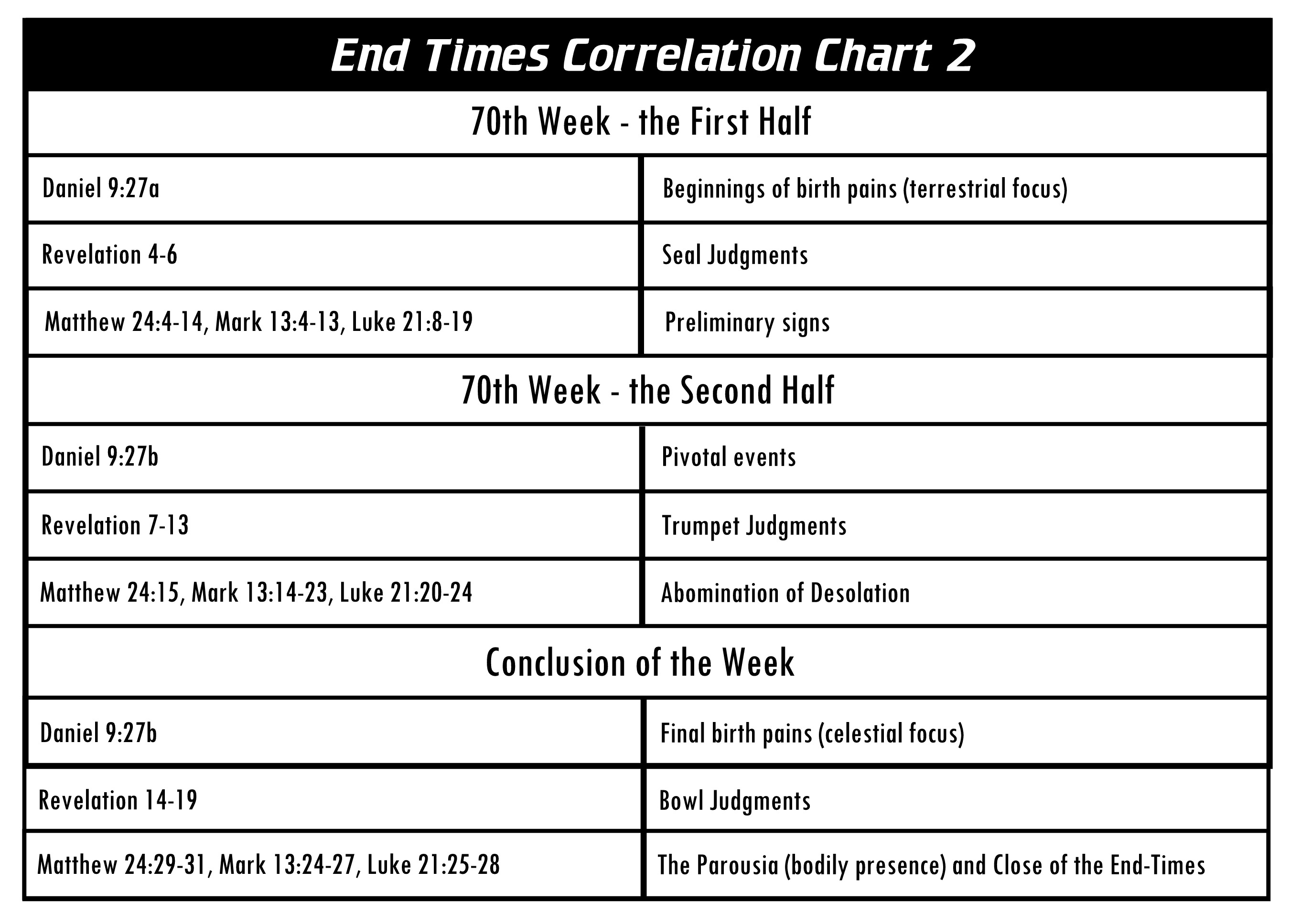
How to be Ready for the End

This lesson is all about How to be Ready for the End-times. While I am a proponent of the A-millennial view of the end times, much of this teaching is part of the Pre-millennial Dispensational position. When you hear John Hagee or Tim LaHaye, or read the Left Behind series, they’re talking about end-times prophecy from this point of view.

To better understand the A-millennial view, read Ray Summers little book called, “Worthy is the Lamb,” Broadman Press, 1951. Also, I will post My Notes on Daniel and My Notes of the Revelation at a later date.

Main Verse: Matthew 24:44 –  For this reason you also must be ready; for the Son of Man is coming at an hour when you do not think He will. 

Passages we will consider: Matthew 24:1-51; Mark 13:1-37; Luke 21:5-36

Purpose: The purpose of this study is to develop the character quality of readiness (preparedness, watchfulness) in anticipation of Christ’s return. Scripture teaches that anticipating Christ’s return motivates us to live in light of eternity (1 Corinthians 15:29-34); causes us to keep ourselves pure (1 John 3:2,3); provides steadfastness inspired by hope (1 Thessalonians 1:3,10); and promises a reward for loving His appearing (2 Timothy 4:8).

Historical Background: Jesus’ instruction to His disciples from the Mount of Olives (Mount Olivet, giving it the name the Olivet Discourse) appears in Matthew 24-25; Mark 13; and Luke 17:20-37. It is one of the Bible’s most important texts because it not only provides the Lord’s final discourse but also His most extensive prophetic teaching.

Much prophetic confusion has resulted from a failure to understand that the Olivet Discourse involves Israel, not the church, and refers to a future (eschatological) age, not the past or present one.

The chronologically of this narrative (Mark 12:28-34) occurs the Wednesday before the crucifixion and immediately after Jesus brought eight “woes” against the leaders of the nation of Israel (Matthew 23:13, 14, 15, 16, 23, 25, 27, 29).

Jesus uses five illustrations to answer the specific questions of the disciples: “‘When will these things be? And what will be the sign of Your coming, and of the end of the age?”‘ (Matthew 24:3).

Like any other passage of Scripture, the Olivet Discourse (Jesus’ answer to these questions) must be interpreted in context. Matthew wrote his Gospel to Jewish people to present divinely attested proof that Jesus (Yeshua) was the legitimate heir to the Davidic throne and that His Messianic claims were true and justified.

Commanded in the Gospels: Matthew 24:42 (Be on the alert), Matthew 24:43 (Be sure of this) – literally “know this,” Matthew 24:44 (Be ready), Matthew 25:13 (Be on the alert), Mark 13:33 (Take heed, Keep on the alert), Mark 13:35 (Be on the alert), Mark 13:37 (Be on the alert). Christ also used five parables to teach the importance of being ready for His second coming:

  1. Thief – Matthew 24:43
  2. Faithful slave – Matthew 24:45-51
  3. Ten virgins ­ Matthew 25:1-12
  4. Talents – Matthew 25:14-30
  5. Doorkeeper – Mark 13:34-36

End times information is found in the Book of Acts (Acts 1:6-7) and the Epistles (1 Thessalonians 5:1- 11; 2 Peter 3:10; Revelation 3:3,1 1;22:7,12,20)

Discussion Questions:

1. What motivated the disciples to point out the temple buildings to Jesus? (Matthew 24:1) Aware of Jesus’ pronouncement against the nation and particularly the Temple establishment (He had just said, “Behold, your house [Temple] is being left to you desolate” – Matthew 23:37-38) the disciples perhaps thought a reminder of the national unity symbolized by the Temple might temper Jesus’ disposition toward national judgment.

A few days earlier, Christ had referred to the temple as His Father’s “house” (Matthew 21:13) but the blessing and glory of God were being removed from Israel (see 1 Samuel 4:21). When Christ “departed from the temple” (Matthew 24:1), the glory of God went with Him. Ezekiel 11:23 describes Ezekiel’s vision of the departure of the Shekinah glory in His day. The glory left the temple and stood on the Mount of Olives.

The disciples were also impressed, as were most in that day, with the Temple’s unrivaled magnificence, which had become a source of national pride: “Some were talking about the temple, that it was adorned with beautiful stones and votive gifts (donations)” (Luke 21:5-6). The disciples made their national statement to Jesus as He left the Temple. While waiting for Him they began pointing out the latest structural additions to the compound, which (according to John 2:20) had been in process for 46 years: “Teacher, behold what wonderful stones and what wonderful buildings!” (Mark 13:1).

Maybe they were trying to comprehend Jesus’ judicial remarks, but then Jesus states that all of the stones they had shown Him would be violently torn down at the time of judgment. Matthew 24:2 says, “And He said to them, “Do you not see all these things? Truly I say to you, not one stone here will be left upon another, which will not be torn down.”

2. What were the two questions that the disciples asked Jesus privately? (Matthew 24:3)

  • “When will these things happen?”
  • “What will be the sign of your coming, and of the end of the age?”

The first question concerned the specific time of the Temple’s destruction: the second (composed of two related parts) concerned “the sign” that would mark Jesus’ advent to Israel (parousia, “bodily presence”) as Messiah at the end of the age. Jesus’ response to these questions forms the prophetic teaching called the Olivet Discourse. The first question is addressed in Luke 21:10-24 and the second is addressed in Matthew 24:4-31 and Mark 13:1-27.

3. What event fulfilled Jesus’ prophetic prediction that “not one stone here will be left upon another, which will not be tom down“? (Luke 21:10-24) When Titus came down in AD 70, he burned the Temple. The foundation stones were made of marble overlaid with gold. As the temple burnt the gold melted and ran down between the cracks in the rocks. The Roman soldiers had to dismantle every stone in order to get to the gold. This “near prophecy” was fulfilled in 70 AD and provided hope that the “far prophecy” would be fulfilled. Prophets would often give a “near prophecy” to validate their credentials as a prophet. Anyone could predict all kinds of things way off in the future.

4. When the disciples spoke of “the end of the age,” to what were they referring? (Matthew 24:3) Christ was not referring to the end of the church age but the end of the age for Israel before the Messiah’s return. The church at this point in time doesn’t even exist. It was started by Christ baptizing believers by the Holy Spirit into a new thing called “the Body of Christ” on the day of Pentecost (Acts 1:5; 2:1-4; 11:13-16; 1 Corinthians 12:13). The church age was a mystery that wasn’t revealed in the Old Testament.

Jesus had already prophetically talked about “the end of the age” (Matthew 13:40,49) for the nation of Israel. In the Parable of the Tares (Matthew 13:24-30, 36-43) Jesus talks about “the end of the age” (Matthew 13:39,40, 13:49) that occurs right before the establishment of the millennial kingdom.

When Jesus explained this parable, He taught that at the end of the age the angels will take all unbelievers away to be burned and all the righteous believers will remain on the earth to be “barned” in the millennial kingdom. The parable of the dragnet (Matthew 13:47-50) teaches the same truth.

5. What will be the “signs” of Christ’s Second Coming? (Matthew 24:4-8) This passage describes the signs, “birth pains” or divine judgments of the first half of the tribulation period, and Matthew 24:14 is the global evangelization that will be accomplished by the midpoint of this period. Remember, this is according to the Pre-millennialism.

Jesus stated that these judgments are not “the end” of the judgments but merely the “beginning” (Matthew 24:8). After “beginning birth pains,” the more intense birth pains come that climax the birth process. Since the tribulation does not immediately begin after the rapture of the church, but begins with the commencement of Daniel’s 70th week (Daniel 9:27), these verses cannot describe events within the Church Age.

The most compelling argument for a Tribulation context for these verses comes from a comparison of Matthew 24:4-13 with the first five seal judgments in Revelation 6.

End Times Corrolation Chart 1

Neither can these signs be used by the church as “signs of the times” to indicate the nearness of the Lord’s coming. Many Christians have used the apparent increasing frequency of earthquakes, apostasy in the church, and moral decline in society in general as indicators that we are fast approaching the rapture and the end-times. However, the rapture is a signless event; and these birth pains do not begin until Israel enters “the time of Jacob’s trouble” (Jeremiah 30:7). Since we do not know how long this will be after the rapture, we must exercise caution in trying to predict the nearness of end-times events based on the presence of these conditions in the present age (Matthew 24:9-14).

6. Does Matthew 24:13 teach that we can lose our salvation? Taken out of context this verse could be used to deny eternal security. There is no reference to redemption or salvation here. The word saved (sothesetai) is eschatological and not soteriological. This verse promises that Christ will rescue those who endure to the end of the tribulation period; then He will usher them into the millennial age. This same concept is repeated in Matthew 24:21-22.

7. Will every unbeliever hear the gospel before the rapture of the church? (Matthew 24:14) The answer is no. This is a reference to the end of the tribulation period and not to the end of the church age. In context this verse teaches that the good news about the kingdom will be presented throughout the tribulation period, and then the end will come. In fact this verse promises that every earth dweller will hear the “gospel of the Kingdom” before Christ returns. Some teach the gospel of the kingdom will probably be proclaimed by the 144,000 Jewish evangelists (Revelation 14:1).

8. What does Jesus say to look for to know that the Great Tribulation has begun? (Matthew 24:15-20) The phrase “the ABOMINATION OF DESOLATION” originally referred to the desecration of the temple by Antiochus Epiphanes, king of Syria in the second century BC. Antiochus invaded Jerusalem in 168 BC, made the altar into a shrine to Zeus, and even sacrificed pigs on it.

However, Jesus clearly was looking toward a yet-future “abomination of desolation.” Some suggest that this prophecy was fulfilled in AD 70 when Titus invaded Jerusalem and destroyed the temple. However, the Apostle Paul saw a still-future fulfillment (2 Thessalonians 2:3-4), as did John (Revelation 13:14-15) when the Antichrist sets up an image in the temple during the future tribulation period. Christ’s words here therefore look beyond the events of AD 70 to a time of even greater global cataclysm that will immediately precede his coming (Matthew 24:29-31).

The Abomination of Desolation involves God being replaced with man in the Most Holy Place of the temple. We are told in Scripture that when the Antichrist is empowered by Satan (Revelation 13:1-4) he will enter the Jewish temple and claim to be god (2 Thessalonians 2:3-4). He then makes war with Israel (Revelation 12:13-17). This act by the Antichrist ushers in the “Great Tribulation” (Matthew 24:21).

9. Who will gain the greatest benefit in reading this discourse? (Matthew 24:15) Both Matthew and Mark (Mark 13:14) tell the reader to consider this text as a means to understanding the prophecy of the Olivet Discourse. This portion of Scripture will be a manual for tribulation saints, complete with a list of imperatives of what to do when they see the Antichrist go into the temple and establish himself in place of the one true God (Matthew 24:16-20).

Many prophetic teachers believe that the command to “flee into the mountains” is a reference to “Petra” (Revelation 12:14). Petra becomes a wilderness and mountainous “hiding place” for the Jewish people. Petra is hidden in the barren mountains of southern Jordan. It is a city that once ranked with almost any in the ancient world. Petra was carved from richly colored sandstone at the crossing of key caravan routes and thrived for a thousand years before it was devastated by earthquakes. Drifting sand covered the ruins.

Note the reference to the Sabbath (Matthew 24:20) which would be of no concern to the church (Colossians 2:16) but of great importance to orthodox Jews who are bound to keep the Sabbath as a perpetual covenant (Exodus 31:13,16; 35:2; Deuteronomy 5:12-15; Numbers 15:32-36). We have a reference to the distance a Jew was allowed to travel in Acts 1:12 “Then they returned to Jerusalem from the mount called Olivet, which is near Jerusalem, a Sabbath day’s journey away.” A Sabbath day’s journey was 2,000 cubits or approximately 3/5 of a mile.

10. How did Jesus use the 70th week of Daniel as a template to answer the disciples’ question? Jesus used the 70th week prophecy as the template for the chronological events He unfolded in His response to the disciples’ questions. This also applies to the judgment section of Revelation (chapters 4-19) where Jesus, the one who gave the Revelation vision to the Apostle John (Revelation 4; Daniel 7:25; 12:7,11,12).

Viewing these texts together (see Correlation Chart 2 below), we find that the “beginning” birth pains of Matthew 24:4-14 correlate with the seal judgments of Revelation 4-6, which…

  1. Have a terrestrial focus;
  2. Fit within the first half of Daniel’s 70th week (Daniel 9:27a); and
  3. Climax with the pivotal event of the Temple’s desecration (abomination of desolation) in Matthew 24:15 and Mark 13:14, the midpoint of Daniel’s 70th week (Daniel 9:27b).

End Times Corrolation Chart 2

Events then intensify to concluding birth pains in Matthew 24:16-26, which…

  1. Correlate with Revelation 7-19,
  2. Have a celestial focus, and
  3. Climax with the heavenly appearing of “the sign” of Messiah’s advent to earth in judgment (Matthew 24:27-31; Revelation 19).

These events fit within the last half of Daniel’s 70th week (Daniel 9:27b), which concludes with the destruction of the temple’s desolator (“the prince who is to come,” the Antichrist, Daniel 9:26).

If Matthew 24:4-14 predict signs that are for the future tribulation period and relate primarily to the Jewish people of that day, they cannot have had a past fulfillment, especially not with the fall of Jerusalem in AD 70. Comparing the events in these verses reveals that they cannot be identified with first-century historical events.

11. How would you describe the nature of the Great Tribulation? (Matthew 24:21-28) The words “has not occurred” and “nor ever will,” along with the description that follows­, identify this as the yet-future time in which God’s wrath shall be poured out upon the earth (see Revelation 7:14). Jesus’ descriptions of the cataclysms that follow closely resemble the outpouring of divine wrath described in the bowl judgments of Revelation 16 and his subsequent appearing in Revelation 19.

Old Testament writers predicted the Great Tribulation in similar terms.

  • Daniel 12:1 – “Now at that time Michael, the great prince who stands guard over the sons of your people, will arise And there will be a time of distress such as never occurred since there was a nation until that time; and at that time your people, everyone who is found written in the book, will be rescued.”
  • Jeremiah 30:7 – “Alas! For that day is great, there is none like it; and it is the time of Jacob’s distress, but he will be saved from it.”
  • Matthew 24:22 – “Unless those days had been cut short, no life would have been saved; but for the sake of the elect those days will be cut short.“

Jesus indicates that if God in eternity past had not determined to cut short the second half of the tribulation to three and 1/2 years, all flesh would perish. For mankind to survive, God determined to prevent the time of “Great Tribulation” from running indefinitely beyond the time limit He had set.

Jesus’ statement implied that this period will be the unparalleled time of trouble for all flesh (Jewish and Gentile) on Earth. For several reasons, this fact prevents the “Great Tribulation” from referring to the Roman Empire’s destruction of Jerusalem, the second Temple, or Israel as a nation-state in A.D. 70:

  1. Only Jewish flesh was threatened in A.D. 70.
  2. The A.D. 70 destruction was not worse than that of Samaria and the northern kingdom of Israel as a nation-state in 722 B.C. or the destruction of Jerusalem, the first Temple, and the kingdom of Judah as a nation­state in 586 B.C.
  3. The destruction of A.D. 70 was not worse than the Holocaust of World War II. Four times as many Jewish people were killed in the Holocaust than in the war that ended in A.D. 70.

12. How does Satan mislead people during the Tribulation Period? (Matthew 24:4,5,11,23-28) Jesus warns his audience to “see to it,” which denotes “to keep your eyes open” that “no one misleads you” (Matthew 24:4; Mark 13:5). Jesus speaks of the future reality that many will be misled (Matthew 24:5, 11 ,24; Mark 16:6). The verb “mislead,” in the active voice means “to deceive by leading into error,” and in the passive voice “to go astray, wander,” (Vines pg.151). These false Christs and false prophets are wandering or shooting-stars that are no longer in a sound doctrine orbit. Jesus warns against false prophets who set forth false Messiahs. These false Messiahs will attempt to establish their credibility through counterfeit sign miracles. Matthew 24:24 says “For false Christ’s and false prophets will arise and will show great signs and wonders, so as to mislead, if possible, even the elect” (cp. Mark 13:22).

Most of the charismatic gifts today are unsimilar to those of the apostolic period. The charismatic sign gifts today are not limited to the Christian church. These experiences transcend denominational lines and are even present in different world religions and cults today. A case in point is the experience of those in the New Age movement who have the Kundalini spirit.

The Kundalini spirit has invaded the church masquerading as the Holy Spirit. It appears that these ecumenical “spirit experiences” may be one of the unifying factors that can bring together a one world religion under the Antichrist after the true church has been raptured. Satan is the source of this end time deception (Revelation 12:9; 13:14; 18:23; 19:20; 20:3, 8, 10).

2 Thessalonians 2:7-10 For the mystery of lawlessness is already at work; only he who now restrains will do so until he is taken out of the way. 8 Then that lawless one will be revealed whom the Lord will slay with the breath of His mouth and bring to an end by the appearance of His coming; 9 that is, the one whose coming is in accord with the activity of Satan, with all power and signs and false wonders, 10 and with all the deception of wickedness for those who perish, because they did not receive the love of the truth so as to be saved.

Revelation 13:11-14 Then I saw another beast coming up out of the earth; and he had two horns like a lamb and he spoke as a dragon. 12 He exercises all the authority of the first beast in his presence And he makes the earth and those who dwell in it to worship the first beast, whose fatal wound was healed. 13 He performs great signs, so that he even makes fire come down out of heaven to the earth in the presence of men. 14 And he deceives those who dwell on the earth because of the signs which it was given him to perform in the presence of the beast, telling those who dwell on the earth to make an image to the beast who had the wound of the sword and has come to life.

13. Does Matthew 24:29-31 refer to the Rapture or the Glorious Appearance at the end of the Tribulation Period? (Matthew 24:29-31) The Second Advent or Coming of Christ has two phases. The first phase is the “rapture of the church” before the tribulation period and the second phase is called the “revelation” that occurs at the end of the Tribulation Period. These two “comings” are clearly contrasted on the chart below.

Second Coming Chart

14. What is the sign of the Son of Man’s Coming? (Matthew 24:30) The Son of Man himself is the sign. The events described here precisely parallel the description in Daniel 7:13; Revelation 19:11-21 . The phrase “all the tribes of the earth will mourn” refers to people of different nationalities who mourn over their own rebellion. Israel in particular will mourn over their rejection of the Messiah (Zechariah 12:10-12).

15. What are the five illustrations that Jesus uses to illustrate the importance of being ready for Christ’s return? (Matthew 24:32-25:30) Jesus instructed His disciples to “be ready” for His return. Christ used five illustrations to make His point:

  1. The Parable of the Fig Tree (Matthew 24:32-35)
  2. The Days of Noah (Matthew 24:36-39)
  3. The Faithful and Evil Slave (Matthew 24:45-51)
  4. The Ten Virgins (Matthew 25:1-13)
  5. The Parable of the Talents (Matthew 25:14-30)

Just as windows let in sunlight, so illustrations illuminate the soul. With delicate yet direct statements, Jesus directed His disciples to God’s divine purposes and disclosed predictive prophetic events that will involve Israel as a nation.

16. What is Jesus trying teach through the parable of the fig tree? (Matthew 24:32-35) Matthew 24:34 says, “Truly I say to you, this generation will not pass away until all these things take place.” Jesus was not referring to the generation of his disciples who listened to him then. This fact is obvious from Matthew 21 :43, where he said, “The kingdom of God will be taken from you and given to a nation bearing the fruits of it.” Historically, the first-century generation would pass away, but the generation of Jewish people living when these signs begin will survive that period and see Messiah come as the King of glory. Yeshua’s promise is certain. It is easier for heaven and earth to pass away than for the King’s words to fail (Matthew 24:35; 5:18).

This parable is also not referring to the generation when Israel became a state in 1948. The text is describing the tribulation generation. The fig tree is a sign of approximation. When the generation that is alive sees the signs listed in these verses they can be confident that Christ’s return will be in their lifetime. Just as tender fig branches that put forth their leaves on the fig tree act is a sign that summer is near, so the signs in this passage tell us that Christ’s second coming is soon. The generation that sees these signs won’t know the precise hour or day but the general period of time (Matthew 24:36).

Unfortunately these verses have been misused to determine the timing of the return of Christ. Some prophetic teachers of the past predicted that the rapture would occur in 1981 . Their rational was that the fig tree represents Israel who became a nation in 1948. If you add a generation (40 years) onto 1948 it adds up to 1988. If we subtract a 7 year tribulation period you would have Christ returning for the church in 1981 (The Late Great Planet Earth by: Hal Lindsey, Bantam Books, 1970, pg.43).

17. How can we know the exact time when Christ returns? (Matthew 24:36) Jesus said, “But of that day and hour no one knows, not even the angels of heaven, nor the Son, but the Father alone.” Jesus declared categorically that no one knows the “day and hour” of Christ’s return. The signs He had just been describing will be conclusive proof that his arrival is very near. Once they have begun, the general time period of his return will be known, because one of the key purposes of the signs will be to make it known. But even during those sign-days the precise “day and hour” of Jesus’ appearing will not be known, a truth he reiterates several times in this Olivet Discourse (see Matthew 24:42, 44, 50; 25:13).

Neither will the supernatural world know the precise time, not “even the angels of heaven.” Although the righteous angels enjoy intimacy with God, hovering around His throne to do his bidding (Isaiah 6:2-7) and continually beholding his face (Matthew 18:10), they are not privy to this secret. The angels will be directly and actively involved in the end time as God’s agents to separate the saved from the unsaved (see Matthew 13:41, 49), but for his own reasons God the Father will not reveal in advance exactly when he will call them into that service.

Still more amazingly not even “the Son” knew at the time he spoke these words or at any other time during his incarnation. Although he was fully God as well as fully man (John 1:1, 14), Christ voluntarily restricted his use of certain divine attributes when he became flesh. “Although He existed in the form of God, [He] did not regard equality with God a thing to be grasped,” that is, to be held onto during his humanness (Philippians 2:6). It was not that he lost any divine attributes but that he voluntarily laid aside the use of some of them and would not manifest those attributes except as directed by his Father (John 4:34; 5:30; 6:38).

18. How does Jesus’ second illustration stress the importance of readiness? (Matthew 24:37-42) Notice that the people in the days of Noah went about their lives while judgment was coming. In total disregard for Noah’s warning (2 Peter 2:5) the people of his day were unconcerned and went about their business as usual. When the flood came who was taken? The unbelievers were taken and the righteous remained on the earth. In the same way when Christ comes the unbelievers will be taken and “burned” (Matthew 13:40-42) but the believers will be left on planet earth to be “barned” (Matthew 13:43) in the Kingdom. This is in contrast to the rapture when believers are taken and unbelievers are left behind to face God’s wrath in the tribulation period. Remember that Jesus is speaking about the Jewish people (not the church) and the consummation of the age for the nation of Israel as they finish out the 70th week of Daniel in preparation for millennial kingdom.

Jesus says, “Therefore,” in view of this illustration you ought to be “be on the alert (present imperative), for you do not know which day your Lord is coming”(Matthew 24:42). The phrase “be on the alert” translates a present imperative, indicating a call for continual expectancy.

19. What characteristics demonstrate readiness in Jesus’ third illustration? (Matthew 24:43-51) In the illustration of the faithful and evil slave, Jesus stresses the importance of being ready in case he comes sooner than anticipated (Matthew 24:43-51). His point here is alertness, vigilance, readiness, preparedness in light of his sudden return. The Lord is coming, and his coming will test his slaves. The illustration is simple, yet sublime. Just as the master in Jesus’ story entrusted all his possessions to his slave, so the God of Israel has entrusted all things in the earth to his slaves. A slave’s response to his Lord reveals the true condition of the slave’s heart (Matthew 24:46, 48-49). The Lord wants to find his slaves faithfully doing his will (Matthew 24:45-46). When the Lord returns, he will reward faithfulness (Matthew 24:47). Failure to do the Lord’s bidding is faithless stewardship and brings the Lord’s just punishment because, in the parable, when such a slave noted his master’s delay, he abused his own slaves. Yet the master returned to the house unexpectedly, and judgment came (Matthew 24:50-51).

In the Lord’s eyes, that slave was a hypocrite. Thus he was separated from the others and consigned to eternal judgment, where there is “weeping and gnashing of teeth” (Matthew 13:42). Likewise, at the Messiah’s second coming, the wicked will be judged and separated eternally from God.

These parables of the faithful and evil slave and the talents given them by the master speak of the privileges God has given to his covenant people Israel and the consequences of willful and prolonged disobedience.

“But be sure of this (present imperative), that if the head of the house had known at what time of the night the thief was coming, he would have been on the alert and would not have allowed his house to be broken into. 44 For this reason you also must be ready (present imperative) for the Son of Man is coming at an hour when you do not think He will.” (Matthew 24:43-44)

As no one knows what hour the thief will come, no one knows the hour of the Lord’s return or the Day of the Lord that accompanies his coming (1 Thessalonians 5:2; 2 Peter 3:10). But the believer is to be ready at all times.

The evil slave represents an unbeliever who refuses to take seriously the promise of Christ’s return (2 Peter 3:4). Though he is an unbeliever (as demonstrated by his punishment – Revelation 22:13), he is still accountable to Christ for the stewardship of his time. Jesus was teaching that every person in the world holds his life, natural abilities, wealth, and possessions in trust from God and must give account of how these things are used.

“Who then is the faithful and sensible slave whom his master put in charge of his household to give them their food at the proper time? 46 Blessed is that slave whom his master finds so doing when he comes. 47 Truly I say to you that he will put him in charge of all his possessions.” (Matthew 24:45-47)

The believer who is found faithful to the Lord in what he has been given will be given charge of all of the Lord’s possessions, having inherited the absolute fullness of the kingdom of God as a fellow heir of Jesus Christ.

Jesus said, “But if that evil slave says in his heart, ‘My master is not coming for a long time, 49and begins to beat his fellow slaves and eat and drink with drunkards“‘ (Matthew 24:48,49)

The evil activities Jesus then mentions, the beating of “fellow slaves” and eating and drinking “with drunkards,” are not meant to characterize every unbeliever during the tribulation, but those activities reflect the attitude many of them will have. Because they think the Lord will not come “for a long time” (Matthew 24:48), they will feel free to indulge themselves in whatever sins and pleasures they desire.

Jesus said, “the master of that slave will come on a day when he does not expect him and at an hour which he does not know 51and will cut him in pieces and assign him a place with the hypocrites; in that place there will be weeping and gnashing of teeth.” (Matthew 24:50-51)

In this case the master will not come as Savior and King to bless and to reward but will come as Judge and Executioner to condemn and to destroy. He will cut the unbelieving slave in pieces and assign him a place with the hypocrites in eternal fire.

The phrase “cut…in pieces’ literally means to cut into two parts. It is used in that strict sense in the Greek translation of the Old Testament in regard to the preparation of an animal sacrifice (Exodus 29:17). To Jews it would therefore carry the unmistakable idea of destruction and death.

The fact that such persons will be assigned along with the hypocrites suggests that they were not hypocrites themselves. Just as today, many people in the end time will be open and honest about their unbelief, even wearing such honesty as a badge of intellectual and moral integrity. But honest unbelievers are just as lost as hypocrites who pretend to have faith. They will go to the same place as the religious phonies they feel superior to and despise.

20. How does this command apply to believers in the Church Age? (Revelation 3:3, 11; 22:7, 12, 20) The Olivet Discourse teaches that when Jesus returns to the earth to establish his kingdom, his return will be unexpected like a thief in the night. Scripture also likens Christ’s coming in the air to rapture his church to the unexpected arrival of a thief.

Jesus told the church at Sardis – “To the angel of the church in Sardis write: He who has the seven Spirits of God and the seven stars, says this: ‘I know your deeds, that you have a name that you are alive, but you are dead. 2 Wake up, and strengthen the things that remain, which were about to die; for I have not found your deeds completed in the sight of My God. 3 ‘So remember what you have received and heard; and keep it, and repent Therefore if you do not wake up, I will come like a thief. and you will not know at what hour I will come to you” (Revelation  3:1-3).

There are no signs or prophetic promises that have to be fulfilled before Christ comes to snatch away (“rapture”) his bride the church (1 Thessalonians 4:13-18). The rapture can happen at any moment. When evaluating the church of Philadelphia Jesus said – “I am coming quickly; hold fast what you have, so that no one will take your crown” (Revelation 3:11).

Other verses emphasize the imminent return of Christ for us His church:

  • Revelation 22:7 “And behold, I am coming quickly Blessed is he who heeds the words of the prophecy of this book.”
  • Revelation 22:12 “Behold, I am coming quickly, and My reward is with Me, to render to every man according to what he has done.”
  • Revelation 22:20 He who testifies to these things says, “Yes, I am coming quickly” Amen Come, Lord Jesus.

The theme of Christ’s “any moment” return has been the basis for New Testament writers to appeal to their audiences to “abide in him (1 John 2:28); live pure lives (1 John 3:2,3); remain steadfast (1 Thessalonians 1:3, 10); and to see any delay in Christ’s return as an opportunity to win our unsaved loved ones, friends, and coworkers to Christ (2 Peter 3:8-15a).

Paul said, “in the future there is laid up for me the crown of righteousness, which the Lord, the righteous Judge, will award to me on that day; and not only to me, but also to all who have loved His appearing” (2 Timothy 4:8).

21. How can we maintain a readiness according to 1 Thessalonians 5:6-11? The Apostle Paul years earlier challenged the Thessalonian believers to be ready for the rapture of the church with these words. Readiness is only achieved as we are alert, sober, putting on the armor, encouraging and building up one another.

Sources:

The questions and answers for this study were gleaned from the following resources.
1 . Serendipity Bible for Groups by: Serendipity House, Zondervon Publishing House, 1998
2. Donie/: The Kingdom of the Lord by: Charles Lee Feinberg, BMH Books, 1981
3. The Expositors Bible Commentary, Volume 8 by: Frank E. Goebelein (General Editor), Zondervan Publishing House, 1984
4. Chronological Aspects of the Life of Christ by: Harold W. Hoehnew, pages 115-139. Zondervon Publishing House, 1977.
5. The End Times by: Hermon A. Hoyt, Moody Press, 1969
6. And the Angels Were Silent by: Max Lucado, pages 133-138, Multnomoh, 1992
7. The MacArthurs New Testament Commentary: Matthew 24-28 by: John F. MacArthur Jr., Moody Press, 1 981 .
8. The Greatness of the Kingdom by: Alva J. McClain, BMH Books, 1974.
9. Things to Come: A Study in Biblical Eschatology by: J. Dwight Pentecost, Zondervan Publishing House, 1958.
10. A Survey of the Eschatology of the Olivet Discourse. Part 1. Pages 162-173. Bibliotheca Sacra, Volume 113, April 1956, No. 450 by: James F. Rand, Dallas Theological Seminary.
11 . A Survey of the Eschatology of the Olivet Discourse. Port 2. Pages 200-213. Bibliotheca Sacra, Volume 113, July 1956, No. 451 by: James F. Rand, Dallas Theological Seminary.
12. Dispensotionolism Today by: Charles C. Ryrie, Moody Press, 1965.
13. There Really is a Difference! A Comparison of Covenant and Dispensotionolism Theology by: Renald E. Shower, The Friends of Israel Gospel Ministry, Inc., 1990.
14. Chrisfs Olivet Discourse on the End of the Age by: John F. Wolvoord, pages 206-21 0. Bibliotheca Sacra, Volume 129, July-September 1972, No. 515. Dallas Theological Seminary.
15. Chrisfs Olivet Discourse on the End of the Age by: by: John F. Wolvoord, pages 206-214. Bibliotheca Sacra, Volume 128, July-September 1971, No. 511. Dallas Theological Seminary.
16. Daniel: The Key to Prophetic Revelation by: John F. Wolvoord, pages 216-237; 267-268. Moody Press, 1971 .
17. Chrisfs Olivet Discourse on the End of the Age by: John F. Walvoord, pages 99-105. Bibliotheca Sacra, Volume 129, April-June 1972, No. 514. Dallas Theological Seminary.
18. Is the Church in View in Matthew 24-25? by: Bruce A. Ware, pages 158-172. Bibliotheca Sacra, Volume 138, April-June 1981, No. 550. Dallas Theological Seminary.
19. The Bible and Future Events: An Introductory Survey of Lost-Day Events by: Leon J. Wood, Zondervon Publishing House, 1973.
20. Understanding the Olivet Discourse, by: Randall Price, Israel My Glory, May/June 2005
21 . Perusing the Future by: Randall Price, Israel My Glory, May/June 2005 pages 11,12,30
22. The Times of Jacob’s Trouble, Israel My Glory, May/June 2005 pages 14-17
23. 11/ustrotions From the King, by: Deane Woods,Israel My Glory, May/June 2005 pages 20-21

[Based on my classes with Richard D. Leineweber Jr.]
© Copyright 1994 Richard D. Leineweber Jr.

New Testament Discipleship

This message called, New Testament Discipleship, comes from 2 Timothy 1:3-12.

Christianity is not a solitary sport, it is a team effort. When we come to faith in Christ, we join a global and a local community, in essence, this community is a timeless spiritual family. When you join a family, you are not alone. People look out for one another. So, how are lives connected in corporate worship? In this room we are all pretty much spectators. It is in a small group that we become participants.

I love small groups and I always encourage people to get involved and join one. It is easy to shop around here at King’s Grant because we have so many groups from which to choose. If you want to explore a group in which to get involved, let me know.

I can talk a whole lot about why small groups are important, but time is limited and I want to go through this text. While Skip used this text two weeks ago, I plan to go in a total different direction. We can talk about timothy and his family, but I prefer to talk about Timothy’s and Paul’s connection through being a part of a faith community. Let’s get started…

1. Reassurance (2 Timothy 1:3) – I thank God, whom I serve with a clear conscience the way my forefathers did, as I constantly remember you in my prayers night and day.

The text tells us that Paul was praying for Timothy, and that he likely had confidence in him. The first thing you notice is the relational aspect of these to followers of Christ. Those who are connected to Jesus pray for one another. In a small group, we are pilgrims on the same journey, giving support, encouragement, and challenge to those in the group. It is a blessing to be involved with fellow believers on a similar journey.

Speaking of blessing, we have the potential to bring out the best in those whom we bless. From the very beginning, God intends for his people to bless others (Genesis 12:1-3, Galatians 3:8). (Smalley and Trent, The Blessing, 1986). What does a blessing entail? How do we bless others? Imagine doing all of the following in a small group…

  1. Expressing Unconditional Love: agape is God’s kind of love, you cannot earn it nor can you lose it. It is not a love that says, “I love you because…” or “I will love you if…” – it is a love that says, “I love you anyway.” There is security in this sort of relationship.
  2. Uttering Spoken Words: a blessing is only a blessing when it is spoken. It matters not how much you care about someone if you never let them know about it. When you invest into other people, you cannot keep silent.
  3. Articulating High Value: Perhaps you saw the movie called, “The Help.” The main character is a black maid who worked for this 1960’s white southern household. This strong woman had a great statement that she repeated in the film, and the little white girl was able to quote it back to her, “you is kind, you is smart, you is important.”
    1. It is like a family reunion, people are usually speaking to each other and talking all over the place but in that final hour people preparing for their goodbyes and are expressing the most important things that need to be said.
    2. Picture the undeveloped traits or habits or qualities in other people that can grow in their heart. Our desire is for them to be the best they can be for the kingdom’s sake.
    3. When we value others, we bring out their best.
  4. Picturing a Special Future: You can do this and thereby bring joy to people. You will make an impact on the kingdom of God and will be encouraging them to make a difference as well.
    1. Picturing a special future is like how Jesus encourages us by mentioning a wonderful statement at the end of time, “well done good and faithful servant,” which bring out the best in our lives, a desire for transformation into godly men and women.
    2. Kim is a hospice chaplain and I often remind her, usually when she leaves the house in the morning, or after a long and difficult day or week, that she is making a difference in the lives of people, especially at this critical stage in their lives, and the lives of their family members and staff.
  5. Disciplining When Needed: You may be thinking that I am just talking about parents and children, but discipline is greater than just a family because as followers of Jesus, we will fail many times in our lives. We need God’s discipline, and often that will come through fellow believers whom we trust and we know they have our back. We are to balance praise and correction. God deals with us rather than ignoring the wrong behavior; the same is true for our brothers in Christ. We cannot ignore behavior that goes against the teachings of the Bible. Ok, let’s move on to…

2. Reminiscence (2 Timothy 1:4-5) longing to see you, even as I recall your tears, so that I may be filled with joy. 5 For I am mindful of the sincere faith within you, which first dwelt in your grandmother Lois and your mother Eunice, and I am sure that it is in you as well.

Two things are noticed here…

  1. Tears (2 Timothy 1:4) What Paul desired, (he longed to see Timothy again).
  2. Testimony (2 Timothy 1:5) What Paul described…
    1. The Reality of Timothy’s faith (2 Timothy 1:5a) (mindful of the sincere faith he had).
    2. The Roots of Timothy’s faith (2 Timothy 1:5b) (which came through his mother and grandmother)
    3. The Reinforcement of Timothy’s faith (2 Timothy 1:5c) (I am sure it is in you as well). It is important to think about from where we have come, and how faith entered our lives. It is very good to share with others in your small group about how you came to faith in Christ, and reaffirm the faith we see in others.

3. Refocus (2 Timothy 1:6-7a) For this reason I remind you to kindle afresh the gift of God which is in you through the laying on of my hands. 7 For God has not given us a spirit of timidity…

  1. Stir up the Gift of God (2 Timothy 1:6) (Kindle afresh the gift of God) Small groups are training ground for living life on purpose, being on mission, and living a missional life.
  2. Suppress the Fear (2 Timothy 1:7a) (we don’t have a spirit of timidity or fear). There is strength in numbers, so your small group will give you the encouragement you need to stand strong in the face of the struggles of life. Finally, we are to

4. Remember (2 Timothy 1:7b-12) Remember what, you ask?

  1. Spirit (2 Timothy 1:7b) (not a spirit of fear, but of power and love and discipline). The Spirit is the one whom Jesus promised to send that would fill us with the power to change the world (Acts 1:8). We must remember that in a small group, we do not depend upon our own power, creativity, teaching, or anything, but we allow the power of the Spirit to flow through us.
  2. Son (2 Timothy 1:8) Therefore do not be ashamed of the testimony of our Lord or of me His prisoner, but join with me in suffering for the gospel according to the power of God,
    1. Don’t be Ashamed (2 Timothy 1:8a) – of the testimony of Jesus. We know what Jesus did to secure our salvation, so never be ashamed of the gospel story. We don’t need to apologize to unchurched people about what we believe, especially when it goes against what the intolerant left mainstream culture promotes.
    2. Don’t be Afraid (2 Timothy 1:8b) – of Paul or Prison. When our society labels us intolerant and narrow-minded, and they come after the church and Christians, don’t be afraid to join with Paul in the suffering for the gospel. We stand stronger with a small group to help us navigate through the dark waters of modern culture.
  3. Salvation (2 Timothy 1:9a-b) who has saved us and called us with a holy calling,
    1. Our Conversion (2 Timothy 1:9a) It is important to understand that the purpose of a small group is to know Christ and make him known. The goal is not just a place to study the Bible, but to share life together, on purpose, with an intentional missional mindset. How can we get one more person to be a part of our group? One we get to a certain size, when will we birth another group where we can both continue reaching and teaching people? It is all about life transformation, and conversion is a great target. After conversion, we embrace our calling…
    2. Our Calling (2 Timothy 1:9b) Paul wrote about a holy calling. What does God want from you? What mission or purpose has he planted in your heart that only you can achieve? How will you walk in a manner worthy of the calling of Christ, and therefore make an eternal impact on the kingdom of God? BUT, our calling leads to service…
  4. Service (2 Timothy 1:9c-10) not according to our works, but according to His own purpose and grace which was granted us in Christ Jesus from all eternity, 10 but now has been revealed by the appearing of our Savior Christ Jesus, who abolished death and brought life and immortality to light through the gospel,
    1. Our Commission (2 Timothy 1:9c). We don’t do any of this in our own strength or according to our own works, but according to the power of Christ. Remember that the body of Christ works together to accomplish the will of God. Each small group has the potential to embrace the commission and seek ways to be on mission together, and encouraging each of us to make an eternal impact.
    2. Our Commander (2 Timothy 1:10). We recognize that the Great Commission comes from our Great Commander. Jesus is the Savior, who abolished death and brought life and immortality through the gospel. Jesus causes our service to make sense. Non-Christians serve in order to give back (it is ME focused), but we “give back” with a purpose (because is it God focused). Serving can lead to…
  5. Servants (2 Timothy 1:11) for which I was appointed a preacher and an apostle and a teacher. This verse reminds us that Paul was a Preacher and Apostle.
    1. What is a Preacher? It is not just someone who stands up here and delivers a sermon. The preacher (kay’-roox) really means, “a herald or messenger” or God’s ambassador (2 Corinthians 5:20). THAT is something that we all can do. We have a story to tell.
    2. What is an Apostle? The apostle (a-po’-sto-los) means, “a delegate, a messenger, one sent forth with orders.” The church is made up of believers, and we are literally “sent-out-ones.” Understanding this fact awaken us to the great possibilities of impacting the kingdom of God. Don’t limit God in what he can do in your life. Be open to go in whatever direction he has set before you!
  6. Suffering (2 Timothy 1:12) For this reason I also suffer these things, but I am not ashamed; for I know whom I have believed and I am convinced that He is able to guard what I have entrusted to Him until that day.
    1. Confidence (2 Timothy 1:12a) “For this reason” expresses Paul confidence. All that he has gone through makes sense when he had the proper perspective. Remember this letter was written at the very end of Paul’s earthly life. He was expecting execution any day. In the midst of this uncertainty, Paul expresses solid confidence.
    2. Conviction (2 Timothy 1:12b) Paul is convinced, and knows for certain that he is in the hands of Jesus. What has Paul entrusted to Jesus until THAT DAY?Perhaps it is either the day of Christ’s glorious return or maybe the day of Paul’s execution. His life. Jesus is able to guard his life, so what have we to fear?

All throughout this passage I see the blueprints for small groups. The purpose of today is to discover what it takes to encourage sticky faith in our kids and in the lives of other people. Small groups encourage stick faith, and the family is God’s original small group. Get involved in one and live life in the community of faith.

The next steps at the bottom of your outline will help you to remember what community has been in your life in the past, and perhaps you will recognize the need to have a more connected community in your current situation.

Next Steps: Make it practical…

1. For whom do you pray on a regular basis? (2 Timothy 1:3)
2. Who has had the biggest role in your spiritual development? (2 Timothy 1:3)
3. What gift has God given to you? (2 Timothy 1:6)
4. How is the Spirit’s power, love, & self-discipline shown in your life? (2 Timothy 1:7)
5. Why has God called you to a holy life? (2 Timothy 1:9)
6. In what ways are you called to be a preacher and apostle? (2 Timothy 1:11)
7. When was there a time that you suffered for the gospel? (2 Timothy 1:12)

Imitation Christianity

Imitation Christianity comes from Hebrews 13:1-7 and is a part of our Sticky Faith series.

At the start I need to encourage you to read and study the Scripture passage for today, and not tune me out if you are not a parent. Although this series is called Stick Faith, taken from a book to which Skip referred last week, my message this week and next week are all about living out Christianity and our faith in real life, whether you’re a parent or not.

How many of you remember the 1967 anti-smoking commercial, “Like father, like son?” It was about a father and 4-year-old son doing things together, and the little boy imitated the father’s actions: painting the house, hand signals while driving in the car, washing the car with a sponge and hose, throwing a stone on a country road, resting at the base of a tree together, and then dad lights up a cigarette, only to see the little boy pick up the pack, too. “Like father, like son?”

As a kid, I remember hearing the phrase, “Do as I say, not as I do.” Well, that is really not an option.

The lesson is that our children are constantly watching us, and they learn from us. The challenge is to always act as if our kids are always watching, because you know, they really are watching. As they get older, they will see whether our actions match our words.

The same goes for any follower of Jesus, people who are unchurched and lost look at YOU to discover if Christianity is real or fake. As believers, this is an awesome responsibility. Remember that witnessing is not so much what we go out and DO, a witness is who we ARE. Our choice then is to be a GOOD witness or a BAD witness. It depends on who we are imitating.

In other situations, people say that “Imitation is the sincerest form of flattery.” People can see someone they admire and seek to imitate them in there humor, golf swing, their attire, or some other preference or attribute. Think about sports icons, movie stars, and other famous people… that is why celebrity endorsements are so important. When the celebrity uses that product, we are more willing to take a risk and purchase that product.

The word imitation usually has a negative connotation because it would appear to be fake. “That handbag is an imitation.” “That jacket is imitation leather.” Or “My Bible cover is imitation leather, not real leather.”

Have you ever heard the compliment, “He’s a model citizen” or “She’s a model Christian?” I’ve had some concern over the term “model” because what does that phrase really mean? Especially when the definition of model, is basically, “an imitation of the real thing.” We want to be an authentic Christian, not an imitation or model Christian.

Today I’m going to talk about imitation Christianity. Not the fake stuff that people can use as evidence to prove that we are hypocritical in our behaviors related to our beliefs, but that fact that we are to imitate Christ, and the fact that others, like our children and unchurched people, will judge our authenticity by how we live out our faith in real life.

Take a look at 1 Corinthians 11:1, “Be imitators of me, just as I also am of Christ.”

I suppose there are none of us who will stand up and confidently say to anyone else, “Imitate me” or “if you want to know what a Christian looks like, look at me.” I am convinced that the longer we walk with Christ, the more we realize that we have so much farther to go in order to conform into the image of Christ.

Today we are looking at Hebrews 13:1-7, a passage that William Barclay calls the “Marks of the Christian Life…” To see this in the context of imitation, we have to take a look at the previous chapters to see the progression of Hebrews concerning living by faith:

  1. Examples of faith – Hebrews 11 – the power of Faith in Christ
  2. Encouragements to faith – Hebrews 12 – the power of Hope in Christ
  3. Evidences of faith – Hebrews 13 – the power of Love in Christ

So, faith, hope, and love, then it All Comes Down to LOVE…

Remember that LOVE is an action word, more than just that warm fuzzy feeling you get when that special someone walks into the room. If love is what defines us a Christians (John 13:35), then how does that love manifest itself in everyday life. Let me quickly suggest 6 ways we can demonstrate love, right out of this Hebrews 13 passage, and those around us can watch and imitate.

1. Community (Hebrews 13:1) – Literally (brotherly love, let it remain)

  1. Deep fellowship is not based on race or relationship, or nationality alone, but on the spiritual life we share together in Christ. Koinonia is all about sharing this common life in Christ.
  2. Fellowship based on anything else but the love of Christ will not last.
  3. When we “let love of the brethren continue,” (meno) it means that love must remain, abide, last, endure.

2. Callers (Hebrews 13:2) – I use the word callers (for someone who makes a short visit), basically, the command is to NOT neglect to show hospitality for strangers.

  1. Where there is love, there is hospitality; a great biblical example is the found in the times of the NT, travelers, no inn, dispersion (sent away from Jerusalem), itinerant preachers.
  2. An OT example of entertaining angels is in the story of Abraham (Genesis 18) where he welcomed the strangers who were said to be angels (meaning messengers).
  3. The command here is the word neglect. This word indicates the subject does the action to itself. So, you all remind yourselves to show hospitality. (There is the same use of remember in Hebrews 13:3).

3. Convicts (Hebrews 13:3) – We are to show compassion and concern for prisoners.

  1. Back in the day, Christians were arrested and imprisoned for their faith, so while identifying with prisoners may be dangerous, Christ’s love demands that we minister to them (Matthew 25:36, 40).
  2. “Remember” is the command in the sentence (you all).
  3. While we are not jailed for our faith, there are many parts of the world where Christianity is outlawed; so pray for the body of Christ around the world.

4. Companion (Hebrews 13:4) – Purity for spouse and other relationships

  1. The home is the first place where Christian love should be practiced.
  2. This text tells us to hold marriage in honor, but our nation has taken a path that does just the opposite.
    1. The first point is that marriage must be in the will of God; so, not to be unequally yoked, and that fornication and adulterous relationships have no part in marriage.
    2. Secondly, children watch mom and dad to learn how marriage works, and they will watch how you treat each other. While no one is perfect, and no marriage is perfect, in general, your daughter will grow up seeking a man like her father, and your son will grow up to be like his father.
  3. Beware of other sexual sins that kill relationships; we live in a culture of tolerance and acceptance of all types of behavior that cannot be described as pure or undefiled.

5. Contentment (Hebrews 13:5-6) – Our character must be free from the love of money; be content with what you have.

  1. When we love God and others as we should, then we will have a right relationship with material possessions.
  2. Covetousness actually means the love of money, or a love for MORE of anything, whether we need it or not. What does it take for a person to be satisfied? Usually the answer is, “little bit more.” We are able to earn money, but we are not to love it (Hebrews 13:5b-6).
  3. God promises not to leave us or forsake us (Hebrews 13:5b). Contentment cannot come from material things that can never satisfy the heart, but God…
  4. God promises to be our helper (Hebrews 13:6). This verse comes from Psalm 118:6, a messianic psalm that is fulfilled in Jesus Christ, which is a source of great peace to the early believers. During persecution, what can they do to me?

6. Conduct (Hebrews 13:7) – Imitate their faith, those who led you, the result of their conduct. The point is that we have the potential to impact others for the kingdom’s sake.

Ok, now let’s look at some OBSERVATION that is Practical; notice the acrostic W.A.T.C.H…

W – Worship

Corporate Worship: Kids are watching to see if you are involved in the…

  • Singing – are you singing or just standing there?
  • Reading – do you open up the Bible to follow along?
  • Praying – are you engaged, with head bowed, or checking your watch and smartphone?
  • Listening – How do you actively listen, taking notes to make comments later during the week, perhaps at dinnertime?
  • Giving – Parents, do your kids see you giving during the offering time, or is it always just passing the plate? Do they have something to put in the plate so they can practice giving?
  • Opening up to the Holy Spirit – How does the message move you, or the worship experience? Are you open to the movement of the Holy Spirit? Are you sensitive to the Spirit moving in your children? Are you able to guide them in spiritual matters?

Personal Worship: The times at home, in private.

  • Do they know about your person devotional habits?
  • Do they see you reading, praying, listening, pouring out your heart to God, seeking him, seeking his direction in your life, confessing, cleansing, adoring God, and thanksgiving?
  • Or perhaps your faith is just for Sunday mornings at 11:00. When our faith is not that big a deal to us, how can we expect the faith of our children be any stronger?

A – Actions

  • Do people see in your life the evidence of the Holy Spirit? Love, joy, peace, patience, kindness, goodness, faithfulness, gentleness, self-control.
  • What about in service to other people? Inasmuch as you have done it to the least of these, you have done it to me.
  • I believe that our world is seeking authenticity in what we say we believe and how it affects our behavior and attitudes.

T – Testimony

  • How did you come to know the Lord? Do your kids or friends know how you came to faith in Christ? What you did to get saved? When it happened? Why it happened?
  • How did you know that God was speaking to you? How do you know when God is speaking to you NOW? How can your kids know that God is speaking to them? How can you encourage it?
  • How can you challenge others when they move in a direction that is contrary to the Bible?
  • How did your kids come to faith in Christ? How can you know for sure that they understand the gospel and what it means to be saved?

C – Church

  • Your attitude toward the church (worshipping, loving, giving, attending, praying)
  • Your activities in the church (serving, teaching, helping, supporting)

H – Holiness

  • How are you becoming more and more like Jesus Christ? We are made into the likeness and image of God, so how does God’s holiness flow out of you?
  • Are you honest with your kids or close friends about your struggles in life? Your disappointments? Fears? Hopes for yourself, for your family, for your children?
  • Are there sins over which you have victory? What about things with which you still struggle (sharing within reason)?

Sticky Faith and Next Steps:

  1. We get what we are – modeling sticky faith, we are the primary guides in our kids lives; they generally become that which we are, including faith, religion, prejudices, preferences, habits. How about anyone you are discipling? Are they imitating you because you imitate Christ? Or are you replicating yourself? Remember that water cannot rise above its source.
  2. We will get what our kids think we are – more important than what parents believe is what teenagers perceive their parents believe.
    1. Right or wrong, this is quite subjective because we can be totally sincere and authentic lovers of God and followers of Jesus and our kids can still think we are judgmental, bigoted, hypocritical, fakers.
    2. We must strive to life with integrity and live above reproach.
    3. If we don’t live in integrity, and we really are not living with authenticity, then student leaders “can’t out-teach what you teach at home (David Fraze). A positive guide can be, “If you were on trial for being a Christian, what evidence would there be to convict you?” Let the evidence speak for itself, the Holy Spirit will convict your kids of the truth.
  3. There are many ways to model and build sticky faith in front of your kids or other people – each parent has to find their own channel to stay in tune with Jesus, utilizing quiet times (in the morning, while jogging, driving to work), and devotional times, and reading.
  4. Who does God want you to invest in and impact?
  5. Why is it so difficult to be content? Honest self-evaluation.
  6. In what ways are you a Christian worth imitating?
  7. In what ways will you encourage a fellow believer this week?

How to Love God and Others

This command is all about how to love God and love other people, from Mark 12:28-34 and Matthew 22:34-40

Purpose: To develop the character quality of agape love for God and our neighbors. Jesus said in Mark 12:30-31, “AND YOU SHALL LOVE THE LORD YOUR GOD WITH ALL YOUR HEART, AND WITH ALL YOUR SOUL, AND WITH ALL YOUR MIND, AND WITH ALL YOUR STRENGTH.’ 31 The second is this, ‘YOU SHALL LOVE YOUR NEIGHBOR AS YOURSELF.’ There is no other commandment greater than these.” This kind of love is intelligent, feeling, willing, and serving. It involves thought, sensitivity, intent, and even action where that is possible and appropriate.

Historical Background: Chronologically this narrative (Mark 12:28-34) occurs the Wednesday before the crucifixion. Jesus had just been worshipped as the “The King of the Jews” two days before as He entered Jerusalem (Mark 11:1-11). Upon arrival in Jerusalem Jesus entered the temple, looked around and then he departed (Mark 11:11). The Jewish multitudes had hoped that He would enter Jerusalem and free them from Roman bondage. He made His way that evening to Bethany, outside of the city and spent the night there with Mary and Martha and Lazarus, whom He had raised from the dead. The next day as He returned to Jerusalem, He cursed a barren fig tree on His journey to the temple (Matthew 21:18-19a; Mark 11:12-14). Jesus entered the temple, overturned the tables of the money changers a second time (John 2:13-22) and attacked Israel’s religious system (Matthew 21:12-13; Mark 11:15-18; Luke 19:45-48).

Jesus leaves and returns the next day (Mark 11:27-28), which says, “They came again to Jerusalem. And as He was walking in the temple, the chief priests and the scribes and the elders came to Him, and began saying to Him, “By what authority are You doing these things, or who gave You this authority to do these things?”

They must have thought “What nerve He has! First of all, He comes in yesterday and disturbs the entire place and then He thinks he can walk back in and teach! Where does He think He gets His authority to do this?” Jesus responds to their question with one of His own. Jesus asked, “The baptism of John was from what source, from heaven or from men?” (Matthew 21:25). The Pharisees found themselves in a dilemma. They desired Christ’s answer but knew it was contingent on their own. They sought to trap Jesus and found themselves trapped. When they realized the implications of answering they answered, “We do not know” (Matthew 21:27). Then Jesus didn’t reveal the source of His authority to them.

Jesus proceeded to teach three parables which taught that the Pharisees would be excluded from the Kingdom:

  1. The two sons (Matthew 21:28-32)
  2. The vineyard (Matthew 21:33-44)
  3. The wedding feast (Matthew 22:1-14)

Jesus in affect said to these leaders, first of all, you are like a son who says he will obey but doesn’t. Secondly, you are like a tenant farmer who leases out a farm and then you kill the servants and the son of the one who leased it to you before you’ll pay any debt. And third, you are like the guests who were invited to a wedding, to marry Christ, and you refused to come, so you are thereby shut out. The religious leaders understood the parables were spoken against them and their intensity of resentment toward Jesus grew (Matthew 21:45-46, Mark 12:12, Luke 20:19).

The religious leaders resented Him and wanted Him dead, but the Roman government had restricted their right to take lives, to execute their own criminals. So they attempted to publicly discredit him (Mark 12:13-34). As they confronted Him with the first question they hoped to force Him to answer in such a way that He will put Himself in a difficult position with Rome, so they can put Him to death as an insurrectionist. This first question (Mark 12:13-17) is a political question. The next two questions (Mark 12:18-27; 28-34) are of a theological nature and would discredit Him among the people.

Matthew 22:34 says, “But when the Pharisees heard that Jesus had silenced the Sadducees, they gathered themselves together.” When the political question from the Herodians and Pharisees had failed, the Sadducees asked Him a question with respect to the resurrection. But once again He doesn’t discredit Himself among the people through His answer. In fact, His answer silenced the Sadducees. This verb “to put to silence” literally means, “to gag.” He gagged them. It’s not that they wanted to be silenced; it’s just that they had no choice. This verb is used in Mark 1:25 in silencing a demon and in Mark 4:39 in silencing a storm. It is used in 1 Corinthians 9:9 of muzzling an ox. So he muzzled them. In other words, it is an unwilling gagging that they received, and he brought their argument to an end where they were unable to say another thing. They were without another thought, another idea, another retort.

It’s when the Pharisees “gathered themselves together” that an expert scribe joined them and formulated the last question to put Jesus to the test (Matthew 22:35). It’s this third question that created the occasion for Jesus to reinforce the greatest commandment that is found in the Old Testament.

Commanded in the Gospels: This command, “you shall” is from Leviticus 19:18. This command is often repeated in the Synoptic Gospels (Matthew 5:43; 19:19; 22:39, Mark 12:31,33; Luke 10:27).

Illustrated in the Book of Acts: This command is indirectly illustrated in Acts. The early church found “favor with all the people” because they were so caring and loving (Acts 2:47). They did the Great Commission in a Great Commandment way!

Amplified in the Epistles: Romans 13:8,9,10; Galatians 5:14; James 2:8

Discussion Questions:

1. Who approached Jesus with the question? (Mark 12:28; Matthew 22:34-35) Mark 12:28 says, “one of the scribes came.” A scribe is one who was responsible to copy and interpret the law. Matthew identifies this same man as a “lawyer.” A lawyer was a scribe that was a law expert. In fact, the word “lawyer” that Matthew uses only occurs one time, and that’s in Matthew 22:35. On every other occasion, twenty-two times, he calls them scribes instead of lawyers. I believe that Matthew is suggesting that this man is a cut above that average scribe. He probably stood out among the scribes as a real expert. So he’s the one who structures and formulates the question and then proposes the question to the Lord.

2. What did this scribe think of Jesus’ answer? (Mark l2:28b) The text says that he recognized “that He had answered them well.” The word “well” literally means that Christ answered, “beautifully, finely, and admirably.” Mark seems to suggest that the question asked by the teacher of the law, in contrast to many that had been asked by his colleagues, was a sincere one. He had been impressed by Jesus’ answer to the previous question. The law expert said in essence, “I know the Old Testament and that was a good answer.” So this Pharisees, this scribe, this lawyer, wasn’t filled with the same venom or hatred that all the Pharisees possessed. This scribe doesn’t seem as committed to killing Jesus. It appears that this scribe is attracted to the wisdom of Jesus.

3. What makes the scribe’s question so significant? (Mark l2:28c) The Scribe asked, “What commandment is the foremost of all?” There are two things that make this question so significant.

1) The first thing that makes this question so significant is that the Jews believed that the teachings of Jesus attacked the teachings of Moses. So if they could get Jesus to supersede Moses in some statement, go beyond what Moses said and set himself up as the authority, then they would discredit Him among the people, because Moses was the number one hero of the Jews for several reasons:

  • Historically in Judaism there is no one like Moses. Moses is the one who talked to God, face to face, as a man speaks to his friend, and that sets him apart from every other Jew.
  • Moses was the one God chose when God searched for a man to whom he could give His law.
  • Moses was the priority writer who penned the first five books of the Old Testament (Pentateuch). The Sadducees only held to the writings of Moses, and they were part of his audience as well as many in the crowd who followed their teachings.
  • A Rabbi in the second century said this of Moses: “God called Moses faithful in His entire house and thereby ranks him higher than the ministering angels themselves.” So many Jews believed that Moses was in a category even above the angelic hosts.
  • He was the greatest one to them and that’s why Matthew 23:2 says that “the scribes and the Pharisees have seated themselves in the chair of Moses.” That’s the ultimate place of authority, it’s absolute power. To identify with Moses is to give direction and be in control of Israel. So if they could only get Jesus to affirm that His teaching supersedes Moses then they could accuse him of being an apostate and discredit Him among the people.

2) The second thing that makes this question so significant is that the rabbis counted 613 individual statutes in the law, 365 which were negative and 248 positive. Attempts were made to differentiate between the “heavy,” or “great,” and the “light,” or “little,” commandments. The rabbis also made attempts to formulate great principles from which the rest of the law could be deduced. The most famous example comes from Hillel, who when challenged by a Gentile, “Make me a proselyte on condition that you teach me the whole law while I stand on one foot,” replied, “What you hate for yourself, do not do to your neighbor: this is the whole law, the rest is commentary; go and learn.”

Some thought that the law about the fringes on the garments was the greatest; some that the omission of washings was as bad as homicide; some that the third commandment was the greatest. It was in view of this kind of distinction that the scribe asked the question; not as desiring a declaration as to which commandment was greatest, but as wanting to know the principle upon which a commandment was to be regarded as a great commandment. (Vincent Word Studies Vol.1)

The question posed to Christ by this scribe arose out of a works salvation understanding of the law and the keeping of its commandments.

Notice Jesus cites a familiar command from the Old Testament that is quoted throughout the New
Testament (Matthew 5:44; 19:19 22:37,39; 23:39; Mark 12:31,33; Luke 10:27; Romans 13:8,10; Galatians 5:14; James 2:8).

4. What commandment did Jesus say is the foremost? (Mark l2:29) Jesus quoted two passages from the OT (Deuteronomy 6:4-5; Leviticus 19:18).

  • Deuteronomy 6:4-9 “Hear, 0 Israel! The LORD is our God, the LORD is one! 5″You shall love the LORD your God with all your heart and with all your soul and with all your might.
  • Leviticus 19:18 You shall not take vengeance, nor bear any grudge against the sons of your people, but you shall love your neighbor as yourself; I am the LORD.

5. What phrase does Mark include that Matthew omits? (Mark 12:29; Matthew 22:37; Deuteronomy 6:4) Only Mark’s narrative reports that Jesus quoted Deuteronomy 6:4, which is central to the Shema, named after the first word of the verse, which means “Hear.” In Hebrew liturgy Deuteronomy 6:4-9, 11:13-21, and Numbers 13:37-41 comprise the Shema. Deuteronomy 6:4-5 is a confession of faith that is recited by pious Jews every morning and evening. Jesus merely identifies the thing that was most familiar to them and says this is the foremost commandment. It basically affirms two things: (1) the unity of God (“the Lord is one”) and (2) the covenant relationship of God to the Jewish people (“the Lord our God”).

It’s important to understand the connection that Deuteronomy 6:4 has with the words that follow. Israel has a covenant relation with God the Father. Deuteronomy 6:4 declares “The LORD is our God.” God is a jealous God (Exodus 20:5; 34:14; Deuteronomy 4:24; 5:9; 6:15; 32:16,21). He expected no other lovers in Israel’s life. This covenant and love relationship wasn’t to be one sided. He expected it to be reciprocal. Israel is the wife of God the Father and the church is betrothed through the New Covenant to God the Son. Loving God is not an option for His people; it’s a mandate.

Bill Gothard writes concerning the basis of God’s jealousy:

“God is jealous because He has established a covenant with every Christian through the death, burial, and resurrection of His Son, the Lord Jesus Christ. Allowing people or things to compete for first place in our affections causes grief and damage to our relationship with the Holy Spirit. The motivation behind God’s jealousy is His overwhelming love and desire to bless us! He longs to demonstrate to the entire world the incredible things that He will do for believers who fully love Him.

God established a parallel covenant with the nation of Israel. He promised that if they would honor this covenant with Him by loving Him with all their heart, soul, mind, and strength, He would make them healthier, wealthier, and wiser than any other nation in the world. However, if they delighted in any other god, He would curse them above all nations on the earth.

I was aware of these Old Testament promises and warnings and of the jealous nature of God. However, I assumed they related only to His relationship with Israel, and that somehow in the New Testament He had become a benevolent God Who overlooks all of our straying affections. As I thought about this, the words of Scripture spoke with powerful authority, “I am the LORD, I change not” (Malachi 3:6). God is just as loving in the Old Testament as He is in the New Testament. And He is just as jealous in the New Testament as He was in the Old Testament.

This explains the words of James 4:1-4: ‘What is the source of quarrels and conflicts among you? Is not the source your pleasures that wage war in your members?… You adulteresses, do you not know that friendship with the world is hostility toward God? Therefore whoever wishes to be a friend of the world makes himself an enemy of God.’

During those powerful moments of interaction with God and His truth, I realized that I am in covenant with the Lord and that in this relationship there can be no toleration of a competing affection. Either I focus my total love upon Him and experience His marvelous blessings, or I entertain various competing affections and experience painful discipline from Him.

I realized that in my own strength I could not love Him as I ought, so I asked Him for the grace that I needed to love Him with all of my “heart, soul, mind, and strength.”

6. In the first commandment, how are we to love God? (Mark l2:30) Jesus says, “AND YOU SHALL LOVE THE LORD YOUR GOD WITH ALL YOUR HEART, AND WITH ALL YOUR SOUL, AND WITH ALL YOUR MIND, AND WITH ALL YOUR STRENGTH.”

Notice Jesus’ response. His answer comes by way of a command that is repeated throughout the New Testament (Matthew 5:44; 19:19 22:37,39; 23:39; Mark 12:31,33; Luke 10:27; Romans 13:8,10; Galatians 5:14; James 2:8). We are to love God and our neighbor.

God is to be loved completely and totally because he, and he alone, is God and because he has made a covenant of love with his people. In the covenant God gives himself totally in love to his people; therefore he expects his people to give themselves totally (“soul,” “mind,” and “strength”) in love to him.

John MacArthur points out that the Hebrew word for “love” used in Deuteronomy 6:5, refers primarily to an act of mind and will, the determined care for the welfare of something or someone. It might well include strong emotion, but its distinguishing characteristics were the dedication and commitment of choice. It is the love that recognizes and chooses to follow that which is righteous, noble, and true, regardless of what one’s feelings in a matter might be. It is the Hebrew equivalent of the Greek agapao in the New Testament, the verb of intelligent, purposeful, and committed love that is an act of the will. This love is in contrast to the emotion and tender affection of phileo and the physical, sensual love of eros (which is not used in the New Testament).

We are also instructed to “love the Lord your God with ALL of our heart, with ALL our soul, with ALL the mind, with ALL your strength.” The word “with” should be translated literally “out of.” The Greek word ek stresses the source of our love. It must rise out of every part of our being. It must rise out of our soul. It must rise out of our heart, our mind, and our strength. The word “all” emphasizes the fact that God doesn’t just want part of the heart but all of the heart. A part won’t do. God wants you to love Him with your whole being. What a rebuke to half-hearted Christians today.

Theologians and psychologists love to dissect the human personality. Is man a two part person (dichotomy) or a three part person (trichotomy). It doesn’t appear that Jesus is sorting out the different parts of man. As you go through the Scriptures the different parts have different usages and sometimes overlap one another. Jesus is simply emphasizing that the accumulation of terms underlines the comprehensiveness of the love that we should have for God. We are to love Him with our total person.

Where do your thoughts go when you have a moment to just let them stray? When you are exhausted and only have a small reserve of energy left at the end of the day, how will you use it?

7. In the second commandment, how are we to love our neighbor? (Mark 12:31) Jesus says, “The second is this, ‘YOU SHALL LOVE YOUR NEIGHBOR AS YOURSELF.’ There is no other commandment greater than these.”

Jesus brought Leviticus 19:18 together with Deuteronomy 6:5 to show that love of neighbor is a natural and logical outgrowth of love of God. These two commandments belong together; they cannot be separated. The Apostle John in the New Testament stresses this point, “If someone says, “I love God,” and hates his brother, he is a liar; for the one who does not love his brother whom he has seen, cannot love God whom he has not seen. 21And this commandment we have from Him, that the one who loves God should love his brother also” (1 John 4:20-21).

8. How should we define the word “neighbor?” (Leviticus l9:34; Luke 10:25-37) In Leviticus 19:18, the neighbor is identified as “sons of your people,” or fellow Israelites. The Old Testament was clear in Leviticus 19:34 (a few verses later) that the word “neighbor” included resident aliens. Leviticus 19:34 says, “The stranger who resides with you shall be to you as the native among you, and you shall love him as yourself, for you were aliens in the land of Egypt; I am the LORD your God.”

The Jews of Jesus’ day held to a more narrow interpretation of the word “neighbor” to only include Jews and full proselytes. Jesus redefined the term to mean “anyone with whom we have dealings at all” (Luke 10:25-37).

9. What does Jesus declare about these two commandments? After stating the two greatest commandments Jesus said in Matthew 22:40, “On these two commandments depend the whole Law and the Prophets” The New King James translates this verse as “On these two commandments hang all the Law and the Prophets” NKJV. This is illustrated with the natural division of the Law below.

10. How many commandments did Jesus give? It’s important to note that Christ gives two commandments and not three. We are living in a day when we are told there are three commands. For example, one writer said that if you don’t properly love yourself, you will be unable to love others. In fact he insists that you must be able to love yourself first before you can love God and your neighbor. The reason Christ did not give a third command was because the type of self-love that He was referring to we already possess. We already love ourselves. It is something that we do automatically and instinctively.

Ephesians 5:28-29 says, “So husbands are also to love their own wives as their own bodies. He who loves his own wife, loves himself. For no one ever hated his own flesh but nourishes it and cherishes it.” Some would appeal to this text to prove that if you don’t love yourself then you can’t love your wife. But the text assumes that self-love or self-preservation is already clearly present in our lives. It’s not something that has to be developed or worked at. Notice first of all the word, “no one ever hated.” Hatred is the opposite of love. In other words, everyone always loves his own flesh. The word “no one” speaks of the universality of self-love which is taken for granted by this passage. It’s universal, “no one.” Notice the word “ever.” The word “ever” sets this forth as a timeless principle. In other words, this statement is true in all ages. There is not one person who ever hated himself. All men love themselves and that’s why they cherish and nourish their bodies.

11. What about those that cut their bodies or even attempt suicide? Many teenagers are willing to cut themselves in order to get attention. Self-love and often the occult (paganism) motivate these actions. Others are willing to attempt suicide to end the pain in their lives regardless of how much it will hurt others and be an offense to a Holy God in whose image they were made. Suicide is the ultimate act of self-love.

12. How has modern psychology influenced the church into making these two commandments into three? (2 Timothy 3:2) Nowhere in Scripture is it found that love of self is a prerequisite for the love of others. There are only two commands that Jesus gave. Numerous terms are used in modern psychology today to suggest that we must work at loving ourselves: self-esteem, self-acceptance, self-regard, self-worth, and descriptive phrases such as you need to feel good about yourself, you need to like yourself. Pastors who use these terms are confused, and they are adopting terminology and concepts and presuppositions from the world and trying to put them into Christianity, trying to sanctify those terms.

Paul warns Timothy that the Apostate church in the end times will be characterized by an emphasis on “loving self” (2 Timothy 3:1-5). The idea of self-love has not been held or taught historically by the church, but things are changing.

  • John Piper, in an article from Christianity Today (Aug. 12, 1977, pg.6) writes, “Today the first and Great Commandment is, ‘Thou Shalt Love Thyself.’ The explanation for almost every interpersonal problem is thought to lie in someone’s low self-esteem.”
  • In the book What Wives Wish Their Husbands Knew about Women, the author writes, “If I could write a prescription for every woman in the world, I would provide each of them with a healthy dose of self-esteem and self-worth… I have no doubt that this is their greatest need.” pg.35
  • In Dare to Discipline Dobson writes: “Self-esteem is their most fragile attribute in human nature; it can be damaged by a very minor incident and its reconstruction is often difficult to engineer.” James Dobson pg.19
  • James Dobson writes in What Wives Wish Their Husbands Knew About Women: “In fact, low self-esteem is a threat to the entire human family.” pg.28
  • In the book Hide and Seek he further says, “The manner of personal wealth is not only a concern of those who lack it. In a real sense, the health of an entire society depends on the ease with which the individual member gain personal acceptance. Thus, whenever the keys to self-esteem are seemingly out of reach for a large percentage of people, as in the twentieth century America, then wide spread mental illness, neuroticism, hatred, alcoholism, drug abuse, violence, and social disorder will certainly occur.” pgs.12-13
  • John R. Stott writes in an article, entitled: Must I Really Love Myself? “A chorus of many voices is chanting in unison today that at all costs I must love myself first.” Christianity Today, May 5,1978, pg.34

In others words, it doesn’t matter whom I tread on, whom I hurt, the first commandment really is to love yourself. That is not what Jesus said.

Robert Schuller writes about self-esteem when addressing the issue of hell. This is what he says about hell: “Hell is not having a good self-image.” He doesn’t believe in a literal hell, he believes in hell on earth and that is if you don’t have a good self-image, that’s hell.

Jesus emphasized self-denial not self-love. There are three reasons we should have reservations about the self-love theology.

  • Because from the beginning to the end the focus of scripture is the exultation of God and not man. It appears to me that Psalms 139:14 is virtually being rewritten today to be read as, “I will please me because for I am fearfully and wonderfully made.” No, the text said, “I will praise Thee for I am fearfully and wonderfully made.”
  • Because I believe that Scripture has a high view of God and a low view of man. Throughout Scripture this is true: try James 4:1-10, you adulteresses, you adulterers. You can go anywhere in Scripture and see a proper evaluation of what we are like.
  • Because Paul designates self-love as a prime characteristic of evil of the last days: 2 Timothy 3:1.
  • Because too often “Christian writers” have proof texted their books with Scripture after having accepted certain pre-suppositions from psychology. The result has been eisegesis, “reading into the text” rather than exegesis, “reading out of the text.”

One of the consequences of self-love theology is a favorable opinion of oneself before salvation. If you have a favorable opinion of yourself before salvation, then you have a heart that cannot receive God’s mercy. It must become utterly empty of all opinion of your worth.

Luke 18:9-14 says, And He also told this parable to some people who trusted in themselves that they were righteous, and viewed others with contempt: 10″Two men went up into the temple to pray, one a Pharisee and the other a tax collector. 11″The Pharisee stood and was praying this to himself: ‘God, I thank You that I am not like other people: swindlers, unjust, adulterers, or even like this tax collector. 12’I fast twice a week; I pay tithes of all that I get.’ 13″But the tax collector, standing some distance away, was even unwilling to lift up his eyes to heaven, but was beating his breast, saying, ‘God, be merciful to me, the sinner!’ 14″I tell you, this man went to his house justified rather than the other; for everyone who exalts himself will be humbled, but he who humbles himself will be exalted.”

The Pharisee was full of self-esteem and it would cost him his eternal destiny. The tax collector saw himself as unworthy and cried out for mercy. The text says, “…this man went to his house justified rather than the other…”

C. S. Lewis said, “In God you come up against something which is in every respect immeasurably superior to yourself. Unless you know God as that, and, therefore, know yourselves as nothing in comparison, you do not know God at all. The real test of being in the presence of God is that you either forgot about yourself all together or you see yourself as a small dirty object.”

The consequences of a favorable opinion of yourself after salvation is to rob God of His glory. The Scriptures teach that God’s glory is somewhat diminished if man glories in himself. Jeremiah wrote, “Let not the wise man glory in his wisdom, or the rich man in his riches, or the mighty man in his might or let him who glories glory in the Lord” (Jeremiah 9:23).

13. How did the scribe affirm Jesus’ answer? (Mark l2:32-33) The scribe said to Him, “Right, Teacher; You have truly stated that HE IS ONE, AND THERE IS NO ONE ELSE BESIDES HIM. 33 AND TO LOVE HIM WITH ALL THE HEART AND WITH ALL THE UNDERSTANDING AND WITH ALL THE STRENGTH, AND TO LOVE ONE’S NEIGHBOR AS HIMSELF, is much more than all burnt offerings and sacrifices.”

The teacher of the law not only reiterated what Jesus said but added two phrases to affirm Jesus’ words. The teacher of the law first added the phrase “AND THERE IS NO ONE ELSE BESIDES HIM” which is an interpretive addition from Deuteronomy 4:35. This affirmed and underscored the uniqueness of Israel’s God. Secondly, the teacher of the law affirmed that the love of God and neighbor are “more important than all burnt offerings and sacrifices” (v.33) which is in keeping with the teachings of the OT prophets.

  • 1 Samuel 15:22, Samuel said, “Has the LORD as much delight in burnt offerings and sacrifices as in obeying the voice of the LORD? Behold, to obey is better than sacrifice, and to heed than the fat of rams.
  • Hosea 6:6, For I delight in loyalty rather than sacrifice, and in the knowledge of God rather than burnt offerings.

In Judaism the law and sacrifices are set side by side with love whereas the scribe was declaring the superiority of love going against the accepted teaching of his day.

John MacArthur writes, “Genuine love of the Lord is intelligent, feeling, willing, and serving. It involves thought, sensitivity, intent, and even action where that is possible and appropriate. God has never sought either empty words or empty ritual. His desire is for the person himself, not simply what the person possesses. If He truly has the person, He inevitably has all that the person possesses as well. And just as God loves us with His whole being, we are to return His love with our whole being.”

John MacArthur adds, “The person who truly loves the Lord with all his heart and soul and mind is the person who trusts Him and obeys Him. That person demonstrates his love by meditating on God’s glory (Psalm 18:1-3), trusting in God’s divine power (Psalm 31:23), seeking fellowship with God (Psalm 63:1-8), loving God’s law (Psalm 119:165), being sensitive to how God feels (Psalm 69:9), loving what God loves (Psalm 119:72,97,103), loving whom God loves (1 John 5:1), hating what God hates (Psalm 97:10), grieving over sin (Matthew 26:75), rejecting the world (1 John 2:15), longing to be with Christ (2 Timothy 4:8), and obeying God wholeheartedly (John 14:21).”

It’s important to note that when the scribe repeated the commandment in Deuteronomy 6:5 he omitted the divine name “the Lord” and replaced it with the pronoun “HIM” in keeping with the practice of pious Jews of avoiding the pronunciation of God’s name.

14.What did Jesus recognize about the scribes reply? (Mark 12:34a) This says, “When Jesus saw that he had answered intelligently,…” Jesus pictures him as replying in the manner of one who possessed a mind of his own and really understood what he said. The man had comprehended the significance of Jesus’ reply (Portrait of Mark by: Heibert). But it’s the heart not just the intellect that must fully comprehend and embrace the way of Jesus.

15. How did Jesus appeal to the scribe to continue on his pursuit of the truth? (Mark l2:34b) Jesus told him, “You are not far from the kingdom of God.” This was “a compliment as well as an appeal to the scribe. His realization of the primary importance of love had placed him spiritually near the kingdom of God. He had come a long way for a scribe, but “not far from” insisted that he must go further and accept that love in the Person of Him who was “the kingdom incarnate.” “Whether or not he ever actually entered it, is written on the yet unread page of its history” (Portrait of Mark by: Hiebert).

16. What does a person have to do to secure entrance into the kingdom? (John 3:3-7) Jesus said, “Truly, truly, I say to you, unless one is born again he cannot see the kingdom of God.” 4 Nicodemus said to Him, “How can a man be born when he is old? He cannot enter a second time into his mother’s womb and be born, can he?” 5Jesus answered, “Truly, truly, I say to you, unless one is born of water and the Spirit he cannot enter into the kingdom of God. 6″That which is born of the flesh is flesh, and that which is born of the Spirit is spirit. 7″Do not be amazed that I said to you, ‘You must be born again’ (John 3:3-7). Jesus taught that a person had two options to enter into the kingdom. The first was to perfectly observe the Law of Moses that He summarized in two commandments in this passage. Entrance into the kingdom through the law requires no love lost for God or one’s neighbor EVER (Galatians 5:1-5).

The other approach is to be born into God’s family through faith in Christ’s substitutionary death and resurrection. This approach requires a recognition that we could never muster up enough effort in “the will of the flesh” to somehow satisfy a Holy God and be declared righteous on our own merits (Romans 3:20; 4:5; Philippians 3:9). John 1:12-13 says, “But as many as received Him, to them He gave the right to become children of God, even to those who believe in His name, 13who were born, not of blood nor of the will of the flesh nor of the will of man, but of God.” This scribe (teacher of the law) was only one step away from entering into the kingdom. He was “near.” It appears that Jesus surmised that he was fully aware of heaven’s expectations and now he needed to recognize his own inadequacy to earn his entrance into the kingdom.

17. Were the religious leaders ready to question more after over hearing this exchange? (Mark 12:34c) The text says, “After that, no one would venture to ask Him any more questions.” A.T. Robertson points out that the phrase, “After that, no one” is a double negative. The sense is the debate was closed and no one would venture (no one dared) to ask another question. Jesus was the complete victor on every side.” (Word Pictures in the New Testament Vol. 7)

Kenneth Wuest translates this verse, “And no one any longer was daring to ask Him a question” (pg.112). The double negative could be translated “no one, no not one”

1. In what way do you want to grow in your love right now: Toward God? Toward those in your neighborhood? Toward strangers? Toward the under resourced?

2. How specifically will you grow in your love? Whom have you selected?

3. What quadrant describes your love quotient?

Sources:

The questions and answers for this study were gleaned from the following resources.
1 . Serendipity Bible for Groups by: Serendipity House, Zondervan Publishing House, 1998
2. The Biblical View of Self-Esteem, Self-Love, Self-Image by: Jay E. Adams, Harvest House Publishers, 1986.
3. The Danger of Self- Love by: Paul Brownback Moody Press, 1982.
4. The Expositots Bible Commentary, Volume 8 by: Frank E. Gaebelein (General Editor), Zondervan Publishing House, 1984
5. Mark- A Portrait of the Servant by: Edmond Hiebert, Moody Press, 1974
6. He Came to Suffer by: Thomas R. Lovejoy, Grace Community Church, 1984.
7. Compassion: Showing Care in a Careless World by: Charles Swindoll, Word Books Publishers, 1984
8. Word Pictures in the New Testament Vol. I by: Archibald Thomas Robertson, Broadman, Press, 1931
9. The MacArthur New Testament Commentary, Matthew 16-23 by: John MacArthur Jr., Moody Press, 1988.
10.Word Studies in the Greek New Testament: Volume 1 by: Kenneth S. Wuest, William B. Eerdman’s Publishing Company, 1950.
11 . The Chronological Life of Christ Vol.2 by: Mark E. Moore, College Publishing Company, 1997
12. The Words and Works of Jesus Christ by: J. Dwight Pentecost, Zondervan Publishing House, 1981
13. Our Jealous God: Love That Won’t Let Me Go by: Bill Gothard, Life Change Book Series, Multnomah Publishers Inc., 2003
14. Diagram from The Connecting Church by Randy Frazee, p. 71, Zondervan Publishing House, 2001

[Based on my classes with Richard D. Leineweber Jr. © Copyright 1994]

How to Honor the Government

This lesson is all about How to Render to Caesar and Render to God what is his (Paying Taxes and being a Good Steward).

Passages: Matthew 22:15-22; Mark 12:13-17; Luke 20:20-26

Purpose: To develop the character quality of gratitude and respect (honor) for government. Jesus taught His disciples that one way to express these qualities is to “…render (aorist Imperative) to Caesar the things that are Caesar’s; and to God the things that are God’s”  (Matthew 22:21). This command also addresses our responsibility to give ourselves fully to God because we were made in His image which was marred through the “fall of mankind” (Genesis 3:1-24; Romans 5:12-14) but can be recovered through the cross (Romans 5:15-21).

Historical Background: Chronologically this narrative (Matthew 22:15-22) occurs the Wednesday before the crucifixion. Jesus had just been proclaimed to be “The King of the Jews” two days before as He entered Jerusalem (Matthew 21:1-11). The multitudes had hoped that He would enter Jerusalem and free Israel from Roman bondage. It was ironic that the next day Christ cursed a fig tree because it reminded Him of Israel’s fruitlessness (Matthew 21:18-19a; Mark 11:12-14) and attacked Israel’s own religious system (Matthew 21:12-13; Mark 11:15-18; Luke 19:45-48).

His actions of entering the temple and overturning the tables of the money changers were questioned as to the source of their authority. Those asking this question were the Pharisees. Jesus impedes the answer to their question with one of His own. Jesus asked, “The baptism of John was from what source, from heaven or from men?” (Matthew 21:25). The Pharisees found themselves in a dilemma. They desired Christ’s answer but knew it was contingent on their own. They sought to trap Jesus and found themselves trapped. When they realized the implications of answering they answered “We do not know” (Matthew 21:27). Then Jesus didn’t reveal the source of His authority to them.

Jesus proceeded to teach three parables which taught the Pharisees would be excluded from the Kingdom.

  1. The two sons (Matthew 21:28-32)
  2. The vineyard (Matthew 21:33-44)
  3. The wedding feast (Matthew 22:1-14).

The religious leaders understood the parables were spoken against them and their intensity of resentment toward Jesus grew (Matthew 21:45-46; Mark 12:12; Luke 20:19). He opposed them and brought to light their hypocrisy and pride. Also, His growing popularity among the people concerned them. He claimed to be Messiah, the Son of God, and He cleansed the temple without getting their permission first! He was genuine; they were false.

The sort of authority they would have sought would have been in the form of rabbinical papers (the authorities of old). After they were publicly unmasked as hypocrites by the three parables they realized they had to do something. They designed a simple strategy which would discredit His ministry. They were hoping to ask Him a question in such a way that either way He answered, He would be in trouble. The question was about paying taxes. The Pharisees thought they could trap Christ this time.

Commanded in the Gospels: Matthew 22:21 (render), Mark 12:17 (render), Luke 20:25 (render). Men who would take more than what Rome had ordered to be collected were swindlers (extortioners KJV), were despised, and often associated with harlots and other public sinners (Matthew 5:46; 9:10-11; 11:19; 18:17; Mark 2:15,16; Luke 5:29,30; 7:34; 15:1 ,2). These tax-gatherers had offices (Matthew 9:9; Mark 2:14; Luke 5:27) and a number of them repented (Matthew 10:3; 21:31-32; Luke 3:12-13; 5:27; 7:29; 18:10-11, 13; 19:2).

Illustrated in the Book of Acts: The Jews often tried to stir up Roman authority by suggesting that Christ or His followers were acting contrary to the decrees of Caesar (Acts 17:17). The Sanhedrin brought Christ before Pilate and falsely accused Him of opposing payment of taxes to Caesar (Luke 23:2). This was a deliberate distortion of Christ’s teaching.

Amplified in the Epistles: Romans 13:6-7

Discussion Questions:

1. What where the Pharisees plotting to do to Jesus? (Matthew 22:15) While Jesus continued to teach the crowds in the Court of the Gentiles, “the Pharisees” gathered privately in another part of the Temple to plan their next move. Because they were still afraid to take action against Him directly they cleverly planned to trap Him.

Mark 12:13 and Luke 20:20 provide a purpose clause (hino – “in order that”) to help us identify their intentions. Mark 12:13 says,”…in order to trap Him in a statement.” The word for “trap” (agrevo is rendered by the KJV as “catch” and literally means “to take by hunting.” It is used metaphorically of the Pharisees and Herodians seeking to catch Christ as He spoke.

Luke 20:20 uses a different word but translates it “catch.” It literally means, “they might take hold of” or “seize his words.” The Pharisees and Herodians were hoping to trap or catch him in some subversive statement against Rome that would ensure His arrest and execution as an insurrectionist. They wanted to “catch Him in some statement, “so that they could deliver Him to the rule and the authority of the governor” (Luke 20:20), who at that time was Pilate.

2. Who were the Herodians? (Mark 12:13) Matthew 22:16a says, “…along with the Herodians.” The Herodians were not normal allies of the Pharisees. In fact, the two groups were usually at odds with each other. Not much is known about the Herodians besides what can be inferred from their name. The Herod family was not Jewish but ldumean, descendants of Israel’s ancient enemies the Edomites. Beginning with Herod the Great, they had received favors from Rome in the form of various high political appointments, including rulerships over parts of Palestine.

The Herodians had no love for Jesus and may even have been instructed by Herod Antipas to try to instigate His death or at least imprisonment. It was that tetrarch who had imprisoned and eventually beheaded Jesus’ forerunner and friend, John the Baptist, and when Herod heard of Jesus’ miraculous works, he was afraid that He was John risen from the dead. But he was also curious to see Jesus in order to witness His miracle-working power (Luke 9:7; 23:8). Sometime later, certain Pharisees who were friendly to Jesus warned Him to flee Perea because “Herod wants to kill you” (Luke 13:31). Consequently, during the latter part of His ministry, Jesus had avoided the territory of Herod because of the hostility toward Him there, “for it cannot be that a prophet should perish outside of Jerusalem” (Luke 13:33).

Any Herodians, even if they were Jews as these men were, would have had strong allegiance to Rome, and it was doubtlessly for that reason that the Pharisees asked some of them to accompany their disciples as they confronted Jesus. Should Jesus fall into their trap and make the expected objection to paying Roman taxes, the Herodian Roman sympathizers would serve as credible witnesses. Although the Pharisees despised the Herodians as irreligious traitors, it well suited their purpose to enlist these men’s help in entrapping Jesus.

3. How did the disciples of the Pharisees and the Herodians address Jesus? (Matthew 22:16; Mark 12:14; Luke 20:21) They addressed Him as “Teacher” (didaskos]. To address a Jewish man as “Teacher” was a high form of honor, reserved for rabbis who had distinguished themselves as astute students and interpreters of Jewish law and tradition. The Talmud said, “The one who teaches the law shall gain a seat in the academy on high.”

4. How did these disciples of the Pharisees and the Herodians play the hypocrite and flatter? (Matthew 22:16b; Mark 12:14; Luke 20:21) They pretended to admire Him and flattered them with three statements. Matthew 22:16b says, “Teacher, we know that You are truthful and teach the way of God in truth, and defer to no one; for You are not partial to any.” Mark E. Moore writes that they were saying to Jesus:

  1. You are a man of integrity, therefore, we can follow your example in this.
  2. You accurately teach the will of God, therefore we can trust your opinion on this.
  3. You are not swayed by men, therefore we can believe your answer will be unbiased. No one was fooled by their false flattery.

Not only the Old Testament but rabbinic tradition strongly condemned flattery and hypocrisy. Despite the fact that rabbinic tradition condemned flattery and hypocrisy, Luke 20:20 says, “So they watched him, and sent spies who pretended to be righteous, in order that they might catch Him in some statement, so that they could deliver Him to the rule and the authority of the governor.” They acted as if they sincerely wanted an answer to the question they were about to pose.

5. What question do they ask Jesus and how does it appear to be a no win situation for Jesus? (Matthew 22:17) They solicited Jesus’ opinion with this question: “Is it lawful to give a poll-tax to Caesar, or not?” It is clear that their simple question is designed to trap Jesus. If he says, “No,” the crowds will be delighted, of course. They hate taxation. More than one third of their income goes to pay Roman taxes. While the crowds would have loved Jesus to ban taxation, the Herodians would have immediately arranged for His arrest and execution. On the other hand, if Jesus says “Yes, we should pay taxes to Caesar,” the people, urged on by the Pharisees, will stop following him. After all, any Messiah who can’t throw off the shackles of Roman domination (and especially taxation) is not worthy of support. Jesus appears to be trapped!

So, if Christ had legitimatized the payment of taxes, He would have seemed to abandon Israel’s hope; but if He had denied Rome the right to collect taxes, He would have been guilty of treason.

6. What motivated them to pose this question? (Matthew 22:18, Mark 12:15; Luke.20:23) Jesus knows what they are up to and calls them on the carpet. Matthew 22:18 says, “Jesus perceived their malice” and Luke 20:23 says “He detected their trickery.” He knew the men who posed the question were not the ones who devised it; and that the words of praise they had just showered on Him were not motivated by admiration but “malice.” The word “malice” (poneria) is better translated “wickedness” (KJV) or “iniquity.” This word speaks of the evilness of their plan. It must have hurt when Jesus identified them as “hypocrites” publicly. Jesus exposes them as hollow people, actors, pretenders, fakes. Mark 12:15 says, But He, knowing their hypocrisy, said to them, “Why are you testing Me? Bring Me a denarius to look at.”

Jesus calls for a coin. The very fact that they have a Roman denarius in their possession indicates they accept Roman rule at some level. After all, you can’t accept a government’s right of coinage without also admitting its right of taxation.

7. What was a poll tax? (Matthew 22:19; Mark.12:14) The name “poll-tax” (kensos) is taken from the Latin censere, from which is derived the English census. Of the many taxes the Romans exacted from occupied territories, none was more onerous to Jews than the poll-tax, a tax payable yearly by every individual and therefore sometimes called the head tax. Among other things, it was for the purpose of collecting the poll-tax that Rome took a periodic census, such as the one that had required Joseph and Mary to travel to Bethlehem just before Jesus was born (Luke 2:1-4).

Paying for the support of the occupying forces and providing the many beneficial services for which Rome was famous required an enormous amount of money, necessarily supplied by taxation. Consequently a land tax of one tenth of the grain and one fifth of the wine and oil produced was assessed annually, as was a one percent income tax on wage earners. Customs taxes on merchandise were collected at all ports and major crossroads.

The Romans offered many services to conquered peoples, not the least beneficial of which was the Pax Romana, or Roman peace. Because of their strategic military and commercial locations, many countries of the Near East had had little respite from war for centuries. They fought one invader after another and were ruled by one conqueror after another. At least under Roman protection they were free from war and could travel in relative safety anywhere in the empire. The Romans also provided Via Romana, valuable roads and aqueducts, many ruins of which still exist today.

Although the poll-tax may not have been the most costly tax for most people, it was the most resented by Jews. Perhaps it was because they considered themselves as personally belonging to God rather than to Caesar. It was the census tax that incited the insurrection of Judas of Galilee in A.D. 6 that was instrumental in the deposing of Herod Archelaus and his replacement by a Roman governor. Judas’ rallying cry was that, because God was their only God and Lord, the census tax would not be paid to Rome. As Gamaliel reminded the Sanhedrin when Peter and the other apostles were being questioned in Jerusalem, the rebel Judas “perished, and all those who followed him were scattered” (Acts 5:37). It was the nationalistic, anti-Roman sentiment of Judas on which the Zealot movement was built and that was behind the rebellion of A.D. 66 that led to the Roman destruction of Jerusalem and the Temple four years later.

It was therefore not by accident that the Pharisees had instructed their disciples to induce Jesus to make a statement about the poll-tax. If He gave an answer favorable to the tax, He would become despised by the Jewish multitudes who until then highly admired Him. In that case, the Jewish leaders would then be free to arrest and have Him executed without interference from the populace. But they presumed He would answer otherwise and openly declare that the tax was both unjust and ungodly and should not be paid to the oppressive, pagan Caesar, thus incurring the wrath of Rome as an insurrectionist.

8. What kind of coin did they bring Jesus? (Matthew 22:19b) Disregarding Jesus’ harsh accusations against them, the men readily “brought Him a denarius,” being more than glad to help Him fall into their snare. The specific coin used for the poll-tax was the denarius, which amounted to the daily wage for a soldier or common laborer in Palestine. Although several coinages, including Greek and Hebrew were used in Israel at the time, and exchange from one to the other was easy, only the Roman denarius could be used to pay the poll-tax. It was a silver coin, minted expressly by the emperor, who alone had the authority to issue coins in silver or gold. All such coins, including the denarius, bore an engraving of the emperor on one side and an identifying inscription on the other.

That fact made the coins especially offensive to Jews for three reasons:

  1. For one thing, the emperor’s picture was a reminder of Roman oppression.
  2. The coin itself had an offensive inscription: “Tiberius Caesar, son of the divine Augustus” and on the flip side, “pontifex maximus” (“the most high priest”).
    1. The coinage of Christ’s day was more than secular; it was religious. The emperors, who believed they were high priests, also believed they were gods.
    2. They often usurped the authority of God by having large numbers of people killed. Many Christians lost their lives because they failed to worship the emperor. Emperor worship was a part of the Roman Empire.
  3. The Mosaic Law specifically forbade the making of images (Exodus 20:4). In modern Israel, certain extremely orthodox Jews strictly forbid the taking of their photographs, because the resulting picture is considered a graven image.

9. Why did Jesus ask them to describe the coin? (Matthew 22:20) Jesus simply holds up the coin and asks whose picture is on it. Matthew 22:20 says, and He said to them, “Whose likeness and inscription is this?” They must have seen where he was headed even as their answer slips from their tongues. The logic is so simple and yet so profound: Give to Caesar what belongs to Caesar and give to God what belongs to God.

10. What command does Jesus give in Matthew 22:21? (Mark 12:17; Luke 20:25) Matthew 22:21 says, they said to Him, “Caesar’s.” Then He said to them, “Then render (aorist Imperative) to Caesar the things that are Caesar’s; and to God the things that are God’s.”

Christ here recognizes two divinely constituted spheres of authority. In the one sphere God is supreme. In the other, Caesar has delegated authority. Christ’s statement anticipated Paul’s teaching that all civil authorities are constituted by God (Romans 13:1-7, John 19:10-11). As such they are God’s ministers to maintain law and order and to provide an atmosphere in which righteous men may live in peace (1 Timothy 2:1-4).

The word “render” is the command of Christ in this narrative. This command is an aorist imperative which denotes urgency and literally means to “pay” or “give back” (apodidomi) implying a debt. It carries the idea of obligation and responsibility for something that is not optional. This is one of the commands of Christ that must be taken seriously. Jesus teaches here that we owe them to the government as surely as we have financial obligations to God as part of our stewardship (Malachi 4:8-12).

This has some ponderous (heavy, weighty) implications:

First, a government does have the right of taxation. If we cheat on our taxes, we are disobeying the ordained authority of God (Romans 13:1-7; 1 Peter 2:13-17).

Romans 13:1-7 tells us… Every person is to be in subjection to the governing authorities. For there is no authority except from God, and those which exist are established by God. 2 Therefore whoever resists authority has opposed the ordinance of God; and they who have opposed will receive condemnation upon themselves. 3 For rulers are not a cause of fear for good behavior, but for evil. Do you want to have no fear of authority? Do what is good and you will have praise from the same; 4 for it is a minister of God to you for good. But if you do what is evil, be afraid; for it does not bear the sword for nothing; for it is a minister of God, an avenger who brings wrath on the one who practices evil. 5 Therefore it is necessary to be in subjection, not only because of wrath, but also for conscience’ sake. 6 For because of this you also pay taxes, for rulers are servants of God, devoting themselves to this very thing. 7 Render to all what is due them: tax to whom tax is due; custom to whom custom; fear to whom fear; honor to whom honor.

The word “tax” in Romans 13:6-7 is phoros in the Greek text. Rome had one tax called kensos in Greek, and that was a head tax, or census. Every person paid it.

Then they had the poll tax, or land tax. That is what Paul is referring to in Romans 13:7. This tax was like our income tax. An assessment was made on land, property, slaves, and capital. The taxable amount of one’s possessions was determined, the appropriate tax rate applied, and then the person was charged the tax. So Paul says to pay your income tax.

Second, Paul also instructs believers to show respect or honor to government officials. The Greek word for honor denotes “assigning a price or value to someone.” It can sometimes refer to money. 1 Timothy 5:7 says, “The elders who direct the affairs of the church well are worthy of double honor, especially those whose work is preaching and teaching.” This would refer to respect and compensation. So our phrase in Romans 13:7, “honor to whom honor is due” could be translated, “Give money to whom money is due.”

It can also mean “respect.” It is best to see Paul as using two words that refer to money, (tax and duty), and two words that demonstrate attitude, (respect and honor). We are to pay our taxes and duty with an attitude of respect and honor. We should respect government officials for their position despite their perspective or personality.

We should be grateful for the provision and protection that is ours in this country; and thank God for placing us here where we have such freedom and prosperity. Our government leaders may not always please us as Christians, but we should be grateful to live in such a benevolent society. As we prosper we should thankfully pay our taxes, and not think of it as a chore we hate or despise.

1 Peter 2:13-17 says to Submit yourselves for the Lord’s sake to every human institution, whether to a king as the one in authority, 14 or to governors as sent by him for the punishment of evildoers and the praise of those who do right. 15 For such is the will of God that by doing right you may silence the ignorance of foolish men. 16 Act as free men, and do not use your freedom as a covering for evil, but use it as bondslaves of God. 17 Honor all people, love the brotherhood, fear God, honor the king.

But, what about… What if Government spends our tax dollars inappropriately? We don’t obey a government because we like what it does, who’s in charge, or how it spends its money.

11. Is there ever an appropriate time for civil disobedience? (Acts 4:19; 5:29) There are appropriate occasions for civil disobedience (Acts 4:19; 5:29). However, civil disobedience should only be reserved for times when the government asks us directly or individually to disobey what God has commanded us to do or not to do. The same Peter that taught “Submit yourselves for the Lord’s sake to every human institution, whether to a king as the one in authority, or to governors…” told those in authority that he would not stop preaching the gospel because he was under a higher authority that had commanded him to fulfill the Great Commission (Matthew 28:16-20).

12. Whose image was on the coin that Jesus was displaying in His hand? (Matthew 22:21b) The image on the coin is Caesar (Tiberias). Obviously, if his picture is on it, then it belongs to him. So what should we do? “Render to Caesar the things that are Caesar’s.”

13. Whose image were the disciples of the Pharisees and the Herodians made in? (Matthew 22:21b) God’s image! Jesus says, “Then render… to God the things that are God’s.” As Jesus looks around the audience, he sees men and women who are as clearly imprinted with the image of God (Genesis 1:26-27; 5:1; Ephesians 4:24; Colossians 3:10). They have an obligation to give their lives to Him. But even now, Jesus the Messiah stands before them. Instead of following Him, as God intended, they are trying to trap him. They are, in this very moment, robbing God that which is due him.

14. How did they respond to Jesus’ answers to their questions? (Matthew 22:22; Mark 12:17; Luke 20:26) Matthew 22:22 says “And hearing this, they were amazed, and leaving Him, they went away.” Luke’s Gospel says, “And they were unable to catch Him in a saying in the presence of the people; and being amazed at His answer, they became silent” (Luke 20:26).

The Pharisees and Herodians are stumped. They have laboriously contrived this “impenetrable” question. Their scheme was foolproof, yet in less than fifteen seconds this uneducated Galilean dismantles their question, exposes their motives, and convicts their hypocrisy. All they can do is walk away with their tails between their legs.

Application Questions:

  1. What was your attitude toward authority in your younger days? (Compliant? Obedient? Rebellious?)
  2. What bothers you the most about government? (Taxes? Scandals? Regulations? Waste? Nothing?)
  3. How has this command impacted your soul?
    1. Mind/Attitude – thoughts
    2. Will – decisions
    3. Emotions – feelings
  4. In your life, what belongs to Caesar? What belongs to God?
  5. How well are you giving to each?

Sources:
The questions and answers for this study were gleaned from the following resources:
1. Serendipity Bible for Groups by: Serendipity House, Zondervan Publishing House, 1998
2. The Expositors Bible Commentary, Volume 8 by: Frank E. Gaebelein (General Editor), Zondervan Publishing House, 1984
3. New Testament Commentary- Exposition of the Gospel According to Mark by: William Hendriksen, Baker Book house, 1975.
4. Mark- A Portrait of the Servant by: Edmond D. Hiebert, Moody Press, 1974
5. The New International Commentary on the New Testament.
6. The Gospel According to Mark by: William L. Lane, William B. Eerdman’s Publishing Company, 1974.
7. He Came to Suffer by: Thomas R. Lovejoy, Grace Community Church, 1984
8. The MacArthur New Testament Commentary, Matthew 7 6-23 by: John MacArthur Jr., Moody Press, 1988.
9. Word Studies in the Greek New Testament: Volume 1 by: Kenneth S. Wuest, William B. Eerdman’s Publishing Company, 1950.
10. The Chronological Life of Christ Vol.2 by: Mark E. Moore, College Publishing Company, 1997
11. The Words and Works of Jesus Christ by: J. Dwight Pentecost, Zondervan Publishing House, 1981

[Richard D. Leineweber Jr. © Copyright 1994]

Life On Purpose

Life on Purpose, from Matthew 28:16-20

Why in the world am I here, today, on this planet, at this point in time? That is a question that people spend a lifetime trying to answer. For many, they discover their gifts, talents, and passions early in life and spend their lives pursuing their dreams. For others, they constantly drift from one cause to the next, which spills over into their work life, their marriage, degrees to seek, new relationships… where does it end? They question the point of life.

After all, it IS a very good question. Why we human being spend some 70-80 years on this planet, struggling through hurts and difficulties, enduring suffering and injustice and poverty, and health issues? What is the point of life?

The writer of Ecclesiastes had the same observation, that life is pointless, all vanity, chasing the wind. There is nothing new under the sun; and just when you think you see something new, like a vapor, it’s is gone.

That, in fact, is my testimony.

While in high school I thought about the purpose of life and I came to the conclusion that THIS temporary life was preparation for the everlasting NEXT life. If there is no heaven at the end of this life, then there is actually no purpose for our existence other than to eat, breathe, sleep, and procreate. Life is then no better than a dog, a flea, a monkey, or an amoeba. If preparation for everlasting life is the purpose of our lives, basically, God’s original intent, then it is extremely important to tell other people about how they can prepare for heaven.

Enter the Great Commission.

These famous words are not just for pastors and missionaries, they are for every follower of Jesus Christ. The question then becomes, will I accidentally carry out the Great Commission or will I approach it with intentionality? By accidentally, I mean going through life and reacting to others around, putting in a good word for Jesus only if someone asks us a question. By intentionality, I mean walking through life with an agenda, no matter what our vocation or position in life, seeking ways to get involved in spiritual conversations with unchurched people.

One clear fact in the early days of the Christian movement is that disciples shared the story of Jesus with other people.

The passage at the end of Matthew’s gospel can be divided into three sections:

  1. The Mountain (Matthew 28:16)
  2. The Mixed Reaction (Matthew 28:17)
  3. The Mandate (Matthew 28:18-20)

MOUNTAIN: One of the last meetings that Jesus had with his disciples was this mountaintop meeting in Galilee. The angel told the women at the tomb on that first resurrection morning to go tell his disciples that he had risen from the dead and that he was going ahead of them into Galilee where he would meet them. Some people interpret this event to be the appearance of Jesus to more than 500 of his followers (1 Corinthians 15:6). But from the mountain in Galilee we get a mixed reaction.

MIXED REACTION: The text says that when they saw him, they worshiped, but some doubted. The fact that Matthew 28:16 says that, “some doubted” is evidence to me that this gathering was probably with more than his eleven closest men. The text mentions the 11 present, but it does not exclude the possibility of more being present. It doesn’t say ONLY the eleven. But the phrase jumps off the page at me because these guys spent so much time with Jesus, had seen the miracles, heard the teaching, failed to understand the predictions, but witnessed the crucifixion and resurrection appearances…

HOW COULD SOME DOUBT? I suppose for the same reasons that many of US doubt today. It’s an incredible story. It’s hard to believe someone is actually raised from the dead. I choose to deny the reality of what I see in front of me. I think I could come up with a better plan to connect with God than this resurrection and faith thing. But the point of the passage is that we have in our possession, GOOD NEWS, so this leads me to the mandate of Jesus.

MANDATE: Have you ever considered why this passage is called the Great Commission? Is this information any greater than the other stuff Jesus taught? Like the Sermon on the Mount? The parables of the kingdom? His prophetic words to his disciples that he was going to be mistreated, abused, and killed by the religious leaders in Jerusalem?

Perhaps it is because this is the last statement of Jesus before the ascension? It is so true that his last command needs to be our first concern. This declaration applies directly to believers, sort of giving us marching orders, explaining the reason and purpose, and the procedure for the task before the church. By the church, I mean those who are born again and who make up the body of Christ. The task is given to each of us, not just to a select few who are deemed to be professional ministers or exhibit a special call of God in their lives. The Great Commission is for ALL of us, but what is the key information that Jesus leaves for us to understand and obey?

In this mandate, we have three sections to chew on…

We have Jesus’ Authority (Matthew 28:18)

The word POWER actually means authority, the right to use the power. Some people actually leave this part out of the Great Commission, choosing to quote only Matthew 28:19-20, but the authority of Jesus cannot be left out.

The entire gospel of Matthew stresses the authority of Jesus to the primarily Jewish audience of Matthew’s gospel.

  1. There was authority in Jesus’ teaching (Matthew 7:29) for He was teaching them as one having authority, and not as their scribes.
  2. There was authority in Jesus’ healing (Matthew 8:1-13) There is the story of the Centurion who was under authority, just say the word and my servant will be healed.
  3. There was authority in Jesus’ forgiving (Matthew 9:6) But so that you may know that the Son of Man has authority on earth to forgive sins”—then He *said to the paralytic, “Get up, pick up your bed and go home.”
  4. There was authority in Jesus’ dealing with Satan (Matthew 10:1) Jesus summoned His twelve disciples and gave them authority over unclean spirits, to cast them out, and to heal every kind of disease and every kind of sickness.
  5. Here Jesus declares that he has ALL authority (Matthew 28:18)

What is a good reason to emphasize the authority of Jesus?

  1. If he has all authority and power, what do we have to fear?
  2. Wherever he leads, we really can go. No matter the circumstance, we know that we are covered by his authority.

Christianity is a missionary faith, and his last command must not be taken lightly.

  1. He does not desire for ANY to perish but ALL to come to him in faith.
  2. We have a message that the whole world needs to hear, even those who live on our streets, in our neighborhoods, offices, community centers, co-workers, classmates, and friends.
  3. We really have the “good news” that a lost world needs to hear. They may not accept it, but they need to hear it.

In the early church we see that they operated on the basis of Jesus possessing authority.

  1. They ministered in his name.
  2. They depended on his power and his guidance.
  3. They did NOT engage a lost world in their own power.

We have Jesus’ Assignment (Matthew 28:19-20a) the activity in which we must become involved.

GOING – this is actually NOT the command in the sentence, but a present participle (going). The only command in the Great Commission is to “make disciples.”

  1. “While you are going, make disciples of all nations.” The definition of a disciple – a learner, not an expert.
  2. No matter where you are, we are to seek ways to witness for Jesus and lead others to him (Acts 11:19-21)

BAPTIZING – Baptize them, in the name of the Father, Son, and the Holy Spirit.

  1. Evangelism – sharing the gospel, the gospel cannot be mimed, it must be spoken.
  2. What is the gospel? (1 Corinthians 15:1-4)
    1. The Gospel is Missional: we must not keep this good news to ourselves. We are under direct orders from the head of the church to share the gospel with every created being (Mark 16:15). “I PREACHED to you” (1 Corinthians 15:1-2, said twice).
    2. The Gospel is Christological: It is about Jesus – HE died, HE was buried, HE was raised, HE appeared, HE appeared, HE appeared.
    3. The Gospel is Historical: The gospel is an undeniable fact of history, even referenced in non-biblical sources (Josephus and Tacitus) (note the verbs) – he died, he was buried, he was raised, he appeared…
    4. The Gospel is Theological: Theology is the study or talk about God. The gospel is theological because it addresses the offensive nature of man’s sin toward a holy God (Habakkuk 1:13)
    5. The Gospel is Scriptural: The good news about the death and resurrection of Christ was predicted in the Old Testament, two times in this text it says, “according to the Scriptures” (Romans 1:1-2, Isaiah 53:5, 10-12, Psalm 16:10)
    6. The Gospel is Personal: Christ’s death was for “OUR sins.” Jesus died for my sins and your sins, that is why it is good news… it must be personally appropriated: “I preached to YOU, which YOU also received, in which also YOU stand, by which also YOU are saved, if YOU hold fast the word which I preached to YOU, unless YOU believed in vain.” (1 Corinthians 15:1-2)

TEACHING – TEACH all that I have commanded you…

There are scriptural models.

  1. The example of the early church (Acts 2:41-47)
  2. The example of Paul (2 Timothy 2:1-2)

It is fine to have a systematic discipleship program, but let’s face it, many people in the church are educated far beyond their obedience.

  1. We make it to all these Bible studies and small groups, but we have made them an end unto themselves.
  2. The goal of any believer and any small group is to be missional. That simply means that we embrace the Great Commission and seek to advance his kingdom with intentionality.
  3. How can we get involved with lost people around us? Or impact those in our circles of influence? There is no impact without contact.

Teach what Jesus has commanded – faithful teaching from the Scriptures. Why teach the commands of Jesus?

  1. John 15:14 – to be Jesus’ friend
  2. John 15:10 – to enjoy God’s love
  3. 1 John 3:22 – to see your prayers answered
  4. John 14:15 – to prove your love for God
  5. 1 John 2:3 – to experience security of salvation
  6. John 14:21 – to know Jesus more deeply
  7. John 14:23 – to have close fellowship with God
  8. 1 John 5:2 – to genuinely love others
  9. 1 John 5:3 – to avoid many of the burdens of life
  10. John 13:34-35 – to be known as a disciple of Jesus Christ

Teach what Jesus has commanded YOU – this makes it personal. We are able to teach only that which Jesus has taught us. How are you growing individually? Personal devotion time? Personal Bible study and worship? How do you talk with other people about the things God is teaching you?

Perhaps a tool can help: The Bible App Initiative… you can find it in the Information Center and online, notice the web address in your outline (www.tiny.cc/groupquestions). Here is a quick list of what you can do with the Bible App Initiative this week:

  1. Attend worship and take notes on the pastor’s message.
  2. Sunday afternoon or evening, go to this webpage and select the proper page of questions (choose by book, then chapter or section of chapter).
  3. Print the questions to have handy throughout the week, perhaps leaving the page near the family dinner table.
  4. At a meal (for example) intentionally read the Bible passage, and then ask several questions to have a discussion with your spouse or family.
  5. You might have a question in mind to ask someone during the day (perhaps at school, at work, or in the neighborhood).
  6. Bible knowledge is one thing, but strive to discover the “take away” of this weekend’s passage, asking, “How can I apply this truth to my life?”

We have Jesus’ Assurance (Matthew 28:20b) which gives us an ability to get the job done.

  1. Jesus is not only in our midst when we get together, but he is with us when we scatter all over the world.
  2. Had Jesus stayed on earth, he could not have fulfilled his promise of sending the helper, the Holy Spirit to guide and remind us of all that Jesus said and did.

Biblical examples of Jesus being with his followers:

  1. While obeying this Great Commission, Paul came to Corinth (Acts 18:1) and won many and baptized them (Acts 18:8) and taught God’s word (Acts 18:11). When it got tough, Paul got a special visit from the Lord (Acts 18:9-10) “Do not be afraid, for I am with you.”
  2. The end of the age: this indicates that the Lord has a plan, he is the Lord of history.

One way to be able to TEACH others is to be a LEARNER ourselves.

  1. Who are your favorite Christian authors?
  2. What are you reading in order to grow spiritually?
  3. Leaders are readers…

All this is designed to lead us into making disciples of all nations, to help others to know God and to love God; to be intentional witnesses and disciple-makers. We will not win the world by accident, we will not make disciples by simply inviting them to church. In our society today, we often equate evangelism with an invitation to church; but in reality, the Christian faith is more caught than taught.

Right now, as we think about the significance of the gospel message and our part in the Great Commission, we are moving into a time of reflection before taking the Lord’s Supper. This is a time of confession of times that we have fallen short, times when we have failed to be all that God desires for us to be, times when we have served ourselves before considering the needs of others.

As we partake of these elements, they represent the body and blood of Jesus. It is a meal that reminds us of the sacrifice of Jesus during that special Passover celebration, and that Jesus had now become the sacrificial lamb who would take away the sins of the world. No longer would our sins be covered, our sins would now be cleansed.

These elements, and our participation in this ordinance, proclaims the death and resurrection of Jesus until he comes back. This is the first step toward our proclamation of the gospel to a lost and dying world.

Lead through the Lord’s Supper…

Now that we have experienced communion together as the body of Christ, may we make the commitment to continue the proclamation of the gospel until the second coming. The times are urgent, and short, may God challenge us to make a difference in the lives of those around us, for his kingdom sake. Let this be a purpose for existence, to know Christ, and make him known.

Next Steps:

  1. Get involved in the Bible App Initiative – www.tiny.cc/groupquestions
  2. How is it that we continue to doubt, (which keeps us from being missional)?
  3. In what ways are you making disciples, and fulfilling his last command?
  4. What specific teaching of Jesus do you need to obey more consistently?
  5. How might you become more bold at putting in a good word for Jesus?
  6. In what ways are you a continual learner, yet living out your faith in practical ways, passing on faith to others?

How to Become a Servant Leader

This lesson is all about servanthood, Matthew 20:20-28; Mark 10:35-45

Purpose: The purpose of this study is to develop the character quality of humility. Servanthood and suffering bring greatness in the kingdom. Jesus taught His disciples “And whoever desires to be first among you, let him be (present imperative) your slave” (Matthew 20:27). The way up is down. God’s ways are counter intuitive. Man’s pride and ego keeps him from greatness. Ken Blanchard asks “What’s your leadership ego?” EGO is either “Edging God Out” or “Exalting God Only.” Servant leadership involves humbly serving those under us so they are successful. Jesus in this passage teaches us how to become a servant leader.

Historical Background: This narrative follows Jesus’ third prediction of the resurrection on the road to Jerusalem (Matthew 20:17-19; Mark 10:32-34; Luke 18:31-34). This passage warns against ambitious pride. This request for places of honor showed a continuing feeling among the disciples that Jesus was going to Jerusalem to restore the glory of the fallen throne and kingdom of David. This request is irreconcilable with the fact that Jesus had just told his disciples that He would die, not reign in Jerusalem. Perhaps they were so consumed with selfish ambition that they didn’t hear what Jesus said. It’s obvious that they weren’t satisfied with Jesus’ recent words promising the Twelve that they would occupy the twelve thrones over the twelve tribes of Israel in the kingdom (Matthew 19:28).

Commanded in the Gospels: Matthew 20:27 – let him be; Luke 22:26 – let him become. The Gospels contain other instruction on this subject (Matthew 10:24, 25a; 23:11; Mark 9:35; 10:43, 44; John 12:26) and cite numerous women who regularly helped Christ by ministering to His needs, (Matthew 8:15; 27:55; Mark 1 :31; 15:41; Luke 8:3; 10:40; John 12:2).

Illustrated in the Book of Acts: Acts 6:1-2; 13:5; 19:22; 20:19, 34; 21:19; 24:23

Amplified in the Epistles: Some Christians have the spiritual gift of serving (Romans 12:7). Others are put in charge of physical tasks that must be cared for by the church. These hold the office of deacon (diokonos) (Philippians 1:1, 1 Timothy 3:8, 10, 12-13) and deaconess, (Romans 16:1; 1 Timothy 3:11) but every Christian must be involved in some form of service (Galatians 5:13; Ephesians 4:12; Hebrews 6:10; 1 Peter 4:10-11). The following men are positive examples of servanthood:

  1. Apollos (1 Corinthians 3:5)
  2. Christ (Philippians 2:7)
  3. James (James 1:1)
  4. John (Revelation 1:1)
  5. Jude (Jude 1:1)
  6. Mark (2 Timothy 4:11)
  7. Onesimus (Philemon 1:13)
  8. Onesiphorus (2 Timothy 1:18)
  9. Paul (Romans 1:1, 1 Corinthians 4:1; 2 Corinthians 4:5, 6:4; 11:8, 23, Galatians 1:10, Philippians 1:1, Titus 1:1)
  10. Peter (2 Peter 1:1)
  11. Timothy (Philippians 2:22)
  12. Tychicus (Ephesians 6:21, Colossians 4:7)

1 . What relationship did mother Zebedee and her two sons have to Jesus? She was Salome, probably a sister of Jesus’ mother (Matthew 20:20; 27:55a, 56; Mark 15:40; John 19:25). If so, then James and John were Jesus’ first cousins. Perhaps they hoped their family ties would help their cause. In addition to relying on their relationship as Jesus’ cousins, the brothers perhaps also thought to play on Jesus’ affection for his mother by having her sister approach Him for the favor. These two disciples were asking for preferential treatment.

2. What did the mother of James and John request? (Matthew 20:20-21; Mark 10:37) One of them wished to sit at His right, the highest assigned position, and the other at His left, the next highest place in a royal court (Josephus, The Antiquities of the Jews). The “right hand” and “left hand” suggest proximity to the King’s person and so a share in his prestige and power. Such positions increase as the King is esteemed and has absolute power (Psalm 16:11; 45:9; 110:1; Matthew 27:64; Acts 7:55-56). Mark has, “in your glory,” Matthew “in your kingdom.” Mark’s phrase clearly points to the Parousia, “when Jesus is enthroned as eschatological judge.”

3. Was Mrs. Zebedee’s request a political power play? (Matthew 20:20) John MacArthur writes, “The first worldly principle for greatness might be called political power play and is reflected in the attempt of the mother of the sons of Zebedee to persuade Jesus to give those two sons, James and John, the highest places of honor in His kingdom. The Bible Knowledge Commentary says, “…with typical motherly pride, felt her sons deserved the two best locations.” Throughout history one of the most common tactics for getting ahead has been using the influence of family and friends to one’s own advantage. These people are manipulated to gain political office, a promotion in business, a lucrative contract, or whatever else is craved. As the saying goes, “It’s who you know that counts.”

It seems incredible that James, John, and their mother could ask Jesus such a crass, self-serving favor immediately after His prediction of the persecution and death He would soon face in Jerusalem. There is no indication, either in this text or in Mark’s parallel account (Mark 10:35), that any of the disciples made a response to what Jesus had just said about His own imminent death. They may simply have discounted His prediction as being merely figurative and symbolic, or they may have been so preoccupied with their own interests and plans that His words went by them.

4. How do we know that Mrs. Zebedee’s request was a joint effort with her sons? (Matthew 20:22; Mark 10:35) From the Matthew passage it is clear that “the mother” was speaking at the request of her “two sons.” In fact, Mark makes no mention of her at all. The three obviously came with a common purpose and plan they had discussed among themselves beforehand. The mother probably spoke first, and then James and John spoke for themselves.

It is implied in Matthew but explicit in Mark that the first request was intentionally general and indefinite: “Teacher, we want you to do for us whatever we ask of You” (Mark 10:35). Their approach was like a child trying to get a parent to promise something before saying what it is for fear that a specific request for it might be denied.

5. How was Mrs. Zebedee’s worship manipulative? (Matthew 20:20) “Bowing down” was a common act of homage, respect or honor given to ancient monarchs, and the mother may have been trying to flatter Jesus by appealing to His sense of power and royalty. By treating Him like a king, she hoped to manipulate Him into making a gesture of generosity. Near Eastern kings liked to pride themselves in having the resources to grant any favor or request. It was such pride that induced Herod Antipas to swear to the daughter of Herodias, “Whatever you ask of me, I will give it to you; up to half of my kingdom” (Mark 6:23).

The fact that James, John, and their mother made a request of Christ for a blank check strongly suggests that they knew the request was not legitimate. The request was purely self-seeking, for her as well as for them. As their mother, she could bask vicariously in their exalted positions, and her own prestige would be greatly enhanced. In marked contrast to what they would become after Pentecost, James and John were not noted for their shyness or being reserved, and Jesus had nicknamed them “Sons of Thunder” (Mark 3:1-7). Their request of Jesus not only was bold but brash. In effect, they were claiming that, of all the great people of God who had ever lived, they deserved to have the two highest places of honor beside the King of heaven.

Like the scribes and Pharisees who loved “the place of honor at banquets, and the chief seats in the synagogues” (Matthew 23:6), James and John longed for prestige and preeminence and to be exalted over the other apostles. Like the self-seeking Diotrephes (3 John 1:9), they loved to be first. But that is not the way to greatness in the kingdom of God.

6. What was Mrs. Zebedee really asking for unknowingly? (Matthew 20:22) “You do not know what you are asking.” Matthew Henry writes, “We know not what we ask, when we ask for the glory of wearing the crown, and ask not for grace to bear the cross in our way to it.” The response, “we are able” is amazing proof of their ignorance and self-confidence. Ambition had blinded their eyes.

John MacArthur writes, “James and John either completely misunderstood what Jesus meant or because, like Peter promising never to forsake Christ, they self-confidently thought they could endure anything required of them, James and John foolishly declared, “We are able.” And just as Peter denied the Lord three times before the cock crowed, those two brothers, along with all the other disciples, fled for their lives when Jesus was arrested (Matthew 26:56).

No doubt with great tenderness and compassion, the Lord then assured the brothers, “My cup you shall drink.” But it would not be in their own power but in the power of the Holy Spirit that they would suffer greatly for their Master’s sake. They did indeed share in the “fellowship of His sufferings” (Philippians 3:1 0).

7. What cup or baptism was Jesus talking about? (Matthew 20:22; 26:39, 42; Mark 10:38-39) “The cup” was a common Jewish metaphor either for joy (Psalm 23:5; 116:13) or for divine judgment against human sin, as here (Psalm 75:7-8; Isaiah 12:2). Jesus applied this figure to Himself for He was to bear the wrath of God’s judgment against sin in place of sinners (Matthew 26:39; Mark 10:45; 14:36; 15:34; Luke 22:42; John 18:11). He would drink the “cup” voluntarily.

If the disciples grasped anything of Jesus’ passion predictions, they probably thought the language of this metaphor referred to the eschatological conflict during which Messiah’s side would suffer losses; but these could scarcely be too severe for one who could still storms and raise the dead.

8. What has Jesus and other New Testament writers said about the role of suffering in Kingdom assignments? On the Sermon on the Mount Jesus taught His disciples that one of the ways to greatnessm it is through suffering for Christ on earth. Jesus said, “Blessed are those who have been persecuted for the sake of righteousness, for theirs is the kingdom of heaven” (Matthew 5:1 0-12).

The Apostle Paul learned that the way to great glory is through great affliction for Christ’s sake. Although he suffered extreme hardship, persecution, and suffering, he considered those things to be insignificant compared to what awaited him in heaven. He told the self-serving, pleasure-loving Corinthians, “For momentary light affliction is producing for us an eternal weight of glory far beyond all comparison” (2 Corinthians 4:17).

Paul also pointed out to the Thessalonians that their suffering wasn’t pointless. It was pain with a purpose. They would be considered worthy when positions in the kingdom were being assigned (2 Thessalonians 1:4-10).

Edmond Hiebert writes, “In the day of judgment their present sufferings will be seen to have been beneficial… the statement is a direct encouragement to the suffering readers. They are assured that their sufferings are significant.

The Apostle Paul challenging young Timothy to be a good soldier who suffers for Jesus Christ wrote, “If we endure, we will also reign with Him…” (2 Timothy 2:12a).

The one who has the greatest glory beside Christ in heaven will be the one who has faithfully endured the greatest suffering for Him on earth.

9. Did James and John ever taste this cup? (Matthew 20:23; Mark 10:39; Acts 12:2; Revelation 1:9) These two brothers are the bookends of apostolic suffering in the early church. James was beheaded and John was tortured and exiled to Patmos for the sake of Christ. The Foxe’s Book of Martyrs of the World describes their suffering:

The Apostle James: St. James was the first of the apostles to meet a martyr’s death. Herod Agrippa, when he was made governor of Judea by the Roman emperor Caligula, raised a persecution against the Christians, and especially singled out St. James as an object of his vengeance. When the apostle was led out to die, a man who had brought false accusations against him walked with him to the place of execution. He had doubtless expected to see St. James looking pale and frightened, but he saw him, instead, bright and joyous, like a conqueror who had won a great battle. The false witness greatly wondered at this, and became convinced that the Savior in whom the prisoner by his side believed must be the true God, or he could not impart such cheerfulness and courage to a man about to die. The man himself, therefore, became a convert to Christianity, and was condemned to die with St. James the apostle. Both were consequently beheaded on the same day and with the same sword. This took place in the year of our Lord 44. [pg.27]

The Apostle John: He was distinguished for being a prophet, apostle, and evangelist. He was brother to James, and not only one of the twelve apostles, but one whom Jesus chiefly loved. St. John founded many churches in Greece. Being at Ephesus, he was ordered by the emperor Domitian to be sent bound to Rome, where he was condemned to be cast into a cauldron of boiling oil. Either this sentence was not carried out, or a miracle saved him from injury, for he was afterward banished by the emperor to the island of Patmos, and there wrote that beautiful book which is called The Revelation of St. John the Divine, and which tells of the joys of the celestial city.

At last Domitian died, and the next emperor, Nerva, was kind to the Christians, and sent St. John back to Ephesus, when he wrote his gospel. He lived to be a very old man, and died a natural death at Ephesus, some writers say in the one-hundredth year of his age. [pg.35]

10. Whose prerogative is it to give these privileged positions away? (Matthew 20:23) Jesus made it clear that granting positions of honor to His right and left in the kingdom is not His prerogative. Such places were not within His jurisdiction to give.

It would not be on the basis of favoritism or ambition that those honors would be bestowed, but on the basis of the Father’s sovereign choice. Personal ambition is not a factor in the eternal, sovereign plan of God. [MacArthur]. Mark 10:38-39 adds a little more text.

11. What other metaphor did Jesus use to describe the suffering that awaited Him? (Mark 10:38-39) The figure of “baptism” expresses a parallel thought. Being under water was an Old Testament picture of being overwhelmed by calamity (Job 22:11; Psalm 69:2, 15; Isaiah 43:2). Here the “calamity” Jesus faced was bearing the burden of God’s judgment on sin which involved overwhelming sufferings culminating in His death (Luke 12:50). He was to “be baptized” by God who placed these sufferings on Him (Isaiah 53:4b, 11). James and John may have thought Jesus was describing a messianic battle and their confident reply, “We can”, showed their willingness to fight in it. But their reply also showed that they had not understood Jesus’ words. So Jesus applied the same “cup” and “baptism” figures to them but in a different sense. In following Him they would share His sufferings (1 Peter 4:13) even to death, but not in a redemptive sense.

12. Why did the other ten disciples become indignant with James and John? (Matthew 20:24; Mark 10:41) The verb “became indignant” speaks of jealous displeasure and is a strong word for angry resentment. The ten felt that James and John had taken advantage of their relation to Jesus.

This jealous reaction indicates that they also harbored the same selfish ambitions. They all would have petitioned Jesus for the exalted, favored positions, given the opportunity. To avert disharmony among the Twelve and to reemphasize the meaning of true greatness (Mark 9:33-37) Jesus contrasted greatness in this world’s kingdoms with that in God’s kingdom.

On the way from Caesarea Philippi to Capernaum they had discussed with one another which of them was the greatest” but were ashamed to admit it to Jesus (Mark 9:33-34). Even at the Last Supper “there arose also a dispute among them as to which one of them was regarded to be greatest” (Luke 22:24). They were all guilty of the same self-serving ambition that had just been demonstrated by the two brothers. [MacArthur]

Jesus sees the cross waiting for Him, James and John see thrones waiting for them, but the other ten disciples could only see James and John. They are upset with these two men not because of the power play or the selfish ambition but because they got to Jesus first.

13. What is the leadership style of the corporate world? (Matthew 20:25; Mark 10:42) Jesus sets aside all the politicking, maneuvering, asking for favors and special privileges and tells His team how different the world’s ways are from kingdom principles.

Now the Lord called them to Himself and reminded them of another wrong way of achieving spiritual greatness. It could be called the way of the dominant dictator. “Lord it over” is a strong term carrying the idea of ruling down on people, the prepositional prefix kata intensifying the verb.

“The rulers of the Gentiles lord it over their subjects,” Jesus said. Virtually every government of that day was a form of dictatorship, often of a tyrannical sort. The world seeks greatness through power, epitomized by despotic “rulers of the Gentiles” such as the pharaohs, Antiochus Epiphanes, the Caesars, the Herods, and Pilate, under all of whom the Jews had suffered greatly.

The same philosophy of dominance is found in modern businesses and even in some Christian organizations. Many people in high positions cannot resist the temptation to use their power to “lord it over” those under them. Some are radical egomaniacs, whereas others are respectable and orthodox. But they share a common worldly desire to control others. Peter therefore warned Christian leaders against “lording it over those allotted to [their] charge” (1 Peter 5:3).

Another wrong way to achieve spiritual greatness is that of the charismatic personality. The expression “great men” carries the idea of distinguished, eminent, illustrious, or noble. It represents those who have high personal appeal and have achieved high stature in the eyes of the world and who seek to control others by personal influence. They can be seen as different in style from those in Matthew 20:25a. Whereas the dominant dictator uses the sheer power of his position and is often hated, the charismatic leader uses the powers of popularity and personality. By flattery, charm, and attractiveness, he manipulates others to serve his own ends.

“Exercise authority over” also translates a strong and intensified Greek verb, and could be rendered “to play the tyrant.”

The church has never been without self-seeking leader who capture the fascination of the people who willingly follow them while they make merchandise of the gospel in order to feather their nests and build up their reputations. By telling people what they like to hear (2 Timothy 4:3), they skillfully take advantage of selfish, gullible believers.

14. How does Jesus measure greatness? (Matthew 20:26; Mark 10:43) Jesus turned the world’s greatness upside down. The self-serving, self-promoting, self-glorying ways of the world are the antithesis of spiritual greatness. They have no place in God’s kingdom and are not to be so among you, Jesus told the Twelve.

Greatness in the Lord’s kingdom does not come through rulership or authority but through service (Matthew 20:26-27). Their goal should be serving, not ruling. Those most highly esteemed will be those who serve, those who are humble.

The world’s way of greatness is like a pyramid. The prestige and power of the great person is built on the many subordinate persons beneath him. But in the kingdom, the pyramid is inverted. As the great commentator R. C. H. Lenski has observed, God’s “great men are not sitting on top of lesser men, but bearing lesser men on their backs.”

Unfortunately, however, there are still many people in the church who, like James and John, continually seek recognition, prestige, and power by manipulating and controlling others to their own selfish advantage.

Jesus said, “Whoever wishes to become great among you, that is, great by God’s standards rather than men’s, shall be your servant.” He was not, as some have suggested, contradicting what He had just taught. He was speaking of an entirely different kind of greatness than the sort James and John were seeking and that the world promotes. This kind of greatness is pleasing to God, because it is humble and self-giving rather than proud and self-serving. The way to the world’s greatness is through pleasing and being served by men, the way to God’s greatness is through pleasing Him and serving others in His name. In God’s eyes, the one who is great is the one who is a willing servant.

15. What did Jesus command His disciples in Matthew 20:27 and Luke 22:26? Jesus said, “and whoever wishes to be first among you let him be your slave” (Matthew 20:17). The verb “let him be” is a present imperative. The Majority Greek Text has the better reading. The way to be “first” is to be a “slave.”

The position and work of a “slave” was much lower and demeaning even than those of a servant. A servant was to some degree his own person. He often owned little more than the clothes on his back, but he was free to go where he wanted and to work or not work as he pleased. But a slave did not belong to himself but to his master and could go only where the master wanted him to go and do only what the master wanted him to do. He did not belong to himself but was the personal property of someone else.

William Barclay has commented, “The world may assess a man’s greatness by the number of people whom he controls and who are at his beck and call; or by his intellectual standing and his academic eminence; or by the number of committees of which he is a member; or by the size of his bank balance and the material possessions which he has amassed; but in the assessment of Jesus Christ these things are irrelevant.” The Christian who desires to be great and first in the kingdom is the one who is willing to serve in the hard place, the uncomfortable place, the lonely place, the demanding place, the place where he is not appreciated and may even be persecuted.

16. Why did the Son of Man come? (Matthew 20:28) To be a ransom for many, (see also question 19, and 1 Timothy 2:5-6).

17. What in this verse suggests that we follow Jesus’ example? (Matthew 20:28) The emphasis of the phrase “just as the Son of Man” sets Jesus forth as our role model. What Jesus says about Himself should also characterize His followers. To discover what it means to become a godly servant and slave, the disciples had only to look at “the Son of Man” Himself.

18. What in the text suggests Jesus’ preexistence? (Matthew 20:28) The phrase “did not come” hints of Jesus’ preexistence.

19. What is the significance of Christ giving His life as a ransom? (Matthew 20:28) In His incarnate role as the Son of Man, Jesus did not come to be served, but to serve.

Read Philippians 2:5-9. Jesus is the supreme example of humility and servanthood, because, as the sovereign of the universe and of all eternity, He subjected Himself to humiliation and even to death. He is the most exalted because He faithfully endured the most humiliation. Although He was the King of kings and had the right to be served by others, He ministered as a Servant of servants and gave His life to serve others.

Jesus’ ultimate act of servanthood, however, was to give His life. “Greater love has no one than this,” He said, “that one lay down his life for his friends” (John 15:13).

In His next statement, Jesus presents the first explicit New Testament teaching about the redemptive work of the Messiah. He would vicariously suffer for the sins of mankind as a ransom for those who trust in Him. He did not simply give His life an example for others. He was no mere martyr for a godly cause, as some claim. Nor was He merely an example of life-giving selflessness, although He was indeed the supreme example of that. Jesus not only lived and died for others but died as a ransom for others.

The word “ransom” (Lutron) was the term commonly used for the redemption price of a slave, the amount required to buy his freedom. It is used only twice in the New Testament (see also Mark 10:45), both times in reference to Christ’s giving of Himself to redeem others. Here it is followed by the preposition anti (“instead of”), expressing an exchange. In 1 Timothy 2:6, the word used for “ransom” is antilutron, which simply combines the two words used here. In both cases the idea is that of a price paid for a life.

The unbeliever is a slave to sin, the flesh, Satan, and death, and it was to redeem men from those slaveries that Jesus gave His life a ransom in exchange for sinners. “There is therefore now no condemnation for those who are in Christ Jesus,” Paul explained to believers in Rome. “For the law of the Spirit of life in Christ Jesus has set you free from the law of sin and of death. For what the law could not do, weak as it was through the flesh, God did: sending His own Son in the likeness of sinful flesh and as an offering for sin, He condemned sin in the flesh” (Romans 8:1-3). “Having been freed from sin,” the apostle had told them earlier, “you became slaves of righteousness” (Romans 6:18). Christ’s sacrifice bought us back from the slavery of sin.

Although the noun lutron is used only twice in the New Testament, other forms of the root word are used frequently as are numerous synonyms (1 Corinthians 6:20; Galatians 3:13; 4:5; Ephesians 1:7; 14; 4:30; Titus 2:14; 1 Peter 1:18-19; Revelation 5:9).

Jesus’ ransom was paid to God to satisfy His holy justice, and it was more than sufficient to cover the sins of everyone who has ever lived and ever will live. His death was sufficient for “the whole world” says John (1 John 2:2). It is not the Lord’s will “for any to perish but for all to come to repentance” (2 Peter 3:9).

Although His ransom is sufficient for every person, it is valid only for those who believe in Him. It is in that sense that His redemption is for many, rather than for all. The Lord was not teaching limited atonement, the idea that He died only for the sins of a select few. Paul makes it clear that Christ died for the whole world: “The man Christ Jesus… gave Himself as a ransom for all” (1 Timothy 2:5-6).

The basic idea behind “for” (anti) is that of being set over against something else, and the word was often used to denote an exchange or substitution. In becoming a ransom for many, Jesus exchanged His life for the lives of the many who would believe in Him. It became His death for the deaths of those many, His undeserved punishment for the punishment they deserved.

20. Did the disciples learn this lesson on servanthood? (Matthew 20:17-18; Luke 19:28, 41; 22:10, 24-26) During the Last Supper, after the disciples had again been arguing about which of them was the greatest, Jesus asked, “Who is greater, the one who reclines at the table, or the one who serves? Is it not the one who reclines at the table? But I am among you as the one who serves” (Luke 22:27).

It was probably at this time that Jesus gave them the beautiful object lesson of servanthood recorded by John (John 13:4-5, 12-17).

Application:

  1. Who has been an example to you of Christ-like servanthood?
  2. How has this command impacted your soul?
    1. Mind- thoughts
    2. Will – decisions
    3. Emotions – feelings
  3. Pray for “five lost friends” and for one another.

Sources:

The questions and answers for this study were gleaned from the following resources.

  1. Serendipity Bible for Groups by: Serendipity House, Zondervan Publishing House, 1998
  2. The Expositors Bible Commentary, Volume 8 by: Frank E. Gaebelein (General Editor), Zondervan Publishing House, 1984
  3. Mark: A Portrait of the Servant by: Edmond Hiebert, Moody Press, 1974
  4. New Testament Commentary- Exposition of the Gospel According to Matthew by: William Hendriksen, Baker Bookhouse, 1973
  5. Descending to Greatness by: Bill Hybels, Zondervan Publishing House, 1993
  6. The Last will be First by: John MacArthur Jr., Word of Grace Communication, 1987
  7. The MacArthur New Testament Commentary, Matthew 16-23 by: John MacArthur Jr., Moody Press, 1988
  8. An Exegetical Commentary on the Gospel According to St. Matthew by: Alfred Plummer, James Family – Christian Publishing Company
  9. Management: A Biblical Approach by: Myron Rush Victor Books, 1986.
  10. Improving Your Serve: The Art of Unselfish Living by: Charles Swindoll, Word Books, 1981
  11. The Servant Leader by: Ken Blanchard & Phil Hodges, Thomas Nelson Publishers, 2003
  12. The Maxwell Leadership Bible by: John C. Maxwell, Thomas Nelson Publishers, 2002
  13. The Thessalonian Epistles by: D. Edmond Hiebert, Moody Press, 1971
  14. Foxe’s Book of Martyrs of the World by: John Foxe, Moody Press
  15. Word Pictures in the New Testament Vol. IV by: Archibald Thomas Robertson, Broadman, Press, 1931
  16. The Greek New Testament According to the Majority Text Edited by: Zane C. Hodges & Arthur L. Farstad, Thomas Nelson Publisher, 1982

Matthew Commentary:

The Greek word for ransom is lytron and is not found apart from this setting in the New Testament. Its basic meaning is money paid to buy back prisoners of war. Barclay calls attention to what “the crude hands of theology” have done with this “lovely saying” and quotes Peter Lombard (as the extreme example), who writes that “the cross was a mousetrap to catch the devil, baited with the blood of Christ” (vol. 2, pp. 234–35). After all the caveats have been registered, Jesus still declares that he came to give his life as a means of redeeming humankind. The Greek text says that he gave his life lytron anti pollōn (“a ransom in the place of many”). It would be difficult to express the substitutionary nature of Jesus’ death in clearer language. This understanding of the death of Jesus as substitutionary is foundational to Christian theology. 1

Additional Comments: The metaphorical language used in Mark 10:45, a ransom (or redemption) for many, is drawn from ancient economic life in which a slave, a prisoner, or a forfeited parcel of land or other possession might be freed by a purchase price paid. The metaphor presents Jesus’ death as the price of the liberation of the many. The statement is paralleled in Matthew 20:28, and similar language is used elsewhere in the NT, for example, 1 Peter 1:18; Hebrews 9:12; Titus 2:14. In still other places the language varies, but the thought remains that Jesus’ death was a redemptive event, indeed, the redemptive event that is the basis for the salvation offered in the Gospel (Romans 3:21–26; 4:25; 5:6; Hebrews 1:3). All this is to say that in the description of Jesus’ death given in 10:45, Mark reflects the basic teaching of early Christianity.

Believer’s Bible Commentary:  It is a sad commentary on human nature that, immediately after the third prediction of His passion, His followers were thinking more of their own glory than of His sufferings.

Christ’s first prediction of suffering gave rise to Peter’s demur (16:22); the second was soon followed by the disciples’ questions, “Who is the greatest …?” So here, we find the third capped with the ambitious request of James and John. They persistently closed their eyes to warnings of trouble, and opened them only to the promise of glory—so getting a wrong, materialistic view of the Kingdom.

Matthew 20:20-21 / The mother of James and John came to the Lord asking that her boys might sit on either side of Him in His kingdom. It is to her credit that she wanted her sons near Jesus, and that she had not despaired of His coming reign. But she did not understand the principles upon which honors would be bestowed in the kingdom.

Mark says that the sons made the request themselves (Mark 10:35); perhaps they did it at her direction, or perhaps the three of them approached the Lord together. No contradiction is involved.

Matthew 20:22 / Jesus answered frankly that they did not understand what they were asking. They wanted a crown without a cross, a throne without the altar of sacrifice, the glory without the suffering that leads to it. So He asked them pointedly, “Are you able to drink the cup that I am about to drink?” We are not left to wonder what He meant by the cup; He had just described it in verses 18 and 19. He must suffer and die.

James and John expressed ability to share in His sufferings, though perhaps their confidence was based more on zeal than knowledge.

Matthew 20:23 / Jesus assured them that they would indeed drink of His cup. James would be martyred and John persecuted and exiled to the Isle of Patmos. Robert Little said, “James died a martyr’s death; John lived a martyr’s life.”

Then Jesus explained that He could not arbitrarily grant places of honor in the kingdom; the Father had determined a special basis on which these positions would be assigned. They thought it was a matter of political patronage, that because they were so close to Christ, they had a special claim to places of preferment. But it was not a question of personal favoritism. In the counsels of God, the places on His right hand and left hand would be given on the basis of suffering for Him. This means that the chief honors in the kingdom are not limited to first century Christians; some living today might win them—by suffering.

Matthew 20:24 / The other ten disciples were greatly displeased that the sons of Zebedee had made such a request. They were probably indignant because they themselves wanted to be greatest and resented any prior claims being made by James and John!

Matthew 20:25–27 / This gave our Lord the opportunity to make a revolutionary statement concerning greatness in His kingdom. The Gentiles think of greatness in terms of mastery and rule. In Christ’s kingdom, greatness is manifested by service. Whoever aspires to greatness must become a servant, and whoever desires to be first must become a slave.

Matthew 20:28 / The Son of Man is the perfect example of lowly service. He came into the world not to be served, but to serve, and to give His life a ransom for many. The whole purpose of the Incarnation can be summed up in two words—serve and give. It is amazing to think that the exalted Lord humbled Himself to the manger and to the cross. His greatness was manifested in the depth of His humiliation. And so it must be for us.

He gave His life a ransom for many. His death satisfied all God’s righteous demands against sin. It was sufficient to put away all the sins of all the world. But it is effective only for those who accept Him as Lord and Savior. Have you ever done this? 3

[Based on my classes with Richard D. Leineweber, Jr. c. 2000]
1 Mounce, R. H. (2011). Matthew (p. 191). Grand Rapids, MI: Baker Books.
2 Hurtado, L. W. (2011). Mark (p. 172). Grand Rapids, MI: Baker Books.
3 MacDonald, W. (1995). Believer’s Bible Commentary: Old and New Testaments. (A. Farstad, Ed.) (pp. 1279–1280). Nashville: Thomas Nelson.